Transit Action Network (TAN)

Advocates for Improved and Expanded Transit in the Kansas City Region.

Archive for the ‘Local Transit Issues’ Category

Jackson County Transit Study Takes a New Direction

Posted by Transit Action Network on June 25, 2012


Calvin Williford, Jackson County Chief of Staff, recently wrote to the Jackson County Commuter Corridors Partner Team describing new developments related to the study currently underway.  He said completion of the current commuter corridors study would be postponed and the County would move forward with a comprehensive transit plan. Letter_Partnership _Team

For almost two years everyone said the study would be completed and a “Locally Preferred Alternative” (LPA) would be decided in the June 2012 time frame.  In a bold step, and with a growing understanding of transit needs, Jackson County decided to wait for more information. The county’s ambitious target date for having a conceptual countywide transit plan in place is the end of July.

Part of the reason for the postponement is that another study, this one in the Highway 71 / Grandview corridor, is just beginning and the County wants to gain an understanding of transit alternatives in that corridor before making any decisions since all three corridors are interrelated.

The biggest reason for the postponement, though, is that a new rail alternative has become available for consideration — the possibility of getting commuter rail to Union Station.  This new alternative uses the Kansas City Terminal (KCT) Railway tracks to get into the area just north of Union Station. These are the tracks that Amtrak uses. It will be a big deal if the County can get the railroad to consider this. In the past KCT has always rejected the idea of accommodating commuter rail, and the cost of putting new tracks in that corridor would require expanding a number of bridges at an estimated cost of $1 billion.

This new KCT alternative is not without concerns. There are capacity issues since so many freight trains use these tracks daily. Therefore a capacity analysis has to be done first to see if this alternative is workable before formally evaluating this corridor for commuter service as part of the AA.  Because of existing challenges, it was assumed from the beginning that KCT would not allow commuter rail on its tracks. No previous study has been completed to estimate costs, ridership numbers or travel-time savings to Union Station using this route.

Will this rail alternative have significantly better quantitative results than the Third and Grand alternative?  We don’t know. The 2007 study of commuter rail in the I-70 corridor concluded: “Possible conflicts at Union Station with a high volume of freight traffic and Amtrak passenger service have a significant likelihood of negatively impacting commuter rail reliability, which is not acceptable when building ridership.”  If capacity issues can be resolved, then this route should definitely be studied. This route would likely be shorter and provide a more desirable terminus — factors that could improve ridership forecasts.
Like the Third and Grand location, this route would require other transit service (such as the Downtown Streetcar) to provide access to the Central Business District (CBD). However, in contrast to the Third and Grand alternative, there are thousands of jobs in the vicinity of a terminal at Union Station. Since there isn’t a fast direct route from the highways to Union Station, commuter rail on the KCT tracks might compete favorably in travel time with driving, provided they can increase the speed of rail. Of course an express bus will likely still be faster to the Government District and the rest of the CBD.

So that leaves the question of cost. Can Jackson County persuade the railroads to bring the cost of access to their tracks down far enough that even if ridership projections are low and the travel time to the CBD is slow, the overall cost of getting to Union Station will be acceptable? Wait and see. The County is working very hard to put this together.

Williford’s letter also mentions Jackson County’s commitment to developing a comprehensive county-wide transit strategy that includes “rail, buses and a well-connected trails system”. The commuter corridors study process has raised the County’s awareness of the huge transit and trail gaps in the county, and considering a comprehensive package to take to voters is a great idea. In order to develop such a strategy, a number of groups have been convened to look at particular parts of an overall multi-modal plan. MARC is working with trails advocates to develop a detailed trails plan that satisfies multiple users, and the KCATA will be taking the lead in configuring and costing a more extensive bus system following the “Smart Moves” concept. Transit Action Network is part of a committee to identify the transit gaps. The original project team is working with the railroads on the capacity study to get into Union Station, but Third and Grand remains a fallback location for rail.

In a recent public meeting Williford talked about Jackson County’s serious “transit deficits” and made the following specific points:

  1. Every community that has developed rail transit has started first with a robust bus system. “Buses are the backbone of every transit system in the country,” he said, citing the “cost effectiveness” of buses over rail.
  2. Service for the mobility-impaired is inadequate.
  3. You can’t get from Kansas City to Independence after 6:00 at night.
Williford also said that while economic development is important, the county is placing greater emphasis on mobility than it did earlier. We think it’s great that the County’s understanding of the transit issues in the region has developed and expanded.

In order to create a comprehensive plan the County needs to fit all the pieces together with a financial package to pay for it. The County has taxing authority up to a one-cent sales tax. The full tax would raise approximately $80 million, derived almost equally from Kansas City and the rest of the county.

As part of this process, the County realized that parks and trails are really important to people. In the recently concluded session of the Missouri legislature the County successfully sought taxing authority for another ¼ cent sales tax for trails and parks. Such a tax could raise about $20 million.

Jackson County has taken on a huge challenge: Create a plan for commuter transit in three corridors, supplemental transit to fill numerous transit gaps throughout the county, and a set of parks and trails amenities. We hope they can come up with a great package at a cost that’ll be a “no-brainer” for voters to support.

Posted in Local Transit Issues, Rail, Regional Transit Issue, Transit Studies | Tagged: , , , | Leave a Comment »

Time To Vote Yes For Streetcar TDD

Posted by Transit Action Network on June 22, 2012


The ballots to form a Transportation Development District (TDD) have been mailed. If you are one of the 555 people who received a ballot, please send it in as soon as possible.

1. Look for an envelope labeled STREETCAR TDD BALLOT ENCLOSED.

2. Open the envelope and fill in the circle next to YES (ballots are optical scan, so heed all instructions!).

3. Seal the ballot in the enclosed blue return envelope.

4. Have ANY notary confirm your signature on the back of the envelope and make sure they stamp it.
5. Mail or hand-deliver the sealed, signed, and notarized envelope back to the Circuit Court Administrator.

Here’s a sample ballot: http://transitkc.com/wp-content/uploads/2012/06/BALLOT.pdf

After formation of the TDD, another vote will set the collection rates later this year. If you registered for a ballot, you should have it by now. Your bank has a Notary Public. If that isn’t convenient, then attend one of the Streetcar Neighbors sessions to get your ballot notarized:

10:30 a.m., Saturday, June 23 @ Mildred’s in the Crossroads (1821 Wyandotte)

12:00 p.m., Sunday, June 24 @ LatteLand in the Loop (1201 Main)

More sessions will be scheduled, so check their Facebook page http://www.facebook.com/streetcarneighbors

Ballots must be returned by 5 p.m. Tuesday, July 31. Results should be available by Aug. 3. A simple majority of ballots cast will form the district. Shortly afterward, a TDD Board will be appointed and will kick off all administrative tasks required by state statute.

The failure to receive a federal TIGER IV grant does not affect this vote. Kansas City had a really aggressive timeline for the streetcar and the feds felt we weren’t far enough along in the process to get a grant.

Two reasons:

– Local funding is not in place (this is the TDD)

– Engineering is not complete (will be completed this year)

TIGER grants are a relatively new method of funding transportation projects. They came out of the stimulus package and Congress likes them enough to have offered this money four times. There may or may not be another round of TIGER grants but if there is, Kansas City could apply again if needed. However, Mayor James said Kansas City is proceeding with the traditional method of funding transit projects. Since the projected cost of this project is $101 million it falls into the FTA Small Starts Program. An Alternatives Analysis is needed to apply for this money. The AA was completed in 2011 and all of that information can now be used to submit an application to the FTA.

The Small Starts Program is the normal way to apply for matching funds from the FTA. The TIGER grant was a new option that would have been faster. Other alternative funding sources may be pursued as well.

Here’s a statement from Mayor James. No one should change their vote, since not getting a TIGER grant is only a temporary setback.

Posted in Action, Local Transit Issues, Rail | Tagged: | Leave a Comment »

Speak Out Against Proposed JO Service Cuts

Posted by Transit Action Network on June 19, 2012


“The proposed cuts would eliminate my ability to use the bus and without a car, I’d be entirely reliant on car pooling (to get to work). It’s very disheartening.”  — TAN advocate and JO rider when she saw the proposed cuts.

Johnson County Transit (JCT) has announced proposed service changes for 2013 (2013Change0614DRAFT). They plan to eliminate 8 routes and reduce or modify 9 other routes. There is time to save The JO. This is an  “opportunity” and “challenge” for riders to organize to both save and promote their routes, but be clear that these cuts are real and potentially permanent if they aren’t stopped.  There are public meetings with the Commissioners and Johnson County Transit but if you want to have an impact ACT NOW. Even if you don’t ride The JO but you care about transit in our region, please get involved.

1.    Contact the County Commissioners

  1. Although there are public hearings later in July, the Final Fiscal Year 2013 Budget discussions for the Commissioners are July 2-3, so contact them before that (continue to contact them after July 3rd)
  2. Tell them why The JO is important to you
  3. Ask them to make a long-term commitment to improving and expanding public transit in Johnson County
  4. Ask them to maintain, not cut, The JO service in 2013, since they are not cutting the funding in 2013
  5. Contact them at the phone numbers shown below or visit their website at http://bocc.jocogov.org/ and send an email.
  6. If you can, contact them again for a status report
Chairman: Ed Eilert (913) 715-0500
District 1: Ed Peterson  (913) 715- 0431
District 2: Jim Allen  (913) 715-0432
District 3: David Lindstrom (913) 715-0433
District 4: Jason Osterhaus (913) 715-0434
District 5: Michael Ashcraft (913) 715-0435
District 6: Calvin Hayden  (913) 715-0436
 

 2.    Use Social Media to contact both Johnson County Commissioners and JCT

  1. http://www.facebook.com/JohnsonCountyGovernment
  2. http://www.facebook.com/JoCoTheJO
  3. http://twitter.com/JohnsonCountyKS
  4. http://twitter.com/JoCoTheJO
  5. Let them know what you think about the proposed transit cuts
  6. Ask them to improve and expand public transit, not shrink it!

3.    Comments to JCT on proposed changes can be made via e-mail, phone, mail

  1. E-mail: Comments@thejo.com
  2. Mail: Johnson County Transit, 1701 West 56 Highway, Olathe, Kansas 66061
  3. Phone: 913-715-8255 – record your message

 4.    Contact your mayor or councilperson in Johnson County

  1. Tell your local officials how important The JO is to you.
  2. Ask your city officials to contact the County Commissioners and JCT to maintain, improve and expand The JO

5.    Organize your bus

  1. Sign a petition to save your bus and deliver it to Johnson County Commissioners and a copy to JCT
  2. Attend the public meetings as a group with signs and an organized presentation

6.    Write letters to the Editor of the KC Star

  1. http://www.kansascity.com/letters/
  2. Mail to The Star, 1729 Grand Blvd., Kansas City, MO. 64108.
  3. Letters can be up to 200 words

7.    Attend Public Hearings to be held by Johnson County Transit

a.    DATES and TIMES:

  • Monday July 9, 2012, 6:30 a.m. to 8:30 a.m.
  • Wednesday July 11, 2012, 4:30 p.m. to 6:30 p.m.

b.    LOCATION: Sylvester Powell Community Center at 6200 Martway in Mission, Kansas. (both hearings)

  1. Ask them not to make service cuts this year, since the budget doesn’t require it. These are “voluntary” cuts at this point. Don’t make major service cuts that aren’t absolutely necessary.
  2. Ask them to do a better job advertising the service. Several routes have poor ridership because no one knows they exist. Example: Route 667 is underused. Except for the new map/schedule poster at 6000 Lamar, the only visible evidence of this route is when one of the buses goes past.

8. EXTREMELY IMPORTANT: Attend the Final FY 2013 Budget public meeting with the Board of County Commissioners

a. DATE and TIME:  Monday July 23, 2012 at 7:00 p.m

b. LOCATION: BoCC meeting room, Johnson County Administration Building, 111 S. Cherry, Olathe, KS 66061

  1. Ask them to maintain The JO service level
  2. Ask them to expand and improve transit
  3. Tell them how important The JO is to people. (Without this public input, County budget cuts will be enacted for 2014 and beyond to match the reduced service levels.)

We previously described The JO’s budget problems (Save The JO – Contact JOCO Commissioners ). The 2013 budget being proposed has enough money for JCT to basically keep current service levels. Johnson County Transit (JCT) is cutting The JO service in 2013 because they’ve been told  that the money won’t be there in future years. At this point, these service reductions are mainly “voluntary”. Once the service is cut it will be much harder to get it back. We need to convince the Commissioners that one of the richest counties in the country needs to adequately fund public transit.

It will take public outcry to budge the County Commissioners and get them to reassure JCT that they will have ongoing funding to maintain service levels. The JO cuts are in response to direction from the Commissioners about the future.

A better solution involves the Johnson County Board of County Commissioners making a commitment to transit which improves and expands The JO. At present, The JO is primarily a commuter service into downtown Kansas City, but that service needs to expand to serve jobs, shopping, entertainment, education, medical and other activities within the county. Johnson County has been highly successful at attracting jobs, but it is almost impossible to get to most of those jobs by public transit. Johnson County’s lack of transit service is the main reason our region came out 90th of 100 cities in our ability to get to jobs using public transit in a 2011 Brookings Institution Report (How Our Region Should Respond to the Brookings Report). In addition to people who currently use The JO to get to work in Downtown Kansas City, more and more of the workers in Johnson County need this service to get to work.

Proposed service cuts for January 2013.

Routes Proposed for Elimination

  • Route 546/D – Johnson-Quivira
  • Route 667/E – Nall-Downtown
  • Route 669/I – KCK-Lenexa-Olathe
  • Route 672/M – JoCo-Downtown Midday
  • Route 676/P – Paola-Spring Hill-Olathe
  • Route 677/R – Downtown-Olathe
  • Route 810 – De Soto FlexRide
  • Route 816 – Spring Hill Shuttle

Routes Proposed for Service Modification and/or Reduction

  • Route 556 – Metcalf-Plaza: Modify route timing due to Transit Signal Priority; modify the 95th & Metcalf bus stop; modify service south of 119th Street.
  • Route 575 – 75th Street-Quivira: Eliminate five trips, reduce service frequency to 60 minutes during peak hours.
  • Route 660 – Antioch-Downtown: Eliminate earliest p.m. southbound trip; extend all trips to K-7 & Santa Fe.
  • Route 661 – Olathe Xpress: Adjust 5:55 a.m. northbound trip to start at 6:00 a.m.
  • Route 664 – Metcalf-Downtown: Eliminate two trips and adjust service to operate every 30 minutes, with “reverse commute” service every 60 minutes.
  • Route 670/L – Gardner-OP Xpress: Reduce “reverse commute” service and eliminate one southbound p.m. trip.
  • Route 673/N – South OP Xpress: Eliminate last southbound p.m. trip; add early southbound p.m. trip to reduce overcrowding.
  • Route 856 – Metcalf-Plaza Flex: Eliminate midday service south of 119th Street.
  • Route 875 – 75th Street-Quivira Flex: Consolidate the schedule to reduce travel time and allow less slack time for flex trips; adjust service frequency.

Additional information from the Johnson County Transportation Council meeting packet:

  • The Connex routes are being reduced with a goal to reduce service by $400,000 to ‘stretch’ the CMAQ funds through 2013. With the relocation of Wright Business College at 103rd and Metcalf, JCT had a 13% increase in ridership on the Connex routes during the first few weeks of the school term.
  • While not listed at this time, staff is also reviewing the impact of service reductions and/or elimination of the Route 812 – JO FLEX (operating within the City of Overland Park). At this point, staff’s primary concern is that Special Edition will be severely impacted by JO FLEX riders displaced by a potential reduction or elimination of the service.

Additional important JCT dates

  • July 30 – Deadline for submitting public input
  • July 30 – August 3 – JCT staff evaluate public input and prepare final service recommendations based on the estimated/proposed FY 2013 transit budget
  • August 9 – BOCC adopts FY 2013 Budget
  • August 14 – JCT staff presents final recommendations to JCTC at Council Meeting

Please contact your commissioners!!!

Posted in Action, Events, Local Transit Issues, Regional Transit Issue | Tagged: , , | Leave a Comment »

“Premier” Smart Growth Conference Scheduled for KC – Call for Session Proposals

Posted by Transit Action Network on June 12, 2012


The Local Government Commission (LGC) is holding the 12th Annual New Partners for Smart Growth: Building Safe, Healthy and Livable Communities conference, February 7-9, 2013 in Kansas City, MO. The event will be held at the Kansas City Convention Center,

Transit Action Network in on the Local Planning Committee for the conference and will be involved in the sessions. Let us know if you have any questions or contact Dean Katerndahl, Director of Government Innovations Forum, Mid-America Regional Council, at deank@marc.org

Smart growth is about building communities with housing and transportation options near jobs, shops, schools, and entertainment.  Smart growth strategies can create diverse transportation systems that serve more people, while fostering economic vitality for both businesses and communities.

The 12th Annual New Partners for Smart Growth conference program will feature cutting-edge policies, projects, programs and partnerships that address the challenges of implementing smart growth development principles.

This dynamic event started in San Diego in early 2002 and has grown in size and reputation and is now considered to be the “premier” smart growth conference held each year. Its unique multi-disciplinary approach brings together a diverse audience representing multiple sectors to network together, learn new tools and strategies, hear the latest research and best practices and case studies, and to form new partnerships to create safer, healthier, and more livable communities everywhere. For more details on this event, visit http://www.NewPartners.org

A formal Call for Session Proposals (CFSP) is now open through June 30.

Included in the sixteen categories for sessions: Transportation, TOD, and Streets (includes – transportation, transit, TOD, parking, street design, complete streets, biking, walking, emergency response)

Additional information:Sponsorship Brochure

For more information about smart growth and transportation see Smart Growth America

Posted in Events, Local Transit Issues, National Transit Issues | Leave a Comment »

Save The JO – Contact JOCO Commissioners

Posted by Transit Action Network on June 8, 2012


Johnson County Transit, The JO, faces the very real possibility of significant budget cuts in the next few years. As a result The JO plans to begin cutting service next year. This will involve eliminating some routes and reducing frequency on others. Details should be available next week.

Please contact your Johnson County Commissioner and also Commission Chairman Ed Eilert and tell them how important The JO transit service is to you and why they should not just keep it but expand it.  Ridership increased 13% last year and has gone up over 12% since the beginning of this year. It doesn’t make sense to cut transit service in difficult economic times while ridership is increasing. Now is the time to increase transit funding, not cut it.

Contact them at the phone numbers shown below or visit the Johnson County website and send an email.

Chairman: Ed Eilert (913) 715-0500
District 1: Ed Peterson  (913) 715-0431
District 2: Jim Allen  (913) 715-0432
District 3: David Lindstrom (913) 715-0433
District 4: Jason Osterhaus (913) 715-0434
District 5: Michael Ashcraft (913) 715-0435
District 6: Calvin Hayden  (913) 715-0436

If you send an email, consider also sending a photo of the riders on your bus. Send it to us too. transactionkc@gmail.com

There has been a lot of newspaper coverage recently about the budget problems Johnson County Transit is facing. In the short-term, the County is doing the right thing by continuing the current budget levels for 2013. However, the County is not committed to maintaining this level of funding or service for the long-term, so Johnson County Transit is being given time to shrink the transit service over a couple of years beginning in 2013.

Unfortunately, many Johnson County Commissioners view commuter transit as a luxury rather than a basic public service. Other major metropolitan areas in America know that a good transit system is a necessity. While the popular image is Johnson County moves only by car, that picture is changing as the cost of driving continues to rise and Johnson County attracts more workers who need transit.

Commissioners rarely hear from the transit riders. Commuters are usually so busy with work and other responsibilities that they take the transit service for granted, expecting it to be there. However, Commissioners often feel that if you don’t speak up you must not exist and/or your needs must not be real. The Board of County Commissioners determines the transit budget for Johnson County Transit.  Decreasing the budget decreases transit service.

Johnson County Transit (JCT) and its governing board, Johnson County Transportation Council (JCTC), have worked diligently with the Commissioners and the County Manager the past couple of months to avert a 25-30% cut in service next January. Nevertheless service cuts are coming. The JO faces a multi-year budget crisis, and it reminds us that transit is not secure in Johnson County.

The JO faces budget cuts from three directions.

1.  The county initially proposed budget cuts of $700,000 from the 2012 level for 2013 – 2014. We have since been told that County support for transit will remain constant in 2013 – no county budget cuts are proposed at this point. Reductions are still in the works for future years. Therefore, JCT will start reducing service in anticipation of future budget cuts.

2.   Federal Congestion Mitigation Air Quality (CMAQ) funds and other federal grants will begin to expire in mid-2013. These grants have been used to increase service on the Metcalf / Shawnee Mission Parkway route (556/856) and to initiate the 75th Street route (575/875).  The county is allowing JCT to use its county reserve account to make up for these costs in 2013 and 2014, but it’s essential that the county pick up those costs in the future. CMAQ grants were provided as seed money contingent on a County commitment to assume the cost upon expiration.  Remind the commissioners of their commitment.

3.   A potential loss of $500,000 from the State budget has been pushed back to 2014. This potential loss is related to a re-allocation of state funds among transit agencies.*  If the State doesn’t remedy this situation, then the County should replace these funds rather than force excessive cutbacks in service.

In addition to working with the Commissioners, JCT is appealing to Lawrence Transit and KU to start paying a share of the popular 710-K-10 route.

JCT and JCTC can’t do everything though. They need riders to impress on the Commissioners the importance of transit.

Transit riders and friends of transit should attend the public hearing on the County budget on July 23rd and speak up about the need for transit. Please join us there.

Public Hearing: July 23rd at 7 PM.
Johnson County Administration Building
111 S. Cherry
Olathe, KS 66061
 

*Kansas uses a formula, which includes ridership numbers, to distribute State transit funds. Lawrence Transit started working cooperatively with the KU transit service. As a result, the KU ridership would be included in the State formula for allocation of transit funds to Lawrence Transit. It is anticipated that this large increase in ridership would result in Lawrence Transit receiving a substantially larger portion of the state funds. If this happens, it would cause a re-distribution of State transit funds away from all the other transit agencies.

Posted in Action, Local Transit Issues, Regional Transit Issue | Tagged: , | Leave a Comment »

TAN’s Position On Transit Alternatives For The I-70 Corridor In Jackson County

Posted by Transit Action Network on June 1, 2012


 Transit Action Network sent its position paper on the I-70 corridor of the Jackson County Commuters Corridors Alternatives Analysis to the Project Team and the Stakeholders. The following position is based on the April 2012 presentations by the Project Team. We understand the numbers are not final, but while we expect them to change to some extent, we do not anticipate they will change in orders of magnitude. Read the whole document TAN Position on I-70 Corridor

1. TAN favors developing Enhanced Express Bus service along the I-70 corridor.

2. Transit facilities should be located and designed to maximize development potential around them.

3. Jackson County should create a County Transit Authority to fund this and other expanded inter-city transit service, thereby relieving localities of this burden.

4. Jackson County should negotiate an agreement with the City of Kansas City to acquire the use of land adjacent to the northern edge of Kessler Park sufficient for a right-of-way for future commuter rail to Second and Grand.

5. Jackson County and Kansas City should develop a working relationship with the Kansas City Terminal Railway to preserve sufficient right-of-way to accommodate additional tracks east of Union Station, so that the possibility of additional rail access (freight and passenger) to the Union Station area is not further compromised.


Posted in County Transit Authority, Local Transit Issues, Rail, Regional Transit Issue, Transit Studies | Tagged: , , , | Leave a Comment »

Consultant Discusses the Preliminary Costs, Ridership and Time-Savings Estimates For The JCCCAA

Posted by Transit Action Network on May 29, 2012


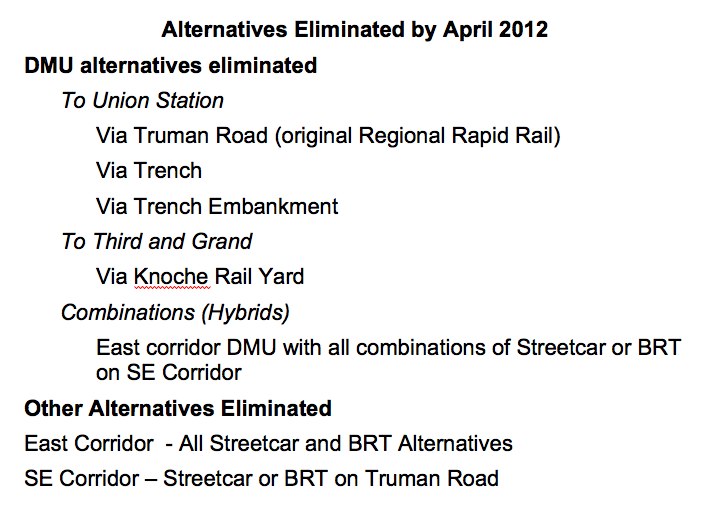
Lisa Koch, senior planner with Parsons Brinckerhoff, returns to discuss the Jackson County Corridor Alternatives Analysis (JCCCAA). Parsons Brinckerhoff released the first wave of quantitative information about the study at an open house the end of April. Lisa brings us up-to-date with the study and why several of the alternatives have been eliminated including the original Regional Rapid Rail commuter rail proposal. That alternative used existing rail right-of-ways in the east and southeast of the county and new track on city streets, including Truman Road, to terminate at the Freight House District, north of Union Station.

Click to Enlarge

Lisa describes the replacement commuter rail proposal, which terminates in the Third and Grand area. She provides information about the remaining alternatives in both the East (I-70) Corridor and the Southeast Corridor (the unused Rock Island right-of-way). For these preliminary estimates, Lisa comments on the high costs, low ridership numbers and the fact that the fixed guideway alternatives don’t provide any time savings over the highways by 2035.

Lisa describes the “right-sizing “ efforts the team is making to fine-tune the alternatives based on what they have learned.  When the alternatives have been revised, the partnership team, consisting of Jackson County, Kansas City, KCATA and MARC, will decide on a Locally Preferred Alternative, (LPA).

At the end of the interview Lisa discusses the economic development numbers for the rail alternative that were presented at the open house. MARC estimated these numbers as a 10% increase on the assessment value of existing properties within a ½ mile radius of the proposed rail stations.

Using property appreciation as a proxy for development around rail stations is a common methodology. This is not an estimate of the impact on jobs or sales tax revenue, but rather the appreciation benefits that existing property owners might see if their property is near a station. It does not represent a net benefit. It does not take into account decreases in property values commonly experienced by property owners between stations and by upper bracket residences near a rail line.

There are also concerns that rail does not create development, it merely moves development from one area to another, next to a rail line. There are some conditions in which appreciation does not occur, in particular, in areas with unlimited ability to sprawl. Property appreciation can be very large – or zero, depending on the circumstances.

TAN believes it is desirable to concentrate activity around stations of any type, bus or rail. Areas with transit-oriented (not created) development are highly desirable, exciting, well-integrated places to work, live, shop and play that make transit investments more cost-effective.  However, after the initial construction investment, successful economic development relies on many factors besides having a station.

For a better understanding of economic development related to property appreciation for transit, read this report by the National Association of Realtors.

Public Transit Boosts Property Values, If Conditions are Right

To view the display boards for the third open house, go to the project website, KCSmartMoves.

Transit Action Network previously reported on the JCCCAA Open House #3.  Read our evaluation of the current information: High Cost Combined with Low Ridership and Insignificant Time-Savings Hurts Rail in the Commuter Corridors Study

To follow the whole study, see the rest of our video series at TAN Videos on our website. The third interview discusses the DMU rail lines east of I-435.

Link to the first interview: MARC And Parsons Brinckerhoff Discuss The Current Status Of The Commuter Corridors Altenatives Analysis

Link to the second interview: Parsons Brinckerhoff Consultant Discusses Three Alternatives In The JCCCAA

Link to the third interview: Discussion About The Regional Rail Alternative for the JCCCAA

Link to the fourth interview: Enhanced Streetcar/DMU/BRT Combinations Are Discussed

Posted in Local Transit Issues, Rail, Regional Transit Issue, Transit Studies, Videos-Transit | Tagged: , , , | Leave a Comment »

It’s Time For Regional Discussion Of Transit

Posted by Transit Action Network on May 24, 2012


Transit Action Network doesn’t usually reply to items in the press, but we think Steve Rose’s column in yesterday’s Kansas City Star warrants a response.

The column, “Talk of Regional Transit Is Just Wasted Breath,” bears reading, even though we find it quite disappointing.

“Wasted breath?” Really?Johnson County, the richest and most populous county in Kansas, could find itself without a meaningful transit system of any kind in the next couple of years, falling behind Wichita and Topeka.  Yet instead of expressing concern, Mr. Rose dredges up 30-year-old biases and frames the current transit situation as Johnson County against the City of Kansas City. That involves a misconception: KCATA was created by the two states and Congress, and is independent of Kansas City.  Lacking taxing authority of its own, it provides transit service under contract with nearly a dozen municipalities.  Kansas City happens to contract for the most service.

Describing the transit cutbacks that Johnson County seems poised to impose on its citizens, Mr. Rose writes:

Where [Johnson County Transit Director] Alice [Amrein] is unrealistic is she told me she is contemplating recommending to the county commissioners that, along with the cutbacks, it may be worthwhile to contract some routes with the Kansas City Area Transportation Authority, otherwise known as the ATA.

Furthermore, Steve Klika, a member of the Johnson County Transportation Council and a representative on the ATA board, was reported in The Star [Mike Hendricks, May 13, “Deep cuts could mean drastic changes for The Jo bus system] as saying, “The only way transit is going to succeed in Kansas City is if it’s regionalized.”

These statements attributed to Ms. Amrein and Mr. Klika are not at all unreasonable. Indeed, prudence indicates that all options be explored. Mr. Rose goes on to quote Johnson County Commission Chairman Ed Eilert as saying, ““We would not turn over any funds to ATA. … Furthermore, we would not give up funding or operational control.”

Nobody is suggesting that. If KCATA were to operate (or even manage the operation of) transit routes in Johnson County it would be under a contract resulting from a competitive bidding process involving other potential transit operators.  That hardly constitutes “turning over” funds to KCATA, and it’s hardly a novel idea. In fact, the possibility of JCT once again contracting with KCATA has been under consideration for years, and KCATA has submitted bids to operate Johnson County transit routes as recently as just a couple of years ago. JCT elected to stay with its current contractor, First Transit.

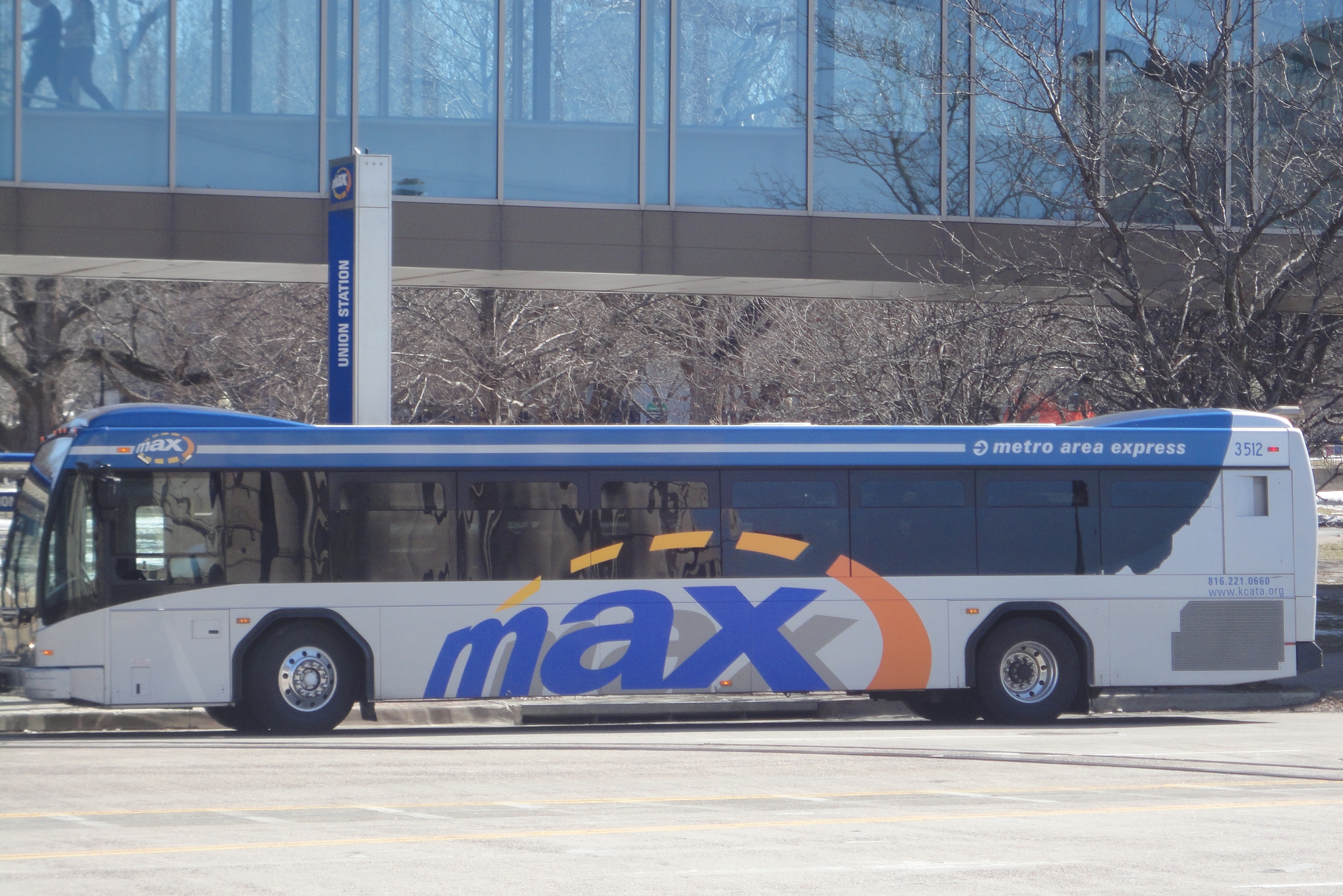
Furthermore, Mr. Rose (and Mr. Eilert) might not be aware that KCATA already performs some basic transit support services under contract to Johnson County Transit.  These include operation of a Regional Transit Information Call Center and maintenance of a number of bus shelters and other facilities. The two agencies are currently working together to get basic information about The JO’s routes and schedules posted at key stops in Kansas City, and KCATA now accepts monthly passes issued by The JO on nearly all Metro routes including MAX.

Mr. Rose then quotes KCATA Board of Commissioners Chairman Robbie Makinen as saying, “I consider this a real opportunity to rekindle the seamless, regional transit discussion.”

Discussion? That makes perfect sense to us. We don’t know what Mr. Rose thinks seamless regional transit is, but we think it means transit that’s easier to understand and use.  That’s important not just in Jackson and Wyandotte counties, but even for Johnson County because thousands of people hold low-paying service jobs in Johnson County but can’t afford to live there. Others travel there to shop or pursue educational, recreational, cultural, and other opportunities.

Improving and expanding public transit service in the Kansas City region is Transit Action Network’s purpose for being. To accomplish this goal we need informed discussion of the current situation. Bringing up perceptions of how things may have been 30 years ago is simply not helpful.

Mr. Rose’s column could be just the thing that’s been needed to re-ignite serious dialog among public officials of the region to move us toward a public transit system that seamlessly serves the region’s citizens. If it does, then we’ll be among the first to say, “Thank you, Mr. Rose.”

Posted in Local Transit Issues, Regional Transit Issue | Tagged: , , | 3 Comments »

Watch the “KC Streetcar Stroll” Video, Attend the Public Meetings & Request Your Streetcar Ballot

Posted by Transit Action Network on May 12, 2012


Kansas City conducted a “Streetcar Stroll” from the River Market to Union Station on May 9th.  About 35 participants were divided into small groups to walk the proposed 2.2 mile route with a guide to describe the proposed station areas and explain the proposed operating method for the streetcar. Video: Part 1 – Interviews with participants. Part 2 – Descriptions of the stations and the operations.

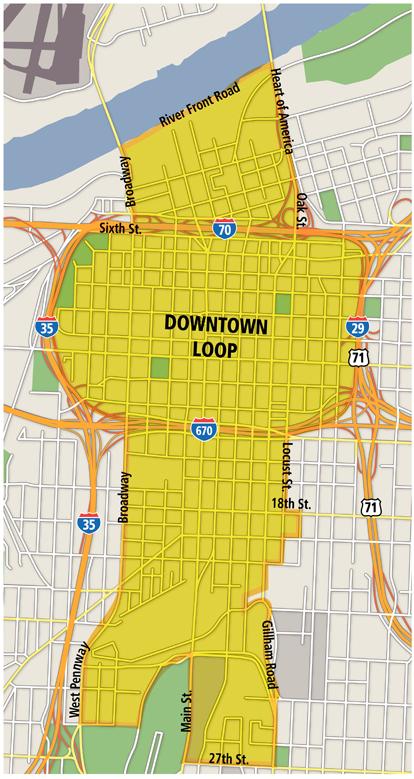
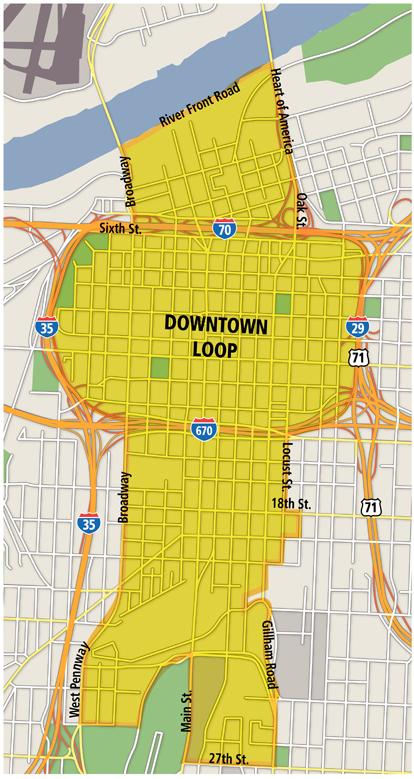
The city is holding three public meetings to explain the streetcar operation and answer questions. Kansas City wants voters in the proposed Transportation Development District (TDD) to understand the project.

TDD Map – Click to Enlarge

The public meetings are from 4-7 p.m with brief presentations at 4:30, 5:30 and 6:30 pm.

Tuesday, May 15, Helzburg Auditorium, Central Library, 14 W. 10th Street

Wednesday, May 16, Atrium, Steamboat Arabia Museum, 400 Grand Boulevard

Thursday, May 17, Arthur Stilwell Room, Union Station, 30 W. Pershing Road

The initial ballot to create the TDD is a mail-in ballot, but you MUST request a ballot by May 22. No Request=No Ballot. So if you live in the proposed TDD, request your ballot today! Ballot requests will be available at the public meetings. Remind your transit friends in the proposed TDD to submit their ballot request.

1. Print the ballot application at http://www.16thcircuit.org/streetcar

2. Print your registration status kceb.org (Use the check your voter status box at the top of the page. This document is used to validate you request.)

3. Send (hand-deliver, fax, mail) both documents to the court address (or fax number) on the application.

Posted in Action, Events, Local Transit Issues, Rail, Videos-Transit | Tagged: | Leave a Comment »

High Cost Combined with Low Ridership and Insignificant Time-Savings Hurts Rail in the Commuter Corridors Study

Posted by Transit Action Network on May 8, 2012


A lot of factors go into making a good transit project.  Most people will gladly tell you they prefer trains to buses. However, when ridership numbers, time savings and costs factors come into the picture, reality hits.  Are the ridership numbers sufficient to justify the cost? Does the project actually save commuters time? Will the project qualify for federal funds to help pay for such an expensive project?  How much would it require in local taxes?

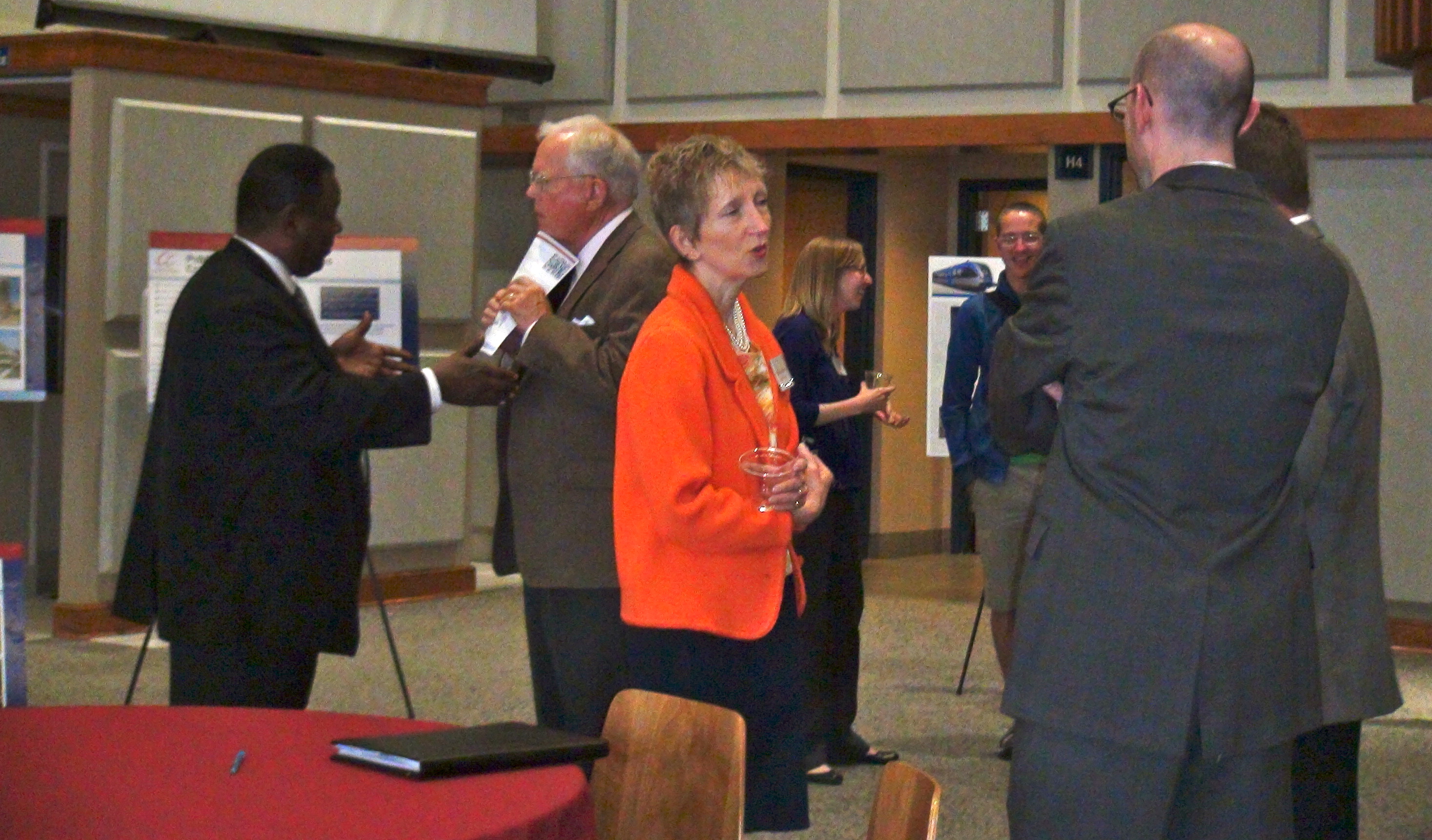
Open House #3 April 24 @ St Paul’s School of Theology

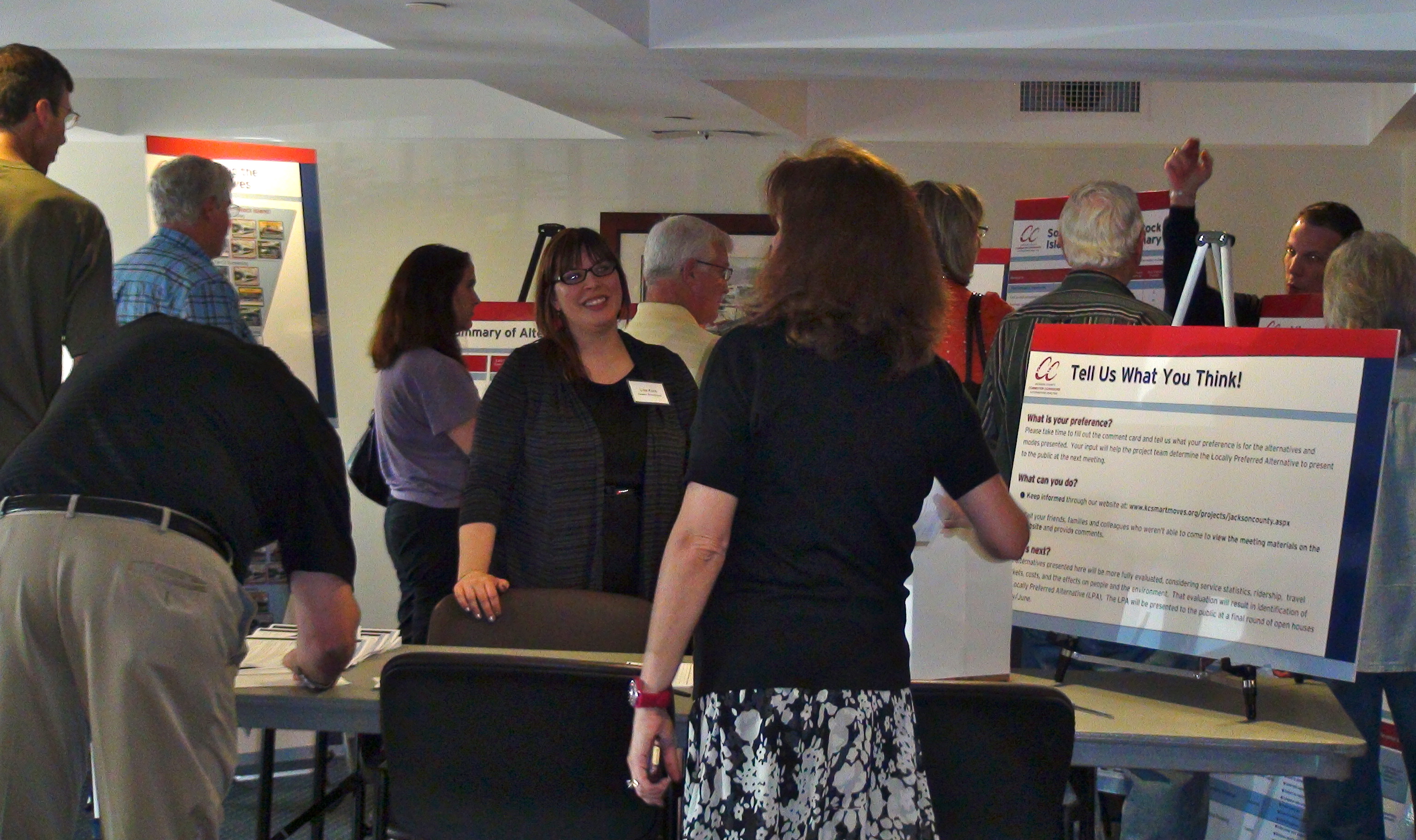
The Jackson County Commuter Corridors Alternatives Analysis (JCCCAA) is beginning to address some of these questions. The project team had its third series of open house meetings April 24-26. (See the Open House Display boards).  One more series is planned.

This open house provided the first look at quantitative results for the current commuter corridor study. The study is not complete and some of the numbers will change.

Some additional information is needed to understand the following information from the open house.

  1. The ridership numbers and travel time are forecasts for 2035. These are the numbers you can expect to see in 23 years.
  2. The dollar figures are for 2012.
  3. The model for forecasting congestion on I-70 only indicates an additional 3-5 minutes for travel time in 2035 over travel times today. The travel time for a car was not provided for comparison.

After evaluating the information from the open house, Transit Action Network’s preliminary conclusion is that, in all probability, none of the fixed guideway alternatives would qualify for federal funding due to the relatively high cost for the low ridership and the insignificant amount of time saved. The FTA uses these factors to measure cost-effectiveness. Of course, the numbers are being revised, but considerable improvements would be needed to change this assessment. Both of the commuter rail lines plus the Rock Island streetcar line and the Rock Island Bus Rapid Transit (BRT) alternatives are probably not cost-effective enough to receive capital funds for construction from the FTA.

A. I-70 Corridor from Oak Grove – Highlights

There are only two alternatives left in this corridor and they are basically the same as were studied in a 2007 Alternatives Analysis. Summary of 2007 I-70 Commuter Corridor AA

 EAST I-70 Corridor

Daily ridership by 2035

Total Capital Cost in millions

Total capital cost per rider based on annual ridership (260 days)

Travel time to 10th and Main from

Travel time in Minutes in 2035

Annual operating cost in millions

Express Bus

600

$35-$39

$237

Oak Grove

59

$3.6

DMU

1,150-2,800

$480-$600

$742-$1806

Oak Grove

61

$10.7

  1. One choice is an enhanced version of today’s highway express bus with more comfortable over-the-road coaches and significantly more service. In 2007 the recommendation was to improve the Express Buses. Compared to the 1,500 riders projected in the 2007 study, the 600 daily riders in the current study looks very low.

    Click to Enlarge I-70 corridor

  2. The second choice is a commuter train (Diesel Multiple Unit or DMU) that stays on the Kansas City Southern rail line toward the Northern Industrial District and then turns west and finishes at Third and Grand. There is a new alignment which is an improvement over the alignment in the 2007 study. There is a narrow strip of land owned by Kansas City, north of Cliff Drive by Kessler Park, that could be used instead of going through a rail yard. However, maximum daily ridership last time was 1,425 and right now this project is showing 1,150-2,800 daily riders. These ridership numbers are not significantly improved considering the project capital cost in 2007 was $102.8-168.9 million. More money is being projected for track improvements, which would increase the train speed and decrease the travel time.
  3. There is not a significant time savings for commuters using the train. The estimated time to 10th and Main from Oak Grove using the Express Bus is 59 minutes and getting to 10th and Main using the DMU plus a transfer to the streetcar is 61 minutes.

B. The Rock Island Corridor – Highlights

Four alternatives are still being considered, but they are not comparable situations.

SE corridor

Rock Island line

Daily ridership by 2035

Total Capital Cost in millions

Total capital cost per rider based on annual ridership (260 days)

Travel time to 10th and Main from

Travel time in Minutes in 2035

Annual operating cost in millions

Express Bus starts in Pleasant Hill

350

$35-$39

$407

Pleasant Hill

63rd and Raytown Road

60

48

$3.6

DMU starts in Pleasant Hill

500

$326-$413

$2,846

Pleasant Hill

65

$9.5

BRT Starts in Lee’s Summit

500

$230-$283

$1,962

63rd and Raytown Road

54

$3.2

SE Urban Corridor

Enhanced streetcar starts at 63rd street and Raytown road

1,850-2,700

$402-$538

$670-$977

63rd and Raytown Road

50

$6.1

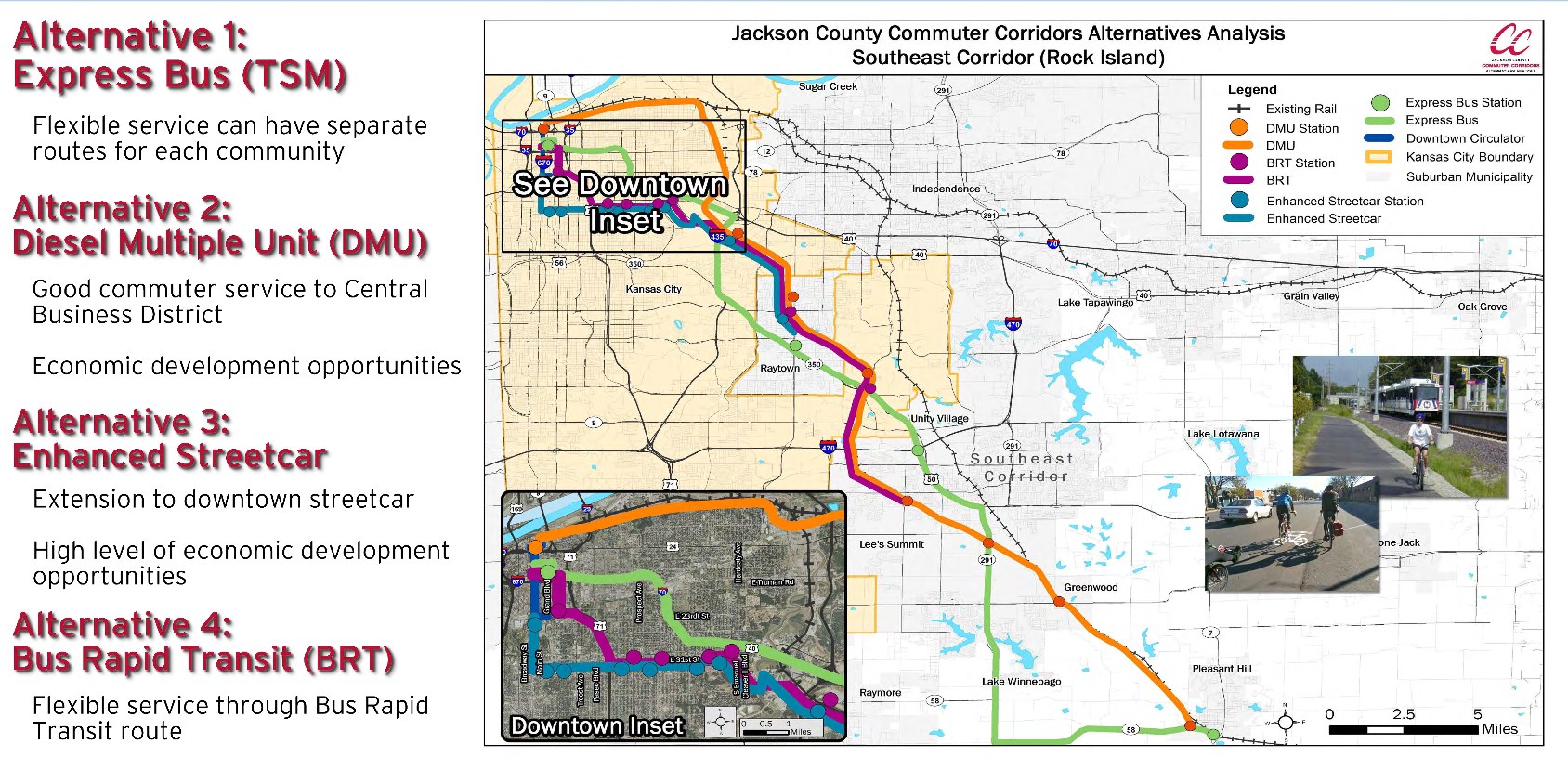
  1. Only the Enhanced Express Bus and the Diesel Multiple Unit go to Pleasant Hill.

    Click to Enlarge SE Rock island Corridor

  2. The Express Bus is an enhanced version of today’s highway express bus with better coaches and significantly more service.
  3. The DMU travels on the Rock Island Line, then continues north toward the Northern Industrial District. North of St. John Avenue it merges with the I-70 corridor KCS line and the two lines share a common segment into Third and Grand. The cost for this line does not include the common rail section since the Rock Island DMU line would only be built if the I-70 DMU line were built.
  4. The Bus Rapid Transit (BRT) only goes to Lee’s Summit. It uses a new paved busway on the Rock Island line to the Sports Complex and then a fixed guideway (the two middle lanes of traffic get barriers to segregate the bus from other traffic) is built on Stadium Drive and Linwood Blvd. At Bruce R. Watkins Drive (Highway 71) it uses the freeway to get into Downtown.
  5. The Enhanced Streetcar is not really part of the commuter corridors since it has been shortened to start at 63rd Street and Raytown Road, which makes it more of an urban corridor route. The streetcar goes down Linwood Blvd in a fixed guideway (the two middle lanes of traffic get barriers to segregate the streetcar from other traffic). At Main Street it would operate in mixed traffic and turn north to meet the proposed Downtown Streetcar line at Pershing.  MARC’s Smart Moves plan consists of two types of corridors – urban corridors that serve the urban core and commuter corridors, which bring people into the city from the suburbs. In fact, the significantly larger ridership numbers projected for this “enhanced streetcar” alternative are from people in the urban core. The streetcar has significantly more riders than the BRT even though they both go down Linwood since the bulk of the streetcar ridership happens west of Highway 71 after the BRT turns north.  Because the streetcar makes several stops along Linwood and functions like an urban streetcar corridor, this alternative does not appear to serve suburban commuters very well.
  6. This is the first AA that has been done in the Rock Island commuter corridor so it is interesting to see such low ridership numbers.

    Open House #3 April 25 @ John Knox Village

  • Express bus – 350; DMU – 500; Bus Rapid Transit – 500. These ridership numbers are breathtakingly low and don’t warrant any rail investment. Even if the study increases the numbers they aren’t going to go up nearly enough to justify the cost of rail. The low ridership projections for the DMU in the Rock island corridor compared to the I-70 corridor is partly because this line doesn’t go through the main population centers of these cities and a lot of the route goes through industrial areas.

For commuters in the Southeast Corridor there are two bus possibilities:  Enhanced Express Bus from Pleasant Hill or Bus Rapid Transit from Lee’s Summit.

  1. To compare travel time between the two buses, look at the time from Raytown Road. The BRT time to 10th and Main is 54 minutes and the express bus from that location is 48 minutes. So the express bus is faster over the same distance.
  2. The Express Bus costs $35-39 million, while the BRT would entail paving the Rock Island line and establishing a fixed guideway on Linwood for a total of $230-283 million. Is the additional cost worth it for a slower travel time and only a few more people?

What about the Rock Island Streetcar? Even though the ridership is better than the other alternatives in this corridor, it is far too low for the cost.

To put this streetcar in perspective, compare it to the Downtown Streetcar project currently being planned.

Streetcar

Daily Ridership by 2035

Total Capital Cost in millions

Capital Cost per Rider-Total Capital Cost Divided by Annual Ridership based on 260 days. (JCCCAA method)

2 mile Downtown Streetcar

6,000

$101

$65

12 mile Rock Island Streetcar

1,850-2,700

$402-$538

$670-$977


Financing Transit in Jackson County

Once transit alternatives are selected for these corridors — i.e., once a “Locally Preferred Alternative” or LPA is determined, local funding has to be obtained.  This is true whether there is a federal contribution to the project or not.

Revenue Source

Uses

Rate/Method

Estimated Amount

Jackson County Sales Tax

Operating and Capital

1-cent sales tax (maximum)

$80 million annually

Jackson County Property tax

Operating and Capital

One mill

$82,500 annually

Farebox revenue

Operating

Fares

Typically 20% of operating costs

Federal Funding

Capital

5309 program for either New Starts (projects > $250 Million) or Bus and Bus Facilities

New Starts 30-50% of construction costs or Bus and Bus Facilities 80 %

Jackson County has special taxing authority allowing voters to approve up to a 1-cent sales tax for transit, which would collect about $80 million annually. Jackson County has significant transit needs, especially in eastern Jackson County.  Not only does commuter transit need to be improved and expanded, but transit is needed to get to other activity centers such as jobs, education, medical facilities, shopping and entertainment in areas other than downtown. (Only 14% of the region’s jobs are currently in the CBD).

Although a property tax is a possible funding source, it doesn’t raise much money.

TAN realizes the study isn’t finished and there will be changes, but the total annual cost is important to understand Jackson County’s ability to provide transit. The following numbers are based on the information presented at the April open house. We will re-do our analysis when adjusted numbers become available.

Estimated Rail and Fixed Guideway Annual Costs

Fixed guideways being studied in two corridors

TAN’s estimate of annualized capital debt service for rail (@4% interest for 25 years) in millions

Annual operating cost in millions

Total annual cost in millions

I-70 corridor DMU

$29-38

$11

$40-49

Rock Island DMU

$21-26

$10

$31-36

Rock island BRT

$15-18

$3

$18-21

SE Corridor streetcar

$29-34

$6

$35-40

Very preliminary conclusions:

Open House #3 April 24 @ John Knox Village

  1. Without federal assistance, Jackson County cannot pay for DMU rail lines in three Corridors. Study of a third corridor, the Highway 71 corridor to Grandview, is just getting under way.  It is possible that the annual costs for the DMUs in the first two corridors (as high as $49MM plus $36MM) could use up more than the 1-cent sales tax ($80 million annually) with nothing left to provide supporting bus services, much less transit to other parts of the county.
  2. Without significant federal funding, any fixed guideway options still being considered would be difficult to justify considering all the other transit needs and issues. The costs would be further complicated with a fixed guideway option in the Grandview corridor.
  3. Voters in Kansas City might object to paying a full 1-cent sales tax on commuter rail from eastern Jackson County without much benefit to taxpayers living within the City. In other words, for a transit tax to pass county-wide, there would have to be something in the package for Kansas City.
  4. Since rail projects are so expensive, most cities seek federal funding to help build projects. The FTA has only been funding large projects with a cost-effectiveness rating of at least Medium. Once a  project qualifies to be considered for federal funding, it still has to compete against other cities and recently the FTA has only been covering 30-50% of the cost of rail projects selected for funding. For perspective look at the FTA current Capital Investment Program Project Profiles.

Sample of FTA Current Commuter Rail Projects

Total project capital cost in millions

Projected Weekday ridership

Denver-Eagle Commuter Rail

$2,043.14

57,300

Orlando-Central Florida Commuter Rail Transit-Initial operating segment

$357.23

7,400

Weber County to Salt Lake Commuter Rail

$611.68

11,800

Providence, RI South County Commuter Rail (extension)

$49.15

3,500

Compare to the commuter rail being studied in Jackson County

I-70 DMU

$480-600

1,150-2,800

Rock Island DMU

$326-413(doesn’t include cost of common segment)

500

Additional very preliminary conclusions:

  1. The two DMU rail lines could cost a billion dollars to build (using high-end estimates of  $600MM plus $413MM).
  2. The capital and operating costs for the Enhanced Express Buses could be covered without federal funding, although federal dollars are much easier to get for this use. Bus projects can usually be funded without issuing bonds. Bonds were not needed for the Troost and Main Street MAX lines. The FTA often pays up to 80% of the capital cost for major improvements to bus systems. Using such an approach, there would be money for other transit services in Jackson County, even without using the full 1-cent sales tax.
  3. Jackson County could fund express buses plus a robust transit system to serve other needs in the county at the same time.
  4. TAN expects that a reasonable allocation of any county transit tax would have to clearly provide a transit benefit in the City of Kansas City. Population and sales tax revenue in Jackson County are about evenly split between Kansas City and the remainder of the county.

Summary

Open House #3 April 25 @ John Knox Village

The purpose of performing an Alternatives Analysis is to find the best transit solution to seek federal funds. Federal funds are particularly important when proposing a rail project since they are so expensive. Sometimes good plans don’t get federal funding because of intense competition, but if a plan doesn’t qualify for federal funds because it isn’t cost effective, then it probably should not be built.  Sometimes cities fund a very short 1-2 mile starter rail line but rarely are long rail lines successfully funded with only local money.

Are Jackson County taxpayers prepared to pay for major transit plans that are not sufficiently cost-effective to qualify for federal funding? We doubt it.

An out-of-town transit consultant spoke at the MARC Transit committee when the two current rail studies started. He advised people to remember that serious rail transit is about the need to move a lot of people. Non-serious rail transit is about wanting to have a train.

Transit consultants in Kansas City will tell you when they do major commuter rail studies in other cities they usually come upon a robust bus transit system that will not be able to efficiently meet demand in the next few years and needs the additional capacity that rail provides. When they come to Kansas City to study rail, no such demand exists. We don’t even have a transit system in eastern Jackson County let alone one that is bursting at the seams and needs to be upgraded to rail.

Bottom line: What is the best use of our current or potentially available public money? Where do we get the biggest transit bang for our buck? Transit Action Network is very pro-rail, but we are also realistic and cost conscious. We want to see a significant transit improvement emerge from this study, and we’re waiting for the next wave of information and for the Locally Preferred Alternative to be determined. We hope the decision will reflect the information gained from spending nearly three years and $2 million dollars studying commuter options to find the best solution for the transit needs in Jackson County. Every major metropolitan region needs a good transit system that is appropriate for the community.

Posted in Local Transit Issues, Rail, Regional Transit Issue, Transit Studies | Tagged: , , , | Leave a Comment »

Get Your Streetcar Ballots!!!!

Posted by Transit Action Network on April 30, 2012


Click to Enlarge

If you are a registered voter in the area designated for the downtown Transportation Development District  (TDD) you can order your ballot to vote to create the district starting today, Monday April 30. This is a mail-in ballot election.

Jackson County Circuit Judge Charles Atwell ruled on Friday that the district would be legal and the proposed financing plan is does not produce an undue burden on property owners. The plan is not unjust or unreasonable.

Request your ballot now!

Applications for a ballot are available as follows:

  • Download from http://www.16thcircuit.org/streetcar/
  • Pick up at the Jackson County Courthouse, 415 East 12th Street, Kansas City, Missouri 64106, Third Floor, Room 303, between the hours of 8:00 a.m. and 5:00 p.m., Monday through Friday, except legal holidays

You will not receive a ballot unless

  • you submit a valid application in accordance with the instructions on the application, and
  • your application is received by the Circuit Court Administrator’s office before 5:00 p.m. CDT on May 22, 2012

Ballots will be mailed on June 19, 2012, to those with a timely and valid application. Ballots will be due for return no later than 5 p.m. on July 31, 2012 in accordance with instructions on the ballot.

See the Full Court Notice Case Number: 1216-CV02419

The result of the Federal Tiger Grant application for $25 million is expected this summer. We sincerely hope to get that money.

Tell all your transit friends in the TDD to request a ballot.

After the voters create the district, a second election is scheduled for the fall to vote for the financing plan.

After that, Streetcar here we come!!!

Posted in Action, Local Transit Issues, Rail | Tagged: | Leave a Comment »

KCATA Comment Period on July Route Changes Closes April 23

Posted by Transit Action Network on April 20, 2012


KCATA recently began implementing service changes based on the Comprehensive Service Analysis completed in 2011. KCATA received over 700 comments on proposed route changes for 55 routes, and 24 route changes were modified based on public input.

Changes have been implemented on a few routes, and changes on 21 additional routes will take effect in July.  Additional changes are scheduled for October and next January. See the Implementation Schedule.

Review the Preliminary Schedules.

KCATA asks customers to submit comments or questions on the preliminary schedules no later than April 23, using any of the following methods:

Posted in Action, Local Transit Issues | Tagged: | 1 Comment »

Don’t Miss Open House #3 – Jackson County Commuter Corridors Alternatives Analysis

Posted by Transit Action Network on April 13, 2012


Please evaluate the remaining alternatives and let the project team know your preferences based on the information currently available. Additional detailed information should be available, including a range of costs, ridership numbers, travel times and potential financing options. The study is not complete and your input is valuable. The project consultants expect to complete the study in early summer.

Posted in Local Transit Issues, Rail, Regional Transit Issue, Transit Studies | Tagged: , , , | Leave a Comment »

Time for Downtown Residents to Get Serious about a Streetcar

Posted by Transit Action Network on April 10, 2012


Downtown is about to enter the next phase of building a streetcar line from River Market to Crown Center.

The line will be 2.2 miles long and is estimated to cost $101 million. The City has applied for a $25 million grant from the Federal Government to help fund the project.  The money will be hard to get because the competition for federal dollars is fierce. Over 700 applications amounting to $10.5 billion dollars in requests were made for the $500 million dollars available. Local support and a local funding mechanism make a big difference to the federal process. Downtown property owners and retail customers will be asked to pay the difference between the project cost and the federal contribution through the formation of a Transportation Development District. Financing the streetcar is a huge hurdle for Kansas City citizens and particularly downtown property owners to overcome.

Now is the time for local action.

1. Take part in the public hearing April 17. The judge will hear testimony for and against the creation of the Transportation Development District (TDD). You don’t have to speak at the hearing, but show up for support and to make a big impression. TAN intends to speak in favor of the streetcar project and the formation of the TDD. Businesses and property owners can object to the formation of the TDD if they feel the structure is unfair.  After this hearing it is up to the judge and the voters.

Streetcar TDD Public Hearing

Tuesday, April 17, 2012 @ 1:30pm

Jackson County Courthouse, 12thand Oak, Kansas City MO

TDD Map - Click To Enlarge

2.  Make sure you are registered to vote, if you live in the Transportation Development District (TDD).  If you aren’t registered – GET REGISTERED!

ONLY REGISTERED VOTERS WILL HAVE A SAY IN WHETHER OR NOT THE TRANSPORTATION DEVELOPMENT DISTRICT IS FORMED AND WHETHER THE STREETCAR LINE IS BUILT.

3.    Follow Streetcar Neighbors on Facebook. Streetcar Neighbors is a group of downtowners dedicated to making the streetcar happen.

If downtown voters create the TDD then there will be an additional election later in the summer to create the necessary funding. The city is actively trying to find alternative funding sources to cover the costs of building and operating the streetcar.

Downtown Streetcar timeline – Downtowners need to register to vote

April 17 – TDD public hearing – BE THERE!

April 18 – TDD judicial hearing

June 5 TDD election (Transportation Development District only)

Summer 2012 – Federal grant winners announced

Fall 2012 – TDD revenue election (Transportation Development District only)

2013-2014- Construction

April 2015 – Operations begins

Posted in Action, Events, Local Transit Issues, Rail | Tagged: | Leave a Comment »

Commuter Corridors Study Narrows Field of Alternatives

Posted by Transit Action Network on April 2, 2012


The  Stakeholders Advisory Panel for the Jackson County Commuter Corridors Alternatives Analysis (JCCCAA) met March 14. Parsons Brinckerhoff, the lead project consultants,updated information about the I-70 Corridor and the Rock Island Corridor. The Grandview corridor was not discussed. Potential alternatives for the Grandview corridor will be affected by the outcome of the Alternatives Analysis for the I-70 and Rock Island corridors.

The Federal Transit Administration (FTA) suggests the alternatives be evaluated using five primary perspectives (Stakeholder’s packet Nov 2011)

  • Effectiveness measures assess the extent to which the alternatives address the stated needs in the corridor.
  • Cost-effectiveness measures assess the extent to which the costs of the alternatives, both capital and operating, are commensurate with their anticipated benefits.
  • Feasibility measures the financial and technical feasibility of the alternatives. Financial measures assess the extent to which funding for the construction and operation of each alternative is considered to be readily available. Technical feasibility assesses potential engineering challenges or restrictions that could limit the viability of an alternative.
  • Impacts assess the extent to which the alternatives could present potential environmental and traffic issues that could be fatal flaws or otherwise influence the selection of a preferred alternative.
  • Equity assesses the extent to which an alternative’s costs and benefits are distributed fairly across different population groups

The consultants identified performance on the Common Segment, the section of the alignment where the two corridors come together and share the street or rail line, as a deciding factor in this level of evaluation.

Consultants evaluated the common segment for five items touching on three of the FTA perspectives.

Click To Enlarge

The “Poor” result in the common segment for Full Regional Rail is understandable if you consider the implications of running a large DMU (Diesel Multiple Unit) for miles on city streets and through neighborhoods. (See video  Discussion About The Regional Rail Alternative for the JCCCAA)  The DMU has the ability to run on freight lines as well as streets.

Last year TAN identified the Common Segment as the most challenging issue for the Regional Rail alternative. Once the rail leaves segregated rights-of-way and moves onto city streets many problems arise. (See Consultants Face Big Challenge Studying Regional Rapid Rail ).

For these criteria, TSM (Transportation Systems Management), which includes Enhanced Express Buses, and the BRT options look the best. However, there are additional criteria to be evaluated.

Eliminated

Full Regional Rail using a DMU on Truman Road or the Trench Embankment is eliminated.

Additional alternatives eliminated

All Rock Island Corridor Streetcar or BRT combinations with a DMU on the I-70 Corridor – These alternatives all require a forced transfer at the Truman Sports Complex. (See video about all eight combinations  Enhanced Streetcar/DMU/BRT Combinations Are Discussed). This issue affects four of the eight combination alternatives. (See combinations marked in yellow on  JCCCAA Modal Combinations Update March 2012)

Alternative at risk

The Enhanced Streetcar via Truman Road – Although in the common segment analysis the Streetcar via Linwood and the Streetcar via Truman Road look the same, the consultants said additional analysis suggests Linwood is a better choice than Truman Road. In the presentation, only the Linwood alignment is advanced to the next level of analysis at this point. (See combination marked in blue on JCCCAA Modal Combinations Update March 2012)

See Consultants JCCC AA March 2012 SAP Presentation. TSM including Enhanced Express Buses is included in the alternatives advancing for further evaluation although it isn’t listed on Slide 14.

Another Version of Rail Under Consideration

Since all of the original commuter rail alternatives using a DMU have been eliminated, another version of commuter rail that doesn’t use city streets or transfer at the Sports Complex is being re-considered.

In Tier One of the study the consultants looked at an alternative that kept the DMU on rail lines and went through the rail yard in the Northern Industrial District by the Missouri River before heading up to the River Market to Third St. and Grand Avenue.

This alternative was initially screened out in the Tier One screening because:

  • “This alignment has limited opportunity for stations, operates in a highly industrial area and constrained railroad environment. It is not as conducive to satisfying the project’s Purpose and Need as other options. “ (Stakeholder’s packet Nov 2011)

In 2007 this alignment, which goes through the Knoche rail yard, was studied for the I-70 corridor and rejected in the near term for commuter rail. Since then, significant changes have been made to that yard making it unsuitable for commuter rail. However, the Neff rail yard, which is slightly south of the Knoche rail yard, is being investigated for feasibility. If the consultants decide this alternative has potential they will add it for a Tier Two level analysis.

In this scenario, the rail alignment would stay on the Rock Island and KCS lines and come together in the vicinity of Rock Creek Junction, east of the rail yard. There are considerable challenges for this alignment including getting through the rail junction and the rail yard.

After discussions with both the consultant and MARC, here is the current situation:

Alternatives Eliminated

  • DMU using Trench or Trench Embankment
  • DMU on Truman Road (Full Regional Rail)
  • Alternatives that force a transfer outside of CBD (Central Business District

Alternative with significant challenges

  • Enhanced Streetcar via Truman Road

Alternatives advancing for further evaluation

  • TSM, including Enhanced Express Bus
  • Enhanced Streetcar via Linwood
  • BRT
  • Modal Combinations

Alternative receiving renewed consideration

  • DMU to River Market via rail yard (KCS and Rock Island)

Alternatives that are advanced in the study will go through further analysis such as ridership numbers, financial feasibility, constructability and economic development potential. Although everyone is impatient to get concrete numbers to compare alternatives, a study of this size would normally take a couple of years to complete and this study is being squeezed into a very short time frame. The consultants were only chosen in April of last year.

Project leader Shawn Dikes said Parsons Brinckerhoff is working to create a complete transit package, which would consist of the Locally Preferred Alternative (LPA) from this study as well as improved transit service to support the LPA. TAN feels it is extremely important to construct a complete transit package to take to the voters.

Besides the study update at the Stakeholders Advisory Panel meeting, there was a short talk by former Congressman Martin Frost about the Transportation Bill being debated in Congress.  He believes the final version will be similar to previous transportation bills, although the House Speaker is having a hard time getting his party to agree to a version that can pass the House. Michael Zuhl, a consultant with R&R Partners, gave a short talk about the transit education campaign for Jackson County.

The consultant team is pulling out all the stops to find the best alternative for commuters in Jackson County. They are trying multiple combinations of vehicles and lots of alternative alignments. Jackson County should feel comfortable that the process is working well and it should be happy to go to the voters with the Locally Preferred Alternative resulting from this study.

Proposed schedule

The Project Team met March 23 and County Executive Mike Sanders and Mayor Sly James went to Washington, D.C. to meet with officials about the transit initiatives underway. This level of cooperation and coordinated transit effort is unprecedented in our region.

Mid-April Stakeholder Advisory Panel

Late April – Public Workshop

4/27 Project Partnership Team meeting

5/25 Project Partnership Team Meeting

May/June – Public Workshop

Summer – Announcement of LPA

Posted in Local Transit Issues, Regional Transit Issue, Transit Studies | Tagged: , , , | Leave a Comment »

U.S. Secretary of Transportation Prasies KC Use Of TIGER Grant

Posted by Transit Action Network on March 25, 2012


In his blog , FastLane, Ray LaHood , the U.S. Secretary of Transportation, praises Kansas City on its use of the $50 million DOT TIGER grant received to improve the Green Impact Zone. 

TIGER transforming Kansas City’s Green Impact Zone

He also raves about the Mid-America Regional Council’s TIGER website, which tracks the money being spent and provides videos showing the progress of individual sub-projects.

Posted in Local Transit Issues, National Transit Issues | Tagged: , | Leave a Comment »

Great Bargain for JCT Commuters and A Step Forward for Seamless Transit

Posted by Transit Action Network on March 15, 2012


Two significant transit decisions are about to be implemented.

1.  Johnson County Transit (JCT) has decided to sell its monthly pass through its website.  The reported price is $67 (plus a small service fee), and sales begin in April for a May 1, 2012 start date. The JO Store

The JO will continue to sell its monthly pass to employers for re-sale to their employees.  Employers will continue to pay $63 per pass, and they generally discount the pass to their employees.

Availability of the monthly pass will be a significant cost saving for Johnson County commuters whose employers don’t sell passes.  Such commuters currently have to pay cash fares ($2.00 each way, or $88 for a 22-workday month), or use 10-ride passes ($18.00 for 10 rides, or $79.20 for a 22-workday month).

 2.  Kansas City Area Transportation Authority (KCATA) will accept the JCT monthly pass on all regular Metro buses (excluding premium-priced commuter routes). KCATA and JCT will allocate revenue from the JCT pass between themselves based on usage.  JCT monthly passes will be accepted on Metro buses beginning May 1, 2012.

Anyone can purchase the JCT monthly pass online to use on either system.

TAN advocates have worked for Seamless Transit for many years, and this development is clearly a step in the right direction.

The advantage to Johnson County residents is obvious: they can use Metro buses during the day for lunch trips or errands, or to get closer to home (e.g. to the Plaza or Waldo) before calling a family member, a friend, or a cab when they work late.  What’s more, Johnson County riders can drive to a Missouri location (such as Waldo) and use Metro buses to reach Missouri attractions on weekends.  (A free ride on a Metro bus compares favorably with a $30 parking fee for a Sprint Arena event.)

Missouri and Wyandotte County residents who also need to use The JO will have the option of purchasing the JCT monthly pass.  These riders will need to evaluate whether their savings will justify the higher up-front cost of the JCT monthly pass.  Riders who use transit only for commuting now pay $3.50 per day in cash fares ($1.50 going to work, $2.00 to return), or $77 per 22-workday month.  A rider who needs to be able to use Metro buses all week as well as commute to Johnson County currently pays $94 for a 22-workday month ($50 Metro pass plus $44 in cash fares on The JO).

Although JCT and KCATA have accepted each other’s transfers for several years, neither system has accepted the monthly bus pass of the other system until now.  The JCT monthly pass will be accepted on Metro buses but the Metro $50 monthly pass will not be accepted on JCT buses, mainly due to the large price difference. (Metro pass users may not know that they can ask for “a transfer to The JO” when they board.  KCATA normally does not issue transfers to its monthly pass users.)

The JCT monthly pass sale through their website and KCATA acceptance of the JCT monthly pass are positive steps toward Seamless Transit. Well over 500 JCT monthly pass holders will get automatic access to the extensive (7 days a week, 20 hours per day, service to five counties) Metro system at no additional cost.

Due to the large fare differential between the two systems and limited service provided by JCT, it will be interesting to track the sales numbers for the JCT monthly pass to see:

  • how many passes are sold to riders outside of Johnson County
  • what percentage of morning commuters from Kansas City to Johnson County use the JCT monthly pass (this direction is considered a reverse commute).

Transit Action Network welcomes a victory for Seamless Transit and will work to make sure that:

  • Metro riders are aware of their new option for access to The JO
  • JO riders make good use of their new access to the Metro system beginning May 1.

Posted in Local Transit Issues, Regional Transit Issue, Seamless Transit | Tagged: , | 1 Comment »

Urgent Action Alert! Downtown Streetcar Needs Letters of Support

Posted by Transit Action Network on March 1, 2012


Kansas City, MO is applying for Federal dollars to help pay the construction costs for the proposed Downtown Streetcar from the River Market to Crown Center.

The Federal Tiger Grant process is competitive and applications with significant local support have a greater chance of success.  Transit Action Network, along with numerous other organizations, already supplied a letter of support to the project team. Now they are asking individuals to do the same.

Vireo (formerly Patti Banks Associates) provided  a form letter for individuals. Letter of Support with Customizeable Language_TAN Feel free to personalize the letter.  Additional information: TIGER Grant Handout for KC Downtown Streetcar. The February 27 deadline on the handout was for organizations. Individuals need to send their letters ASAP. Applications close mid-March.

Hardcopies are requested since original signatures are preferred.

Send to:

Julie Lorenz
Burns & McDonnell
9400 Ward Parkway
Kansas City, Missouri, 64114

Posted in Action, Local Transit Issues, Rail | Tagged: | Leave a Comment »

Enhanced Streetcar/DMU/BRT Combinations Are Discussed

Posted by Transit Action Network on February 24, 2012


The Partnership Team and consultants added eight additional alternatives to the Jackson County Commuter Corridors Alternatives Analysis (JCCCAA).  In the final interview of this series, Lisa Koch, senior planner with the lead consulting team Parsons Brinckerhoff, discusses these alternatives which include various combinations of three transit modes; Enhanced Streetcar, Diesel Multiple Unit (DMU) and Bus Rapid Transit (BRT). Maps of all the combinations are available below.

Lisa also describes the traffic control elements being planned for an Enhanced Streetcar to travel on the streets and how these elements differ from the ones used by the Regional Rail DMU alternative discussed in the previous interview.

For a closer look at the display board Lisa uses during the interview, see JCCCAA display-board-nov 2011 or print page 11 of the second open house display boards. JCCCAA-open-house-display-boards-nov 2011

Summary of JCCCAA Streetcar/DMU/BRT combinations being studied

Click to enlarge

Maps of all the Streetcar/DMU/BRT Combinations

A. Enhanced Streetcar/DMU – Linwood Alternative

B. Enhanced Streetcar (ALL) – Linwood Alternative

C. Enhanced Streetcar/DMU – Truman Road Alternative

D. Enhanced Streetcar (ALL) – Truman Road Alternative

E. BRT/DMU – Linwood Alternative

F. BRT (ALL) – LinwoodAlternative

G. BRT/DMU – Truman Road Alternative

H. BRT (ALL) – Truman Road Alternative

An alternatives analysis requires a substantial amount of work to evaluate the possible transit solutions for a corridor. The analysis includes a complex comparison process to decide which alternative is the best fit for our region at this time. Lisa has agreed to visit with TAN again to update us on status of the study and provide insight into the FTA process used to rate the alternatives.

TAN appreciates Tom Gerend of MARC and Lisa Koch of Parsons Brinckerhoff, along with Shockey Consulting and TranSystems, for making all of this information available to our viewers.

The next open house is March 13 -15 going to be re-scheduled.

Traffic Control Elements for RAIL on Streets in the JCCCAA

Link to the first interview: MARC And Parsons Brinckerhoff Discuss The Current Status Of The Commuter Corridors Altenatives Analysis

Link to the second interview: Parsons Brinckerhoff Consultant Discusses Three Alternatives In The JCCCAA

Link to the third interview: Discussion About The Regional Rail Alternative for the JCCCAA

Project website:  KCSmartMoves

Posted in Local Transit Issues, Rail, Regional Transit Issue, Transit Studies, Videos-Transit | Tagged: , , , | Leave a Comment »

Discussion About The Regional Rail Alternative for the JCCCAA

Posted by Transit Action Network on February 20, 2012


In the third of our four interviews, Lisa Koch, senior planner with Parsons Brinckerhoff, discusses the Regional Rail alternatives for the Southeast Corridor (the unused Rock Island line through Raytown and Lee’s Summit) and the Eastern I-70 Corridor (the underutilized Kansas City Southern line through Blue Springs).

Diesel Multiple Unit -DMU

Lisa describes the routes being considered, along with traffic control elements that would be required by the Federal Railroad Administration for a Diesel Multiple Unit (DMU) train to use new rail on the streets of Kansas City and Independence to reach a commuter rail terminal in the Freight House District, north of Union Station.

For a closer look at the display board Lisa uses during the interview, see JCCCAA display-board-nov2011 or print page 11 of the second open house display boards. JCCCAA-Open-House-Display-Boards-Nov2011


Following is the proposed map for the Regional Rail system being studied in the Southeastern and Eastern Corridors of Jackson County. MP (Mile Point) is the distance in miles from Union Station.

Click To Enlarge


Details of all the alternatives are changing as the study continues.

The Jackson County Commuter Corridors Alternatives Analysis is scheduled for completion in late Spring 2012.

Our fourth interview, covering combinations of streetcars, DMU and BRT, will be posted later this week.

Link to the first interview: MARC And Parsons Brinckerhoff Discuss The Current Status Of The Commuter Corridors Altenatives Analysis

Link to the second interview: Parsons Brinckerhoff Consultant Discusses Three Alternatives In The JCCCAA

Posted in Local Transit Issues, Rail, Regional Transit Issue, Transit Studies, Videos-Transit | Tagged: , , , | Leave a Comment »