Transit Action Network (TAN)

Advocates for Improved and Expanded Transit in the Kansas City Region.

Posts Tagged ‘KCATA’

Registration Open -12th Annual New Partners for Smart Growth Conference, February 7-9, 2013

Posted by Transit Action Network on October 12, 2012


Registration is now open for the 12th Annual New Partners for Smart Growth Conference, February 7-9, 2013 in Kansas City, MO.

The multi-disciplinary program includes over 90 plenaries, breakouts, workshops and trainings, and will feature cutting-edge policies and programs, projects, best practices, as well as strategies and implementation tools that address the challenges of implementing smart growth development principles.

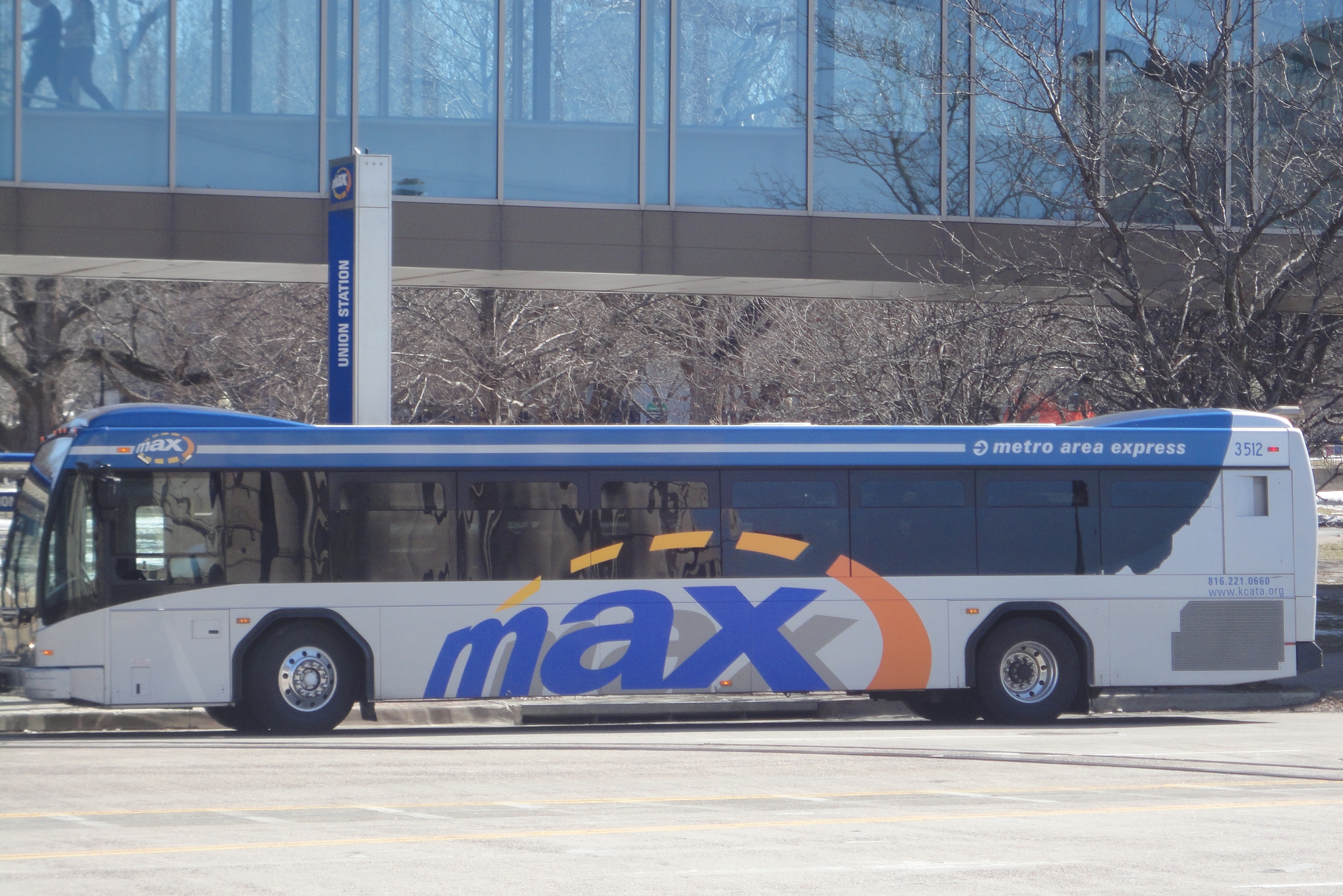
KCATA, FTA, and Transit Action Network are sponsoring the tour  Low Cost/High Benefit BRT – The Kansas City MAX. Be sure to attend the conference, sign up for this tour on the MAX and learn how to implement a MAX system, including equitable development, environmental justice issues, planning, design, engineering and funding strategies.

Other conference features include:

  • 15 tours of local model projects;
  • Coordinated networking opportunities;
  • Professional Continuing Education Accreditation;
  • Additional optional pre-conference workshops and tours;
  • So much more!

The official hotel room rate for our group is $119 (single/double) until January 14, 2013 at 5:00pm CDT. After that date, the group rate is subject to availability and is not guaranteed.

To make your reservations at the Marriott Kansas City Downtown Hotel, call 1-877-303-0104 and indicate that you are attending the New Partners Conference. You can also make your New Partners Conference hotel reservations online through  Marriott Kansas City Downtown Hotel Reservations. 

Visit www.NewPartners.org  for more details on the conference program, tours, special events and opportunities, featured speakers, travel and hotel information, local attractions, and to REGISTER NOW!

Posted in Events, Local Transit Issues, National Transit Issues | Tagged: | Leave a Comment »

Transit Riders Get More Saturday Seats On Popular KCK Route

Posted by Transit Action Network on October 5, 2012


Loretta Jackson-Cowans, Kathy Darcy and Janet Rogers testified at the UG budget hearing in July 2012

There’ll be fewer people standing on Route 101 Minnesota / State Ave. buses beginning October 6.  That’s because the Metro will use bigger buses on Saturdays.

Route 101 buses run less frequently on Saturdays — hourly instead of every 30 minutes — and many passengers were having to stand as they did their weekly errands for grocery shopping and other purposes.  Add strollers and shopping carts to the riders, and things were getting pretty crowded.

Transit Action Network advocates Loretta Jackson-Cowans, Kathy Darcy, and Janet Rogers testified about the overcrowding at the Unified Government’s budget hearing on July 30, 2012.  That testimony, added to the fact that this route gets the most complaints from Wyandotte County riders, convinced the Commissioners to provide more money for 40-passenger buses instead of 23-passenger buses on Saturdays.  Speaking up really does matter.

Transit industry standards consider 125% of seated capacity as the maximum desirable load on buses.  When loads routinely exceed that level, the condition needs to be remedied. For a 23-seat bus, 29 passengers is the upper level, and that level was being exceeded regularly.

Not only is overcrowding a safety hazard for riders, but it has a dampening effect on ridership as people are discouraged from riding due to sardine-can-like conditions.

This “problem” is actually a sign of success. It shows how popular and important Route 101 is, and that it certainly deserves to be upgraded to the “Connex” service next year. In the meantime,  Commissioners of the Unified Government of Wyandotte County agreed to upgrade to large buses, and we are pleased to see the upgrade happen the very next quarter.

TAN is glad we could help, and we appreciate the data provided by Metro staff.

Enjoy the extra seats!

Follow us on Twitter: https://twitter.com/transactionkc

Like us on Facebook: http://www.facebook.com/TransitActionNetwork

Posted in Local Transit Issues | Tagged: , | Leave a Comment »

Route 142 – 3rd and Grand and Zona Rosa? Check Out All the Metro Changes

Posted by Transit Action Network on September 27, 2012


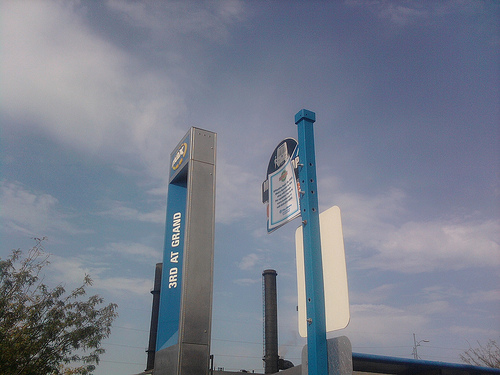
Did you see the notice taped over the bus stop sign at the 3rd and Grand MAX Station? It’s evidence of good things to come. Really good things.

Beginning on Sunday, September 30, KCATA Route 142 – North Oak will change. Here’s what’s in store:
– Route 142 will operate seven days a week.
– Hours of operation will be extended into the evening.
– Buses will run more often during much of the day.
– Buses will stop at the 3rd and Grand park-and-ride lot / MAX Station for direct connections to Main Street MAX and access to Bike-Share.
– Buses will operate both north and south on Grand, making it easier to find your bus for the return trip.
– Buses will continue to go south through Crown Center to 27th and Grand.
– And finally — Ta-Dah! – Route 142 will go all the way up to Zona Rosa.

Put it all together and you have the makings of an almost guaranteed surge in ridership.

This change to Route 142 represents a significant improvement in transit service for the Northland — maybe the most significant ever!

What’s more, North Oak is one of the transit corridors in the region identified for major improvements with money from both the TIGER Grant (2009) and the more recent Creating Sustainable Places program.

What’s not to like?

Big changes are happening on the Metro this Sunday as KCATA rolls out more of the route and schedule changes resulting from the Comprehensive Service Analysis. Check out all the changes to see how they affect you.  Metro Changes.

For further information about Route 142:
Bulletin from KCATA
www.kcata.org/rider_bulletins/142-north_oak_adds_zona_ros…
New route map
www.kcata.org/images/uploads/142mwk.gif
New schedule:
www.kcata.org/images/uploads/142.pdf

Posted in Local Transit Issues, Regional Transit Issue | Tagged: | Leave a Comment »

US 71 Transit Study – Video of Open House

Posted by Transit Action Network on September 10, 2012


The Jackson County US 71 Transit Study, an Alternatives Analysis, started in June and is the third transit corridor to be studied as the County works to complete a transit package to put before voters. Completion is scheduled for the end of the year.

There have been two Stakeholder meetings (Janet Rogers and Mark McDowell both represent TAN) and a public meeting. Until a final decision has been made for locally preferred alternatives in the three corridors, nothing can go forward.

The US 71 corridor originates in downtown Kansas City, Missouri and extends south of the downtown area, terminating in Belton, Missouri. The corridor generally parallels U.S. 71 crossing Kansas City (MO), Grandview and Belton and is being evaluated as a potential addition to the Jackson County Commuter Corridors Alternatives Analysis, a transit study that has been in progress since 2011, which consists of the I-70 corridor and the Rock Island corridor.

This corridor is very congested and portions of US 71 between 51st and 75th are particularly slow. Current transit service on U.S. 71 and parallel service on Prospect provide transit access for the area, but scheduled travel times are almost double the travel time of the automobile.

The US 71 corridor study is benefiting from the work already done in the other corridors. This study is considering Express Buses, Bus Rapid Transit (BRT), streetcars and commuter rail. Just a reminder that the commuter rail is not electrified light rail. It is a diesel vehicle, Diesel Multiple Unit (DMU), which operates on existing freight lines or new tracks.

The project team, Jackson County, MARC, KCATA and Kansas City, Missouri  and the consulting team, Parsons Brinckerhoff, are all the same as the previous study.

The study is in Phase I, which provides the purpose and needs statement and does an initial evaluation of the alternatives to decide which ones will go through to Phase II.

The first two alternatives advance automatically to Phase II

1. NO Build  – do nothing plus

  • all capital improvements identified in the fiscally constrained MARC 2040 Long Range Transportation Plan (LRTP) that will be implemented by 2035.
  • the existing bus network augmented with the recommendations listed in the KCATA Comprehensive Service Analysis Key Corridor Network.

2. TSM (Transportation Systems Management)

Everything in No Build plus

  • capital improvements and bus network enhancements.
  • an expansion of KC Scout Intelligent Transportation Systems.
  • New park and ride lots
  • Capital bus enhancements on U.S. 71 (such as bus on shoulder), which will be identified and evaluated as part of Tier 2.
  • New intermodal transfer point in vicinity of Hillcrest and Bannister Road.
  • Seven U.S. 71 / Prospect BRT station pairs.
  • Extension of local bus service along Prospect to Bannister Road and Blue Ridge.
  • Extension of Express Bus service (Route #471) from current terminus Point at U.S. 71 & Red ·  Bridge Road to U.S. 71 & M-150. The extended service would serve park and ride lots at U.S.
  • 71/M-150 and at Truman Corners Shopping Center. Number of trips would be increased from 5 AM and 5 PM to 8 AM and 8 PM.

Three additional alternatives to be evaluated for advancement to Phase II

Alternative 1: Bus Rapid Transit (BRT)

  1. Two alignments are anticipated for the BRT alternative–a Commuter BRT on U.S. 71 and an Urban BRT on Prospect.
    1. US 71 Commuter BRT connects M-150 in Grandview with the 10th and Main Transit Center.
    2. Prospect Urban BRT connects Bannister Road in south KC with the 10th and Main Transit Center.

Alternative 2: Enhanced Streetcar Alternative

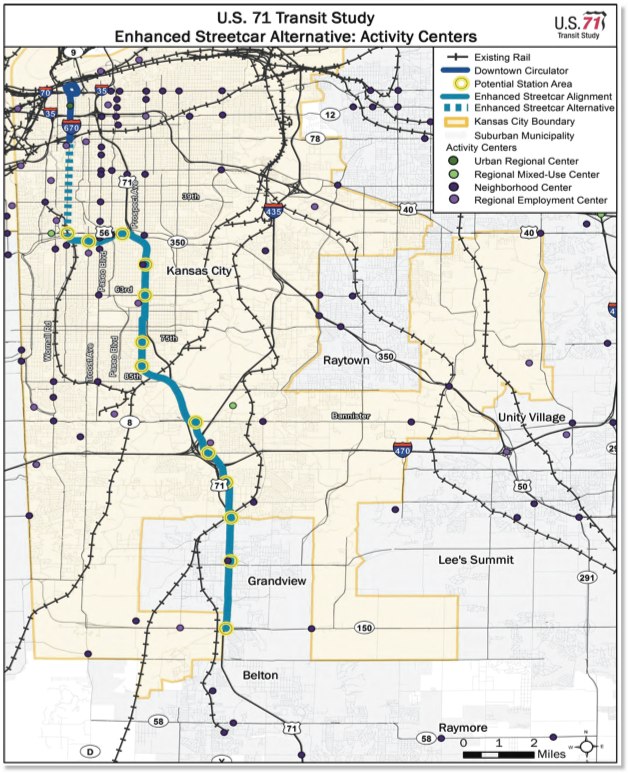
The enhanced streetcar would serve a third phase of the KC streetcar system (phase II would be to the Plaza). The streetcar would travel on the west side of US 71 and ends at M-150. A feeder bus network would also be a part of this alignment.

We expect the streetcar alternative to be eliminated because it is so expensive and probably wouldn’t qualify for federal funds to help us pay for it. We expect the projected ridership to be too low to make the line cost-effective by FTA standards. If it is advanced to Phase II it will be because the partners want to do the cost and ridership analysis for future reference.

Alternative 3: Diesel Multiple Unit Alternative

The alignment for the DMU Commuter Service South Line runs from the Jackson County Line to Leeds Junction. South of Leeds Junction the rail travels with limited stops on KCS track to its destination near M-150 in Grandview. North of Leeds Junction, it shares a common line with the Rock Island Corridor alternative, and farther north those lines combine with the I-70 corridor into downtown.  The two possible alignments for the DMU Commuter Service Common Line into downtown run from:

a. Leeds Junction to the River Market

b. Leeds Junction to Union Station via the Trench

The DMU alignment crosses nearly 80 bridge structures. About 20 of those would require improvement of some kind, up to and including replacement.

The stations along this alignment are limited due to various complications, including physical challenges and the lack of population and employment density.

The U.S 71 corridor has a large low-income population. The ability to provide improved access to work opportunities is an important goal of the enhanced transit system.

There will be additional public involvement as the study progresses.

US71 – combined alternatives – Click to Enlarge

US71 – BRT -Click to Enlarge

US71 – Streetcar- Click to Enlarge

US71 – DMU – Click to Enlarge

For more detail, review the information from the public open house materials and fill out the comment form.

http://www.kcsmartmoves.org/projects/us71transitstudy-openhouse1.aspx

Posted in Local Transit Issues, Rail, Regional Transit Issue, Transit Studies | Tagged: , , , | Leave a Comment »

All About Smog – One More Reason to Save the JO

Posted by Transit Action Network on August 14, 2012


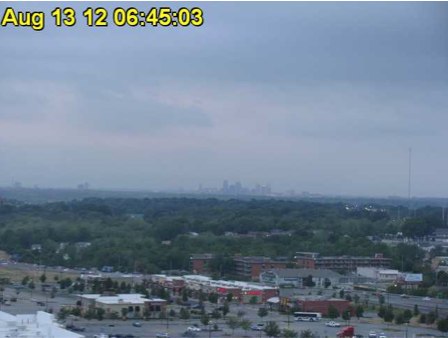
This is a Missouri Dept. of Natural Resources photo from August 13, 2012 from Blue Ridge Mall looking at downtown Kansas City. The KCPT tower, right-middle of the photo, is 3 miles away and the downtown skyline is 8 miles away. On a bad day, you can’t see the tower and on a really bad day even the skyline disappears from view. So what is smog?

The term “smog” was coined at the turn of the century to describe the hazy horizon of industrialized European cities, but around the 1950s, vehicle emissions began to take the place of factories in creating this noxious mixture of “smoke” and “fog”. Smog is a haze we see today during our hot and humid summers. This combination of ground-level ozone, nitrogen dioxide, hydrocarbons and dust particles is monitored regularly and regulated by the US EPA due to increasing health concerns for sensitive populations like children, the elderly and people with allergies or asthma.

In Kansas City, emergency room visits and hospital admissions increase significantly when ground-level ozone concentrations are high. Ground-level ozone irritates the eyes and nose, causes inflammation, difficulty breathing and even chest pain. It is formed by emissions from vehicles, power plants and other sources mixing with heat and sunlight, which is why summer is the most troublesome for air quality. Poor air quality knows no political boundaries, though, and smog will often creep northward with the warm, south winds of summer.

There is something we can all do to help. With daily work commutes averaging around 20 miles, multiple highway corridors, and abundant parking, it’s easy to see why so many folks in the Kansas City area drive to work. It’s also easy to see how our routines are contributing nearly half of the ozone forming emissions that contribute to poor air quality. Leaving your car at home even twice a week can save over 270 pounds of harmful ozone-forming emissions.

The MidAmerica Regional Council’s RideShare Connection is hosting the Green Commute Challenge now through September 28th to help raise awareness of air quality issues, reduce use of single-occupant vehicles in the peak summer season, and encourage transit use across the metro area through an employer-based contest. Thirty teams have joined from across the Kansas City area and over 900 people are taking the challenge to use alternative transportation.

Between bicycling, riding the bus or carpooling to work, and walking or simply staying in for lunch, the challenge has already reduced emissions by over 250,000 pounds. That’s like taking 14,000 cars off the road for a day. During the 12-week challenge, participants track their trips online and earn points. It’s a great way to see how our individual choices can add up to big benefits and many participants are using public transportation to earn serious points for their teams.

We can all do our part for air quality and using transit is a great way to start. And you don’t have to wait for national fuel efficiency standards or alternative energy sector growth to help! Compared to other household actions, using transit can reduce emissions by more than 10 fold.  A robust public transportation system is one of the very best investments any community can make to minimize emissions and reduce greenhouse gases. Transit can’t beat bicycling or other no-emission commutes, but modern buses are often hybrids using natural gas, biodiesel and other low emission fuels. The KCATA Metro MAX has several hybrid and clean diesel vehicles and both KCATA and The JO will be adding natural gas vehicles to their fleet.

Does being a transit rider make you an air quality hero? It depends who you ask but there’s no doubt that reducing even a few solitary commuting trips in your car can help reduce greenhouse gas emissions that contribute to global climate change and poor local air quality. Kansas City had 18 Ozone Alert days already in 2012, up from only 9 last year and 4 in 2010. We’ve exceeded ozone concentration standards 16 times this year and we’re setting a pace to top the last 2 years combined for quantifiable poor air quality. Poor air quality affects everyone’s health and it can make doing business more expensive as tighter regulations are enacted to meet basic national standards.

When local budgets get tight and cuts seem imminent, priorities have to be defined to guide the process, but with growing concerns about air quality and the human health impacts a very clear reality in the Kansas City metro area, you have to ask: why is public transportation not a priority in Johnson County? How can eliminating bus routes by 45% (and reducing service on another 45% of routes) serve our collective goals for air quality when it is the first, best way to reduce harmful ozone-causing emissions? We don’t believe cutting bus services voluntarily is in the best interest of Johnson County or the collective community when it comes to air quality issues or the kind of reliable public transportation system the public increasingly demands.

It’s not too late to improve air quality in Kansas City. From alternative fuel blends and hybrid vehicles to using low emissions paint in our homes and native landscaping in our yards, people across the metro are doing so much to reduce harmful greenhouse gases and ground-level ozone in our community. Using transit is one of the most effective things you can do to help ease air pollution and prevent smog from ever forming. The only question is: if you live or work in Johnson County, will you still have the transit option in 2013?

Contact Johnson County Board of County Commissioners

  1. Phone: 913-715-0430
  2. Email contact form: http://bocc.jocogov.org/webform/contact-us

http://finances.msn.com/saving-money-advice/6804691

http://www.marc.org/Environment/airQ/pdf/FAQfourpage.pdf

http://www.dnr.mo.gov/env/esp/aqm/kccam.htm

http://www.apta.com/gap/letters/2010/Pages/100728_obama.aspx

http://www.marc.org/Environment/airQ/pdf/ozonereports/O3WeeklySummary.pdf

Posted in Action, Local Transit Issues, Regional Transit Issue | Tagged: , , , | Leave a Comment »

Open Houses – U.S. 71 Transit Study – July 12 and 17

Posted by Transit Action Network on July 10, 2012


The U.S. 71 Transit Study is underway.  The project team and lead consultant are the same as for the Jackson County Commuter Corridors Alternatives Analysis. The project team consists of MARC, Jackson County, Kansas City, and KCATA. The lead project consulting firm is Parsons Brinckerhoff.  Transit Action Network has two advocates on the Stakeholder Advisory Panel.

The U.S. 71 corridor begins in the downtown loop of Kansas City, Mo., and runs south along U.S. 71/Bruce R. Watkins Dr. through Kansas City and Grandview to M-150 near the Cass County border. This heavily traveled corridor includes not only the U.S.71 highway facility, but also Prospect Avenue and adjacent railroad assets.

The study will build on and coordinate with the Jackson County Commuter Corridor Alternatives Analysis, which is studying the I-70 and Rock Island corridors. This study is funded largely by a $652,200 competitive grant from the Federal Highway Administration, which Jackson County acquired.

During the open houses, participants can tell the project partners whether enhanced transit is needed in the corridor and, if so, what their preferred transit option might be. A short update on the alternative analysis study will be given at 4:30 p.m. each day.

Visit the project Website. http://www.kcsmartmoves.org

Posted in Events, Local Transit Issues, Rail, Regional Transit Issue, Transit Studies | Tagged: , , , | Leave a Comment »

Independence Revises Its Local Transit Routes – IndeBus

Posted by Transit Action Network on June 29, 2012


Independence changes its local routes effective July 2, 2012. Along with new buses and a new contract operator, First Transit, the routes are changing significantly. Fares will remain the same.

View schedules and maps, and watch a video explaining the system at the IndeBus page on the Independence website.

The shift from KCATA to First Transit for the local routes will cost Independence about $14,000 more than previously, but the city calculates a 30% increase in transit miles and 30% more hours of service by eliminating the current 2-hour break in the middle of the day. Service will run until about 6:00 pm.

First Transit will also operate the local para-transit (IndeAccess), and local senior service (IndeAcess+) transportation services within Independence. These services replace the local Dial-A-Ride service. There is a new photo ID and coupon program for qualified riders. KCATA will continue to provide the Share-A-Fare para-transit service from Independence into Kansas City and Share-A-Fare services will continue to be available in most of Independence.

KCATA will continue to provide inter-city service connecting Independence to Kansas City on routes 24 and 15X (previously the 24X). Check the new Metro schedules.

Beginning July 2nd, all questions for IndeBus, IndeAccess, and IndeAccess+ will be answered by First Transit at 461-IBUS (4287).  For questions related to the 24 and 15x Routes or ShareAFare, riders can continue to call the KCATA Regional Call Center. Independence is currently including transfer information in its local training for the 461-IBUS call center.  First Transit operators should work through alternatives for transfers and trips with riders. Independence is not contracting with the Regional Call Center to provide information about their local buses. The Regional Call Center can answer questions about all the Metro services.

Explaining the route changes and new operator, Independence Director of Community Development Jennifer Clark said, “Independence is responding to rider demand and interests. This is a rider focused model and reflects the best interests of the community.”

Improvements to the system include having a full time employee responsible for the Transit Center at Truman and Noland Roads to make sure it is clean and functioning. In addition, the new local buses will have two wheelchair slots instead of one. Buses all have GPS, and an app from TransLoc will be available for real-time information about buses using a smart phones. Check the city website to download the app in July.

At this point there is a compatibility problem between the Metro and IndeBus fareboxes, but the two system operators are working with the farebox vendor to resolve the problem. The solution may not be in place by July 2nd, in which case riders using both systems will be instructed on how to use a transfer or monthly pass.

For more information watch Clark’s presentation about the new transit system to the Independence City Council on June 25. Her presentation starts at 24:36 minutes into the video and lasts about 17 minutes.

The City Council Transit Committee plans to initiate a public input process. Although it hasn’t been defined yet, it will represent a mix of interests such as riders, residents and businesses, and will report back to the Transit Committee on matters such as efficiency of operations and customer satisfaction. We think this committee is a good idea, and that all transit agencies should have a similar stakeholder committee that meets regularly to provide feedback.

One cloud still hanging over the new service is whether Independence will receive a share of federal funds that come to the Kansas City region through KCATA for its local routes. Currently the cost of the transit service provided to Independence by KCATA is offset by approximately $600,000 annually,  $400,000 of which is allocated for local routes.

Two issues affect this money.

  1. KCATA is in the process of defining a formula to distribute or apply these federal funds throughout the region, and Independence may qualify for less money under the new formula, especially since they are using a private operator.
  2. Section 13c of the Federal Transit Law protects public transportation workers if operations are shifted to a private provider. This law could be used to prevent Independence from receiving this money for the local routes.  Jonothan Walker, president of local 1287 of the Amalgamated Transit Union, has told us the ATU is working on several fronts, including monitoring Independence’s use of these federal funds.  “None of the new service shall receive funding except private. If Independence tries to use it (federal funds) for expansion of lines and for private use, they may find our ATU International legal team involved.” See our previous article for more information Independence Ponders Transit Options (Dec 6, 2011).

Independence was aware of these funding issues before contracting with First Transit, and is monitoring the funding situation.  TAN is concerned that if the federal funding is withheld from Independence, it would have a negative impact on transit service in Independence. We hope that Independence has a plan to deal with that situation if it happens, and that Independence riders are well served by their new local routes.

Posted in Local Transit Issues | Tagged: , | 1 Comment »

Jackson County Transit Study Takes a New Direction

Posted by Transit Action Network on June 25, 2012


Calvin Williford, Jackson County Chief of Staff, recently wrote to the Jackson County Commuter Corridors Partner Team describing new developments related to the study currently underway.  He said completion of the current commuter corridors study would be postponed and the County would move forward with a comprehensive transit plan. Letter_Partnership _Team

For almost two years everyone said the study would be completed and a “Locally Preferred Alternative” (LPA) would be decided in the June 2012 time frame.  In a bold step, and with a growing understanding of transit needs, Jackson County decided to wait for more information. The county’s ambitious target date for having a conceptual countywide transit plan in place is the end of July.

Part of the reason for the postponement is that another study, this one in the Highway 71 / Grandview corridor, is just beginning and the County wants to gain an understanding of transit alternatives in that corridor before making any decisions since all three corridors are interrelated.

The biggest reason for the postponement, though, is that a new rail alternative has become available for consideration — the possibility of getting commuter rail to Union Station.  This new alternative uses the Kansas City Terminal (KCT) Railway tracks to get into the area just north of Union Station. These are the tracks that Amtrak uses. It will be a big deal if the County can get the railroad to consider this. In the past KCT has always rejected the idea of accommodating commuter rail, and the cost of putting new tracks in that corridor would require expanding a number of bridges at an estimated cost of $1 billion.

This new KCT alternative is not without concerns. There are capacity issues since so many freight trains use these tracks daily. Therefore a capacity analysis has to be done first to see if this alternative is workable before formally evaluating this corridor for commuter service as part of the AA.  Because of existing challenges, it was assumed from the beginning that KCT would not allow commuter rail on its tracks. No previous study has been completed to estimate costs, ridership numbers or travel-time savings to Union Station using this route.

Will this rail alternative have significantly better quantitative results than the Third and Grand alternative?  We don’t know. The 2007 study of commuter rail in the I-70 corridor concluded: “Possible conflicts at Union Station with a high volume of freight traffic and Amtrak passenger service have a significant likelihood of negatively impacting commuter rail reliability, which is not acceptable when building ridership.”  If capacity issues can be resolved, then this route should definitely be studied. This route would likely be shorter and provide a more desirable terminus — factors that could improve ridership forecasts.

Like the Third and Grand location, this route would require other transit service (such as the Downtown Streetcar) to provide access to the Central Business District (CBD). However, in contrast to the Third and Grand alternative, there are thousands of jobs in the vicinity of a terminal at Union Station. Since there isn’t a fast direct route from the highways to Union Station, commuter rail on the KCT tracks might compete favorably in travel time with driving, provided they can increase the speed of rail. Of course an express bus will likely still be faster to the Government District and the rest of the CBD.

So that leaves the question of cost. Can Jackson County persuade the railroads to bring the cost of access to their tracks down far enough that even if ridership projections are low and the travel time to the CBD is slow, the overall cost of getting to Union Station will be acceptable? Wait and see. The County is working very hard to put this together.

Williford’s letter also mentions Jackson County’s commitment to developing a comprehensive county-wide transit strategy that includes “rail, buses and a well-connected trails system”. The commuter corridors study process has raised the County’s awareness of the huge transit and trail gaps in the county, and considering a comprehensive package to take to voters is a great idea. In order to develop such a strategy, a number of groups have been convened to look at particular parts of an overall multi-modal plan. MARC is working with trails advocates to develop a detailed trails plan that satisfies multiple users, and the KCATA will be taking the lead in configuring and costing a more extensive bus system following the “Smart Moves” concept. Transit Action Network is part of a committee to identify the transit gaps. The original project team is working with the railroads on the capacity study to get into Union Station, but Third and Grand remains a fallback location for rail.

In a recent public meeting Williford talked about Jackson County’s serious “transit deficits” and made the following specific points:

  1. Every community that has developed rail transit has started first with a robust bus system. “Buses are the backbone of every transit system in the country,” he said, citing the “cost effectiveness” of buses over rail.
  2. Service for the mobility-impaired is inadequate.
  3. You can’t get from Kansas City to Independence after 6:00 at night.

Williford also said that while economic development is important, the county is placing greater emphasis on mobility than it did earlier. We think it’s great that the County’s understanding of the transit issues in the region has developed and expanded.

In order to create a comprehensive plan the County needs to fit all the pieces together with a financial package to pay for it. The County has taxing authority up to a one-cent sales tax. The full tax would raise approximately $80 million, derived almost equally from Kansas City and the rest of the county.

As part of this process, the County realized that parks and trails are really important to people. In the recently concluded session of the Missouri legislature the County successfully sought taxing authority for another ¼ cent sales tax for trails and parks. Such a tax could raise about $20 million.

Jackson County has taken on a huge challenge: Create a plan for commuter transit in three corridors, supplemental transit to fill numerous transit gaps throughout the county, and a set of parks and trails amenities. We hope they can come up with a great package at a cost that’ll be a “no-brainer” for voters to support.

Posted in Local Transit Issues, Rail, Regional Transit Issue, Transit Studies | Tagged: , , , | Leave a Comment »

TAN’s Position On Transit Alternatives For The I-70 Corridor In Jackson County

Posted by Transit Action Network on June 1, 2012


 Transit Action Network sent its position paper on the I-70 corridor of the Jackson County Commuters Corridors Alternatives Analysis to the Project Team and the Stakeholders. The following position is based on the April 2012 presentations by the Project Team. We understand the numbers are not final, but while we expect them to change to some extent, we do not anticipate they will change in orders of magnitude. Read the whole document TAN Position on I-70 Corridor

1. TAN favors developing Enhanced Express Bus service along the I-70 corridor.

2. Transit facilities should be located and designed to maximize development potential around them.

3. Jackson County should create a County Transit Authority to fund this and other expanded inter-city transit service, thereby relieving localities of this burden.

4. Jackson County should negotiate an agreement with the City of Kansas City to acquire the use of land adjacent to the northern edge of Kessler Park sufficient for a right-of-way for future commuter rail to Second and Grand.

5. Jackson County and Kansas City should develop a working relationship with the Kansas City Terminal Railway to preserve sufficient right-of-way to accommodate additional tracks east of Union Station, so that the possibility of additional rail access (freight and passenger) to the Union Station area is not further compromised.


Posted in County Transit Authority, Local Transit Issues, Rail, Regional Transit Issue, Transit Studies | Tagged: , , , | Leave a Comment »

Consultant Discusses the Preliminary Costs, Ridership and Time-Savings Estimates For The JCCCAA

Posted by Transit Action Network on May 29, 2012


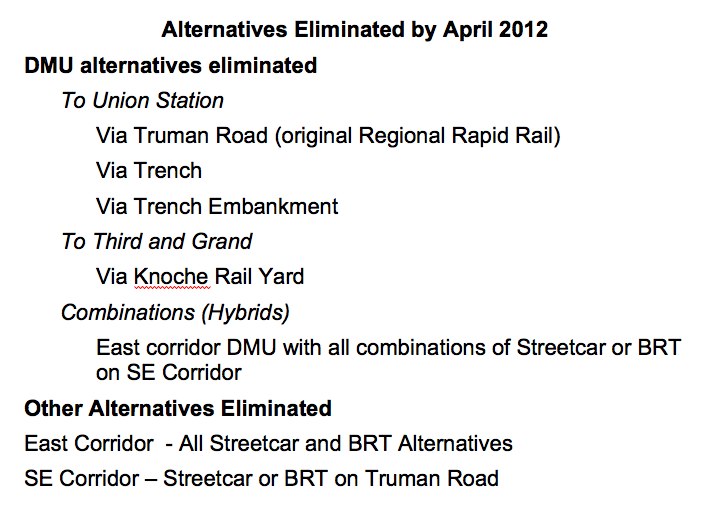
Lisa Koch, senior planner with Parsons Brinckerhoff, returns to discuss the Jackson County Corridor Alternatives Analysis (JCCCAA). Parsons Brinckerhoff released the first wave of quantitative information about the study at an open house the end of April. Lisa brings us up-to-date with the study and why several of the alternatives have been eliminated including the original Regional Rapid Rail commuter rail proposal. That alternative used existing rail right-of-ways in the east and southeast of the county and new track on city streets, including Truman Road, to terminate at the Freight House District, north of Union Station.

Click to Enlarge

Lisa describes the replacement commuter rail proposal, which terminates in the Third and Grand area. She provides information about the remaining alternatives in both the East (I-70) Corridor and the Southeast Corridor (the unused Rock Island right-of-way). For these preliminary estimates, Lisa comments on the high costs, low ridership numbers and the fact that the fixed guideway alternatives don’t provide any time savings over the highways by 2035.

Lisa describes the “right-sizing “ efforts the team is making to fine-tune the alternatives based on what they have learned.  When the alternatives have been revised, the partnership team, consisting of Jackson County, Kansas City, KCATA and MARC, will decide on a Locally Preferred Alternative, (LPA).

At the end of the interview Lisa discusses the economic development numbers for the rail alternative that were presented at the open house. MARC estimated these numbers as a 10% increase on the assessment value of existing properties within a ½ mile radius of the proposed rail stations.

Using property appreciation as a proxy for development around rail stations is a common methodology. This is not an estimate of the impact on jobs or sales tax revenue, but rather the appreciation benefits that existing property owners might see if their property is near a station. It does not represent a net benefit. It does not take into account decreases in property values commonly experienced by property owners between stations and by upper bracket residences near a rail line.

There are also concerns that rail does not create development, it merely moves development from one area to another, next to a rail line. There are some conditions in which appreciation does not occur, in particular, in areas with unlimited ability to sprawl. Property appreciation can be very large – or zero, depending on the circumstances.

TAN believes it is desirable to concentrate activity around stations of any type, bus or rail. Areas with transit-oriented (not created) development are highly desirable, exciting, well-integrated places to work, live, shop and play that make transit investments more cost-effective.  However, after the initial construction investment, successful economic development relies on many factors besides having a station.

For a better understanding of economic development related to property appreciation for transit, read this report by the National Association of Realtors.

Public Transit Boosts Property Values, If Conditions are Right

To view the display boards for the third open house, go to the project website, KCSmartMoves.

Transit Action Network previously reported on the JCCCAA Open House #3.  Read our evaluation of the current information: High Cost Combined with Low Ridership and Insignificant Time-Savings Hurts Rail in the Commuter Corridors Study

To follow the whole study, see the rest of our video series at TAN Videos on our website. The third interview discusses the DMU rail lines east of I-435.

Link to the first interview: MARC And Parsons Brinckerhoff Discuss The Current Status Of The Commuter Corridors Altenatives Analysis

Link to the second interview: Parsons Brinckerhoff Consultant Discusses Three Alternatives In The JCCCAA

Link to the third interview: Discussion About The Regional Rail Alternative for the JCCCAA

Link to the fourth interview: Enhanced Streetcar/DMU/BRT Combinations Are Discussed

Posted in Local Transit Issues, Rail, Regional Transit Issue, Transit Studies, Videos-Transit | Tagged: , , , | Leave a Comment »

It’s Time For Regional Discussion Of Transit

Posted by Transit Action Network on May 24, 2012


Transit Action Network doesn’t usually reply to items in the press, but we think Steve Rose’s column in yesterday’s Kansas City Star warrants a response.

The column, “Talk of Regional Transit Is Just Wasted Breath,” bears reading, even though we find it quite disappointing.

“Wasted breath?” Really?Johnson County, the richest and most populous county in Kansas, could find itself without a meaningful transit system of any kind in the next couple of years, falling behind Wichita and Topeka.  Yet instead of expressing concern, Mr. Rose dredges up 30-year-old biases and frames the current transit situation as Johnson County against the City of Kansas City. That involves a misconception: KCATA was created by the two states and Congress, and is independent of Kansas City.  Lacking taxing authority of its own, it provides transit service under contract with nearly a dozen municipalities.  Kansas City happens to contract for the most service.

Describing the transit cutbacks that Johnson County seems poised to impose on its citizens, Mr. Rose writes:

Where [Johnson County Transit Director] Alice [Amrein] is unrealistic is she told me she is contemplating recommending to the county commissioners that, along with the cutbacks, it may be worthwhile to contract some routes with the Kansas City Area Transportation Authority, otherwise known as the ATA.

Furthermore, Steve Klika, a member of the Johnson County Transportation Council and a representative on the ATA board, was reported in The Star [Mike Hendricks, May 13, “Deep cuts could mean drastic changes for The Jo bus system] as saying, “The only way transit is going to succeed in Kansas City is if it’s regionalized.”

These statements attributed to Ms. Amrein and Mr. Klika are not at all unreasonable. Indeed, prudence indicates that all options be explored. Mr. Rose goes on to quote Johnson County Commission Chairman Ed Eilert as saying, ““We would not turn over any funds to ATA. … Furthermore, we would not give up funding or operational control.”

Nobody is suggesting that. If KCATA were to operate (or even manage the operation of) transit routes in Johnson County it would be under a contract resulting from a competitive bidding process involving other potential transit operators.  That hardly constitutes “turning over” funds to KCATA, and it’s hardly a novel idea. In fact, the possibility of JCT once again contracting with KCATA has been under consideration for years, and KCATA has submitted bids to operate Johnson County transit routes as recently as just a couple of years ago. JCT elected to stay with its current contractor, First Transit.

Furthermore, Mr. Rose (and Mr. Eilert) might not be aware that KCATA already performs some basic transit support services under contract to Johnson County Transit.  These include operation of a Regional Transit Information Call Center and maintenance of a number of bus shelters and other facilities. The two agencies are currently working together to get basic information about The JO’s routes and schedules posted at key stops in Kansas City, and KCATA now accepts monthly passes issued by The JO on nearly all Metro routes including MAX.

Mr. Rose then quotes KCATA Board of Commissioners Chairman Robbie Makinen as saying, “I consider this a real opportunity to rekindle the seamless, regional transit discussion.”

Discussion? That makes perfect sense to us. We don’t know what Mr. Rose thinks seamless regional transit is, but we think it means transit that’s easier to understand and use.  That’s important not just in Jackson and Wyandotte counties, but even for Johnson County because thousands of people hold low-paying service jobs in Johnson County but can’t afford to live there. Others travel there to shop or pursue educational, recreational, cultural, and other opportunities.

Improving and expanding public transit service in the Kansas City region is Transit Action Network’s purpose for being. To accomplish this goal we need informed discussion of the current situation. Bringing up perceptions of how things may have been 30 years ago is simply not helpful.

Mr. Rose’s column could be just the thing that’s been needed to re-ignite serious dialog among public officials of the region to move us toward a public transit system that seamlessly serves the region’s citizens. If it does, then we’ll be among the first to say, “Thank you, Mr. Rose.”

Posted in Local Transit Issues, Regional Transit Issue | Tagged: , , | 3 Comments »

High Cost Combined with Low Ridership and Insignificant Time-Savings Hurts Rail in the Commuter Corridors Study

Posted by Transit Action Network on May 8, 2012


A lot of factors go into making a good transit project.  Most people will gladly tell you they prefer trains to buses. However, when ridership numbers, time savings and costs factors come into the picture, reality hits.  Are the ridership numbers sufficient to justify the cost? Does the project actually save commuters time? Will the project qualify for federal funds to help pay for such an expensive project?  How much would it require in local taxes?

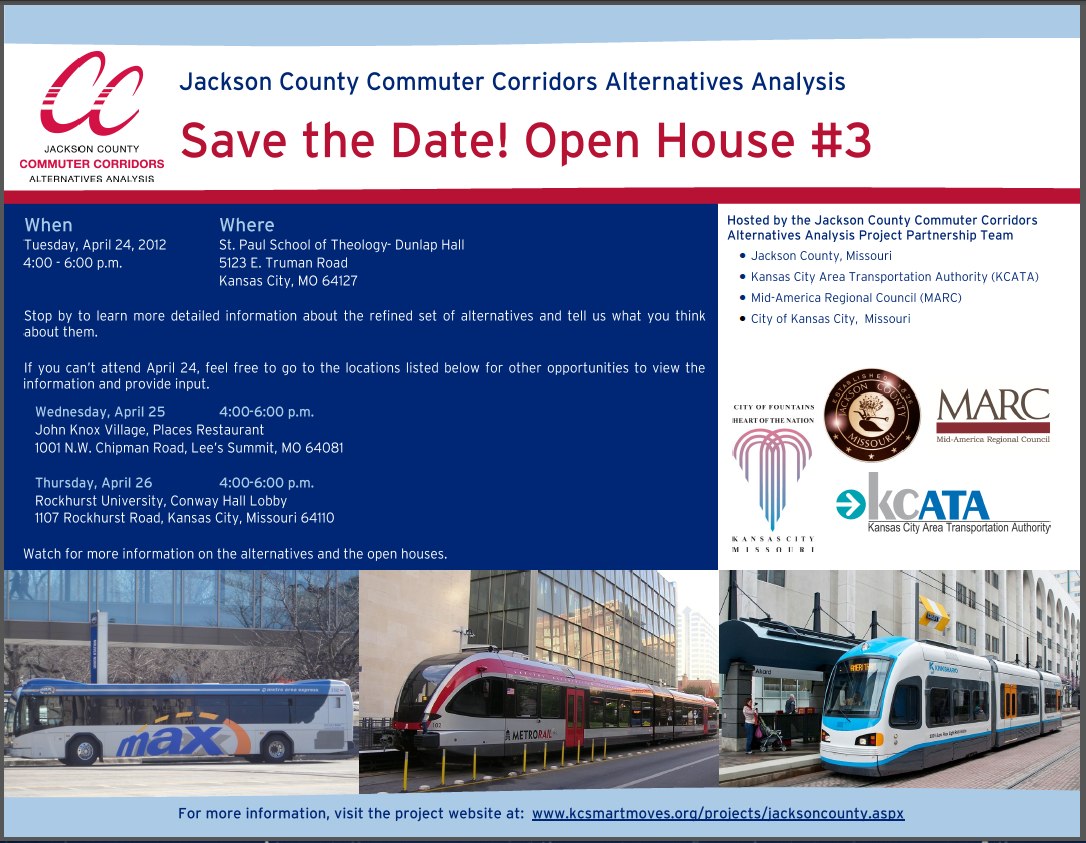
Open House #3 April 24 @ St Paul’s School of Theology

The Jackson County Commuter Corridors Alternatives Analysis (JCCCAA) is beginning to address some of these questions. The project team had its third series of open house meetings April 24-26. (See the Open House Display boards).  One more series is planned.

This open house provided the first look at quantitative results for the current commuter corridor study. The study is not complete and some of the numbers will change.

Some additional information is needed to understand the following information from the open house.

  1. The ridership numbers and travel time are forecasts for 2035. These are the numbers you can expect to see in 23 years.
  2. The dollar figures are for 2012.
  3. The model for forecasting congestion on I-70 only indicates an additional 3-5 minutes for travel time in 2035 over travel times today. The travel time for a car was not provided for comparison.

After evaluating the information from the open house, Transit Action Network’s preliminary conclusion is that, in all probability, none of the fixed guideway alternatives would qualify for federal funding due to the relatively high cost for the low ridership and the insignificant amount of time saved. The FTA uses these factors to measure cost-effectiveness. Of course, the numbers are being revised, but considerable improvements would be needed to change this assessment. Both of the commuter rail lines plus the Rock Island streetcar line and the Rock Island Bus Rapid Transit (BRT) alternatives are probably not cost-effective enough to receive capital funds for construction from the FTA.

A. I-70 Corridor from Oak Grove – Highlights

There are only two alternatives left in this corridor and they are basically the same as were studied in a 2007 Alternatives Analysis. Summary of 2007 I-70 Commuter Corridor AA

 EAST I-70 Corridor

Daily ridership by 2035

Total Capital Cost in millions

Total capital cost per rider based on annual ridership (260 days)

Travel time to 10th and Main from

Travel time in Minutes in 2035

Annual operating cost in millions

Express Bus

600

$35-$39

$237

Oak Grove

59

$3.6

DMU

1,150-2,800

$480-$600

$742-$1806

Oak Grove

61

$10.7

  1. One choice is an enhanced version of today’s highway express bus with more comfortable over-the-road coaches and significantly more service. In 2007 the recommendation was to improve the Express Buses. Compared to the 1,500 riders projected in the 2007 study, the 600 daily riders in the current study looks very low.

    Click to Enlarge I-70 corridor

  2. The second choice is a commuter train (Diesel Multiple Unit or DMU) that stays on the Kansas City Southern rail line toward the Northern Industrial District and then turns west and finishes at Third and Grand. There is a new alignment which is an improvement over the alignment in the 2007 study. There is a narrow strip of land owned by Kansas City, north of Cliff Drive by Kessler Park, that could be used instead of going through a rail yard. However, maximum daily ridership last time was 1,425 and right now this project is showing 1,150-2,800 daily riders. These ridership numbers are not significantly improved considering the project capital cost in 2007 was $102.8-168.9 million. More money is being projected for track improvements, which would increase the train speed and decrease the travel time.
  3. There is not a significant time savings for commuters using the train. The estimated time to 10th and Main from Oak Grove using the Express Bus is 59 minutes and getting to 10th and Main using the DMU plus a transfer to the streetcar is 61 minutes.

B. The Rock Island Corridor – Highlights

Four alternatives are still being considered, but they are not comparable situations.

SE corridor

Rock Island line

Daily ridership by 2035

Total Capital Cost in millions

Total capital cost per rider based on annual ridership (260 days)

Travel time to 10th and Main from

Travel time in Minutes in 2035

Annual operating cost in millions

Express Bus starts in Pleasant Hill

350

$35-$39

$407

Pleasant Hill

63rd and Raytown Road

60

48

$3.6

DMU starts in Pleasant Hill

500

$326-$413

$2,846

Pleasant Hill

65

$9.5

BRT Starts in Lee’s Summit

500

$230-$283

$1,962

63rd and Raytown Road

54

$3.2

SE Urban Corridor

Enhanced streetcar starts at 63rd street and Raytown road

1,850-2,700

$402-$538

$670-$977

63rd and Raytown Road

50

$6.1

  1. Only the Enhanced Express Bus and the Diesel Multiple Unit go to Pleasant Hill.

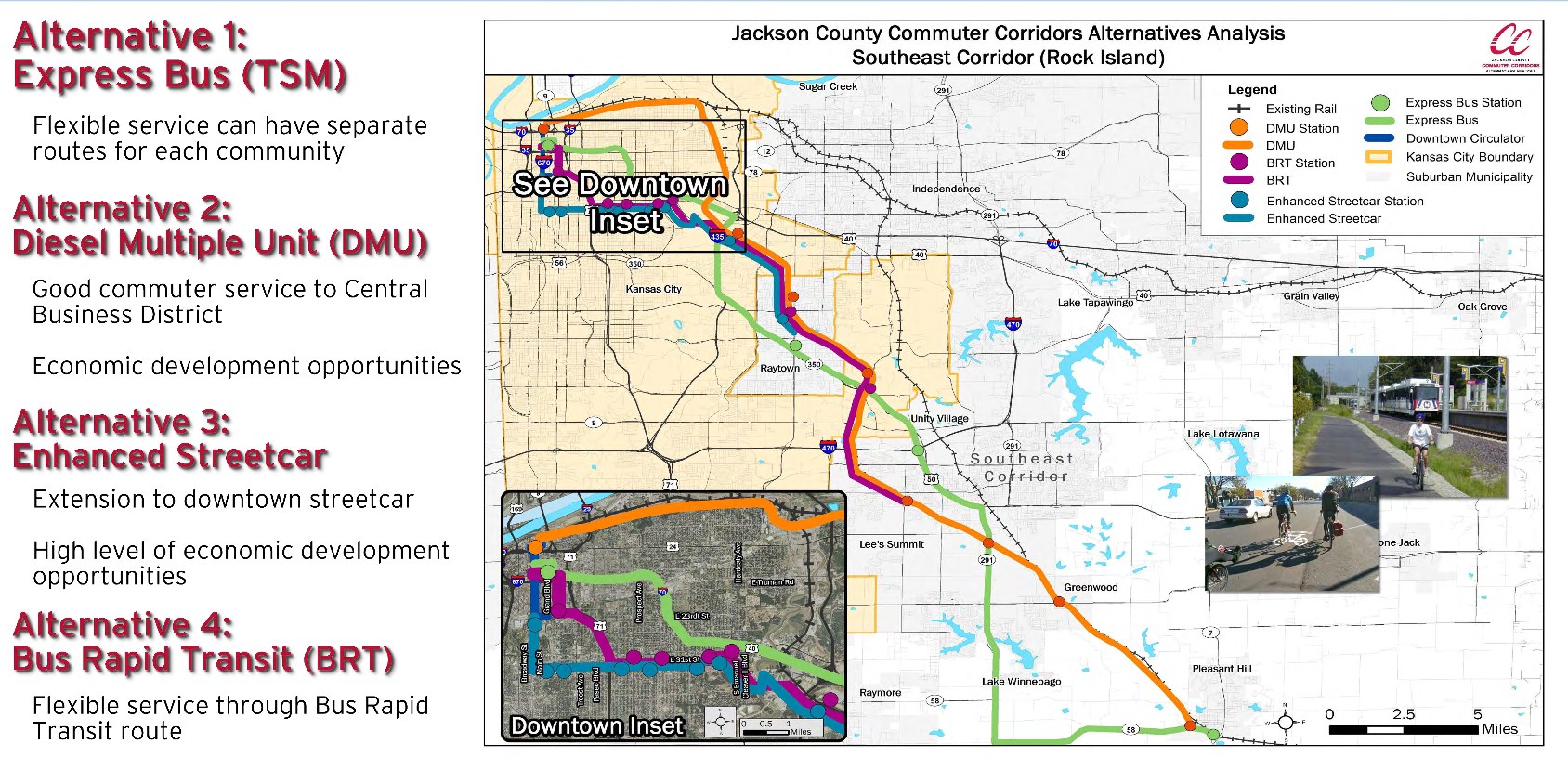
    Click to Enlarge SE Rock island Corridor

  2. The Express Bus is an enhanced version of today’s highway express bus with better coaches and significantly more service.
  3. The DMU travels on the Rock Island Line, then continues north toward the Northern Industrial District. North of St. John Avenue it merges with the I-70 corridor KCS line and the two lines share a common segment into Third and Grand. The cost for this line does not include the common rail section since the Rock Island DMU line would only be built if the I-70 DMU line were built.
  4. The Bus Rapid Transit (BRT) only goes to Lee’s Summit. It uses a new paved busway on the Rock Island line to the Sports Complex and then a fixed guideway (the two middle lanes of traffic get barriers to segregate the bus from other traffic) is built on Stadium Drive and Linwood Blvd. At Bruce R. Watkins Drive (Highway 71) it uses the freeway to get into Downtown.
  5. The Enhanced Streetcar is not really part of the commuter corridors since it has been shortened to start at 63rd Street and Raytown Road, which makes it more of an urban corridor route. The streetcar goes down Linwood Blvd in a fixed guideway (the two middle lanes of traffic get barriers to segregate the streetcar from other traffic). At Main Street it would operate in mixed traffic and turn north to meet the proposed Downtown Streetcar line at Pershing.  MARC’s Smart Moves plan consists of two types of corridors – urban corridors that serve the urban core and commuter corridors, which bring people into the city from the suburbs. In fact, the significantly larger ridership numbers projected for this “enhanced streetcar” alternative are from people in the urban core. The streetcar has significantly more riders than the BRT even though they both go down Linwood since the bulk of the streetcar ridership happens west of Highway 71 after the BRT turns north.  Because the streetcar makes several stops along Linwood and functions like an urban streetcar corridor, this alternative does not appear to serve suburban commuters very well.
  6. This is the first AA that has been done in the Rock Island commuter corridor so it is interesting to see such low ridership numbers.

    Open House #3 April 25 @ John Knox Village

  • Express bus – 350; DMU – 500; Bus Rapid Transit – 500. These ridership numbers are breathtakingly low and don’t warrant any rail investment. Even if the study increases the numbers they aren’t going to go up nearly enough to justify the cost of rail. The low ridership projections for the DMU in the Rock island corridor compared to the I-70 corridor is partly because this line doesn’t go through the main population centers of these cities and a lot of the route goes through industrial areas.

For commuters in the Southeast Corridor there are two bus possibilities:  Enhanced Express Bus from Pleasant Hill or Bus Rapid Transit from Lee’s Summit.

  1. To compare travel time between the two buses, look at the time from Raytown Road. The BRT time to 10th and Main is 54 minutes and the express bus from that location is 48 minutes. So the express bus is faster over the same distance.
  2. The Express Bus costs $35-39 million, while the BRT would entail paving the Rock Island line and establishing a fixed guideway on Linwood for a total of $230-283 million. Is the additional cost worth it for a slower travel time and only a few more people?

What about the Rock Island Streetcar? Even though the ridership is better than the other alternatives in this corridor, it is far too low for the cost.

To put this streetcar in perspective, compare it to the Downtown Streetcar project currently being planned.

Streetcar

Daily Ridership by 2035

Total Capital Cost in millions

Capital Cost per Rider-Total Capital Cost Divided by Annual Ridership based on 260 days. (JCCCAA method)

2 mile Downtown Streetcar

6,000

$101

$65

12 mile Rock Island Streetcar

1,850-2,700

$402-$538

$670-$977


Financing Transit in Jackson County

Once transit alternatives are selected for these corridors — i.e., once a “Locally Preferred Alternative” or LPA is determined, local funding has to be obtained.  This is true whether there is a federal contribution to the project or not.

Revenue Source

Uses

Rate/Method

Estimated Amount

Jackson County Sales Tax

Operating and Capital

1-cent sales tax (maximum)

$80 million annually

Jackson County Property tax

Operating and Capital

One mill

$82,500 annually

Farebox revenue

Operating

Fares

Typically 20% of operating costs

Federal Funding

Capital

5309 program for either New Starts (projects > $250 Million) or Bus and Bus Facilities

New Starts 30-50% of construction costs or Bus and Bus Facilities 80 %

Jackson County has special taxing authority allowing voters to approve up to a 1-cent sales tax for transit, which would collect about $80 million annually. Jackson County has significant transit needs, especially in eastern Jackson County.  Not only does commuter transit need to be improved and expanded, but transit is needed to get to other activity centers such as jobs, education, medical facilities, shopping and entertainment in areas other than downtown. (Only 14% of the region’s jobs are currently in the CBD).

Although a property tax is a possible funding source, it doesn’t raise much money.

TAN realizes the study isn’t finished and there will be changes, but the total annual cost is important to understand Jackson County’s ability to provide transit. The following numbers are based on the information presented at the April open house. We will re-do our analysis when adjusted numbers become available.

Estimated Rail and Fixed Guideway Annual Costs

Fixed guideways being studied in two corridors

TAN’s estimate of annualized capital debt service for rail (@4% interest for 25 years) in millions

Annual operating cost in millions

Total annual cost in millions

I-70 corridor DMU

$29-38

$11

$40-49

Rock Island DMU

$21-26

$10

$31-36

Rock island BRT

$15-18

$3

$18-21

SE Corridor streetcar

$29-34

$6

$35-40

Very preliminary conclusions:

Open House #3 April 24 @ John Knox Village

  1. Without federal assistance, Jackson County cannot pay for DMU rail lines in three Corridors. Study of a third corridor, the Highway 71 corridor to Grandview, is just getting under way.  It is possible that the annual costs for the DMUs in the first two corridors (as high as $49MM plus $36MM) could use up more than the 1-cent sales tax ($80 million annually) with nothing left to provide supporting bus services, much less transit to other parts of the county.
  2. Without significant federal funding, any fixed guideway options still being considered would be difficult to justify considering all the other transit needs and issues. The costs would be further complicated with a fixed guideway option in the Grandview corridor.
  3. Voters in Kansas City might object to paying a full 1-cent sales tax on commuter rail from eastern Jackson County without much benefit to taxpayers living within the City. In other words, for a transit tax to pass county-wide, there would have to be something in the package for Kansas City.
  4. Since rail projects are so expensive, most cities seek federal funding to help build projects. The FTA has only been funding large projects with a cost-effectiveness rating of at least Medium. Once a  project qualifies to be considered for federal funding, it still has to compete against other cities and recently the FTA has only been covering 30-50% of the cost of rail projects selected for funding. For perspective look at the FTA current Capital Investment Program Project Profiles.

Sample of FTA Current Commuter Rail Projects

Total project capital cost in millions

Projected Weekday ridership

Denver-Eagle Commuter Rail

$2,043.14

57,300

Orlando-Central Florida Commuter Rail Transit-Initial operating segment

$357.23

7,400

Weber County to Salt Lake Commuter Rail

$611.68

11,800

Providence, RI South County Commuter Rail (extension)

$49.15

3,500

Compare to the commuter rail being studied in Jackson County

I-70 DMU

$480-600

1,150-2,800

Rock Island DMU

$326-413(doesn’t include cost of common segment)

500

Additional very preliminary conclusions:

  1. The two DMU rail lines could cost a billion dollars to build (using high-end estimates of  $600MM plus $413MM).
  2. The capital and operating costs for the Enhanced Express Buses could be covered without federal funding, although federal dollars are much easier to get for this use. Bus projects can usually be funded without issuing bonds. Bonds were not needed for the Troost and Main Street MAX lines. The FTA often pays up to 80% of the capital cost for major improvements to bus systems. Using such an approach, there would be money for other transit services in Jackson County, even without using the full 1-cent sales tax.
  3. Jackson County could fund express buses plus a robust transit system to serve other needs in the county at the same time.
  4. TAN expects that a reasonable allocation of any county transit tax would have to clearly provide a transit benefit in the City of Kansas City. Population and sales tax revenue in Jackson County are about evenly split between Kansas City and the remainder of the county.

Summary

Open House #3 April 25 @ John Knox Village

The purpose of performing an Alternatives Analysis is to find the best transit solution to seek federal funds. Federal funds are particularly important when proposing a rail project since they are so expensive. Sometimes good plans don’t get federal funding because of intense competition, but if a plan doesn’t qualify for federal funds because it isn’t cost effective, then it probably should not be built.  Sometimes cities fund a very short 1-2 mile starter rail line but rarely are long rail lines successfully funded with only local money.

Are Jackson County taxpayers prepared to pay for major transit plans that are not sufficiently cost-effective to qualify for federal funding? We doubt it.

An out-of-town transit consultant spoke at the MARC Transit committee when the two current rail studies started. He advised people to remember that serious rail transit is about the need to move a lot of people. Non-serious rail transit is about wanting to have a train.

Transit consultants in Kansas City will tell you when they do major commuter rail studies in other cities they usually come upon a robust bus transit system that will not be able to efficiently meet demand in the next few years and needs the additional capacity that rail provides. When they come to Kansas City to study rail, no such demand exists. We don’t even have a transit system in eastern Jackson County let alone one that is bursting at the seams and needs to be upgraded to rail.

Bottom line: What is the best use of our current or potentially available public money? Where do we get the biggest transit bang for our buck? Transit Action Network is very pro-rail, but we are also realistic and cost conscious. We want to see a significant transit improvement emerge from this study, and we’re waiting for the next wave of information and for the Locally Preferred Alternative to be determined. We hope the decision will reflect the information gained from spending nearly three years and $2 million dollars studying commuter options to find the best solution for the transit needs in Jackson County. Every major metropolitan region needs a good transit system that is appropriate for the community.

Posted in Local Transit Issues, Rail, Regional Transit Issue, Transit Studies | Tagged: , , , | Leave a Comment »

KCATA Comment Period on July Route Changes Closes April 23

Posted by Transit Action Network on April 20, 2012


KCATA recently began implementing service changes based on the Comprehensive Service Analysis completed in 2011. KCATA received over 700 comments on proposed route changes for 55 routes, and 24 route changes were modified based on public input.

Changes have been implemented on a few routes, and changes on 21 additional routes will take effect in July.  Additional changes are scheduled for October and next January. See the Implementation Schedule.

Review the Preliminary Schedules.

KCATA asks customers to submit comments or questions on the preliminary schedules no later than April 23, using any of the following methods:

Posted in Action, Local Transit Issues | Tagged: | 1 Comment »

Don’t Miss Open House #3 – Jackson County Commuter Corridors Alternatives Analysis

Posted by Transit Action Network on April 13, 2012


Please evaluate the remaining alternatives and let the project team know your preferences based on the information currently available. Additional detailed information should be available, including a range of costs, ridership numbers, travel times and potential financing options. The study is not complete and your input is valuable. The project consultants expect to complete the study in early summer.

Posted in Local Transit Issues, Rail, Regional Transit Issue, Transit Studies | Tagged: , , , | Leave a Comment »

Commuter Corridors Study Narrows Field of Alternatives

Posted by Transit Action Network on April 2, 2012


The  Stakeholders Advisory Panel for the Jackson County Commuter Corridors Alternatives Analysis (JCCCAA) met March 14. Parsons Brinckerhoff, the lead project consultants,updated information about the I-70 Corridor and the Rock Island Corridor. The Grandview corridor was not discussed. Potential alternatives for the Grandview corridor will be affected by the outcome of the Alternatives Analysis for the I-70 and Rock Island corridors.
The Federal Transit Administration (FTA) suggests the alternatives be evaluated using five primary perspectives (Stakeholder’s packet Nov 2011)

  • Effectiveness measures assess the extent to which the alternatives address the stated needs in the corridor.
  • Cost-effectiveness measures assess the extent to which the costs of the alternatives, both capital and operating, are commensurate with their anticipated benefits.
  • Feasibility measures the financial and technical feasibility of the alternatives. Financial measures assess the extent to which funding for the construction and operation of each alternative is considered to be readily available. Technical feasibility assesses potential engineering challenges or restrictions that could limit the viability of an alternative.
  • Impacts assess the extent to which the alternatives could present potential environmental and traffic issues that could be fatal flaws or otherwise influence the selection of a preferred alternative.
  • Equity assesses the extent to which an alternative’s costs and benefits are distributed fairly across different population groups

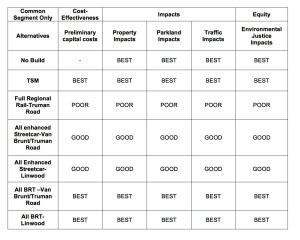
The consultants identified performance on the Common Segment, the section of the alignment where the two corridors come together and share the street or rail line, as a deciding factor in this level of evaluation.

Consultants evaluated the common segment for five items touching on three of the FTA perspectives.
Click To Enlarge

The “Poor” result in the common segment for Full Regional Rail is understandable if you consider the implications of running a large DMU (Diesel Multiple Unit) for miles on city streets and through neighborhoods. (See video  Discussion About The Regional Rail Alternative for the JCCCAA)  The DMU has the ability to run on freight lines as well as streets.

Last year TAN identified the Common Segment as the most challenging issue for the Regional Rail alternative. Once the rail leaves segregated rights-of-way and moves onto city streets many problems arise. (See Consultants Face Big Challenge Studying Regional Rapid Rail ).

For these criteria, TSM (Transportation Systems Management), which includes Enhanced Express Buses, and the BRT options look the best. However, there are additional criteria to be evaluated.

Eliminated

Full Regional Rail using a DMU on Truman Road or the Trench Embankment is eliminated.

Additional alternatives eliminated

All Rock Island Corridor Streetcar or BRT combinations with a DMU on the I-70 Corridor – These alternatives all require a forced transfer at the Truman Sports Complex. (See video about all eight combinations  Enhanced Streetcar/DMU/BRT Combinations Are Discussed). This issue affects four of the eight combination alternatives. (See combinations marked in yellow on  JCCCAA Modal Combinations Update March 2012)

Alternative at risk

The Enhanced Streetcar via Truman Road – Although in the common segment analysis the Streetcar via Linwood and the Streetcar via Truman Road look the same, the consultants said additional analysis suggests Linwood is a better choice than Truman Road. In the presentation, only the Linwood alignment is advanced to the next level of analysis at this point. (See combination marked in blue on JCCCAA Modal Combinations Update March 2012)

See Consultants JCCC AA March 2012 SAP Presentation. TSM including Enhanced Express Buses is included in the alternatives advancing for further evaluation although it isn’t listed on Slide 14.

Another Version of Rail Under Consideration

Since all of the original commuter rail alternatives using a DMU have been eliminated, another version of commuter rail that doesn’t use city streets or transfer at the Sports Complex is being re-considered.

In Tier One of the study the consultants looked at an alternative that kept the DMU on rail lines and went through the rail yard in the Northern Industrial District by the Missouri River before heading up to the River Market to Third St. and Grand Avenue.

This alternative was initially screened out in the Tier One screening because:

  • “This alignment has limited opportunity for stations, operates in a highly industrial area and constrained railroad environment. It is not as conducive to satisfying the project’s Purpose and Need as other options. “ (Stakeholder’s packet Nov 2011)

In 2007 this alignment, which goes through the Knoche rail yard, was studied for the I-70 corridor and rejected in the near term for commuter rail. Since then, significant changes have been made to that yard making it unsuitable for commuter rail. However, the Neff rail yard, which is slightly south of the Knoche rail yard, is being investigated for feasibility. If the consultants decide this alternative has potential they will add it for a Tier Two level analysis.

In this scenario, the rail alignment would stay on the Rock Island and KCS lines and come together in the vicinity of Rock Creek Junction, east of the rail yard. There are considerable challenges for this alignment including getting through the rail junction and the rail yard.

After discussions with both the consultant and MARC, here is the current situation:

Alternatives Eliminated

  • DMU using Trench or Trench Embankment
  • DMU on Truman Road (Full Regional Rail)
  • Alternatives that force a transfer outside of CBD (Central Business District

Alternative with significant challenges

  • Enhanced Streetcar via Truman Road

Alternatives advancing for further evaluation

  • TSM, including Enhanced Express Bus
  • Enhanced Streetcar via Linwood
  • BRT
  • Modal Combinations

Alternative receiving renewed consideration

  • DMU to River Market via rail yard (KCS and Rock Island)

Alternatives that are advanced in the study will go through further analysis such as ridership numbers, financial feasibility, constructability and economic development potential. Although everyone is impatient to get concrete numbers to compare alternatives, a study of this size would normally take a couple of years to complete and this study is being squeezed into a very short time frame. The consultants were only chosen in April of last year.

Project leader Shawn Dikes said Parsons Brinckerhoff is working to create a complete transit package, which would consist of the Locally Preferred Alternative (LPA) from this study as well as improved transit service to support the LPA. TAN feels it is extremely important to construct a complete transit package to take to the voters.

Besides the study update at the Stakeholders Advisory Panel meeting, there was a short talk by former Congressman Martin Frost about the Transportation Bill being debated in Congress.  He believes the final version will be similar to previous transportation bills, although the House Speaker is having a hard time getting his party to agree to a version that can pass the House. Michael Zuhl, a consultant with R&R Partners, gave a short talk about the transit education campaign for Jackson County.

The consultant team is pulling out all the stops to find the best alternative for commuters in Jackson County. They are trying multiple combinations of vehicles and lots of alternative alignments. Jackson County should feel comfortable that the process is working well and it should be happy to go to the voters with the Locally Preferred Alternative resulting from this study.

Proposed schedule

The Project Team met March 23 and County Executive Mike Sanders and Mayor Sly James went to Washington, D.C. to meet with officials about the transit initiatives underway. This level of cooperation and coordinated transit effort is unprecedented in our region.

Mid-April Stakeholder Advisory Panel

Late April – Public Workshop

4/27 Project Partnership Team meeting

5/25 Project Partnership Team Meeting

May/June – Public Workshop

Summer – Announcement of LPA

Posted in Local Transit Issues, Regional Transit Issue, Transit Studies | Tagged: , , , | Leave a Comment »

Great Bargain for JCT Commuters and A Step Forward for Seamless Transit

Posted by Transit Action Network on March 15, 2012


Two significant transit decisions are about to be implemented.
1.  Johnson County Transit (JCT) has decided to sell its monthly pass through its website.  The reported price is $67 (plus a small service fee), and sales begin in April for a May 1, 2012 start date. The JO Store

The JO will continue to sell its monthly pass to employers for re-sale to their employees.  Employers will continue to pay $63 per pass, and they generally discount the pass to their employees.

Availability of the monthly pass will be a significant cost saving for Johnson County commuters whose employers don’t sell passes.  Such commuters currently have to pay cash fares ($2.00 each way, or $88 for a 22-workday month), or use 10-ride passes ($18.00 for 10 rides, or $79.20 for a 22-workday month).

 2.  Kansas City Area Transportation Authority (KCATA) will accept the JCT monthly pass on all regular Metro buses (excluding premium-priced commuter routes). KCATA and JCT will allocate revenue from the JCT pass between themselves based on usage.  JCT monthly passes will be accepted on Metro buses beginning May 1, 2012.

Anyone can purchase the JCT monthly pass online to use on either system.

TAN advocates have worked for Seamless Transit for many years, and this development is clearly a step in the right direction.

The advantage to Johnson County residents is obvious: they can use Metro buses during the day for lunch trips or errands, or to get closer to home (e.g. to the Plaza or Waldo) before calling a family member, a friend, or a cab when they work late.  What’s more, Johnson County riders can drive to a Missouri location (such as Waldo) and use Metro buses to reach Missouri attractions on weekends.  (A free ride on a Metro bus compares favorably with a $30 parking fee for a Sprint Arena event.)

Missouri and Wyandotte County residents who also need to use The JO will have the option of purchasing the JCT monthly pass.  These riders will need to evaluate whether their savings will justify the higher up-front cost of the JCT monthly pass.  Riders who use transit only for commuting now pay $3.50 per day in cash fares ($1.50 going to work, $2.00 to return), or $77 per 22-workday month.  A rider who needs to be able to use Metro buses all week as well as commute to Johnson County currently pays $94 for a 22-workday month ($50 Metro pass plus $44 in cash fares on The JO).

Although JCT and KCATA have accepted each other’s transfers for several years, neither system has accepted the monthly bus pass of the other system until now.  The JCT monthly pass will be accepted on Metro buses but the Metro $50 monthly pass will not be accepted on JCT buses, mainly due to the large price difference. (Metro pass users may not know that they can ask for “a transfer to The JO” when they board.  KCATA normally does not issue transfers to its monthly pass users.)

The JCT monthly pass sale through their website and KCATA acceptance of the JCT monthly pass are positive steps toward Seamless Transit. Well over 500 JCT monthly pass holders will get automatic access to the extensive (7 days a week, 20 hours per day, service to five counties) Metro system at no additional cost.

Due to the large fare differential between the two systems and limited service provided by JCT, it will be interesting to track the sales numbers for the JCT monthly pass to see:

  • how many passes are sold to riders outside of Johnson County
  • what percentage of morning commuters from Kansas City to Johnson County use the JCT monthly pass (this direction is considered a reverse commute).

Transit Action Network welcomes a victory for Seamless Transit and will work to make sure that:

  • Metro riders are aware of their new option for access to The JO
  • JO riders make good use of their new access to the Metro system beginning May 1.

Posted in Local Transit Issues, Regional Transit Issue, Seamless Transit | Tagged: , | 1 Comment »

Enhanced Streetcar/DMU/BRT Combinations Are Discussed

Posted by Transit Action Network on February 24, 2012


The Partnership Team and consultants added eight additional alternatives to the Jackson County Commuter Corridors Alternatives Analysis (JCCCAA).  In the final interview of this series, Lisa Koch, senior planner with the lead consulting team Parsons Brinckerhoff, discusses these alternatives which include various combinations of three transit modes; Enhanced Streetcar, Diesel Multiple Unit (DMU) and Bus Rapid Transit (BRT). Maps of all the combinations are available below.

Lisa also describes the traffic control elements being planned for an Enhanced Streetcar to travel on the streets and how these elements differ from the ones used by the Regional Rail DMU alternative discussed in the previous interview.

For a closer look at the display board Lisa uses during the interview, see JCCCAA display-board-nov 2011 or print page 11 of the second open house display boards. JCCCAA-open-house-display-boards-nov 2011

Summary of JCCCAA Streetcar/DMU/BRT combinations being studied

Click to enlarge

Maps of all the Streetcar/DMU/BRT Combinations

A. Enhanced Streetcar/DMU – Linwood Alternative

B. Enhanced Streetcar (ALL) – Linwood Alternative

C. Enhanced Streetcar/DMU – Truman Road Alternative

D. Enhanced Streetcar (ALL) – Truman Road Alternative

E. BRT/DMU – Linwood Alternative

F. BRT (ALL) – LinwoodAlternative

G. BRT/DMU – Truman Road Alternative

H. BRT (ALL) – Truman Road Alternative

An alternatives analysis requires a substantial amount of work to evaluate the possible transit solutions for a corridor. The analysis includes a complex comparison process to decide which alternative is the best fit for our region at this time. Lisa has agreed to visit with TAN again to update us on status of the study and provide insight into the FTA process used to rate the alternatives.

TAN appreciates Tom Gerend of MARC and Lisa Koch of Parsons Brinckerhoff, along with Shockey Consulting and TranSystems, for making all of this information available to our viewers.

The next open house is March 13 -15 going to be re-scheduled.

Traffic Control Elements for RAIL on Streets in the JCCCAA

Link to the first interview: MARC And Parsons Brinckerhoff Discuss The Current Status Of The Commuter Corridors Altenatives Analysis

Link to the second interview: Parsons Brinckerhoff Consultant Discusses Three Alternatives In The JCCCAA

Link to the third interview: Discussion About The Regional Rail Alternative for the JCCCAA

Project website:  KCSmartMoves

Posted in Local Transit Issues, Rail, Regional Transit Issue, Transit Studies, Videos-Transit | Tagged: , , , | Leave a Comment »

Discussion About The Regional Rail Alternative for the JCCCAA

Posted by Transit Action Network on February 20, 2012


In the third of our four interviews, Lisa Koch, senior planner with Parsons Brinckerhoff, discusses the Regional Rail alternatives for the Southeast Corridor (the unused Rock Island line through Raytown and Lee’s Summit) and the Eastern I-70 Corridor (the underutilized Kansas City Southern line through Blue Springs).

Diesel Multiple Unit -DMU

Lisa describes the routes being considered, along with traffic control elements that would be required by the Federal Railroad Administration for a Diesel Multiple Unit (DMU) train to use new rail on the streets of Kansas City and Independence to reach a commuter rail terminal in the Freight House District, north of Union Station.

For a closer look at the display board Lisa uses during the interview, see JCCCAA display-board-nov2011 or print page 11 of the second open house display boards. JCCCAA-Open-House-Display-Boards-Nov2011


Following is the proposed map for the Regional Rail system being studied in the Southeastern and Eastern Corridors of Jackson County. MP (Mile Point) is the distance in miles from Union Station.

Click To Enlarge


Details of all the alternatives are changing as the study continues.

The Jackson County Commuter Corridors Alternatives Analysis is scheduled for completion in late Spring 2012.

Our fourth interview, covering combinations of streetcars, DMU and BRT, will be posted later this week.

Link to the first interview: MARC And Parsons Brinckerhoff Discuss The Current Status Of The Commuter Corridors Altenatives Analysis

Link to the second interview: Parsons Brinckerhoff Consultant Discusses Three Alternatives In The JCCCAA

Posted in Local Transit Issues, Rail, Regional Transit Issue, Transit Studies, Videos-Transit | Tagged: , , , | Leave a Comment »

Parsons Brinckerhoff Consultant Discusses Three Alternatives In The JCCCAA

Posted by Transit Action Network on February 17, 2012


Lisa Koch, a senior planner with the lead consulting firm for the study, Parsons Brinckerhoff,  discusses three of the alternatives being studied in the Jackson County Commuter Corridors Alternatives Analysis (JCCCAA) with Transit Action Network.

No Build

Transportation Systems Management

Enhanced Express Bus (part of TSM)

Lisa also describes the travel demand model used to estimate ridership for each mode in the study’s forecast year of 2035.

The study is in the second phase, called Tier Two, where a detailed analysis of the remaining alternatives is conducted and the alternatives are narrowed down to come up with a Locally Preferred Alternative (LPA). The study is scheduled to be completed in late Spring 2012.

http://vimeo.com/36946225

This map is the current proposed map of the Enhanced Express Bus System. It has different colors to represent the different express bus services being considered. Some services are new. PR stands for Park and Ride lots. The map is subject to change.

In 2007 there was an I-70 Commuter Corridor Alternatives Analysis (AA).  In the Summary Report the consultant’s near-term recommendation was to improve the Express Bus system. The AA also studied the underutilized Kansas City Southern (KCS) Railroad line. In that study, the KCS line traveled to the Knoche Rail Yard and then new rail  was needed from there (near the Missouri River) up to Third St. and Grand.  In another variation the KCS line connected to the Trench, the Kansas City Terminal Railroad tracks that run past Union Station. Neither of those rail alternatives were recommended in 2007 and both of those options were eliminated from the current study in the Tier One evaluation.

Link to the first interview: MARC And Parsons Brinckerhoff Discuss The Current Status Of The Commuter Corridors Altenatives Analysis

Posted in Local Transit Issues, Rail, Regional Transit Issue, Transit Studies, Videos-Transit | Tagged: , , , | Leave a Comment »

MARC And Parsons Brinckerhoff Discuss The Current Status Of The Commuter Corridors Altenatives Analysis

Posted by Transit Action Network on February 15, 2012


Last week Transit Action Network sat down with Tom Gerend, Assistant Director of Transportation and Project Manager at Mid-America Regional Council (MARC), and Lisa Koch, Senior Planner with Parsons Brinckerhoff,  in a series of four video interviews to discuss the Commuter Corridors Alternatives Analysis currently underway in Jackson County.

MARC is on the Partnership Team overseeing the study and Parsons Brinckerhoff is the lead consulting firm conducting the study.

Transit Action Network believes this is a good time to bring everyone up to date since the last public open house was the end of November 2011. The next open house won’t be held until after the Stakeholders Advisory Panel on March 6. (update-the third open house will be March 13-15 rescheduled)

These interviews provide background on the study as well as the current information about the three corridors and the multitude of alternatives being studied.

Keep in mind that none of the alternatives have been chosen to implement at this point and the situation changes as new information becomes available and decisions are made. Since the last open house, more analysis has been done and another alternative has been eliminated. Consultants and engineers continue to look for the best solutions to challenges presented by the options.

Join us on this first interview with Tom for an introduction to the series and background on the study.

The study website is KCSmartMoves.org

Posted in Local Transit Issues, Rail, Regional Transit Issue, Transit Studies, Videos-Transit | Tagged: , , , | Leave a Comment »