Transit Action Network (TAN)

Advocates for Improved and Expanded Transit in the Kansas City Region.

State Ave. Connex Open House-AUG 10

Posted by Transit Action Network on August 6, 2011


Attend the second open house for the State Avenue Connex Transit Improvement Project and learn about the exciting transit improvements being made.

Where: Unified Government Neighborhood Resource Center (4601 State Avenue, Suite 84) in Kansas City, KS. The center is located in the lower level of Indian Springs Mall. Access is available from the southeast entrance.  (Route information to the open house)

When: 3 to 5:30 p.m. on Wednesday, August 10, 2011

More than $10 million in transit improvements are being made on the Minnesota/State Avenue route in Kansas City, Kansas.  Over the next two years commuters will benefit from the enhancements on this major east-west route in Wyandotte County. State Avenue links jobs, neighborhoods and activity centers from Kansas City’s urban core to newer development in the Village West area. These improvements are being paid for through the federal government TIGER grant.

For more route information and schedules, log on to http://www.kcata.org or call 816-221-0660 from 6 a.m. to 7 p.m. on weekdays.

Questions?

Keith Sanders, Project Manager
Kansas City Area Transportation Authority
816-346-0359
ksanders@kcata.org
http://www.kcata.org

Emerick Cross, Interim Transit Manager
Unified Government Transit
913-573-6784
ecross@wycokck.org
http://www.wycokck.org

Posted in Events, Local Transit Issues | Tagged: | Leave a Comment »

Meet the TIGER

Posted by Transit Action Network on August 4, 2011


Mid-America Regional Council (MARC) is producing a video series about how our bi-state area is using the federal TIGER grant we received.

TIGER (Transportation Investment Generating Economic Recovery) grants were born out of the recession. TIGER is a national discretionary and competitive grant program of the U.S. Department of Transportation funded by the American Recovery and Reinvestment Act. The Kansas City bi-state region received $50 million in federal funds for transportation infrastructure projects along several regional transit corridors and in the Green Impact Zone in Kansas City, Mo. David Warm, MARC director, says these investments will improve sustainability, competitiveness and position us for success in the 21st century economy.

The series will be produced over the next few years to document the Kansas City regional TIGER improvements.

View the TIGER Introductory Six-Minute Video on the MARC website or YouTube. Future videos are expected to be shorter and focus on individual projects, event/activities and interviews.

To monitor our regional TIGER grants visit the MARC TIGER website or track the 120 projects funded by this grant.

Congress is making a third round of TIGER grants available. These grants are replacing a lot of earmarks. MARC will probably prepare a TIGER III application and potential submissions are being discussed.

Posted in Local Transit Issues, National Transit Issues, Regional Transit Issue | Tagged: | Leave a Comment »

How Our Region Should Respond to the Brookings Report

Posted by Transit Action Network on July 22, 2011


The recent Brookings Institute report on transit access to jobs, “Missed Opportunity: Transit and Jobs in Metropolitan America,” was released more than two months ago.  It ranked our region 90th out of the top 100 urban regions in our ability to get people to jobs by transit.  That got the attention of many of the region’s leaders — at least for a couple of weeks.

Some might quibble with the study methodology (and Brookings would probably admit to some flaws), but we can all agree that the current transit network doesn’t do a very good job of getting people to jobs here in the Kansas City region.

The question is: What do we do about it?

It’s obvious that the region needs to invest more in transit.  We already knew that.  Missouri invested only $119,000 in the KCATA last year, compared with the $10’s of millions that many other states with large urban areas invest in their transit systems. Even Kansas invests more in its urban transit systems than does Missouri.

But we don’t just have just a transit problem, we have a job sprawl problem.  New employment keeps getting scattered out on the edges of our region in places that are beyond the current transit network and would be costly to serve by transit.

Our region’s economic development people apparently give little or no consideration to transit availability when they try to attract new employers, and competing local jurisdictions seem to fall all over themselves to hand out tax breaks — again, without considering transit availability.

We’ve known for a long time that two-thirds of transit riders are going to work, or going in search of work.  The Brookings report helps to re-frame the transit issue as one of equitable access to jobs and other opportunities.  People who need and want jobs often can’t get to them — can’t even get to a job interview — because they don’t have a reliable car and transit service is lacking.  The situation is just going to get worse in the future as gas prices continue their upward trend and more people need to turn to transit.

Mid-America Regional Council and the transit agencies are actively engaged in many transit studies and projects: the Smart Moves Transit Plan, Downtown and Commuter Corridor  Studies, and investments to make additional corridors “BRT-ready”. These are all good, but Transit Action Network’s impression — and we hope we’re wrong — is that the region doesn’t intend to do much more than it is already doing.  Unfortunately, that isn’t enough to rectify the problems identified in the Brookings Report.

Moreover, MARC and the transit agencies can’t do everything that’s needed.  City and county public officials must be aware of the problem, must take it seriously, and must implement many of the necessary steps.

Transit Action Network makes the following recommendations to the region’s leadership:

1 – Identify the 500 largest job locations (including major “opportunity locations” such as health care, shopping, higher education) in the region, measure how well our transit network serves those locations, promote better transit service to these locations where needed, and track how we improve the situation over time.

2 – Track local, state and federal money used to operate our public transit systems over time, adjusted for inflation.

3 – Publish an annual “Transit Access to Opportunities Report Card” based on the information gathered, and share it with elected officials and the public.

In addition to collecting and reporting data:

4 – Continue to work for additional transit funding.

5 – Impress upon local and regional economic development people, as well as local public officials, the importance of guiding development to existing “activity centers” and transit-served corridors when new employers are courted, or when current employers relocate. That’s called for in our region’s policy on new development, and it requires a new kind of “affirmative action” by local jurisdictions to make sure it happens.

6 – Identify transit friendly land use and zoning policies, and provide municipalities with appropriate templates to assist in adopting such policies.

7 – Discourage public subsidies or incentives for employers who locate beyond the reach of public transit.

8 – Work with state, federal, and private organizations involved with the financing of multi-family housing to make sure it’s located near employment and transit.

9 – Improve coordination of services currently provided by our three transit providers to make using transit more “seamless” for transit riders.

If the Kansas City region is to avoid falling behind in its struggle to compete with other cities, we must place higher priority on getting people to jobs by transit.

Posted in Local Transit Issues, Regional Transit Issue | Tagged: | Leave a Comment »

Open House in Independece July 19 and July 23 -Potential Transit Alternative

Posted by Transit Action Network on July 19, 2011


The Independence City Council Transit Committee is seeking public input on the potential changes to the transit system.

Open House meetings for the Potential Transit System will take place on:

  • Tuesday, July 19, 2011
    • 2:30 pm to 4:30 pm at Noland Road Baptist Church, 4505 S. Noland Road
    • 5:30 to 7:30 at Hawthorn Place Apts Gymnasium, 16995 Dover Lane
  • Saturday, July 23, 2011
    • 1:30 pm to 3:30 pm at Palmer Center, 218 A North Pleasant Street

There are no cuts planned to the current service.

The goal is to:

  • Improve Efficiency of Resources
  • Increase Ridership
  • Improve Access to Public Facilities
  • Increase Opportunities to Shop Local
  • Improve Access to Employment

Take the online survey or print the  Potential Transit System survey and mail it. You can listen to a detailed description of the changes on the website.  Independence Open House

Posted in Events, Local Transit Issues | Tagged: | Leave a Comment »

Johnson County Transit Open House – July 19

Posted by Transit Action Network on July 18, 2011


Johnson County Transit is having an open house, to present the transit investments along  Metcalf Avenue and Shawnee Mission Parkway that are being funded by the federal government  Transportation Investment Generating Economic Recovery (TIGER) Grant.

  • When: Tuesday July 19
  • When: 5 to 7 pm
  • Where: Matt Ross Community Center at 8101 Marty, Overland Park, KS 66204

Significant improvements will be made to passenger facilities in this transit corridor as well as improving the transit signal priority system.  The project will include:

  • Eighteen transit stations;
  • Two park-and-ride facilities;
  • Pedestrian access improvements along Metcalf Avenue from 87th Street to College Boulevard;
  • Pedestrian access improvements at Broadmoor and Martway;
  • A transit signal priority system, which will improve bus movement, timing and efficiency; and
  • A transit center adjacent to Mission’s downtown, to support existing transit service and future local bus service.

Representatives from Johnson County Transit (JCT), the cities of Overland Park, Mission and Roeland Park and project team members will be available to answer questions.

Open House Invitation

TAN hopes that these improvements will encourage Johnson County to devote more money to additional transit services.

Posted in Events, Local Transit Issues | Tagged: | Leave a Comment »

GSA and EPA Make A Bad Move

Posted by Transit Action Network on July 16, 2011


As transit advocates the hypocrisy of the local General Services Administration (GSA) and local Environmental Protection Agency (EPA) to move the Region 7 EPA offices from downtown Kansas City, Kansas to a building in Lenexa, Kansas is almost unbearable.

The EPA facility is moving from a transit rich location in a city center in the middle of the region to an extreme western suburb with a deplorable level of transit service.

Keep in mind that the decisions around this move were made locally and deliberately. This move is not the decision of some bureaucrat in Washington, D.C. who doesn’t know the difference between Kansas City, KS and Kansas City, MO. The GSA office is local. They knew that leaving the current EPA facility meant they would leave downtown Kansas City, Kansas since there isn’t another qualified building for the EPA needs in that vicinity.  Deciding to stay in Kansas meant they would move to the suburbs. Although the GSA Solicitation For Offers has a “city center neighborhood” location option, this was a false choice since they eliminated that possibility by not allowing Missouri to compete. They had just failed after three years to negotiate a new lease with the only qualifying building in a city center in Kansas. Unless the bid submission for the current EPA building changed drastically from earlier negotiations, they were on their way to the suburbs.

Even if the area is stuck with this result we should complain to the heads of the GSA and EPA and tell them to get their internal house in order and instruct their employees to abide by government goals, priorities and Presidential Executive Orders. Federal facilities are supposed to be located in sustainable locations in sustainable communities. According to a government website sustainable communities are places that have a variety of housing and transportation choices with destinations close to home.

The local GSA office made the worst location decision possible.

 When the GSA couldn’t find enough qualified bidders close to the Science and Technology lab in KCK they extended the search area from the lab and limited the search to Kansas. They had to go out 20 miles to even include this Lenexa building. Google transit calculates a 20-21 mile drive to this building from the science lab.  This was the wrong decision.

It is common knowledge in this region that the EPA used to be located in Missouri. It was moved from Missouri to downtown Kansas City, Kansas apparently due to congressional pressure to help revitalize downtown KCK. (Timeline)

The GSA says they had congressional approval to extend the search distance and stay in Kansas, However, the local GSA made this determination and then submitted it to Congress for approval and received this reply, “The GSA Contracting Officer was directed to consider the expansion approved if Congress had not responded by Dec. 16, 2009. No inquiry from Congress was received.” EPA Regional Office Background April 20, 2011. So they got permission for this search area by default.

TAN believes if the rationale for being in KCK is abandoned then the reason to limit the search to Kansas is void and Missouri should have been included in the central business district search. In this case, there may not have been a need to extend the distance out to the extreme western suburbs of the region.

The federal government agrees with this position. Presidential Executive Order 13514 on Federal Leadership In Environmental, Energy, and Economic Performance clearly states federal facilities should “Operate high performance sustainable buildings in sustainable locations” and ensure “that planning for new Federal facilities or new leases includes consideration of sites that are pedestrian friendly, near existing employment centers, and accessible to public transit, and emphasizes existing central cities …”

Executive Order 13514 had been in place for over a year when the GSA Solicitation For Offers (SFO) for a new location was released. Previous executive orders covering sustainability issues have been in effect since Nixon. What happened here doesn’t appear to abide by either the letter or the spirit of the Order by either the local GSA or the local EPA.

 Although the EPA didn’t make the decision to move, and they don’t contract to lease buildings for federal facilities, EPA isn’t blameless. The EPA Program For Requirements document and the GSA Solicitation ignored Executive Oder 13514 and ignored sustainable communities and sustainable locations. The EPA document even fails to list their Office for Sustainable Communities.  (EPA “Program Requirements” starts on page 83 of the Executed Lease Agreement)

GSA has added a page to its website regarding this move and its commitment to Executive Order 13514. It states “GSA has enthusiastically embraced that direction “, but cost was a bigger factor. This contains only a kernel of truth. Sustainable buildings have been enthusiastically embraced.  However the evidence shows there was no mention of sustainable communities or locations in either the GSA or EPA “Sustainability” section of their documents. They didn’t even pretend to abide by this part of the Presidential Executive Order. Of course lower bids can be obtained if major factors are left out of the solicitation.

Transit Situation

 The building at 11201 Renner Boulevard, Lenexa doesn’t qualify as a sustainable location.

 The transit situation at this location is awful. Either the buses don’t cover a long enough workday or they are too far away. If you are disabled and can’t drive or afford a $50,000 specially equipped van, you may not be able to get to work. Area ADA transit services either don’t go to Lenexa or are already overbooked. Add to this the fact that the buses are so slow hardly anyone uses them.

GSA says that less than 5% of the EPA employees use public transit. They aren’t counting all of the public transportation services. Another 75 people use the KCATA vanpool service, AdVANtage. Johnson County Transit (JCT) doesn’t have a vanpool program. So between the buses, vans and ADA public transportation services provided by KCATA and Unified Government Transit (UGT) that is closer to 100 of the 670 employees, or 15%. That is a significant number of employees who are going to lose their public transportation options.

Johnson County, where Lenexa is located, is basically a “transit desert” except for some commuter routes into downtown KCMO and the K-10 Connector to Lawrence, KS. The lack of transit service and the job sprawl in this part of the metro area are the main reasons that Kansas City rated 90 of 100 in the recent Brookings Institute report on job accessibility in the top 100 cities. JCT has no money to start new services, even though they are located in one of the richest counties in the US, but they may be able to change the routes to be closer to the facility.

Lenexa will benefit significantly if the EPA relocates there. TAN would like to see Lenexa step forward to support increased transit funding in Johnson County to improve the transit situation.

The cost issue

GSA cites the cost difference as the major reason for the choice of the new location. Of course everyone wants to save the government lots of money. However in this economic climate there is every reason to believe that a facility in Missouri, in the city center and much closer to the Science lab, could have made a comparable offer. We won’t know though since the GSA eliminated that possibility.

 Conclusion

We can’t turn back the clock and have GSA and Urban America, the owner of the current EPA building in Kansas City, Kansas, agree to a lease. Unfortunately the lease for the Lenexa building was signed April 4, 2011. (Executed Lease Agreement)

Urban America has filed an official bid protest with the General Accountability Office (GAO) Bid Protest Forum. By July 25, 2011 the GAO has to rule on whether federal procurement law was violated. The GAO bid protest process can only result in a recommendation. Since the contract has been signed even if Urban America wins the bid protest, the likely outcome would be a recommendation to pay Urban America for the cost of the bid process. (Timeline)

There is a terrible irony to moving the EPA and the Region 7 Sustainable Communities Office to this new location. How can government agencies move employees to a location that undermines what they stand for and the work they are committed to do?

TAN believes that the federal government must lead by example as stated in the Executive Order. The federal government should not add to the job-sprawl in Johnson County in direct conflict of a Presidential Executive Order, especially when there was such an obvious alternative by allowing Missouri facilities to compete.

Even if the GSA is not found guilty of breaking the law it doesn’t mean we shouldn’t complain to keep this from happening again.

Contact the EPA and GSA to let them know what you think about their actions and tell them both locally and in Washington, D.C. to implement the “Recommendations  for Sustainable Siting of Federal Facilities”.

 GSA

Washington D.C.- Administrator of the General Services Administration, Martha N. Johnson (202) 501-0800  martha.johnson@gsa.gov

Two special email addresses have been established to collect comments about this move: Washington D.C. office kc-epa@gsa.gov, Local office kansasepa@gsa.gov

EPA 

Washington D.C.- Administrator for the Environmental Protection Agency, Lisa P. Jackson jackson.lisap@epa.gov

Local EPA Office Phone: (913) 551-7003, Region 7 EPA Regional Administrator – Karl Brooks x7303  Brooks.Karl@epa.gov

Additional reading – Kaid Benefield’s blog http://switchboard.nrdc.org/blogs/kbenfield/epa_region_7_we_were_just_kidd.html

Posted in Action, Local Transit Issues, National Transit Issues, Regional Transit Issue | Tagged: | Leave a Comment »

Please Comment on the Downtown Corridor (Streetcar) Alternatives Analysis

Posted by Transit Action Network on June 28, 2011


More than 100 people attended the first open house for the Downtown Corridor Alternatives Analysis. However if you missed the open house you can still see the presentation and the maps, and include your comments about the study.

See the first presentation  DCAA Overview-Presentation1

These are the various alignment alternatives being considered for the streetcar.

A.”Bi-directional” options – both tracks running north and south on a single street.

Grand Avenue

Walnut Street

Main Street

Baltimore Avenue

A reason to use single streets is expressed in the Nelson/Nygaard Comprehensive Service Analysis currently underway for the KCATA bus system.

“Routes should operate along the same alignment in both directions to make it easy for riders to know how to return to their location of trip origin. All routes should operate along the same alignment in both directions, except in cases where such operation is not possible due to one-way streets or turn restrictions.”

B. “Couplet” options – one direction runs on one street while the other direction runs on an adjacent street. All couplet options contain streets that are currently configured for two-way auto traffic (in whole or just sections).

Grand/Walnut Couplet

Main/Walnut Couplet

Main/Baltimore Couplet

A reason to use couplets, when not necessary due to street constraints, is for the potential of greater economic development. Many people see rail as an engine of economic development and if the route is split onto two streets then it may generate additional development.

South of 20th Street, all streetcars run on Main or Grand. Baltimore options divert to Main at 10th Street. The River Market is a large loop in all scenarios.

View the maps for the various alignments. DCAA-Alignment-Alternatives-Map

COMMENT FORM: Be sure to fill out a comment form about the plan.

Visit KCSmartMoves to keep up-to-date with the study.

Posted in Action, Local Transit Issues, Rail, Transit Studies | Tagged: , | Leave a Comment »

KCATA Board to Consider Draft Transit Service Guidelines

Posted by Transit Action Network on June 19, 2011


As part of its Comprehensive Service Analysis (CSA), KCATA and the Nelson Nygaard team have developed proposed service guidelines for KCATA “Metro” transit services.  This is a draft report and subject to change, yet it is developed to the point that the study team is presenting it to the Board of Commissioners on June 22.

From the Board Briefing:

The service guidelines are intended to aid KCATA in designing route service, setting appropriate service levels, establishing minimum levels of service performance, and continuously evaluating route performance.   

In the context of the CSA, the proposed service guidelines will also serve as a primary tool in developing recommended service plans and educating riders and stakeholders about the plan and route design principles.

At the June 22 KCATA Board Meeting staff will provide an overview of the draft transit service guidelines.

In the near future there will be an opportunity for public comment. In the meantime you can read the draft here.  KCATA CSA Draft Transit Service Guidelines June 2011

Posted in Local Transit Issues, Transit Studies | Tagged: | Leave a Comment »

June 21 – First Open House for Downtown Corridor (Streetcar) Alternatives Analysis

Posted by Transit Action Network on June 13, 2011


June 21, 2011: The partnership team for the Downtown Corridor Alternatives Analysis will hold the first public open house to learn about the study and alignment alternatives for a possible starter line. The open house is between 4-6:30 pm in the Helzberg Auditorium at the Central Branch of the Kansas City Public Library at 10th and Main. Short, identical presentations will be given at 4:30 and 5:30 p.m.

Read the news release: Open house scheduled for Downtown Corridor Alternatives Analysis

Comment or RSVP at the FACEBOOK event page: Downtown Corridor Alternatives Analysis Open House #1

The partnership team has set up a Downtown Corridor Alternatives Analysis webpage. Under Study Materials get the FAQ and Fact Sheet #1 which includes a map.

Posted in Events, Local Transit Issues | Tagged: , , | 1 Comment »

June 13 – WHY KC Region Ranked 90th of 100 and What To Do About It

Posted by Transit Action Network on June 8, 2011


The MARC TRANSIT COMMITTEE is sponsoring a Special Forum to present the study and the findings on the Brookings Institution Report

Presenter: Brookings’ co-author Elizabeth Kneebone

When: June 13 at 1:30 pm

Where:  Kauffman Foundation Conference Center, Paseo Room-changed to Town Square Room, 4801 Rockhill Road. Kansas City, Mo 64110

This forum will focus on the report Missed Opportunity: Transit and Jobs in Metropolitan America which ranks the top 100 cities for transit access to jobs. Following the presentation, there will be an open discussion on current transit initiatives and the crafting of a regional response to this report. This meeting is open to the public.

Brookings divided the metro area into the CITY and the SUBURBS. The CITY is defined as both the city of Kansas City and the Unified Government of Wyandotte County. Everything else in the metro is the SUBURBS. Unfortunately the suburbs in their study go so far out that a lot of rural area is included.

The report evaluates the ability of people within ¾ mile of a transit stop or station to get to work in 90 minutes using public transit. Brookings is measuring if transit is even possible to take to work. We don’t fully agree with Brookings approach, for instance many people in the suburbs who live farther than ¾ mile from a transit stop have transit access to work using park and ride lots.

Even with our concerns about the report, it does point out the seriousness of our transit situation. 80% of the CITY has transit coverage but only 25% of the jobs in the metro area are accessible by that transit. The report says only 33% of the suburbs have transit coverage but only 10% of all jobs are reachable by transit in 90 minutes from the suburbs. The overall KC job access rate for the metro area is calculated at 18%.

Of course the biggest question is how will the region use this information to better serve the needs of the community with transit.

TAN doesn’t agree with the Brookings ranking, and we can certainly quibble with their methodology, but we can all agree that our transit-to-jobs situation needs work.  While we don’t have all the answers, we do have some thoughts about tentative actions:

  • Additional funding for transit is needed
  • A set of relevant and objective local measures are needed to track our future progress in making transit available to more people
  • Since it will take more than “throwing money at transit” to achieve these ends, such as providing a transit option to more of the region’s residents for access to jobs and other opportunities, it will take deliberate attention to where future development is located, especially when public incentives are involved.
  • Although there are notable improvements recently, continued efforts are needed between the transit providers to provide a seamless transit experience for riders.

This forum is open to the public and if you are interested in transit please come take part. TAN will be present to make sure we understand WHY we rated so low and to help develop a response.

Multiple comments and criticisms relating to the new transit report are showing up in the media and on the blogs including TAN’s article last week. You may find them interesting reading. One item that seems to drive several bloggers crazy is that New York didn’t come out on top and it was beaten by some small cities. Honolulu came out number one.

Nate Silver’s Five Thirty Eight column in the New York Times

On the Economics of Mass Transit and the Value of Common Sense

Brookings has responded to Nate’s comments with further explanations about the report. New York has a great transit system but not everyone in the suburbs has access which lowered its ranking.

Maintenance on Silver’s Transit Line by Alan Berube and Robert Puentes

Other commentaries

Kaid Benfield on the NRDC staff blog

Warning: transit data may not mean what you think they mean

Richard Layman from Urban Places and Spaces

The weird findings on transit from the recent Brookings Institution

Noah Kazis on Streets Blog

Do 12 American Regions Have Better Transit Access Than NYC? Doubtful.

Alon Levy on Pedestrian Observations

Brookings Folly

Posted in Events, Local Transit Issues, Regional Transit Issue | Tagged: , , , | Leave a Comment »

A Transit Adventure to a Movie Musical and Art Museum

Posted by Transit Action Network on June 6, 2011


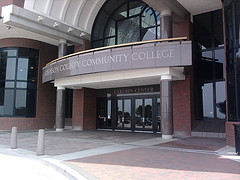
Carlsen Center at JCCC

You are looking for a classic movie musical for free. You want to visit a free beautiful art museum.  You want to use Johnson County Transit (AKA “The JO”) to get there. Here is the “Transit Adventure to a Movie Musical and Museum” deal for you!

Art work at Yardley Hall

Johnson County Community College is offering a free Wednesday morning film series during June at Yardley Hall in the Carlsen Center on campus.  Films begin at 10:00 am.

The films are:

June 8 – Kiss Me Kate

June 15 – Gigi

June 22 – Bye Bye Birdie

June 27 – West Side Story

Art work in the Nerman Museum "Some/One"

More information: JCCC Summer Movie Musicals

After the movie you can enjoy the art work on display just a few steps away at the Nerman Museum of Contemporary Art.

Have lunch at Cafe Tempo at the Nerman, or at the food court in the Student Center, and explore the campus.

The "Tired Beast" at JCCC

Sure, you could drive there, but we encourage you to give The JO a try.

Since we want to encourage transit ridership throughout the region, here are sample itineraries from locations in Missouri:  Crown Center, The Plaza, and Waldo:

Crown Center

Depart from the bus shelter at 2345 Grand (NE corner of Pershing and Grand) via Route 660(A) at 7:45 or 8:15 am.  Use your Metro transfer or pay $2.00 cash fare.

Arrive at Carlsen Center 75 minutes later, in plenty of time for coffee and the movie.

Depart from Carlsen Center via Route 660(A) at 3:05, 3:35, or 4:00, arriving at 2345 Grand about 68 minutes later.

Plaza

Depart from Northbound MAX stop next to Tennis Courts via Route 556 at 7:53 am. Use your Metro transfer or pay $2.00 fare.  Arrive at 6000 Lamar Transfer Center about 20 minutes later and transfer to Route 660(A) at 8:22 am.

Arrive at Carlsen Center in plenty of time for coffee and the movie at 10:00.

Depart from Carlsen Center via Route 660(A) at 4:00.  Pay $2.00 cash fare and ask for a transfer.  Arrive at 6000 Lamar in time to transfer to Route 556(H), departing from 6000 Lamar via Route 556(H) at 4:45 pm and arriving at Plaza about 17 minutes later.

Johnson County Transit Route 575 connects with KCATA's MAX at Waldo

Waldo

Depart from Waldo MAX stop at 74th and Broadway at 7:35 am.  (Note: This is a small bus.)  Use your Metro transfer or pay $2.00 fare.

Arrive at Carlsen Center in plenty of time for coffee and the movie at 10:00.

Depart from Carlsen Center via Route 875 at 12:11 or 1:41 pm, and arrive at Waldo MAX stop about 70 minutes later.

Fares

Regular fares are $1.50 (Metro) and $2.00 (The JO).  We suggest you use MAX or another Metro route to reach the above departure points.  Pay the regular Metro fare, ask for a transfer, and use that transfer to board the JCT bus for your trip to JCCC.  For the return trip in the afternoon, pay the regular $2.00 fare and use your transfer to board MAX or any other Metro bus.

Map of transit service to and from JCCC

Verify times or check other departures at TheJO.

Give it a try.  And let us know how it went. TransActionKC@gmail.com

Posted in Transit Adventures | Tagged: | Leave a Comment »

Central Europe and London-Part 2-Prague

Posted by Transit Action Network on June 1, 2011


Prague Hlavni Nadrazi main train station

Prague, Czech Republic- (city population 1.3 million, density 6,771 inhabitants/ sq. mi., metro population 2.3 million -KCMO-density 1538.4 inhabitants /sq. mi (2010))

Budapest Keleti Station

The only rainy day on our trip was spent taking the express train from Budapest’s Keleti Station to Prague’s Hlavani Nadrazi Station. This is central Europe so this wasn’t high-speed rail, but as an express train it didn’t have a lot of stops. This train took 7 hours to cover 275 miles. We purchased our tickets online at RailEurope before we left home. We had a 1st class compartment and since it was low season we had it all to ourselves. It was great to be in a comfortable train all day watching the geography and agriculture of Hungary, Slovakia and the Czech Republic go by on a rainy day.

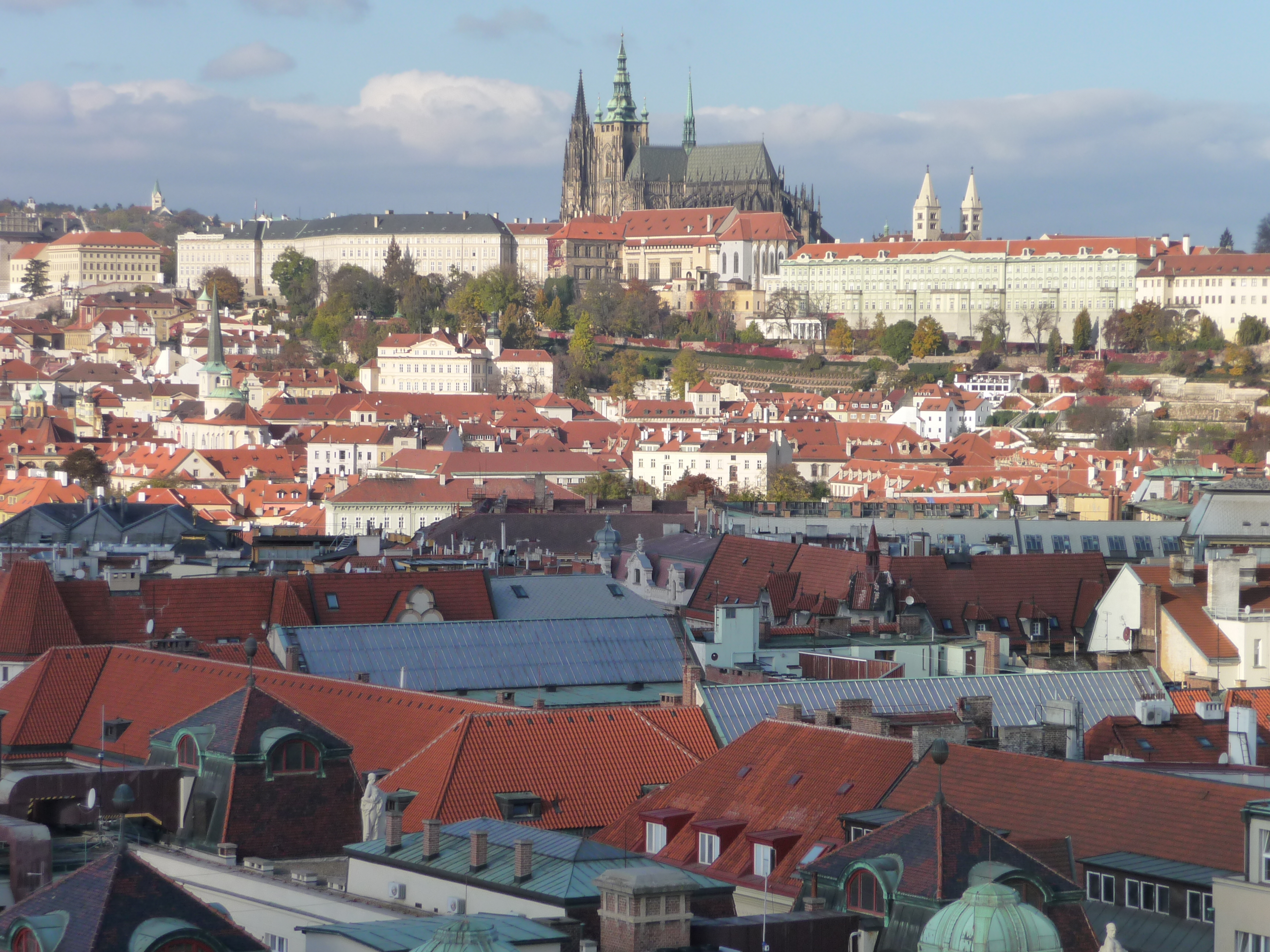
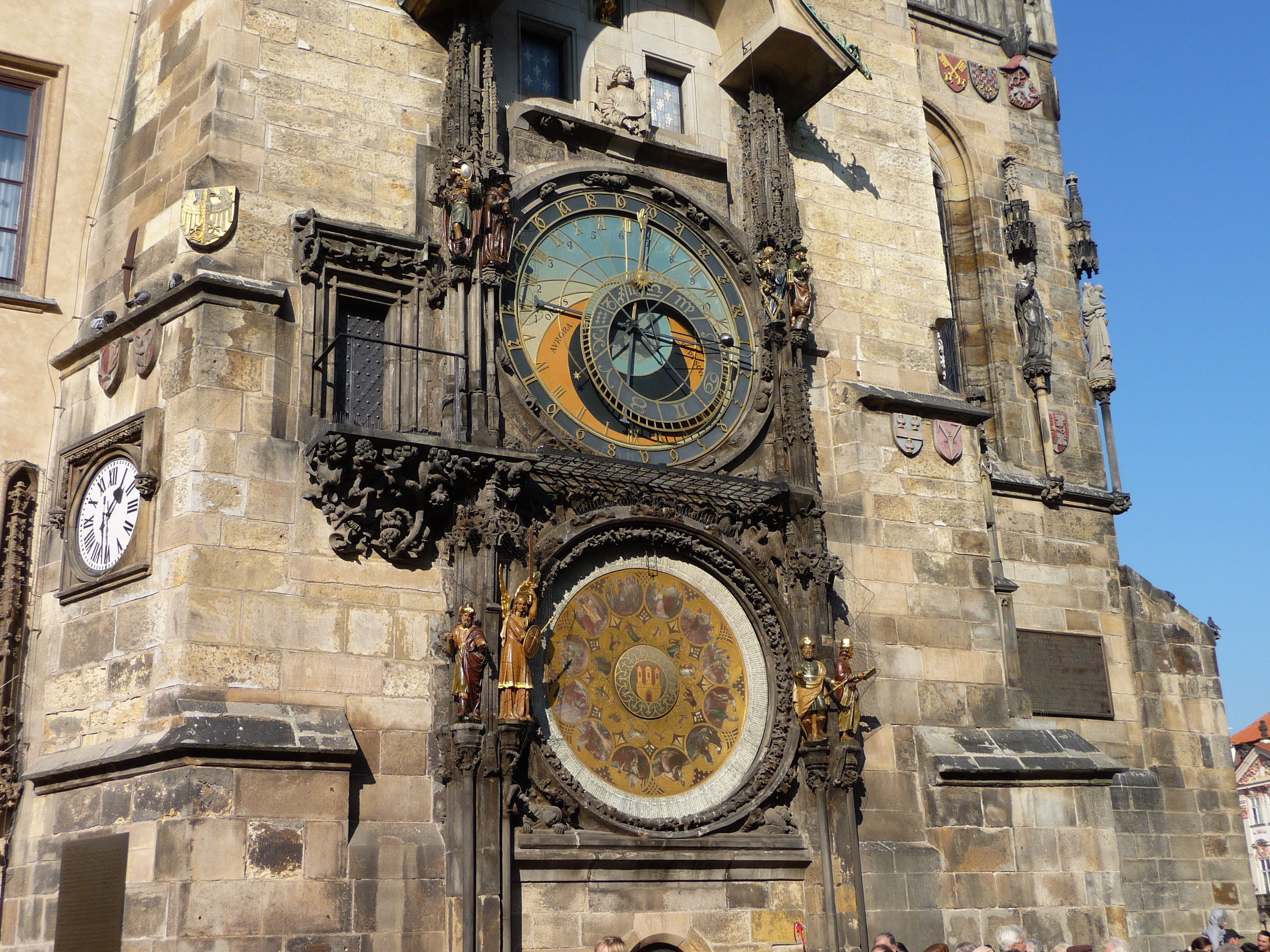
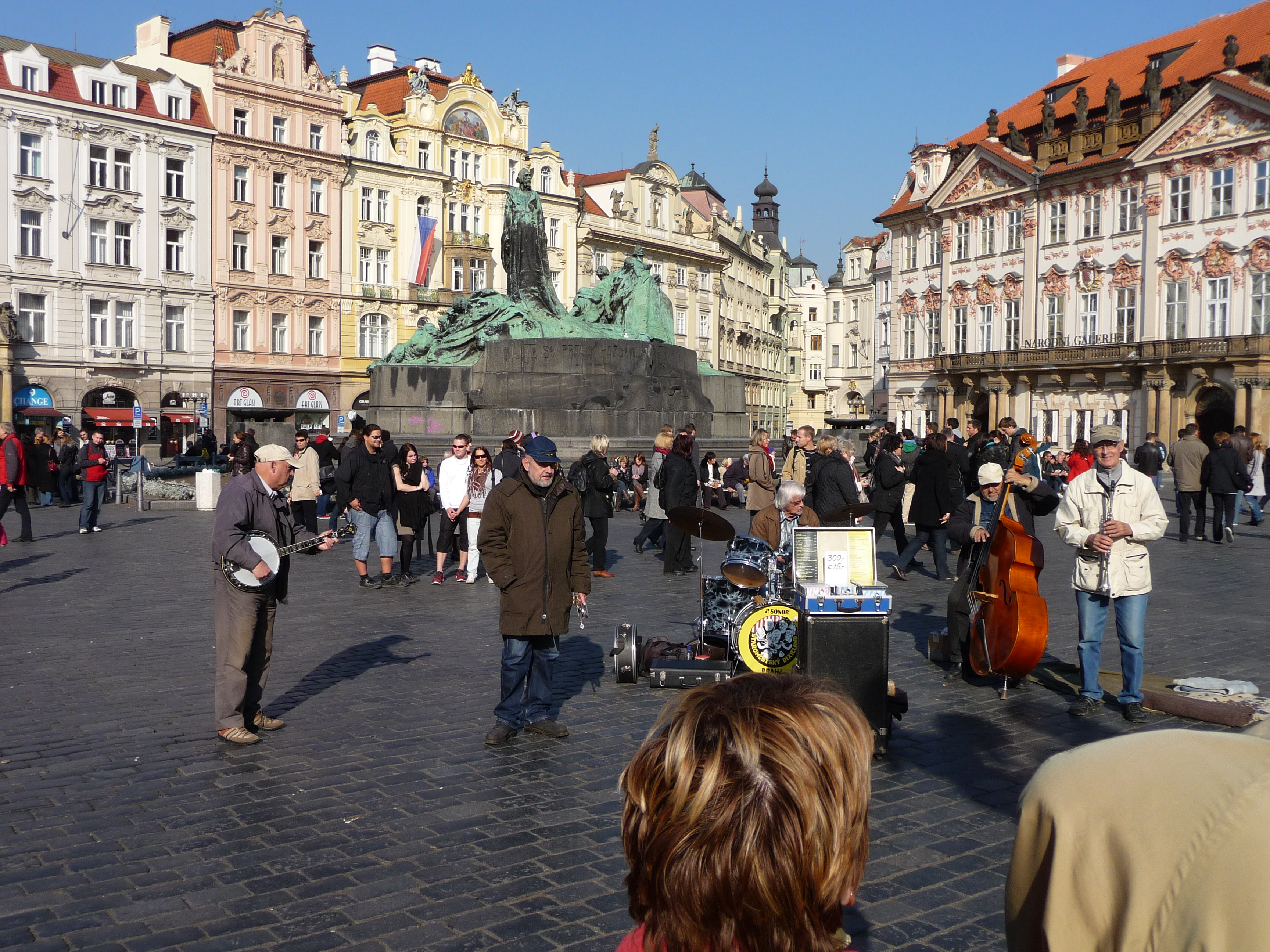
UNESCO listed Prague’s extensive historic center as a World Heritage site in 1992. Prague wasn’t bombed in WWII, unlike Budapest(see previous post). Prague’s Old Town (Staré Město) is an amazing concentration of historical sites, churches, a Jewish quarter, a huge astronomical clock (a main tourist attraction) and winding streets all in the shadow of a 9th century castle and St Vitus Cathedral. We stayed in the heart of the old medieval town in a 14thcentury building that had been converted to a hotel and residential building, so we walked everywhere.

Vltava River, Lesser Town and Castle Hill

St. Climent's Cathedral in Old Town

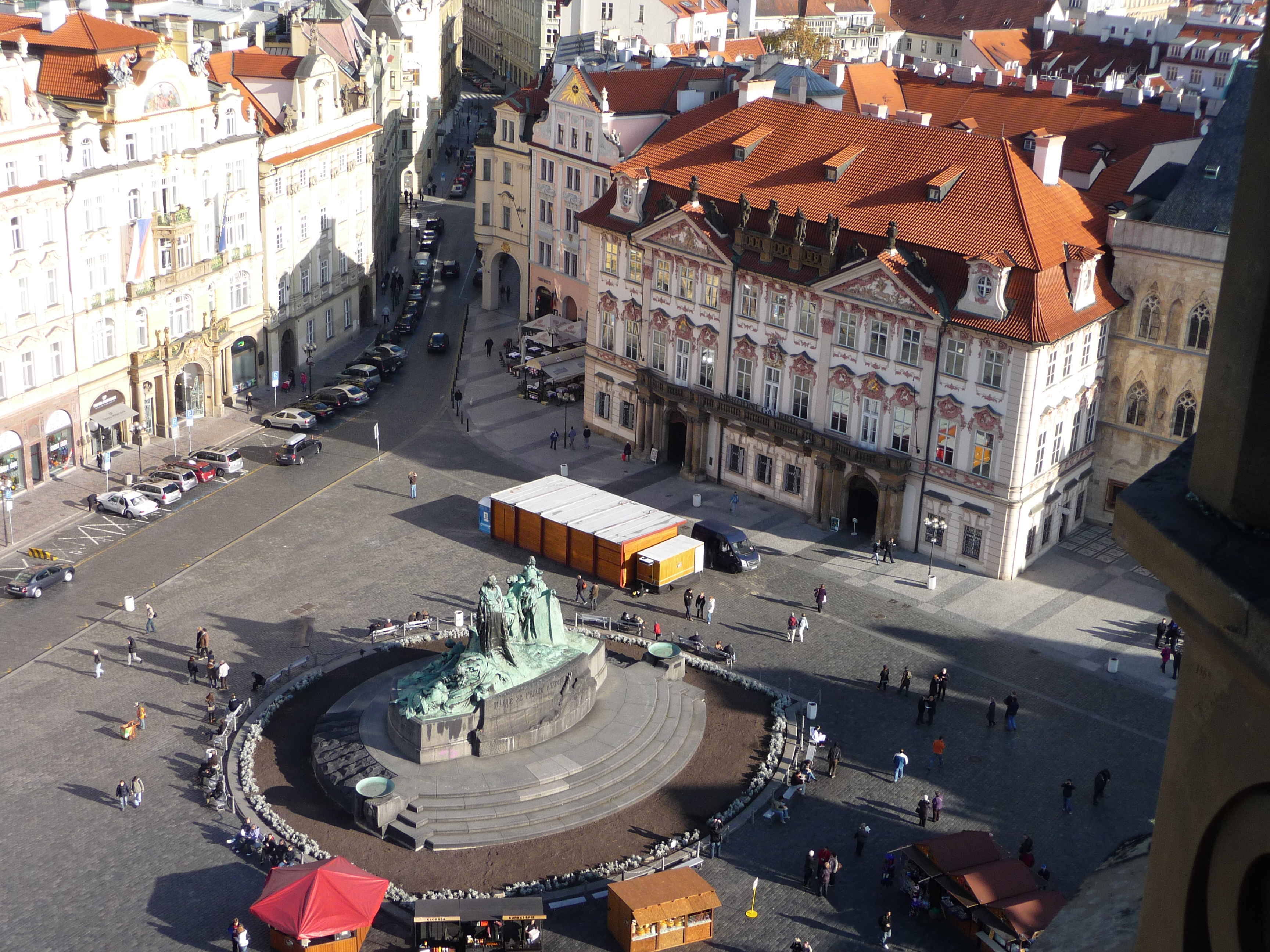
Old Town Square

Old Town Square from the bell tower

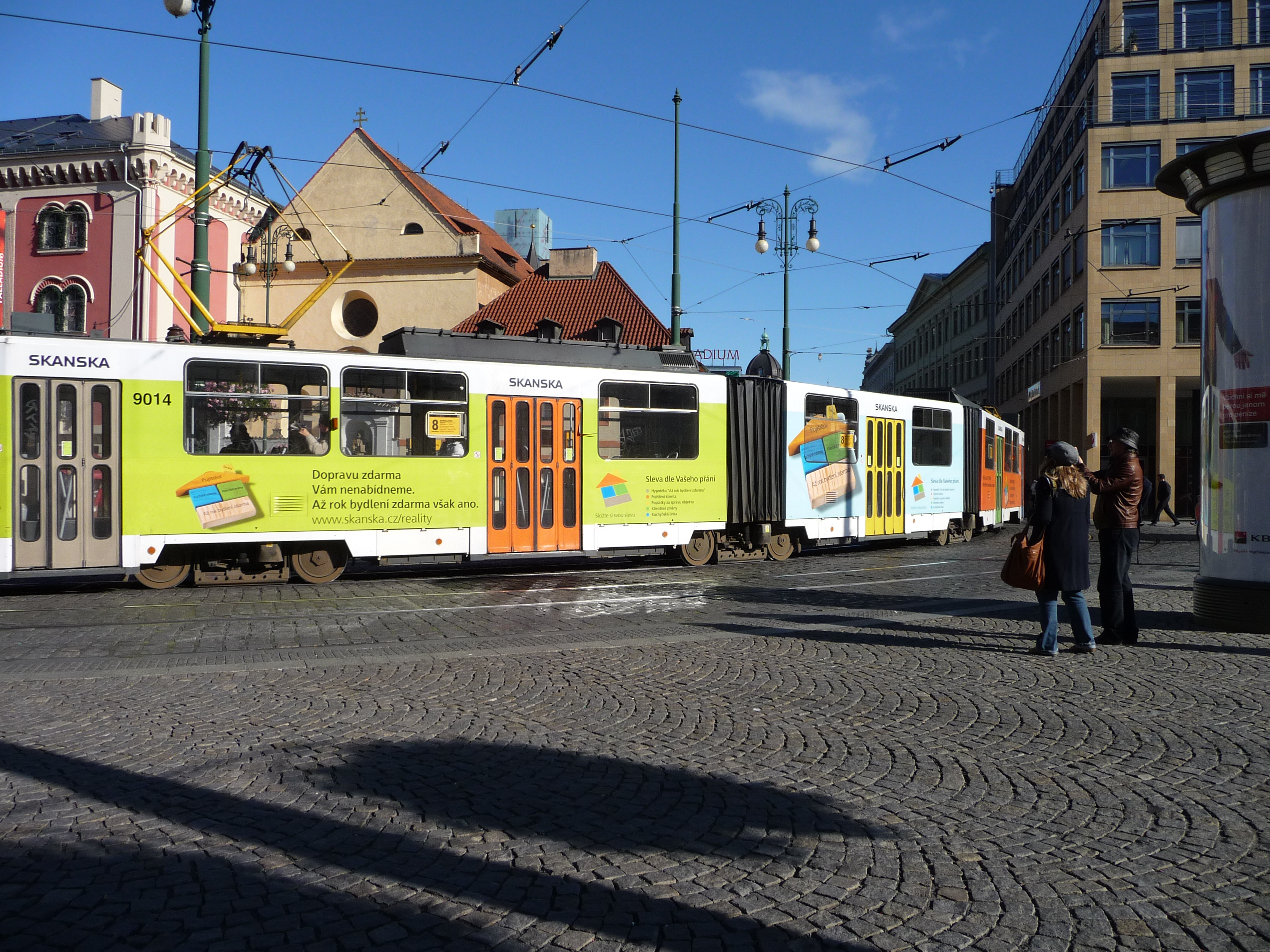
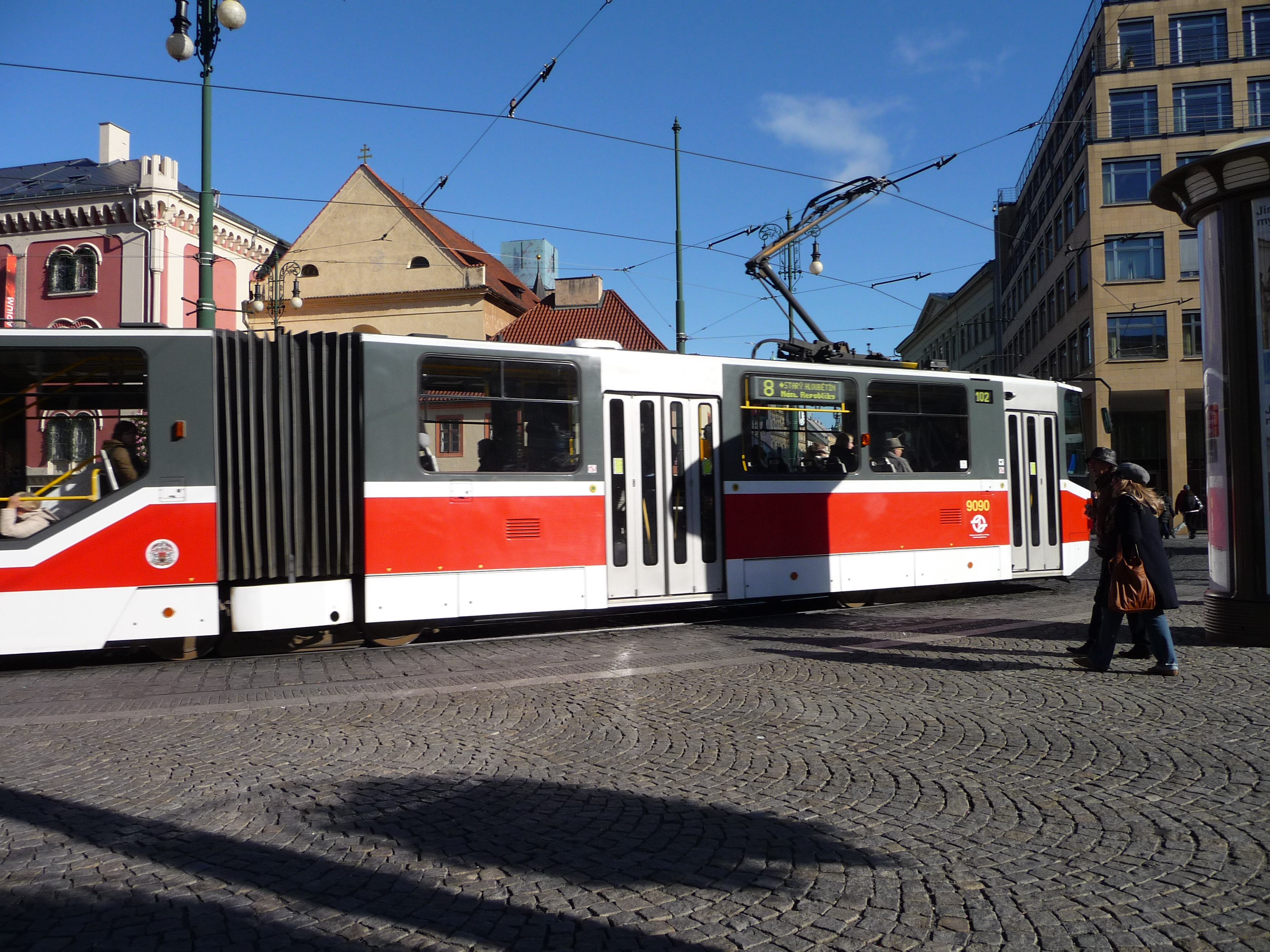
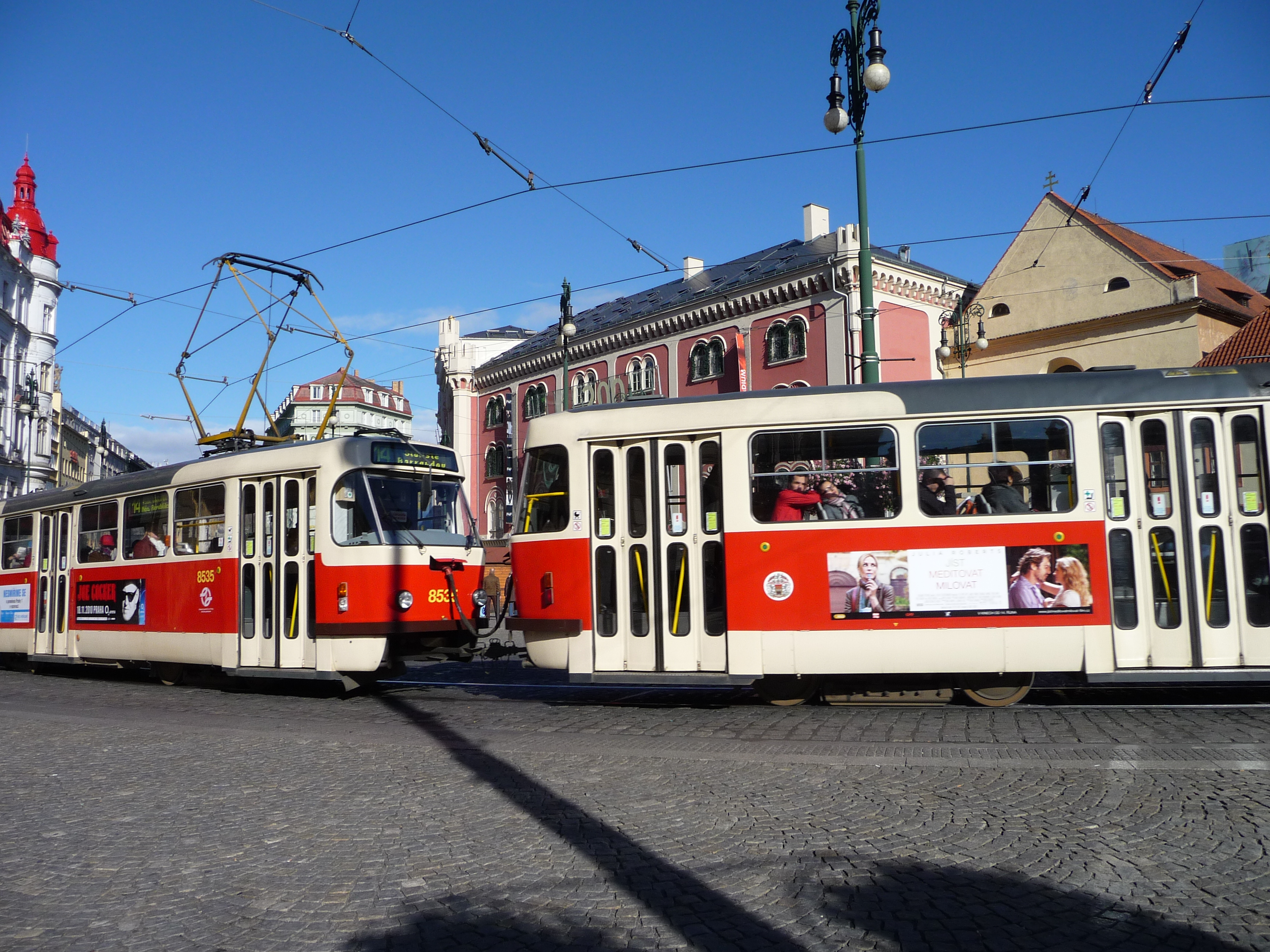
If you visit Prague I hope your ankles and legs are in good shape because you will be walking on lots of narrow, convoluted, cobblestone streets and up lots of steps.  Walking and public transit are the way to see Prague. Biking isn’t usually recommended in the tourist areas since the streets are so narrow and the cobblestones make very bumpy rides plus all this is mixed in with cars and small trucks. You see very few people on bikes in the Old Town. Cars are allowed in the Old Town and trams go around the outer part but buses are not allowed in the Old Town except for some tourist buses to pick people up in the main square.

Tram - Prague

Castle Hill from the Clock Tower

Astronomical Clock-Prague

Franz Kafka's boyhood home

Tram in Prague

There are several parts of the historic district, the Old Town where the peasants and merchants lived and across the Vltava River to Lesser Town and up the Castle Hill to the castle area where the rulers live. The set up is similar to Budapest except these weren’t administered as separate towns. The Charles Bridge connects Old Town and Lesser Town on your way to the Castle. On the river’s bank in Lesser Town is the Franz KafkaMuseum, worth it if you are a fan.

Public transit ticket vending machines

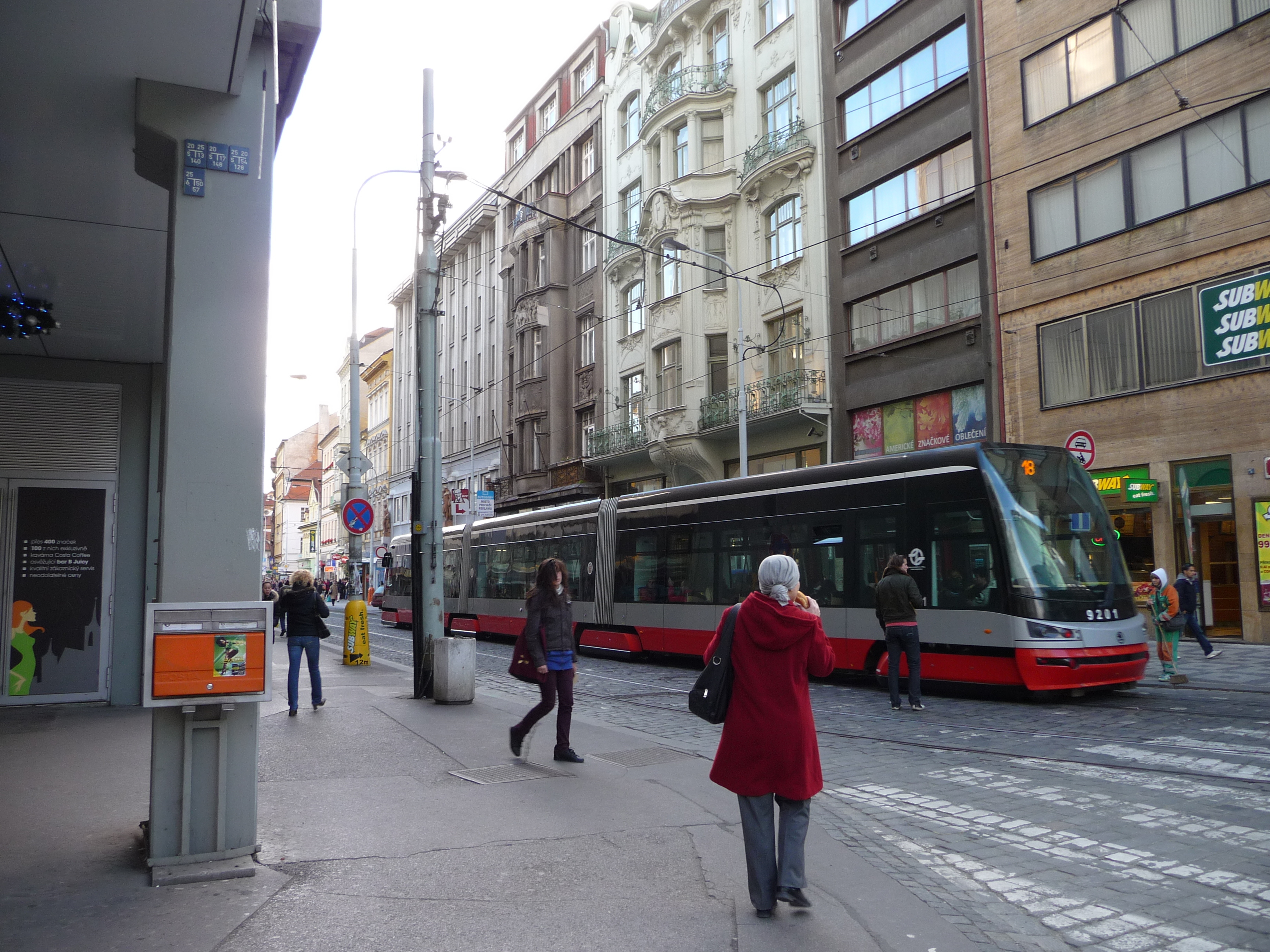
Outside of the Old Town, Prague has a one of the best transit systems in Europe with a metro (subway – 3 lines, 400 million passengers a year), trams (26 lines, 300 million passengers a year) and buses. The metro is only 30 years old and mostly Russian built. Two thirds of the population uses public transit. Single and transfer tickets are available at yellow vending machines.  Tickets may also be purchased at metro ticket offices, tourist information offices and newspaper stands. 1, 3 and 5 day passes are available. In Prague you can also purchase transfer tickets through your mobile phone and have the ticket delivered to your phone in one minute. Very technically up to date.

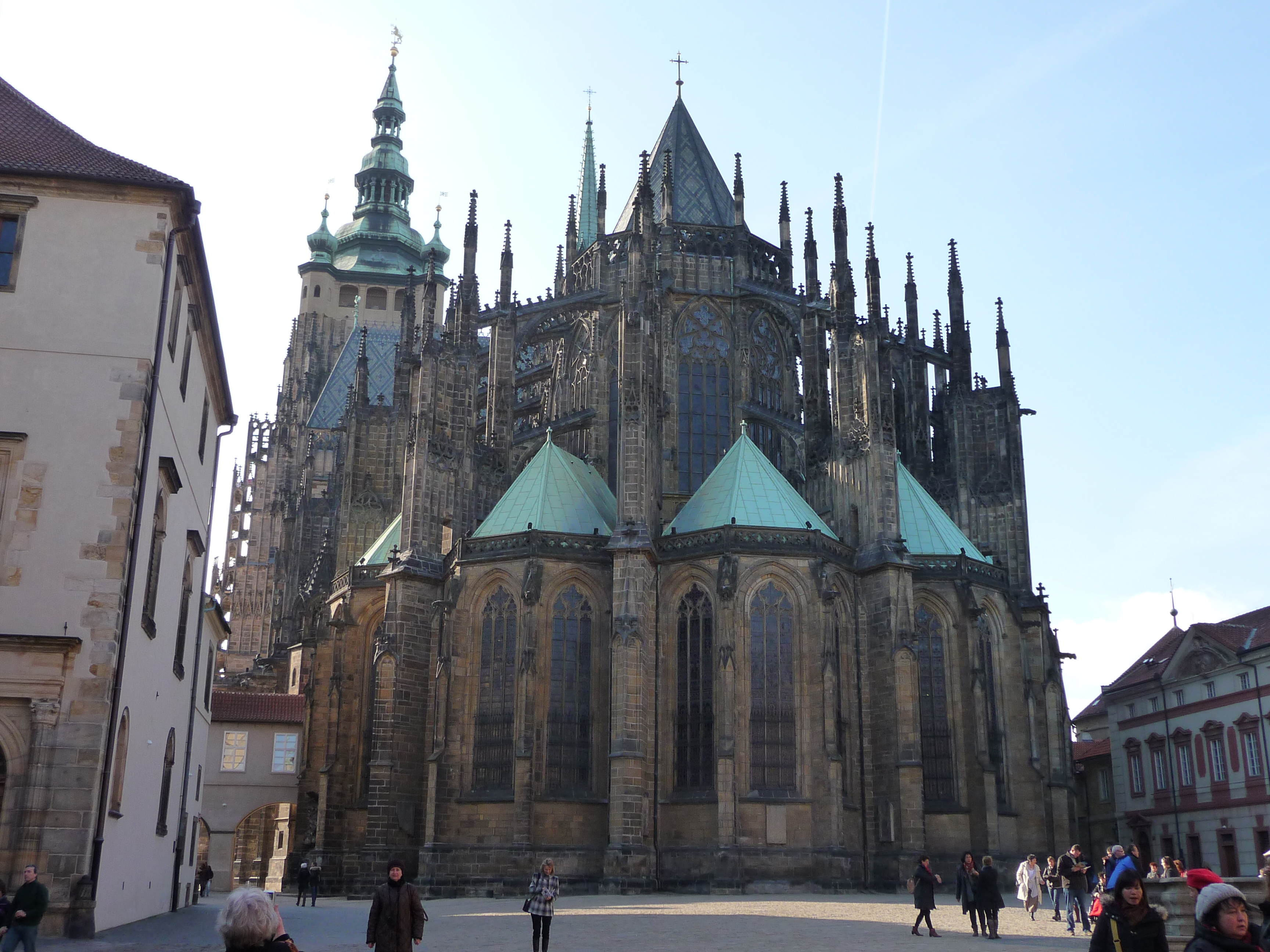
Back of St. Vitus Cathedral

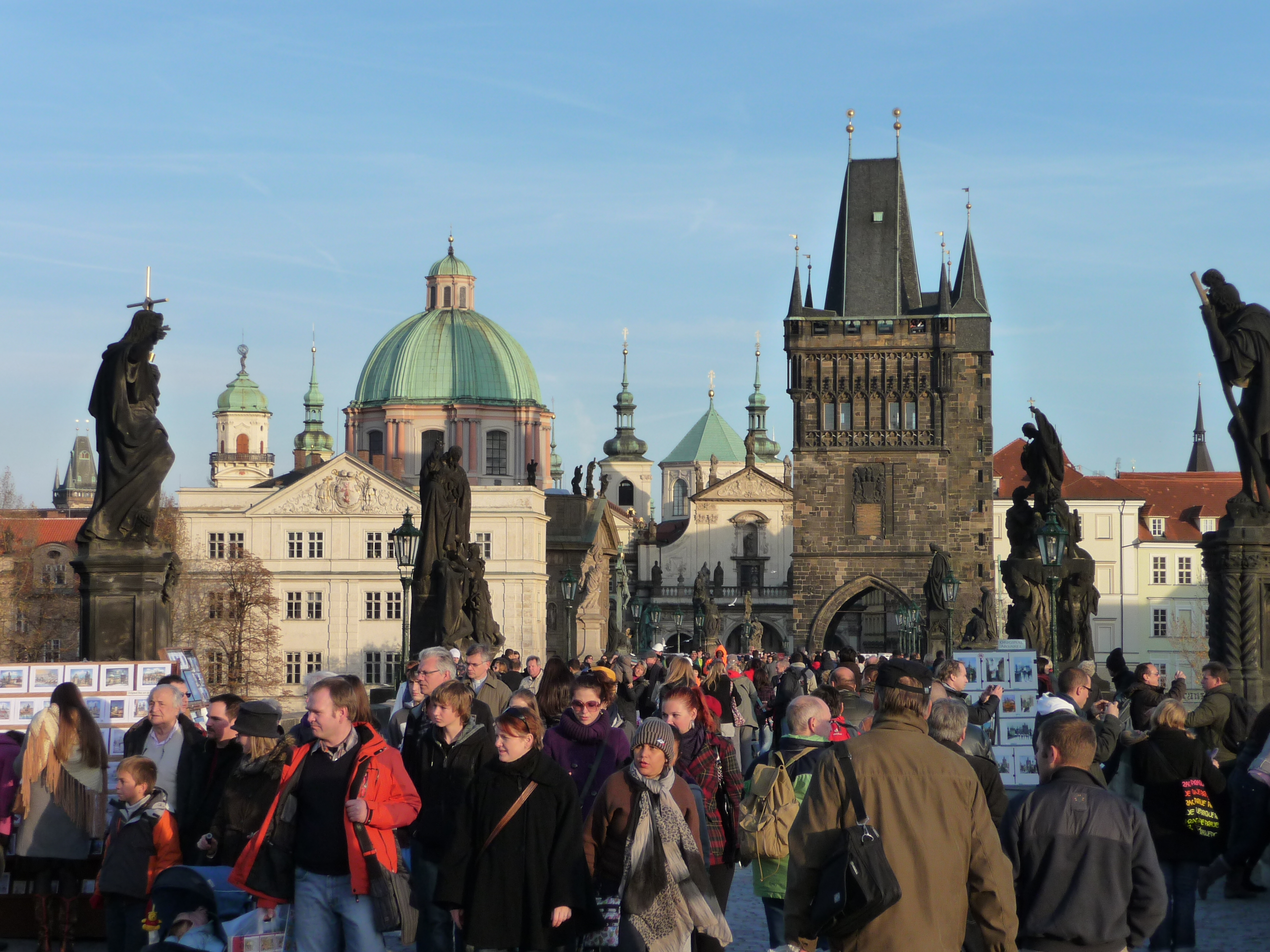
Charles Bridge in low season

Most services are handicapped accessible – but check to make sure.  They have some special transportation mini-buses available, too

If you visit in high season it might be cheaper to stay just outside the Old Town and take a tram in. Some tourist buses come in to the Old Town Square (Staromestske) like the HOP ON HOP OFF bus but they don’t stay. The HOP ON HOP OFF bus in Prague mainly does a trip around the perimeter of the Old Town and castle, so we didn’t take it. No buses are allowed in the Old Town and with such an excellent metro and tram system most public transit buses are on the outskirts of the city.

Prague’s taxis have a bad reputation so ask the price from your hotel before using them and make an agreement before you get in.

Musicians in the Old Town Square

Musicians on Charles Bridge

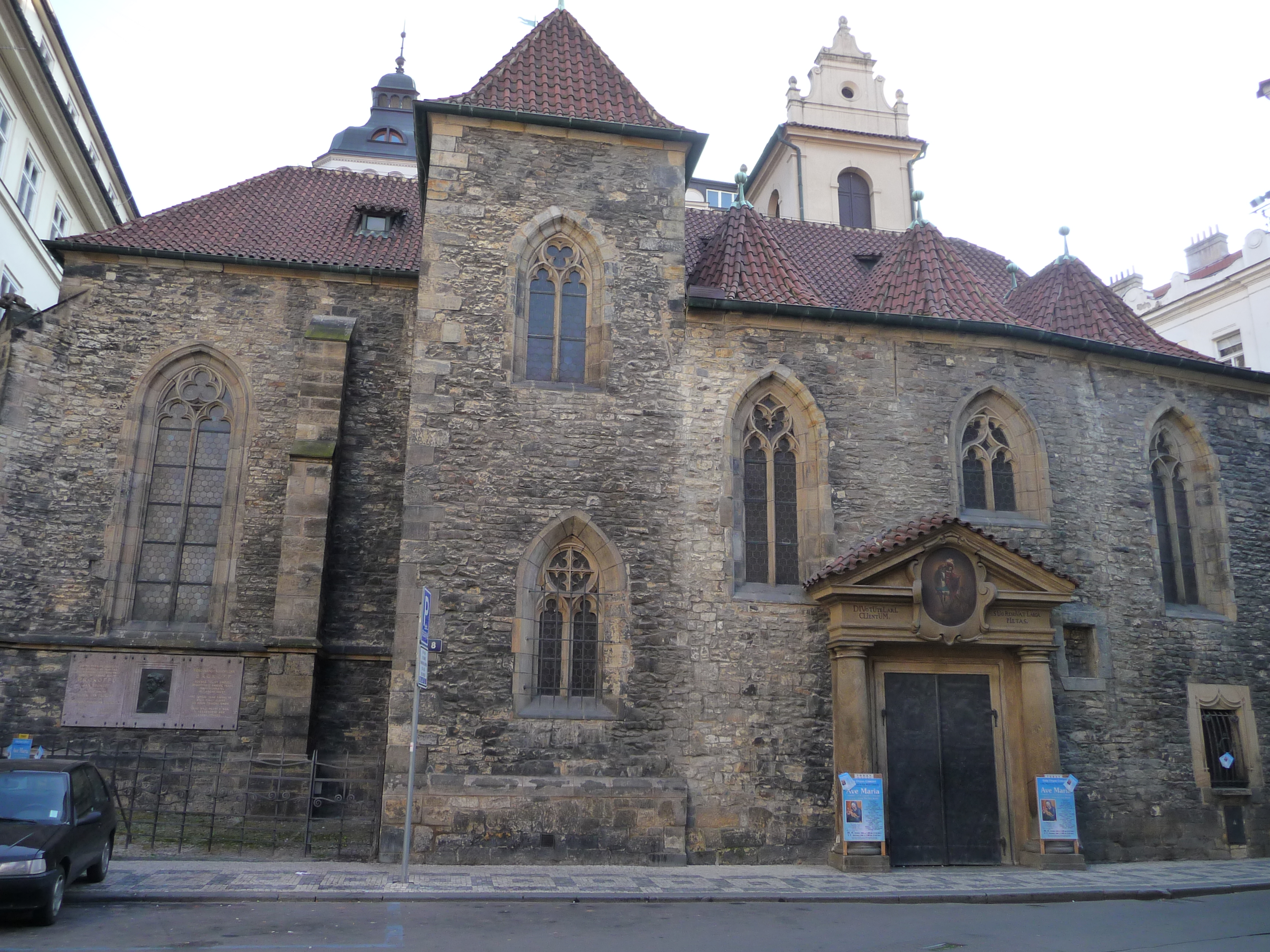
Prague is renowned for its music. There are bands in the Old Town Square and on the Charles Bridge, our hotel had a blues club in the basement, Susan Vega performed one night at the Hard Rock Café just off the Old Town Square, every church has concerts and there are the Prague symphony and opera houses. All of it is delicious and depends on your time, interest and pocketbook. The concerts in the churches are a big tourist attraction and since these are all stone churches with vaulted ceilings, the sound is very beautiful. Although we went to several church concerts that were excellent, I want to recommend a small ancient, beautifully preserved church, St. Martin in the Wall. The big churches are more famous; their interiors are beautiful and sometimes so over the top with Baroque decorations that they are a bit gaudy for me. However St. Martin in the Wall is very old and built into the side of the Old Town wall. It has barren stone walls and a small chapel. We experienced the best sound quality with an amazing performance in this unassuming venue.

Prague tram

St. Martin in the Wall Church

You will need a full day to explore the Castle area, the largest in Europe. The Castle consists of a lot of different buildings with courtyards. In the center of the complex is St. Vitus Cathedral. It is very impressive and if you are up to it climb the winding staircase up the South Bell tower, 287 steep narrow steps. Go as early in the day as possible before it gets really crowded. I waited for my husband who thinks that all towers were created for him to climb. The cathedral is magnificent. I suggest you get an audio guide to the castle district and the cathedral if you are really interested in exploring this site.

Part of the fun of the Castle is getting there. The Castle steps are famous and there are two choices. Since none of the trams were close to our location in the Old Town, we zigzagged up the streets so the trip was not as steep as the castle steps. We walked down the Old Castle steps at the end of the day.

Halfway down the Old Castle Steps

Walking up to the castle:

1. Castle Steps (Zámecké schody) – these are considered the romantic Castle Stairs, which will take you to the Garden on the Ramparts (Zahrada na Valech).

2. Old Castle Steps (Staré zámecké schody) – These are near the  Malostranská metro station and Jiřská street. You will be rewarded with one of the most beautiful views of Prague.

Prague tram in Lesser Town-4 articulations

Getting There by Tram

Taking the tram will save you a walk uphill or up the stairs, and the ride is quite scenic. Take tram 22 (e.g. from Národní třída or the Malostranská metro station) and get off at one of these stops:

Some streets are tram only

1. Královský letohrádek – if you get off here, you can start with the Royal Garden, Belveder and Ballgame Hall, then cross the Deer Moat bridge to get to the Second Courtyard
Note: The Royal Garden and Deer Moat are closed from November through March

2. Pražský hrad – this is considered the main Prague Castle stop. Get off here if you would like to start at the Second Courtyard.

3. Pohořelec – getting off here will enable you to walk to the Castle through Hradčany and arrive at the main entrance. Considered the nicest route.

A good way to go is to take the tram up to the Castle and walk back down when you’re done.

Memorial to Jan Palach and others

Wenceslas Square

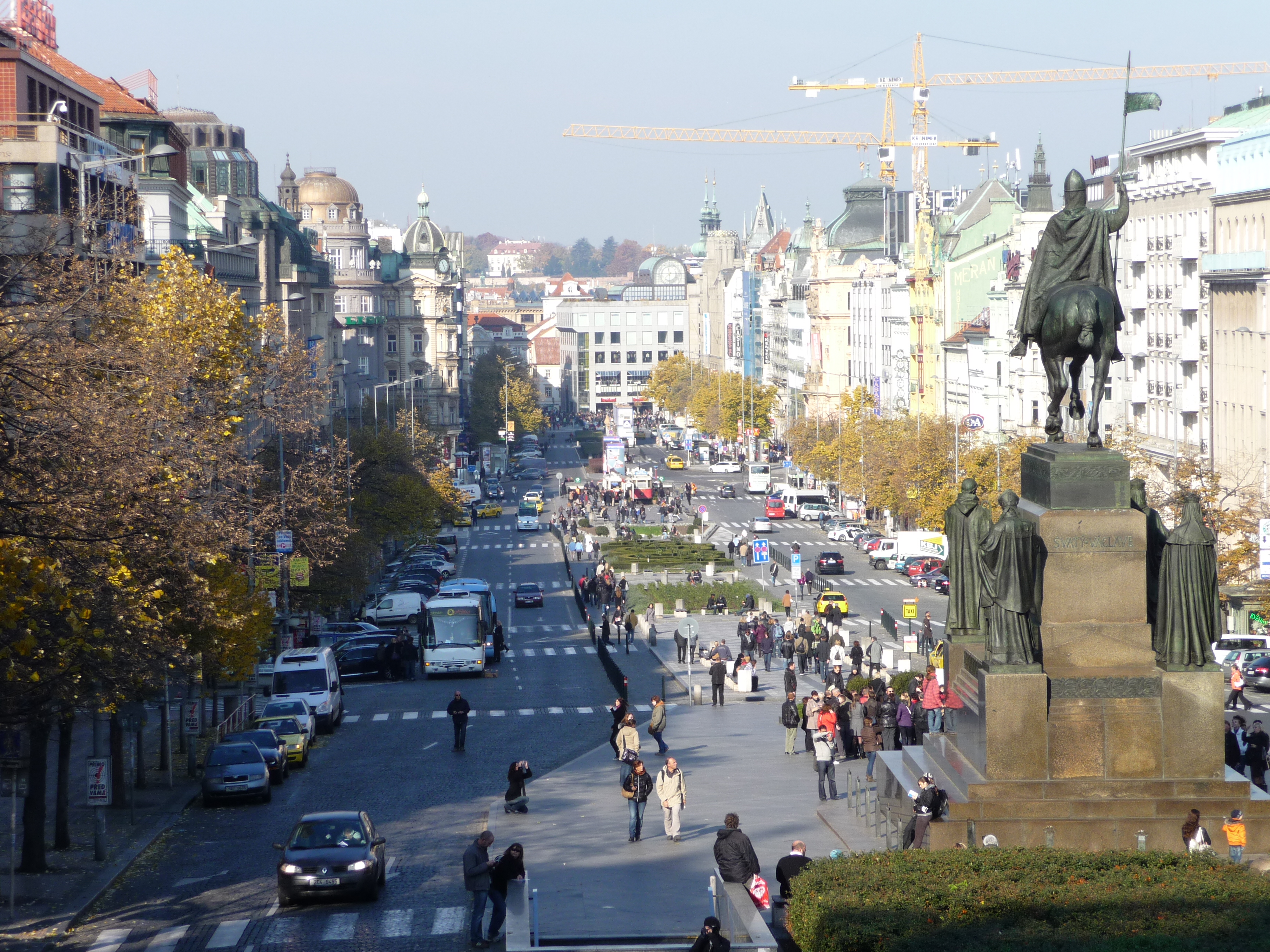
A five-minute walk from the Old Town Square is New Town (east and south of the Old Town), dominated with wide straight streets set out in a grid.  Wenceslas Square has a huge statue of Saint Wenceslas (yes, the one from the Christmas song) at the top of the street. Of course the Good King was really a prince and is considered the founder of the kingdom. His brother killed him in 935 AD. So much for family values!

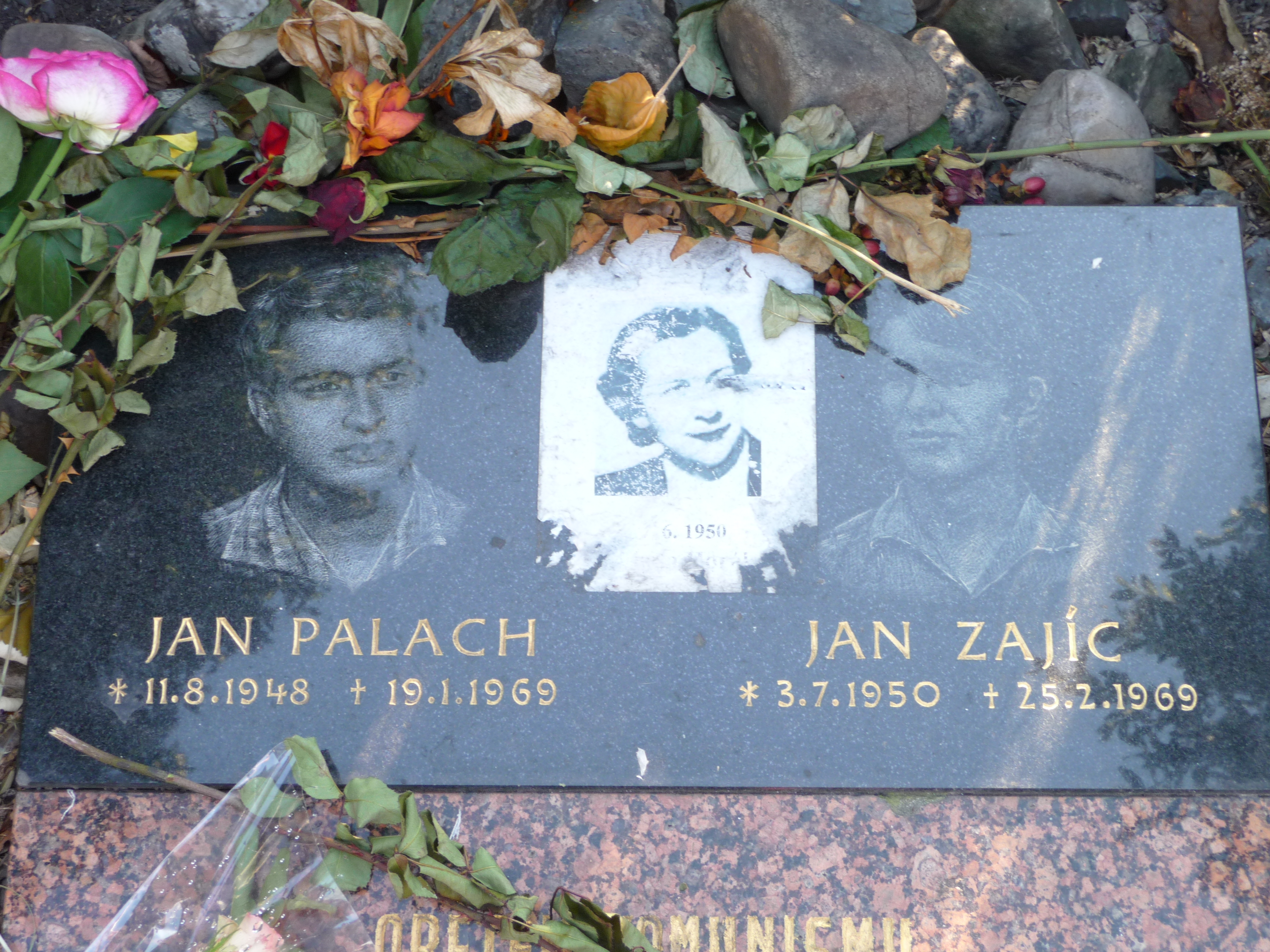
Part to the way down Wenceslas Square is a small memorial to Jan Palach who set himself on fire January 1969 to protest the Russian occupation and the demoralization of the Czech people.

At the bottom of the street starts a long pedestrianized shopping area with all the top designer shops and lots of restaurants.

Bill at an Absinthe Shop and Museum

Prague is also known for its beer. However, you’ll see Absinthe (the Green Fairy) being sold everywhere in Prague. It’s bad reputation and subsequent ban throughout most of the western world came from the disastrous effects it had on French artists in the 1900’s. However, the ill health effects and early deaths were mainly related to becoming alcoholics, not the wormwood in the drink.  The US ban was lifted in 2007.

Janet at a chocoholic paradise

It is good I don’t live in Prague because I would die from chocolate overdose at the Choco Café. The dark hot chocolate (70%) is so thick you need a spoon (it is actually referred to a spooning chocolate). I ordered mine with wild berries but they had lots of fruit choices and combinations. Drinking a whole mug must have equaled several candy bars. They also have great food.

Next stop-London

Photos by Janet and Bill Rogers, except the rail stations and vending machines

Posted in Rail, Transit and Travel | Leave a Comment »

Upcoming Public Events

Posted by Transit Action Network on May 30, 2011


First Partners Congress on Creating Sustainable Places

MARC is holding the first Partners Congress, to learn more about Creating Sustainable Places and provide your input — through facilitated breakout sessions and electronic polling. Sustainable places require good transit options.

When: Wednesday, June 1, 2011, 9 a.m. – noon, (Registration at 8:30 a.m.)

Where: Jack Reardon Convention Center, 500 Minnesota Ave., Kansas City, KS 66101

Who Should Attend: Anyone from the public or private sector who is interested in creating a more resilient and adaptable region.

Registration: There is no cost to attend, but registration is required. Register online or call 816-701-8234.

Open House for State Avenue Corridor Transit Improvements

 The Kansas City Area Transportation Authority (KCATA) and the Unified Government of Wyandotte County-Kansas City, Ks. (UG), are holding an open house to discuss preliminary design plans for the Minnesota/State Avenue transit corridor.

When: Tuesday, June 7, 2011, 4 p.m. to 6 p.m.

Where: McCarthy Gallery Room, Jack Reardon Convention Center, 500 Minnesota Ave., Kansas City, KS 66101

Who Should Attend: Any area residents, businesses and commuters wanting to review project exhibits and provide comment. KCATA and UG staff, along with consultant design team members, will be on hand to answer questions and discuss issues and/or concerns.

Registration: No registration required.

Posted in Events, Local Transit Issues, Regional Transit Issue | Tagged: , | 1 Comment »

We Rank 90th of 100 – Is Anybody Surprised?

Posted by Transit Action Network on May 22, 2011


Last week the Brookings Institution released a report, Missed Opportunity: Transit and Jobs in Metropolitan America, examining the ability of America’s 100 largest cities to get people to work by transit. It should come as no surprise to residents of the Kansas City region that we came in 90th.

Click on table to enlarge

MARC has posted a preliminary response in their online newsletter, Transportation Matters

KCATA General Manager Mark Huffer has also responded to the study on the KCATA website.    KCATA Responds To Brookings Institution Report

The Brookings report is not about quality, as Huffer notes. The KCATA customer satisfaction is over 90%, its buses are on time over 92% of the time and the cost per mile is significantly under the national average.

This report is about quantity of transit service. We don’t have enough transit in the region to get people to work. This problem directly relates to a lack of transit funding. Our region provides very little money for transit compared to our peer cities. Mr. Huffer cites the need for a regional funding mechanism, and TAN agrees wholeheartedly.  MARC proposed a regional transit concept and funding strategy over 10 years ago with Smart Moves. Some parts of that plan are gradually being implemented, like the MAX buses, but funding has remained elusive. Nothing major can change without more money.

The big question is how the region will respond to being ranked 90th.  Will the region’s leaders shrug and proceed with business as usual?  Or will they take the ranking seriously as a challenge to our viability as an urban region, roll up their sleeves, and confront the problem.

We have an abundance of ‘good intentions’ already in place including MARC’s new policy direction regarding future development, a new Long Range Transportation Plan, the recent HUD Sustainable Communities Planning grant, the First Suburbs Coalition, Imagine KC, multiple Alternatives Analysis studies, multiple phases of Smart Moves, and even a broad-based regional commitment to being America’s Green Region. But are they enough?  Will good intentions translate into actions?

We have not developed a transit system relevant to our region’s population or our situation. The Kansas City region has sprawled out in every direction, and therefore lacks the density needed for some of the more capital-intensive transit infrastructure investments. Unfortunately, jobs have sprawled along with residents and retail, and “job sprawl” is especially hard to serve by transit. Even better transit to downtown would address only part of the problem since fewer than 14% of the region’s jobs are now located in Kansas City’s Central Business District.

Getting people to jobs that are dispersed all over the region makes for a daunting task for our underfunded transit agencies.

What do we do?  The Brookings Institution makes three main recommendations, but will we move to implement them?

  • Transportation leaders should make access to jobs an explicit priority in spending and service decisions, especially given the budget pressures they face.
  • Metro leaders should coordinate land-use, economic-development, and housing strategies with transit decisions to ensure transit reaches more people and more jobs efficiently.
  • Federal officials should collect and publicize standardized transit data to enable public, private and nonprofit entities to make more informed decisions and maximize the benefits of transit for labor markets.

Transit Action Network offers the following preliminary recommendations for MARC and the region:

– Evaluate the methodology used by Brookings to be sure it doesn’t misrepresent us.

– View this low ranking as a challenge to improve public transit and, at least as important, assure that most of the region’s future development is accessible by transit.

– Accept that we have not provided a realistic transit choice for getting most people to work, and increase our efforts to get broad-based transit funding, perhaps county-by-county.

– Acknowledge the “good intentions” that the region has in place, but carefully examine whether they are enough, and then adopt new policies and actions as necessary.

– Adopt and implement a set of measures to track our progress toward improving our ranking. If we measure it, we have a lot better chance of making progress.

The Brookings report and a regional response will be the major issue for discussion at the June meeting of MARC’s Transit Committee.  TAN will be there and actively participating in the discussion.

Posted in Action, Local Transit Issues, Regional Transit Issue | Tagged: , | Leave a Comment »

MARC Transit Committee Meeting 5/4/11

Posted by Transit Action Network on May 16, 2011


MARC Transit Committee Meeting 5/4/11

1. Tom Gerend, MARC Assistant Director of Transportation, gave a short update on the Downtown Corridor (Streetcar) Alternatives Analysis.

Tom clarified the report in the KC Star about the line costing $25 million per mile.  It is important to distinguish between single and double tracked routes.

  • This $25 million cost is more relevant to single track routes, like a loop.
  • This study is looking at tracks running in both directions, double tracked.  The route may be 2 miles long but there are 4 miles of track.
  • The cost per track mile will vary greatly depending on whether the track bed is built to a streetcar or a light rail standard.
  • All of these options are going to be studied.
  • NOTE: A previous streetcar presentation at the Transit Committee by a different consultant estimated the cost of a streetcar with double tracks and built to light rail standards at $40 million per route mile, an estimate of $80 million for a two-mile route with these characteristics.

2. Mark Swope, Olsson Associates, gave an update of the Smart Moves Implementation Phase III Study.

  • This study brings together the Phase I Urban Corridors Bus Rapid Transit study, Phase II Commuter Corridors/Commuter Rail Study and Local Services, including paratransit. The regional plan will detail preferred service strategies and include a corresponding financial analysis including developing financial funding scenarios.
  • Mark presented information breaking down both operating and capital costs by county through 2020 using the transit scenarios from the previous studies.

3. After the main meeting the Seamless Transit Workgroup met to continue discussions related to making transit work more easily for riders.

  • KCATA and JCT have been working together to post additional JCT schedule information.
  • KCATA and JCT are discussing the possibility of a reciprocity agreement to allow riders to use monthly passes on either service.
  • JCT is working on improvements to “basic passenger infrastructure” at bus stops, including improved signs, route and schedule information, and concrete pads to connect sidewalks to the street. Bus stops with a higher level of service would get additional amenities.
  • In the discussion regarding real-time information through mobile devices, the transit providers explained that they use different technologies to communicate with riders. In the near term, any real-time information will be provided separately.

Next meeting June 1


Posted in Local Transit Issues, Meeting Reports, Transit Studies | Tagged: , , | Leave a Comment »

KCATA Board of Commissioners Meeting 4/27/11

Posted by Transit Action Network on May 5, 2011


1. During public comment, Ron McLinden, Transit Action Network, asked the board to initiate a unilateral 90-day trial period in which KCATA honors Johnson County Transit monthly passes on Main Street MAX buses.  A limited trial could be implemented at little or no cost, and would be an important symbolic step toward improving the region’s transit system by making transit a more viable option for more people.  The Board agreed to consider the request.

2.The board authorized a contract to purchase eight 2011 Dodge Caravan passenger vans for use in the KCATA”s AdVantage Vanpool Program. The eight vehicles in the current fleet of 33 vehicles have exceeded their 100,000-mile and four-year useful life. The AdVantage Vanpool Program is available to commuters who either reside or work in a community supporting the KCATA through service agreements, and who do not have access to existing public transit services for their commute trip.

View the program http://www.kcata.org/rider_guide/advantage_vanpool_program/

(Unfortunately, the money is for replacement vans only. No additional vans are being added to the vanpool although there is a waiting list and we are in a period of high demand due to high gas prices. This program is great for groups of 6 or more people who want to ride together to work and other forms of public transit are not available: example-people who live in Lee’s Summit but work close to the airport)

3. The Board of Commissioners authorized a cooperative agreement for a KU Medical Center Area Transit Study toward the goal of improving transit service for those working in and around the medical center and improving connections between current transit routes.

The study arose from discussions between Mayor Reardon of Kansas City, Kansas, and Mayor Foster of Roeland Park about improving transit service for those working in and around the medical center and improving connections between current transit routes.

KCATA, MARC, Johnson County Transit, the City of Roeland Park, and the Unified Government have jointly developed a scope for a consultant to analyze options to improve transit services to KU Medical Center for nearby residents, employees, and visitors and to improve transit connections.

HNTB has been selected to conduct the study under their on-call services contract with KCATA, at an estimated cost of $72,500. The study is to be completed this fall. Federal planning funds will be used for 80% of the cost with remaining local funds to be provided by the Unified Government, Johnson County Transit, the City of Roeland Park, and KCATA.

4. The Board of Commissioners authorized a service contract with the City of Kansas City, Missouri, from May 1, 2011, to April 30, 2012, with a City contribution of $43.1 million.

From the 1/2 cent sales tax the contract includes $19.9 million for Metro, $1.9 million for Share-A- Fare and $40.2 thousand to fund specialized services for reverse-commute job transportation. There is $21.3 million from the 3/8-cent sales tax for public transportation.

This contract is an increase of 6.2% over last years contract. Part of that increase is due to the ordinance passed in December 2010 to restore funding to public transit and part is due to higher sales tax revenues.

Keep in mind that this contract is still less than the 2004/2005 Kansas City contract.

Share-A-Fare Price Increases 2011

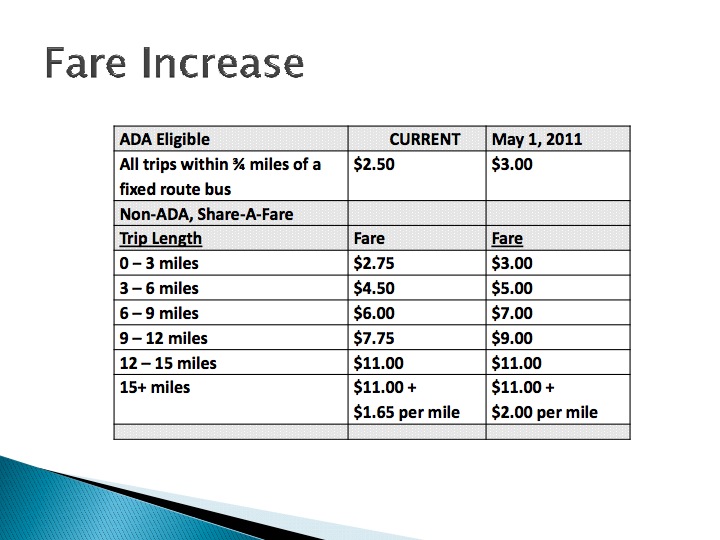
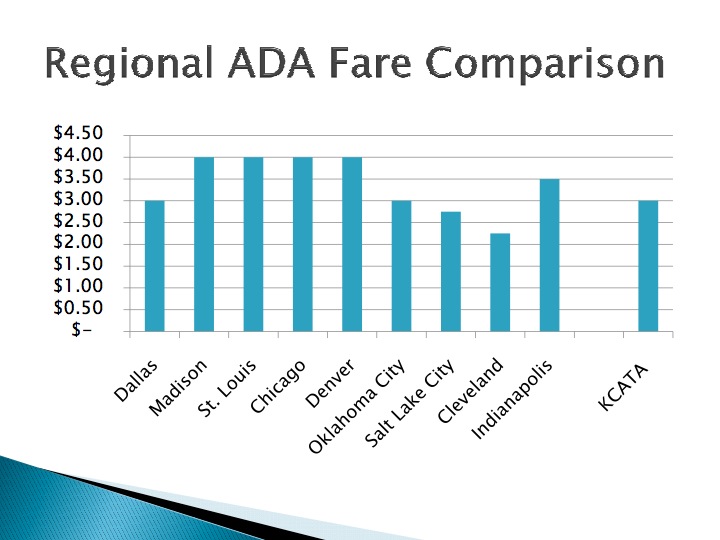
5.Bryan Beck, KCATA’s Director of ADA Compliance and Customer Service, provided an update on the fare increase from $2.50 to $3 per ADA eligible ride for the Share-A-Fare program, including the results of two public meetings and additional public input.  He presented general information and a service review of the Share-A-Fare program. See the full presentation- SAF Update 

6. Cindy Baker, KCATA Director of Marketing,  made a presentation on the State Avenue corridor project, funded by TIGER grants. It is in the design phase and the design team will soon be meeting with Advisory Council, stakeholders, and the general public. One component of this phase is the branding that will go hand in hand with design and then implementation. This project includes transit infrastructure improvements that could serve as a precursor to a future MAX line.

Johnson County Transit is in a similar situation with their Shawnee Mission Parkway/Metcalf route, also a TIGER-funded improved-transit corridor, but not full BRT service.

The JO has been working with consultants and the public to brand their new line. They have opted to call it “The JO Connex”. KCATA, Unified Government, and Johnson County Transit are all amenable to developing a regional brand, called “Connex,” that would represent a family of routes that include enhanced transit amenities, but do not increase service levels to MAX standards.

Next meeting May 25, 2011.

Posted in Local Transit Issues, Meeting Reports, Transit Studies | Tagged: , , , | Leave a Comment »

Streetcar Presentation at Downtown Neighborhood Association

Posted by Transit Action Network on April 29, 2011


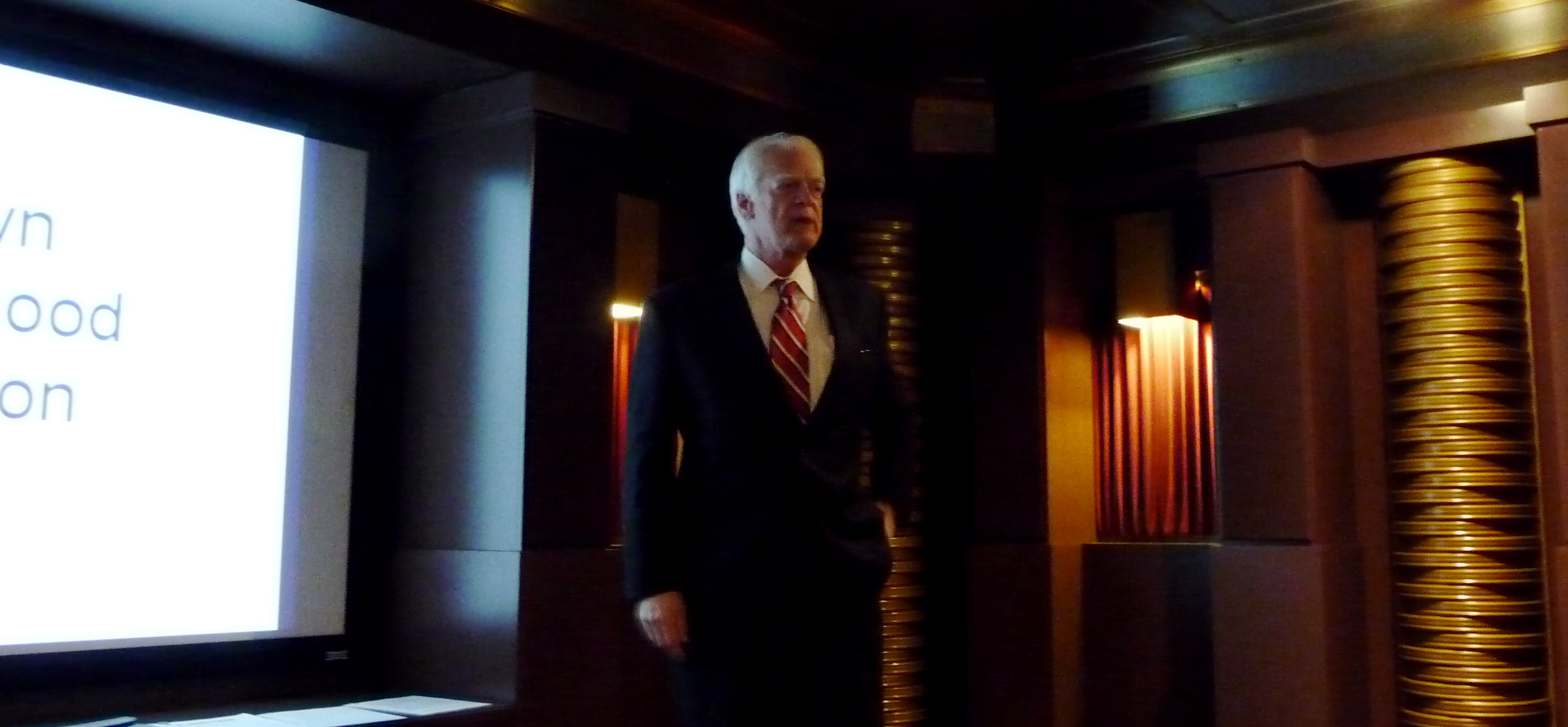
Sherri McIntyre, KCMO Assistant City Manager. addresses DNA

Sherri McIntyre, KCMO Assistant City Manager, and Mark McDowell, Transit Action Network, both addressed the Downtown Neighborhood Association Wednesday evening regarding the Downtown Corridor (Streetcar) Study. Sherri talked about the nature of the study, how the study would progress, its time frame and how positive the city is about implementing a modern streetcar line downtown. Mark McDowell then focused on different financing issues and how a Transportation Development District (TDD) is a possible funding mechanism. The Missouri legislation for a TDD will be a strong contender for funding all or part of a streetcar line for both capital and operating expenses.

Mark McDowell addresses DNA

Since the study is scheduled to be completed by the end of the year, it is not too early to start grassroots organizing. Transit Action Network asks Downtown residents, as well as residents in the River Market and Crossroads, to take part in a group to make the streetcar happen and to participate in an eventual campaign to pass whatever funding mechanism is ultimately proposed.   Downtown residents can contact TAN at TransActionKC@gmail.com to find out more.

The Kansas City Star (April 29) carried a front-page article by Mike Mansur about the meeting. http://bit.ly/mNA8Zs

Posted in Action, Meeting Reports, Rail | Tagged: | Leave a Comment »

Future Downtown Streetcar could be in the Hands of Downtown Residents

Posted by Transit Action Network on April 25, 2011


Come hear about a Transportation Development District. Presented by Mark McDowell and TAN.

Downtown Neighborhood Association April Meeting | 04.27.11 | 7:00 pm | Central Library | Film Vault

http://www.dnakcmo.org/dna-events.html

Posted in Events, Local Transit Issues, Rail | Tagged: | Leave a Comment »

Streetcar Study Off to Fast Start

Posted by Transit Action Network on April 20, 2011


A Downtown Streetcar “Alternatives Analysis” (AA) study is on a fast track to completion, according to Charlie Hales, project manager for lead consultant HDR.  That’s our conclusion based on Hales’ presentation to the Kansas City Parking and Transportation Commission today.  The Commission, chaired by Councilwoman Jan Marcason will be the “primary sounding board” guiding the study.

Hales, who has had extensive rail transit experience in Portland and other cities, said though the federal funding situation is uncertain, the best way to get such funding is to have a plan ready when the next money becomes available.

The study timetable is ambitious:
– June – Statement of purpose and need, plus identification of initial alternatives.
– August – Alternatives evaluation and financing options.
– September – Draft of a Locally Preferred Alternative (LPA) report.
– November – Formal recommendation of a single Locally Preferred Alternative.

The FTA has awarded $400 million in grants for streetcar projects in the past 15 months through the TIGER and “Urban Circulator” programs, Hales said, and USDOT Secretary Ray LaHood really likes streetcar projects.  Getting the current study done will enable Kansas City to be “nimble” in applying for FTA “new starts” or “small starts” money, or other federal money that may become available.  Some transportation funding, for example, has recently been turned back by other grantees, and that money — even high-speed rail money — could conceivably be redirected to a streetcar project such as ours.

The Downtown Streetcar study will follow the FTA’s formal process, which requires consideration of reasonable options for both route and mode, but will seek a so-called “categorical exclusion” (a category of project considered not to have major environmental impacts) to simplify the “environmental screen” required in the FTA process.  Issues such as event-related street closures (e.g., at Sprint Arena and Crown Center), utility location requirements, the strength of bridges over the freeways, and where to locate a maintenance facility are among those to be addressed in the study.  Other factors include ridership forecasts (estimates based on travel demand models as well as “off-model” considerations) and financing options.

Hales noted that the study will build on a number of recent and ongoing local studies, including the Greater Downtown Area Plan, KCATA’s Comprehensive Service Analysis, the region’s Urban Corridors Study, and the Grand Boulevard Vision, plus all of the light rail planning work that’s been done in past years.  The streetcar study will be coordinated with the Commuter Corridors study (not yet underway), which will consider commuter rail in two major corridors.

Keeping the project manageable is important, too.  When projects fail, Hales said, it’s not for engineering reasons.  Rather, it’s for political reasons.  Thus, every effort will be made to keep all stakeholders involved, to limit expectations, and to avoid a key mistake of past Kansas City rail studies, letting the scope of the project expand.  Holding the project to just two miles gives it the highest likelihood of success, based on past voter response.  (It’s widely expected that funding for this project would come largely from within the streetcar corridor, and thus a citywide vote would not be required.)  This also keeps it small enough that the city might be able to finance it without federal assistance, should that become necessary.

KCATA General Manager Mark Huffer noted that a bill has been introduced in the Missouri Senate that would allow a Transportation Development District (TDD) to be set up specifically for transit, and that would simplify the makeup of the TDD’s governing body.  That bill (which might not be critical) might or might not get through the General Assembly this year.

Assistant City Manager Sherri McIntyre will oversee the project for the City.  She said she looks forward to guiding the study to completion and then getting the project built.

Said Chairman Marcason: “I’m the most optimistic that I’ve ever been (about getting a rail transit project done).”

Posted in Local Transit Issues, Rail, Transit Studies | Tagged: , , | Leave a Comment »

Downtown Trends and Transit- Is a Streetcar in Kansas City’s future?

Posted by Transit Action Network on April 18, 2011


Downtown areas are being revitalized all over America.

The 2011 March-April edition of the magazine The Futurist looks at current trends in an article titled “The “American Dream” Moves Downtown”.

Although the Renaissance in many downtown areas came with light rail, read streetcar for KC.  Portland is leading the way in using streetcars, which helps other cities see their potential.

Times are changing, as are attitudes in KC. The corridor from the River Market to Crown Center has lots of activities and major attractions with more and more people actually living in the area. Demand for more effective inner city transit from the people who will use it may finally have arrived. It certainly has arrived in other cities around the country.

The trend includes more than just rail. Other aspects of enhanced downtown areas include restoring and enhancing natural settings with small to mid-size parks, urban ornamental or vegetable gardens (like the one at 18th and Broadway), integrating commercial and residential functions in multi-use buildings and changing public infrastructure to favor people over cars.

Since transit is considered a major component of this trend it is often called “Transit-Oriented Development” or TOD, which has mixed use, relatively dense development that emphasizes walk-ability.

KC already has some of the improvements mentioned in the article and the new zoning code that went into effect January 2011 will help with others.

The new study for a two-mile long streetcar is starting. If a good plan emerges from the study, let’s hope we find a way to finance building it as well as operate it.

Posted in Local Transit Issues, Rail | Tagged: | Leave a Comment »