Transit Action Network (TAN)

Advocates for Improved and Expanded Transit in the Kansas City Region.

Missouri State Rail Plan – Open House Nov. 2

Posted by Transit Action Network on October 29, 2011


Missouri Department of Transportation will host an open house and discussion about the movement of goods and people by freight and passenger rail.

Where: Sermon Center North Room, 201 N. Dodgion Ave, Independence

When: 5:30 – 7 p.m. Wednesday, November 2, 2011

VISION

Missouri’s rail vision is to provide safe, environmentally friendly transportation options supporting efficient movement of freight and passengers, while strengthening communities and advancing global competitiveness through Inter-modal connectivity.

STATE RAIL PLAN

The Missouri Department of Transportation is developing a Statewide Rail Plan that will provide the strategic framework for the development of both freight and passenger rail service in Missouri for the next twenty years.

Discussion items include:

  • An overview of the Plan and Federal Rail funding
  • The current state of freight and passenger rail in Missouri
  • The business case for rail including it’s importance to Missouri’s economy
  • Increased demand and interest in intercity passenger rail
  • The role of publicly funded improvements to move people and goods on privately owned railroad systems.
  • The importance of different types of rail projects compared to other infrastructure needs, given likely funding limitations.

MoDOT wants your input. If you cannot attend the public open house, the presentation and public comment forms are available at the MoDOT State Rail Plan website.  The virtual meeting and comment period will be accessible through November 18.  Public Meeting Presentation  Please spread the word.

Posted in Events, Rail, Regional Transit Issue | 1 Comment »

Central Europe and London-Part 3 – London

Posted by Transit Action Network on October 24, 2011


Diesel Electric Hybrid Red Double Decker Buses

London, UK- (city population 7.8 million, density 12,892 inhabitants/ sq. mi., metro population (mid-2010); 2.3 million -KCMO-density 1,446 inhabitants /sq. mi (2010))

Parliament, London

Big Ben, London

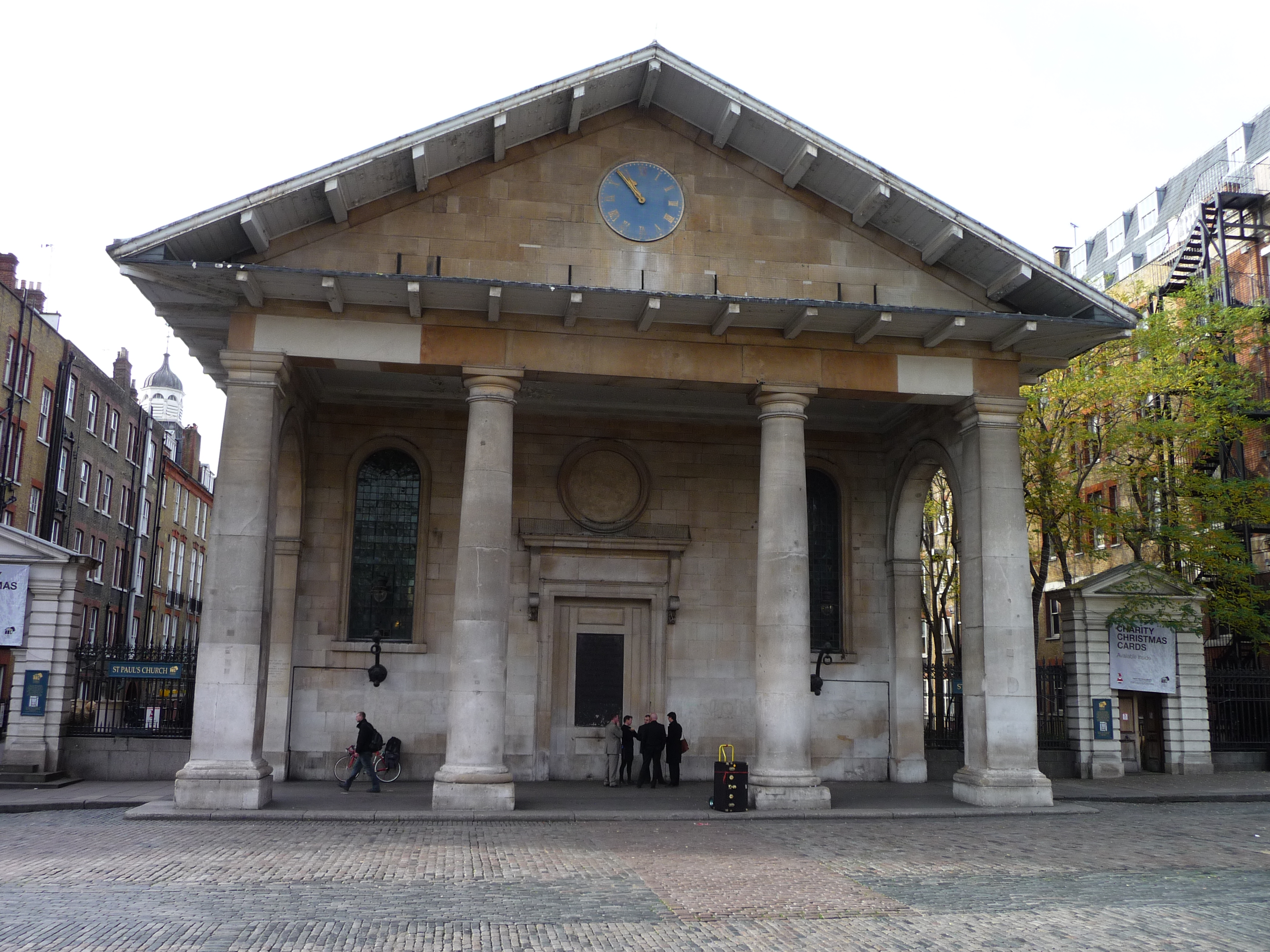
We only had a short stop over in London to go to the theatre and see friends. Since we knew we were going to the theatre in the West End we stayed at a hotel on the Strand by Covent Garden so we could walk to all the theatres. This is a great location. Many of the best sites are in easy walking distance, such as  the British Museum, the Tate Gallery, Tate Modern, National Gallery, Westminster Abbey, Big Ben, Parliament, the London Eye Ferris Wheel, Trafalgar Square, St. Martin in the Fields Church, National Theatre, Shakespeare’s Globe Theatre, all the West End theatres and of course Covent Garden itself. Take a few minutes to visit inside St. Paul’s-Covent Garden’s parish church (fondly known as the Actor’s Church) – most people spend a lot of time in the square behind the church watching performers but go to the other side for a restful garden and the memorials in the church dedicated to many famous actors of the 20th century, including Charlie Chaplin, Noel Coward, Gracie Fields, Stanley Holloway, Boris Karloff and Vivien Leigh.

We arrived at Heathrow Airport. There are multiple ways to get into the city center. Heathrow has a direct connection to central London on the Piccadilly Tube (subway) line, which goes right into the Covent Garden station.  Journey time is approximately 55 minutes to central London. Heathrow is located approximately 20 miles to the west of central London. Leaving Heathrow to return home was a nightmare because the check-in and security lines took nearly three hours.

London black cab

Of course you can come into London from Heathrow by taxi (cab) which is much more expensive but faster and direct to your hotel.  The London cabs are easily identifiable with a specific design and most of them are black cars. Make sure you learn what they look like. On occasion, as in all big cities, people have been known to fake being cabbies for criminal purposes.  London cabbies have to pass a grueling test to get a license. It takes between 2 and 4 years to pass this test. Anyone who can pass The Knowledge has a great memory and knows London forwards and backwards. It is the world’s most demanding training course for taxicab-drivers, and applicants will usually need at least twelve “appearances” (attempts at the final test), after preparation averaging 34 months, to pass the examination. London has the best cabbies in the world. I wish New York City would implement the taxi standards that London has. New York should consider implementing The Knowledge for NYC. Of course, new technology may make this level of  expertise obsolete.

See Transport for London for all the transportation options in London. See Wikipedia articles about TfL and information on transport in London.  Transport for London  (TfL maps) maps cover the Tube, tram, buses, walking, river, rail , DLR  (Docklands Light Railway) and red double-decker buses (many are diesel-electric hybrids) for London.

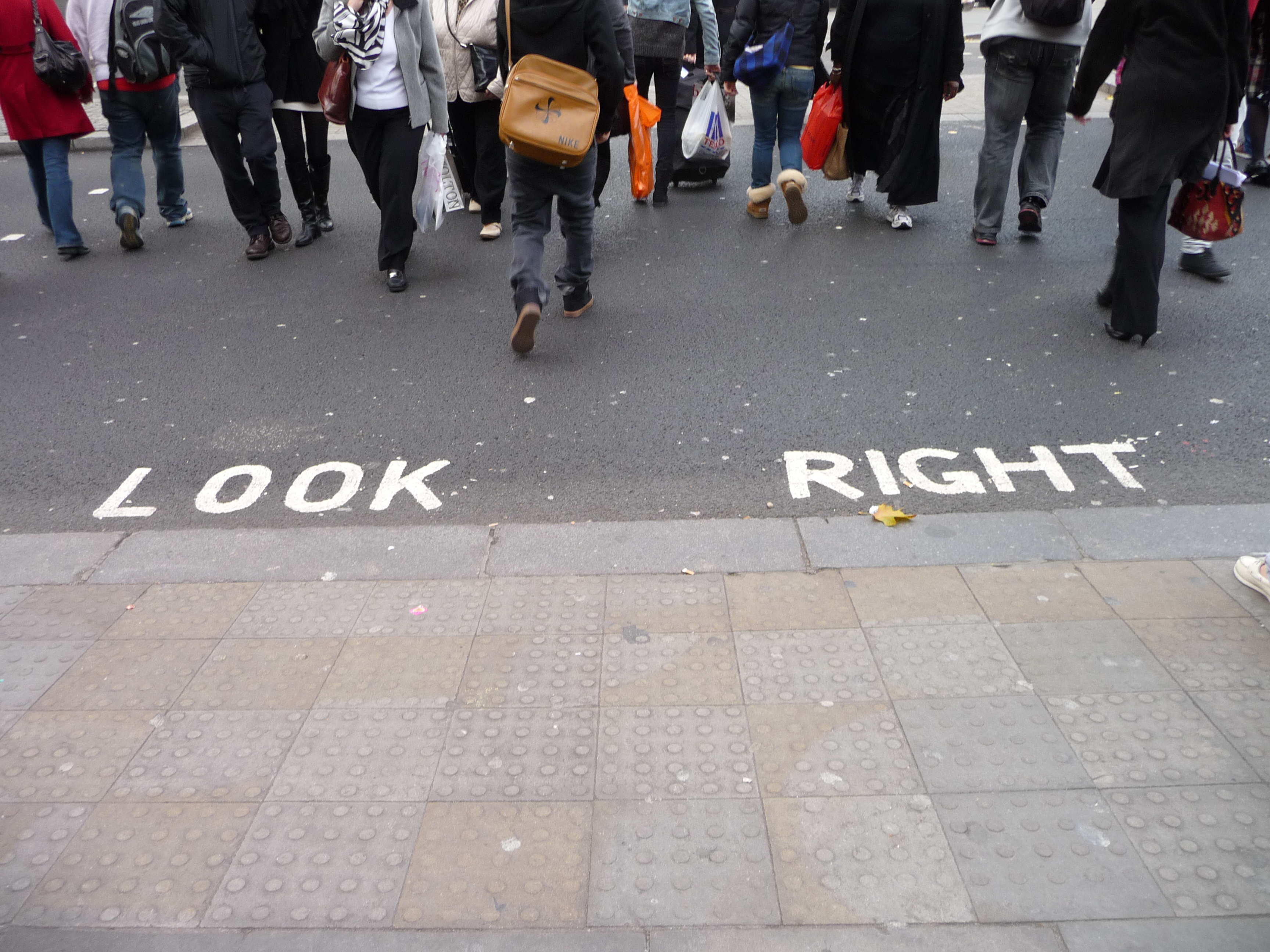
Be careful crossing the street

St. Paul's Church, Parish Church of Covent Garden-The Actors Church

Although the Tube and double-decker buses are always great, the biggest transportation news in London is bicycles. Bikes are the fastest growing form of transportation in the city. Bike riders are a very diverse group. We saw a lot of people in spandex outfits with expensive bikes with all the bells and whistles but we also saw a man wearing a suit riding an upright one-speed bike with a wicker basket.  Most people wear helmets.

Bike parking in Covent Garden

With bikes come lots of bike parking spots. Approaching the main shopping area of Covent Garden is a bike park that is supervised by the police. Remember that most of London is covered by CCTV now. This parking area had signs warning of the police surveillance as well as a notice that the police will stamp your bike with a tracking number if you chose to park there. I spoke with a man locking up his bike and he said that the police come around regularly to make sure the bikes are stamped with a number. The police put the number into their tacking system and it is up to you to enter your information on the internet to register your bike. I asked if this had reduced theft. He wasn’t aware of any thefts at this location for the two years he had been parking there. However, the best part of the system is that the second-hand bike dealers that were notorious for selling stolen bikes are no longer in business. Good News!

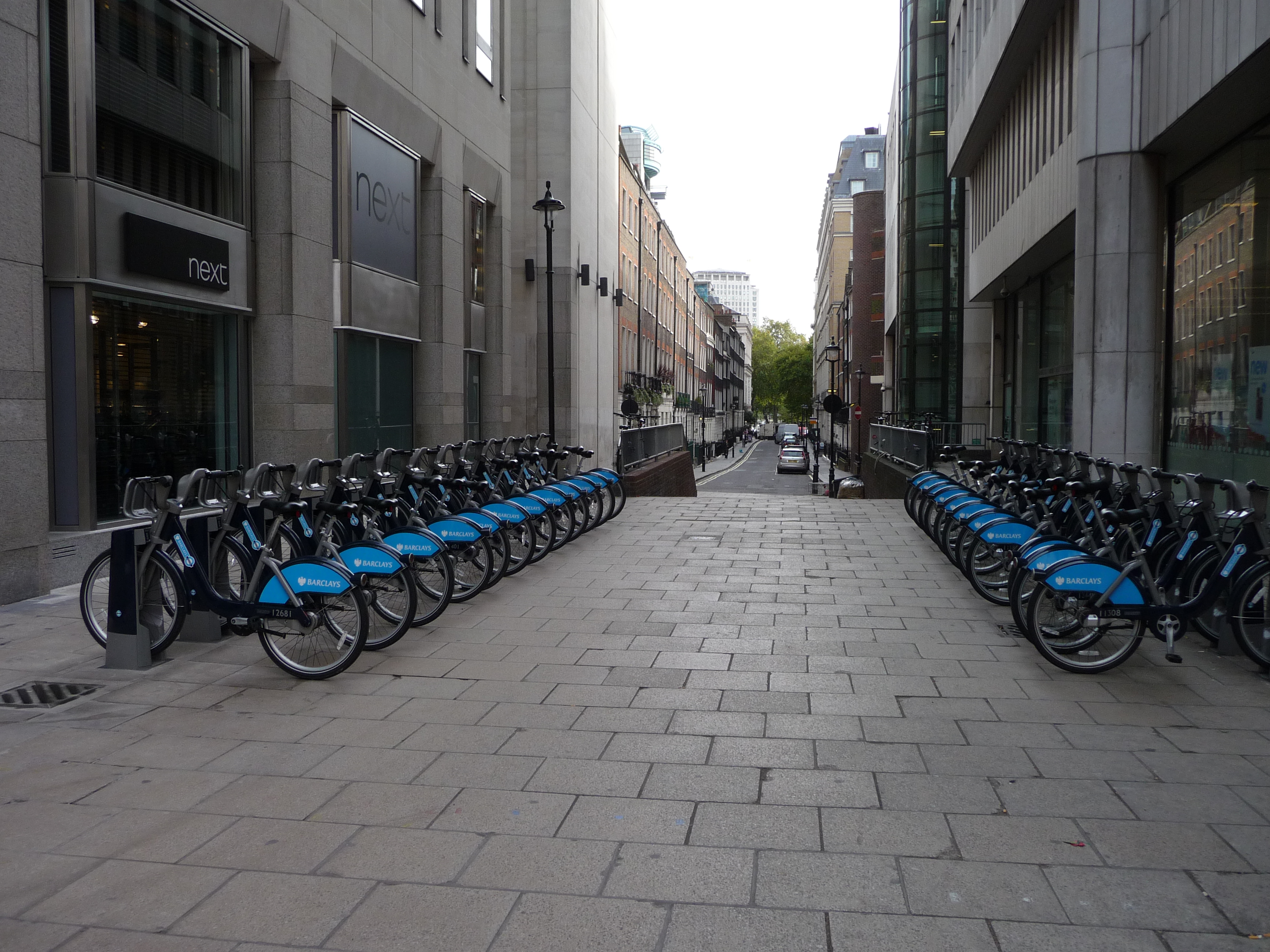
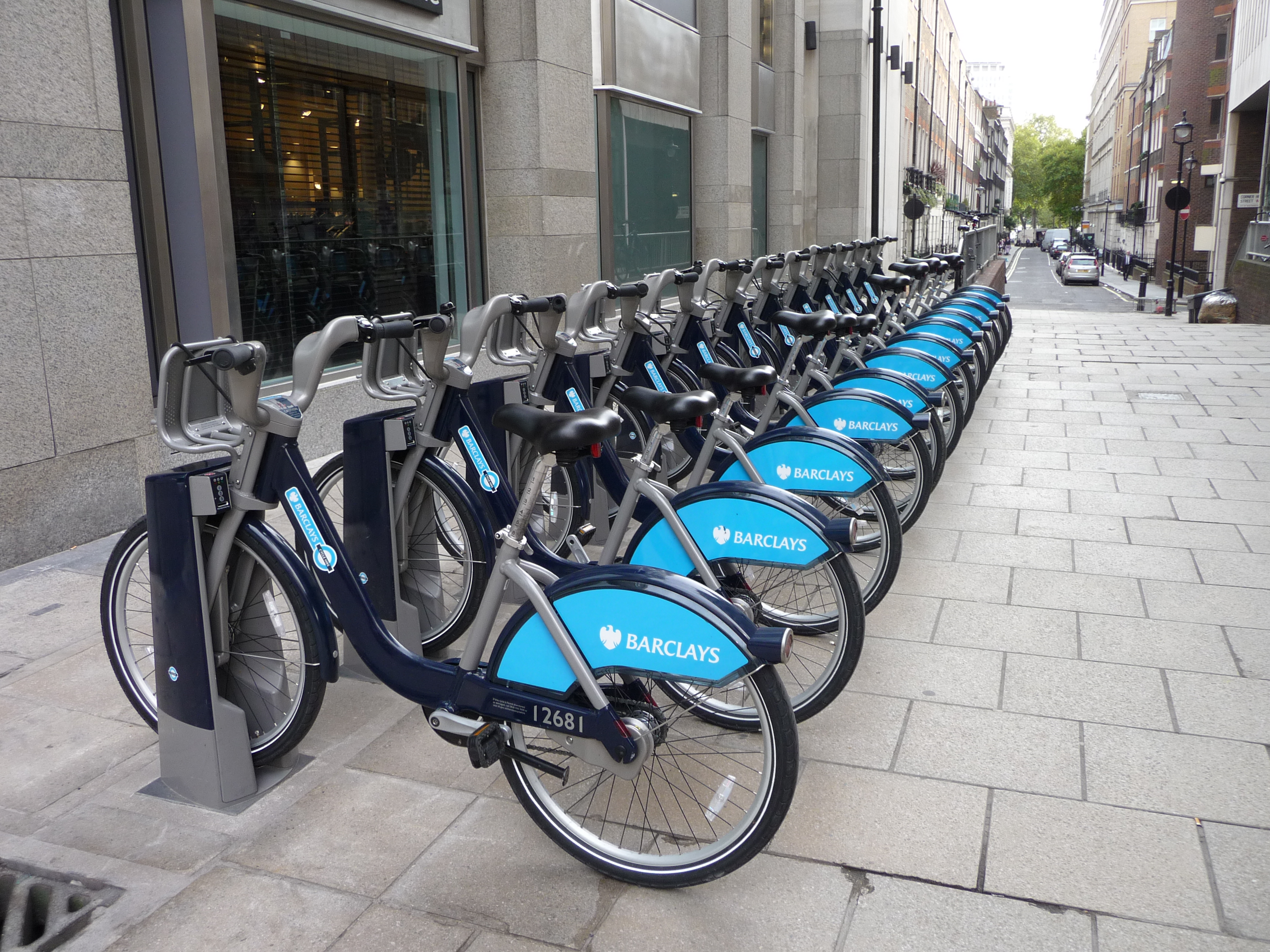
London started one of the earliest bike rental systems in a major city. The bikes are mainly used for short trips. They are free the first ½ hour and only £1 for the next 30 minutes. Watch the video about how the system works.

Bike rental rack by Charing Cross Station-filled up during the work day

Barclays Bank is advertised on the London rental bikes

The bikes were well used after work

About 10 am we passed the bike stand outside the Charing Cross Tube station close to our hotel and all the slots were full. People had either ridden the bikes to work, since this area is a major work location, or to the Tube Station. About 7 pm we passed the same location and only two bikes were left. On that day the bikes were really well used. The biggest lesson learned by the early adopters of bike rental systems was to have visually outstanding bikes. If they looked like normal bikes they often got stolen. A unique look equates to free advertising, too. Several cities in America have similar bike rental systems now and I look forward to Kansas City implementing Bike Share KC in 2012.

Trafalgar Square

London’s Tube is a great asset. If you are going to be in London for a while, consider getting an Oyster Card. Oyster is a plastic Smartcard you can use instead of paper tickets. You put pay as you go credit on it, which you use up as you travel. It is valid across all travel zones and automatically calculates the best value fare for all the journeys you make in a single day. There is a Visitor Oyster card too. London Oyster cards can be used on all buses, trams, Tube, DLR and London Overground services, and nearly all National Rail services. You can buy an Oyster card online before you go. You can also use your Oyster card to receive discounted fares on TfL River Services.

If you  are in the suburbs the London Overground consists of 5 suburban lines. Services have been upgraded and infrastructure improved since the government took it over.

Avoid driving in London since there are so many good transit options. Congestion charging in the central zone in another reason not to drive in the city. The congestion charge is the price you pay to drive into the central zone.  The charge is £10 daily if you pay in advance or on the same day, or £12 if paid the following charging day. There are discounts available. Parking and gas (petrol) are really expensive too. There has been a six per cent increase in bus passengers due to congestion charging and by law, all net revenue raised by the charge (£148m in financial year 2009/10) has to be invested in improving transport in London. Of course you could consider renting an electric car if you need to go somewhere not easily accessible by transit.

Electric Car and Charging Station in Covent Garden

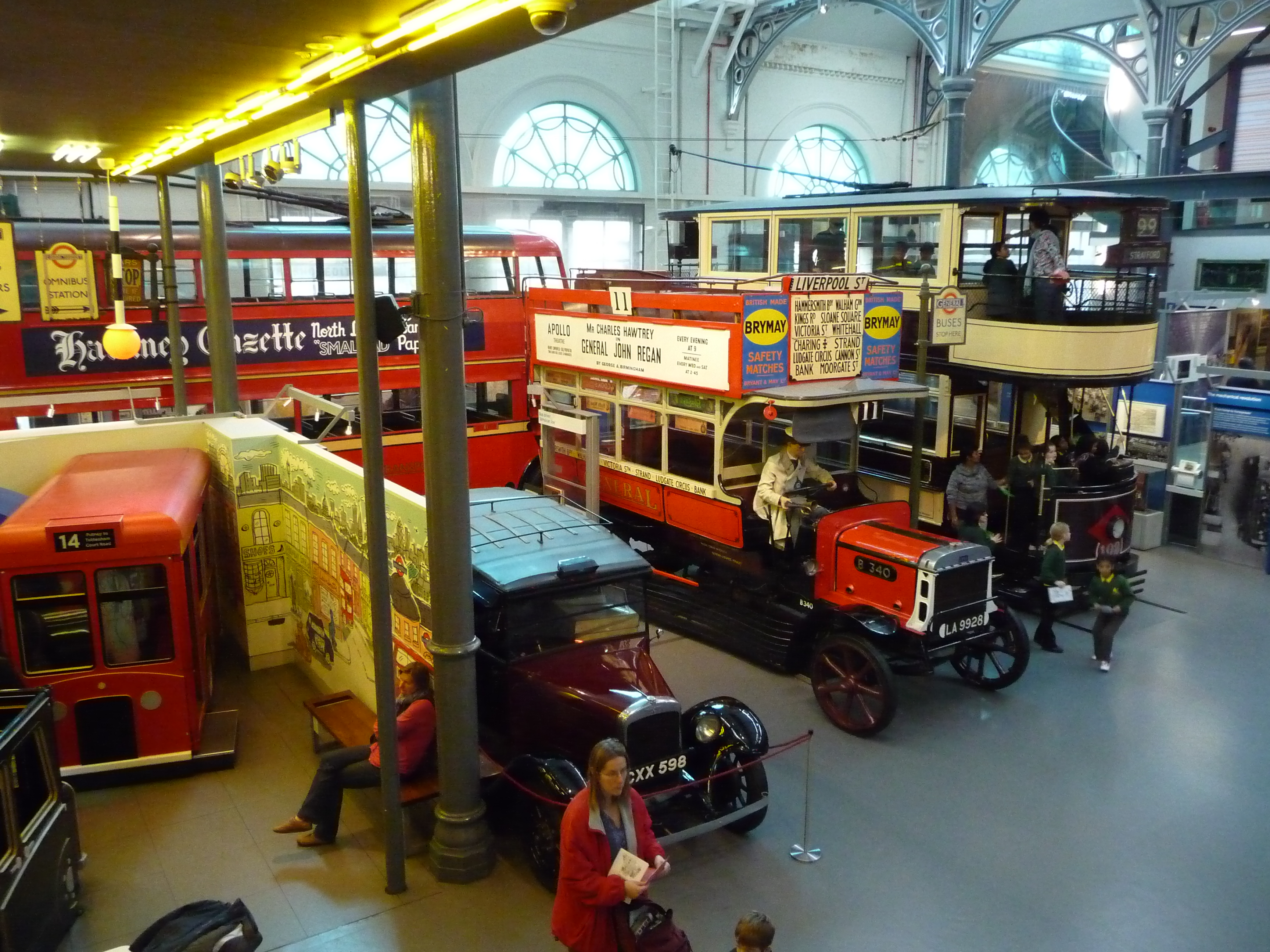
Vintage Transit-London Transport Museum -1

Vintage Transit-London Transport Museum - 2

Be sure to visit the London Transport Museum in Covent Garden. It is in a wonderful steel and glass Victorian building, which used to be the wholesale flower market. Flower girls, like Eliza in the musical My Fair Lady, got their flowers here. Although the flower market has moved south, the London Transport Museum makes good use of this building. It is well worth a visit. There are great displays, information about how the London transportation system developed and historic vehicles. They have special exhibits too. When we were there “Under Attack” showed how the subways were used as air raid shelters during the blitz in World War II.

This article concludes reporting on this trip. I enjoyed sharing what I learned and experienced about transit in these three cities.  The related articles are on Budapest and Prague. Hope you enjoyed reading them.

Happy Traveling!

Janet at the London Transport Museum

Bill strolling through Covent Garden

Janet

Photos by Janet and Bill Rogers except for the red hybrid buses, London cab and Trafalgar Square.

Posted in Transit and Travel | 1 Comment »

JCT Results of Bus Rapid Transit Study – Open House in Overland Park – Oct. 18

Posted by Transit Action Network on October 17, 2011


New JCT bus- Will become pre-BRT CONNEX bus

Johnson County recently completed an  alternatives analysis study that recommends deploying “Bus Rapid Transit service in mixed traffic” for the Metcalf Avenue and Shawnee Mission Parkway corridor. (Metcalf/SMP October 2011 Newsletter) The bus rapid transit route will extend from 119th Street and Metcalf Avenue in Overland Park to 47th Street and Troost Avenue in Kansas City, Mo. Johnson County Transit, and the cities of Mission and Overland Park, will share the study results. The pre-BRT service will initially be “branded” as “CONNEX,” and four buses have already been purchased for this purpose.  TAN is concerned that there is no plan or firm commitment to provide the funding necessary to add service even to the Phase I level described in the October 2011 Newsletter. 

Open House

When: Oct. 18, from 5–7 p.m.

Where: Matt Ross Community Center,  8101 Marty, Overland Park, Kan.

The study evaluated the level of transit service best suited to meet transportation needs in the corridor. This transit corridor connects two states and multiple communities.   Study website  Mixed-flow lanes represent the no-cost, simplest,  most basic type of operation for bus service but they are the least effective BRT service.  According to the FTA Characteristics of BRT 2009 Update “most systems with less than 25 percent improvement (in travel time) operate on-street in mixed traffic lanes”.

New JCT bus- will be pre-BRT CONNEX line

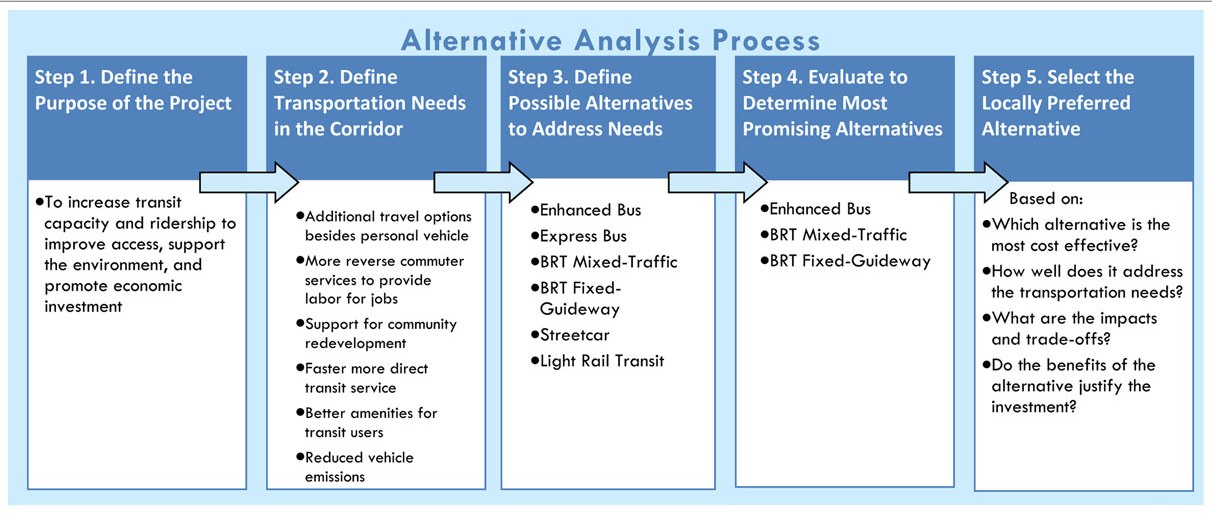
Alternative Analysis Process for JCT - click to enlarge

The Kansas City Regional TIGER (Transportation Investments Generating Economic Recovery) Grant is providing $10.7 million in transit improvements along the Metcalf Avenue/Shawnee Mission Parkway corridor. These infrastructure improvements are scheduled to be complete in November 2012. JCT would not have qualified for Federal money for these types of infrastructure improvements or BRT upgrade using the FTA Very Small Starts program. To receive FTA Very Small Starts funding, like the Troost MAX received,  routes must meet several requirements including at least 3,000 riders per day.  We don’t believe that the whole JCT system averages that ridership per day. By using TIGER grant money for these infrastructure improvements, these requirements did not have to be met.

Aside from spending this federal TIGER money, what steps are Johnson County, The JO, Overland Park, and Mission taking to build ridership in this corridor? TAN understands this line currently serves fewer than 400 riders per day.

Posted in Events | Tagged: | Leave a Comment »

Final Open House-See Designs for State Avenue “Connex” Transit Corridor – Oct 20

Posted by Transit Action Network on October 13, 2011


The Kansas City Area Transportation Authority and Unified Government Transit of Wyandotte County/Kansas City, Kan., are hosting the final open house for the public to review the detailed improvement plans for the “Connex” transit corridor. Displays will provide information about the overall design of the corridor, plus specific plans for two new MetroCenters: Midtown KCK (47th and State Ave.) and Downtown KCK (7th and Minnesota Ave.). This major east-west route connects the city’s revitalized urban core to new development occurring in the Village West area.

Detailed plans for enhanced transit amenities and pedestrian infrastructure in the State Avenue corridor of Kansas City, Kan., will be on display.

When: 3:30–6 p.m. on Oct. 20

Where: St. Patrick Catholic Church Parish Hall, 1086 N. 94th St., Kansas City, KS 66112

Link to more information about the improvements on the KCATA website

The Kansas City Regional TIGER Grant is funding $10.3 million in transit improvements along State Avenue in Kansas City, Kan. The Transit Center and Corridor Transit Station Improvements are scheduled for completion 3rd quarter 2012.

Posted in Events, Local Transit Issues, Transit Studies | Tagged: , | Leave a Comment »

So Many Alternatives to Evaluate in Jackson County!

Posted by Transit Action Network on October 13, 2011


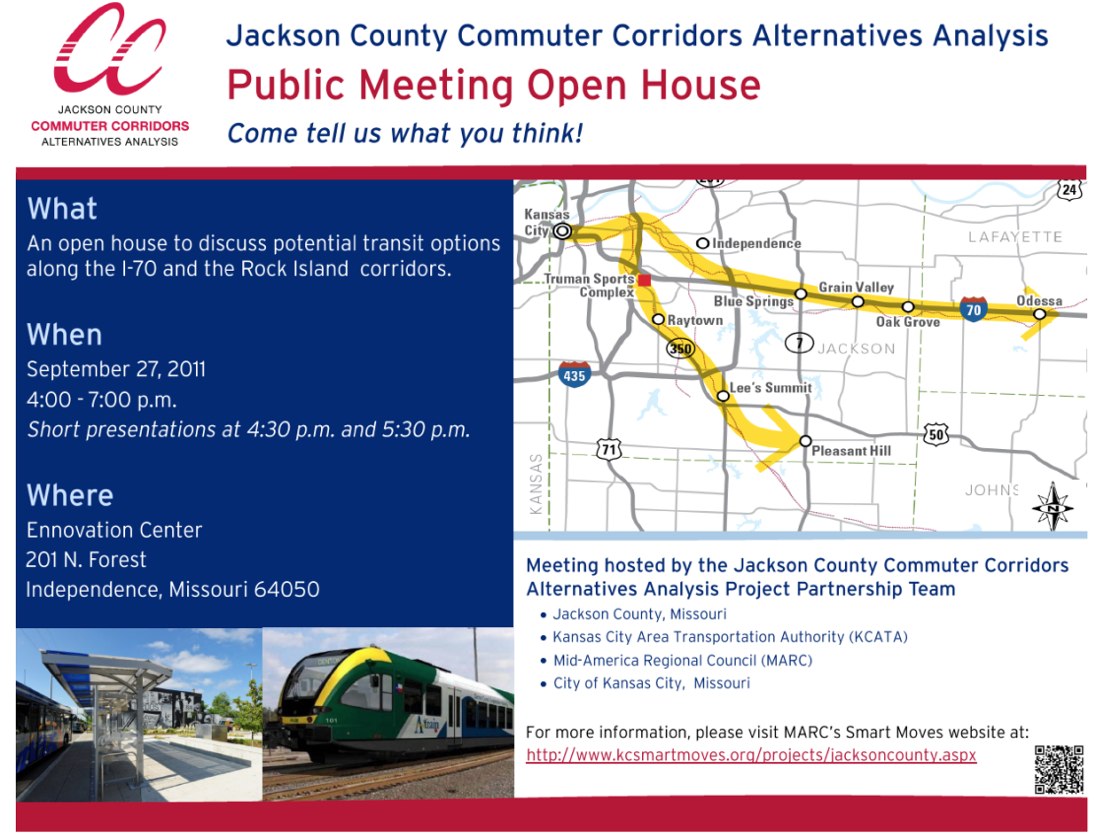
The Jackson County Commuter Corridors Alternatives Analysis is studying six different alternatives to find the best option to improve transit from Eastern Jackson County into downtown Kansas City.  The commuter corridors under consideration are east along the I-70 corridor to Oak Grove and southeast along the old Rock Island Corridor possibly all the way to Pleasant Hill.
JCCCAA Open House-Independence

The Federal Transit Administration requires the study look at different alternatives to find the best and most cost-effective solution in a corridor. At the first open house the project team presented each alternative with descriptions and maps. They published the JCCCAA_Open_House_Booklet_092711 with these details.

The study is guided by FTA standards and will evaluate and compare the alternatives for mobility improvements, user benefits, operating efficiencies, cost effectiveness, ridership numbers, capital and operating costs, existing transit supportive land-use, and economic development effects. Economic development effects are evaluated based on transit supportive plans and policies and the actual performance of the land use policies as well as the potential impact of the project on regional land use.  Transit supportive plans and policies include factors such as growth management, transit supportive corridor policies, supportive zoning regulations near stations and tools to implement land use policies.

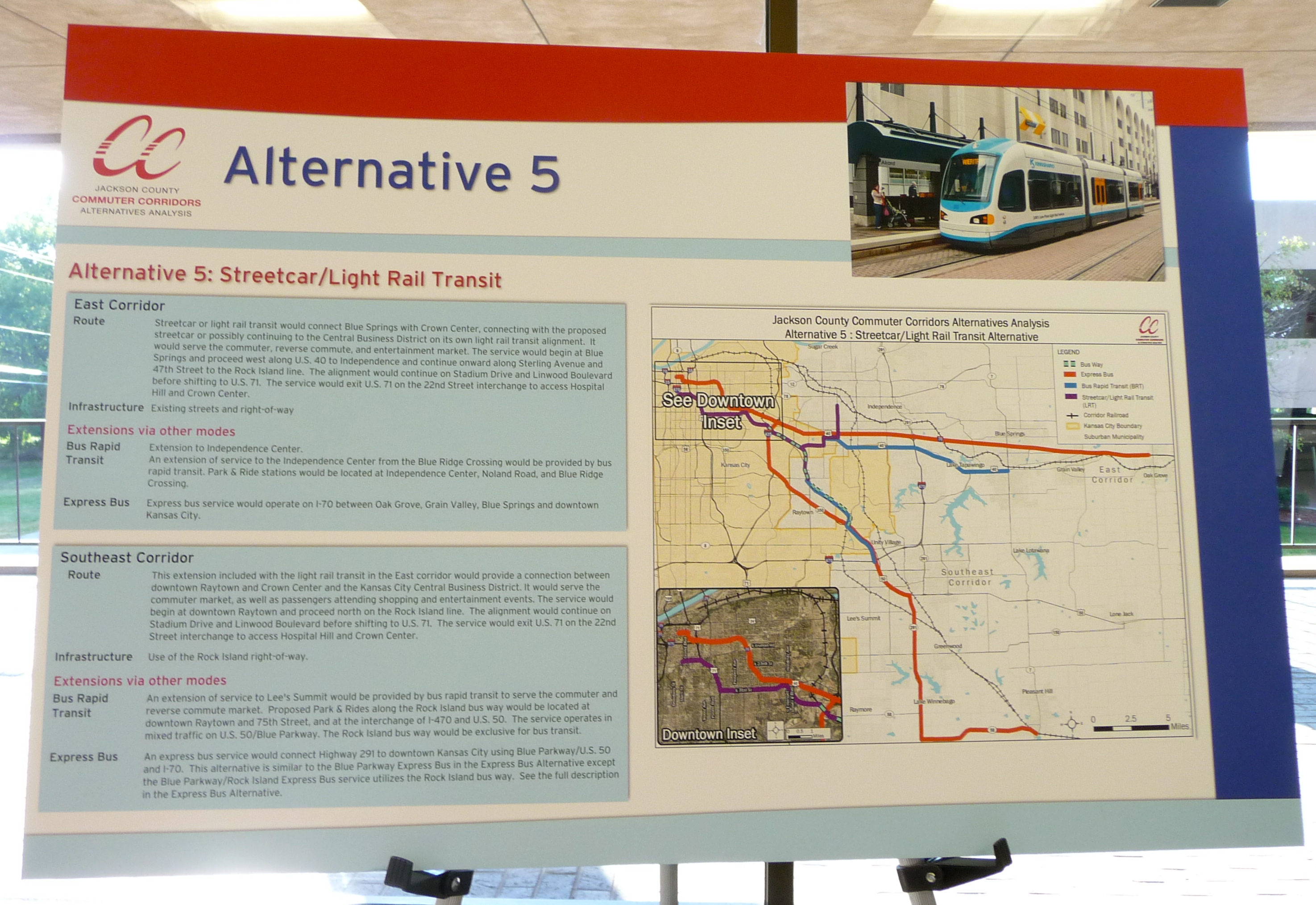
Here are the basic alternatives under consideration. The streetcar/light rail description in the booklet of the Alternative 5 eastern corridor is incorrect. It is a spur into Independence. The map is correct.

Alternative 1 is the baseline alternative for comparison. This is a  “No Build” scenario with minimum investment.

Display board for one of the alternatives

Alternative 2 is Transportation System Management to improve operating efficiency of current systems without adding capacity on the highways or making major capital improvements to the transit system. This could include improvements to the Scout System, improvements to the transit system already identified in the KCATA Comprehensive Service  Analysis, and expansion of Transportation Demand Management/ridesharing programs. TAN feels that many of these ideas should be implemented regardless of the other outcomes in the study since they can be done in the near term with relatively small financial outlays and noticeable improvements to the management of the corridors for all transportation modes, including cars.
Independence Mayor Reimal

Alternative 3 is an Enhanced Express Bus to Oak Grove and Pleasant Hill via the current highway system. There is the possibility of using Bus on Shoulder on I-70 between I-470 and the Kansas City Central Business District sometime in the future.

Alternatives 4 and 5 basically build on Alternative 3 by adding Bus Rapid Transit (BRT) on US 40 and the Rock Island corridor, then adding a streetcar/light rail line from Crown Center that has two spurs, one to Independence and one to Raytown.  In these versions, the southeastern corridor uses the Rock Island corridor as a fixed guideway for the Enhanced Express Bus as well as the BRT.

One of the alternatives 3, 4 or 5 may be the preferred alternative if Regional Rapid Rail isn’t competitive in the analysis.

Alternative 6 is the Regional Rapid Rail system. There are three variations to the route provided, but the Truman Road route has been discussed the most. This system uses underutilized rail in the suburbs but requires new rail in multiple sections including the last seven miles into downtown. The eastern corridor uses the KC Southern line to Noland Road then requires new rail to cut over to the Truman Sports Complex. The southeastern corridor uses the old Rock Island line to just west of the Truman Sports Complex at US40. The Rock Island Corridor has not been used for almost 40 years, so it will be interesting to find out how much renovation is needed to return the line to safe operating condition.

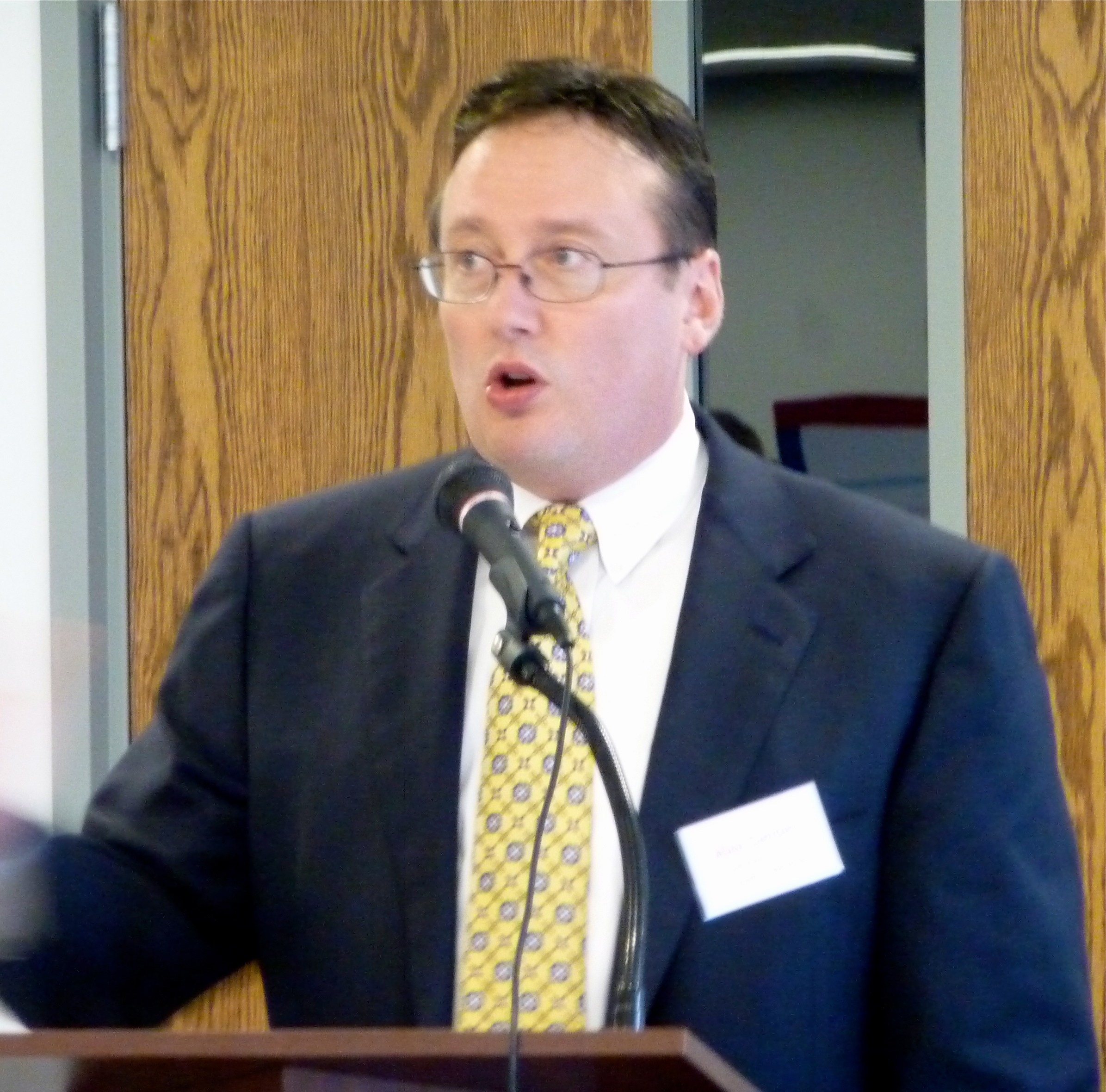
Jackson County Executive Mike Sanders

Study participants from Parsons Brinckerhoff, Shockey Consulting and MARC

Both lines converge just east of the sports complex. There is discussion of a station south of the Chiefs south parking lot, what is currently the wooded area past entrance 3 to the Chiefs parking lot. A train viaduct can be seen as it crosses Blue Ridge Cuttoff just north of Raytown Road.

The two routes use a Common Line into downtown.  The last seven miles of the Common Line, after Leeds Junction by US 40, is on new tracks and often runs on city streets. According to the MARC corridor study in 2010, anytime the DMU (Diesel Multiple Unit) vehicle travels on the streets it will have a maximum speed of 25 mph.  It goes north in the vicinity of 18th and Topping to Truman Road west of Jackson Avenue, and travels on Truman Road at a maximum speed of 25 mph. It turns south on Cherry to 20th where it turns west to arrive north of Union Station in the Freight House district close to Jack Stack Bar-B-Que.  This area is on the old KC Star storage track.  TAN still has many outstanding concerns about this alternative as expressed in an earlier article related to last year’s corridor study.

There are two other versions of this alternative. One has the eastern route stay on the KCS line until 23rd street and skips the Sports Complex. The 23rd street route runs down the center of the street at a maximum speed of 25 mph and connects with the Common Line at I-435. The other variation has both routes connecting at the Sports Complex, and traveling along the Common Line but cross Truman Road and follows the Kansas City Terminal and then the “trench embankment” into the Freight House district north of Union Station.

TAN is waiting on the project team to provide more details about the routes as they proceed in the study. Some sections of the routes are still vague, but that is normal since the study just started and the team needs time to find the best options.

The project team held three open house sessions the last week of September, Independence, Raytown and Union Station, to explain and discuss the “Purpose and Needs” statement for the project and show the public the proposed alternatives. There was an excellent turnout. Three additional public meetings are planned in November 2011, January 2012 and March 2012.  Visit the study’s website for more information.
Project Leader Shawn Dikes

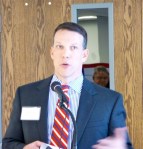
In Independence, Jackson County Executive Mike Sanders spoke about the need to plan ahead for future transit needs. He also made the point that even if you personally don’t use transit many of the people you interact with do, so you still need transit. Parsons Brinckerhoff Project Manager Shawn Dikes had a PowerPoint presentation to explain the study. See his presentation JCCCAA-Open-House-Presentation-Sept2011

This study is costing $1.2 million. MARC plans to add the study for the US71/Grandview corridor to this study. Jackson County has already received $652,200 to do that study plus MARC has applied for another $1.2 million for the US71 corridor and hopes all these studies can be combined.

TAN feels very strongly that the region needs to implement the best alternative from this study, whether it is Enhanced Express Bus, BRT, Streetcar/Light Rail, Regional Rapid Rail  or a combination.  If we are going to spend this amount of money on studies then it is our responsibility, to the best of our ability, to implement the recommendations that come out of them.

Posted in Local Transit Issues, Meeting Reports, Rail, Transit Studies | Tagged: , , | Leave a Comment »

Why a downtown streetcar?

Posted by Transit Action Network on October 4, 2011


Probably the best reason for a streetcar is that the people in this corridor want it. If you look at past voting records from the light rail votes, people in the downtown corridor consistently vote for it. People in this area will also be the biggest beneficiaries of it; and they’re the most enthusiastic about it.

Rail is a service upgrade from buses. Streetcars offer a smoother ride. Their route is clearer, especially for infrequent riders such as visitors. There is a lower risk you will wind up where you don’t want to be and have to find a way back. Many people simply prefer rail over buses.

Rail, together with appropriate land use policies, transit oriented zoning codes and improved passenger amenities, offers potential for channeling economic development to the route.

10,000 people live downtown now. An estimated 57,000 people work and live within three blocks of the proposed line. River Market is the fastest growing residential area in the city. The Sprint Center, Power & Light District, Kaufman Performing Arts Center, the continued explosion of retail and entertainment in the Crossroads, new buildings and renovated buildings all mean more and more people are living and working along the proposed streetcar route. In the downtown corridor there is now the density of residents, jobs, and entertainment destinations to generate the number of trips that should make the streetcar a success.

Since this 2.2 mile starter line focuses on such a small segment of the city no one is going to ask the whole city to pay for it. Although the project team is just starting an in-depth analysis for financing options, a Transportation Development District is high on the list of options for at least some of the funding. Additional funding sources, like federal Small Starts money, can be pursued. The project team may identify other funding mechanisms too. Many other cities started off paying for small starter lines themselves.

What about MAX? MAX has proved that additional people will take transit if it meets a certain standard. Much of the Main Street MAX won’t be affected by the streetcar but a small section of the MAX route may change to another street, where MAX overlaps the streetcar. This change would provide even more transit options in downtown.

Let’s do this Kansas City. It is time to get started with rail in an area that cries out for it!

Additional information

Click to enlarge

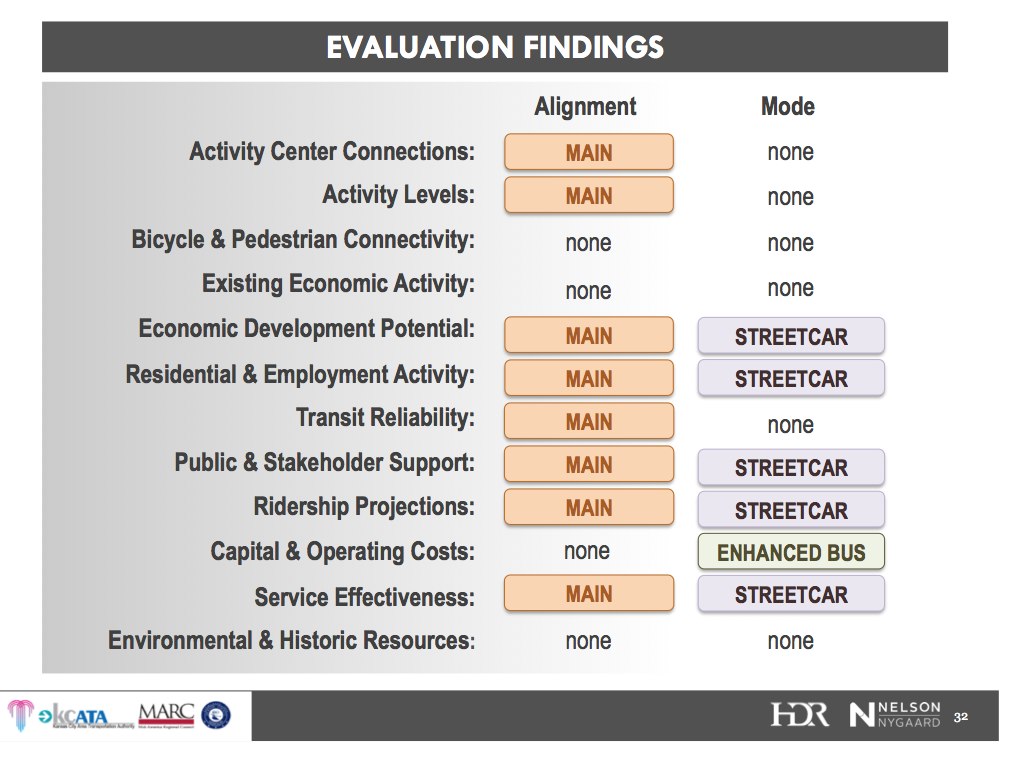
The Project Team for the Downtown Corridor Alternatives Analysis recommended a streetcar on Main Street for a service upgrade between the River Market and Crown Center. The City Council unanimously adopted this alternative last Thursday.

Summary of evaluation findings: this table shows the preference for each evaluation criteria for both the alignment (Main vs Grand) and the mode (Streetcar vs Enhanced Bus).

See the project team’s full presentation to the Parking and Transportation Committee on 9/20 including the map with major activity centers.  Preliminary engineering may cause some changes to the final route. KC-DCAA-Tier2-Evaluation-Presentation

View all the project team documents at http://www.kcsmartmoves.org/projects/downtowncorridor-documents.aspx

According to the project documents “The financing plan may potentially be used to apply for federal funds through New Starts, Small Starts, or other federal programs. Creative leveraging of private funding options, public/private partnership options, and federal grant opportunities will be explored. Ultimately, the preferred financing strategy will be one with great local support—voted on not through a city-wide initiative, but by targeted partners willing to invest in strengthening the downtown Kansas City economy through this project.”

Read the KC Star: http://www.kansascity.com/2011/09/29/3174905/kc-council-committee-backs-proposed.html#ixzz1ZNn7D3tb

Posted in Local Transit Issues, Rail | Tagged: | Leave a Comment »

First Open House – SEPT 27- Jackson County Commuter Corridors Alternatives Analysis

Posted by Transit Action Network on September 22, 2011


The first open house for the JCCCAA will be September 27 at the Ennovation Center, 201 N. Forest, Independence from 4 pm to 7 pm. Jackson County Executive Mike Sanders and the Parsons Brinckerhoff Project Manager Shawn Dikes will give short presentations at 4:30 pm and 5:30 pm. Be there to see maps of the alternatives under consideration for upgrades to commuter transit service from eastern Jackson County (and beyond) into downtown Kansas City in the I-70 Corridor and the Rock Island corridor.


There are two additional opportunities for public comment. The project boards from the open house will be displayed at key locations in the corridors from 9 a.m. to 7 p.m.  Project partnership and consultant team staff will be on hand to answer questions from 5 to 7 p.m.  These additional meetings will take place according to the following schedule.

Posted in Events, Local Transit Issues, Rail, Regional Transit Issue, Transit Studies | Tagged: , , | Leave a Comment »

Main vs. Grand? Streetcar vs. Bus? Final Open House!

Posted by Transit Action Network on September 15, 2011


The Partnership Team for the Downtown Corridor Alternatives Analysis (AA) is getting ready to announce the recommended route (Grand Blvd. or Main St.) and type of service (streetcar or bus) for a downtown starter line from the River Market to Crown Center.  Find out about the purpose of the study  and the decision-making  process used to arrive at these recommendations at the third and final open house. A general strategy to fund construction, operation, and maintenance of the starter line will be presented too.

Third and final public open house

When: Tuesday, Sept. 20, 2011, from 4 to 6:30 p.m.

Where: In the atrium of the Steamboat Arabia Museum (in the River Market)

400 Grand Blvd, Kansas City, Mo.

No formal presentations will be given.

View the news release. http://www.kcsmartmoves.org/news/2011-09-08_dcaa_third_open_house.aspx

Posted in Events, Local Transit Issues, Rail, Transit Studies | Tagged: , | Leave a Comment »

So Many Studies, So Little Transit

Posted by Transit Action Network on September 14, 2011


In September of 2009, Brad Cooper of the KC Star wrote an article titled “KC’s rail dreams prove costly; Area has little to show for its money, but advocates say every study moves city closer to a solution.” Brad writes about Kansas City’s “love-hate relationship with transit that has cost taxpayers nearly $17 million, mostly in federal cash”.

In 2011 the Brookings Institution ranked the Kansas City region as 90th of 100 cities in our ability to get people to work using transit.

After decades of transit studies and a MARC developed regional transit plan called Smart Moves, why do we still have such limited transit service in the region?

Will the two “Alternatives Analysis” studies currently being conducted turn this pattern around?

Janet Rogers, co-founder of Transit Action Network, is convening a Communiversity course to discuss these issues and more on Oct 8. Be there!

From the Communiversity catalog:

Social Concerns Section

8002A
Millions and Millions of Dollars for Transit Studies-Where’s the Transit?
Why does the KC region have transit studies but rarely add any additional transit? What are our chances of getting a downtown streetcar or commuter rail? What happened to Smart Moves? What is an alternatives analysis? What can we do to improve the situation? Get the transit scoop from a co-founder of Transit Action Network and transit advocate for over a decade. Bring $2 to class for handouts. Janet Rogers worked to save the Eastern Jackson County commuter buses and restore KC transit funding.
CONVENER: Janet Rogers
CLASS FEE: $9.00
Sec. A: 1 session(s); Beginning Saturday, October 08, 2011 1:00 PM;
Flarsheim Hall, Rm. 260, 5110 Rockhill Rd., UMKC Campus, KCMO, Rockhill Rd. south of 51st.;
LIMIT: 30

Communiversity Online Class Registration Site.

https://ecomm2.umkc.edu/commu/

Course page  https://ecomm2.umkc.edu/commu/BrowseDetail.aspx?category=social

Posted in Events, Local Transit Issues, Rail, Regional Transit Issue, Transit Studies | Leave a Comment »

KCATA Invites Comments on Proposed 2012 Route Changes

Posted by Transit Action Network on September 13, 2011


KCATA is proposing changes to transit service in Kansas City, Mo. The goal, according to the Metro, is to provide the most efficient service while holding the line on costs and not increasing the their budget.

Route changes for more than 50 routes serving Kansas City, Mo. have been released for public review and comment.  Phased implementation will begin as early as April, 2012.

These proposals are a result of a Comprehensive Service Analysis, or CSA, performed by transit consulting firm Nelson Nygaard of Boston.

We encourage you to review the proposed changes.

There are several ways to comment:

  • Online Form: www.kcata.org/metro2012
  • Mail: KCATA, Planning Dept., 1200 E. 18th St., Kansas City, MO 64108
  • Phone: 816-346-0300 (leave comment on prerecorded line)
  • Email: metro2012@kcata.org
  • Public Meetings: To be scheduled this fall. Meetings will be announced on the KCATA website, in passenger bulletins and on TAN’s website.

Once comments are received, schedules will be designed to improve reliability, provide more direct service and better match demand.  “One of the goals of the CSA is to make riding transit more attractive by designing service that is more intuitive and rider-friendly,” says a KCATA news release.

For further perspective, view a presentation about the proposed changes made to the KCATA Board of Commissioners in August.  It gives an overview of the CSA process.

Presentation of Proposed Route Changes 2012

TAN is reviewing the proposed changes and will be submitting comments.

Many of the changes look really good to us.  Here are some of our initial impressions:

  • Providing service to KCI between 5:30 am and 11:00 pm, seven days a week, will be a great improvement.  Seven-day service to the airport is of enormous symbolic importance.
  • We didn’t see indication that Main Street MAX would be straightened through Downtown, or that Plaza-only trips would be extended to 51st Street in order to better serve UMKC and the Plaza Library.
  • Elimination of Route 57 means there will be no local stops on Main between the Plaza and Downtown.  That might be a problem.

  • Service changes proposed for the area west of Main Street appear complicated and deserve careful review.
  • Service changes proposed for the Northland are, likewise, complicated and deserve careful review.
  • It’s a small thing, but we especially like the emphasis on “clockface headways.”  This means buses would be scheduled to come past each stop at regular intervals — every 10, 15, 20, 30, or 60 minutes.  Thus, for example, you’d be able to count on a bus at 17 and 47 minutes past the hour.  (Night service at the 10th and Main Transit Center already works this way — after 6:30 pm, buses on 10 or more routes depart shortly after 10 and 40 minutes past the hour.)

One last very important point:  Proposed route changes may make transit a little less convenient for some people, but it’s also likely that the change will make transit a more viable option for even more people.  That’s what’s really important.

Posted in Action, Local Transit Issues | Tagged: | 2 Comments »

New ID Card Puts Transit in UMKC Student Pockets

Posted by Transit Action Network on September 10, 2011


After years of discussion, UMKC students now enjoy public transit as part of their activity fee.

UMKC students who are currently enrolled and have a NEW “One Card” student ID have full access to MAX and other Metro bus routes.  Students just “swipe” their One Card through the farebox and ride in style.

Students voted last spring that all students would pay an additional $14 per term to get full access to the KCATA transit system. What’s more, the spring term card is good all summer, so the cost is only $28 dollars a year.

UMKC  is served by both Troost MAX and Main Street MAX, routes that have the highest level of service in the entire region. It’s less than a month into the program and already students are using their cards nearly 1,000 times a day, far more than projected.

To TAN’s surprise and pleasure, KCATA included access to its premium express routes from the suburbs. The Blue Springs, Lee’s Summit and Liberty routes are normally $3 each way, but the pass is also valid on these KCATA routes.

KCATA has posted a UMKC New Rider Starter Kit  on it’s website. The best part though is the link to a YouTube video the students made about the new service. We should all have that much energy! We do have that much enthusiasm for transit and the possibilities and options it provides: savings for students, plus a boost in ridership for The Metro.

Posted in Local Transit Issues, Regional Transit Issue | Tagged: | Leave a Comment »

Commuter Corridors Advisory Group Has First Meeting

Posted by Transit Action Network on September 8, 2011


The first meeting of the Jackson County Commuter Corridor Alternatives Analysis Stakeholder Advisory Panel was held on August 31. Project manager Shawn Dikes of Parsons Brinckerhoff said the study team is “starting from scratch,” and that they are not here to validate some pre-determined solution.  TAN advocates Janet Rogers and Mark McDowell are on the panel.

The study team offered a wider range of options than a lot of people expected: several bus alternatives; streetcar or light rail on a couple of alignments; and several “commuter rail” alignments that had not previously been seen in public. Dikes admitted, however, that they chose to eliminate such options as subways, monorails, and gondolas.  (That got a laugh.)

By consensus the group eliminated a commuter rail route that would terminate at the north edge of the river market.

Dikes reminded the panel that FTA funding for rail projects that are doing well in an AA are currently receiving a maximum of 50 % of the capital costs to build the system. Asking for less money increases a project’s chances of being federally funded.
Whether a suitable so-called “common line” can be found westward from near the sports complex into downtown Kansas City may turn out to be the critical question for commuter rail. At the meeting, TAN expressed concern that one of the routes would go through a disadvantaged community in the vicinity of 18th and Topping. Project work has to comply with Title VI of the Civil Rights Act of 1964.  Disadvantaged communities affected by the project have to be included in the planning process and the project cannot adversely affect the community. Lawsuits have been field against rail projects in other cities related to this issue.  MARC is already discussing these issues with community leaders.

Dikes said that the FTA would not fund rail that hurts bus service.  The rail service in this study would likely differ enough from express bus routes, that the express buses could not be eliminated in order to help pay for rail.

Transit Action Network posted some concerns a couple of weeks ago about the commuter rail concept as developed in last year’s corridor study: https://transactionkc.com/2011/08/16/consultants-face-big-challenge-studying-regional-rapid-rail/

The consultant team has drafted a “Purpose and Need” statement and is currently developing an executive summary.

According to the FTA: “(A) study “purpose and need” establishes the problems that must be addressed in the analysis; serves as the basis for the development of project goals, objectives, and evaluation measures; and provides a framework for determining which alternatives should be considered as reasonable options in a given corridor. … This information provides the context for performing the analysis and for identifying the measures against which alternatives strategies will be evaluated. It also serves as an introduction for decision makers, stakeholders, and the general public to the study area and its transportation problems and needs.”

The FTA goes on to say that “the purpose and need statement serves as the cornerstone for the alternatives analysis.” The statement should not point to one solution, but be as concise as possible, focusing on the primary transportation issues addressed in the alternatives analysis.

The first public meeting on the alternatives analysis will be from 4:00 to 7:00 p.m. on September 27, 2011 at the Ennovation Center, 201 N. Forest Avenue, Independence, Mo. The focus of the meeting will be on the purpose and need for the project and the range of alternatives being considered. Four public meetings are planned. Details will follow as they become available.
Posted in Events, Local Transit Issues, Meeting Reports, Rail, Regional Transit Issue, Transit Studies | Tagged: , | Leave a Comment »

Excitement at Union Station – Modern Streetcar – Hybrid MAX bus -Information on DCAA

Posted by Transit Action Network on August 23, 2011


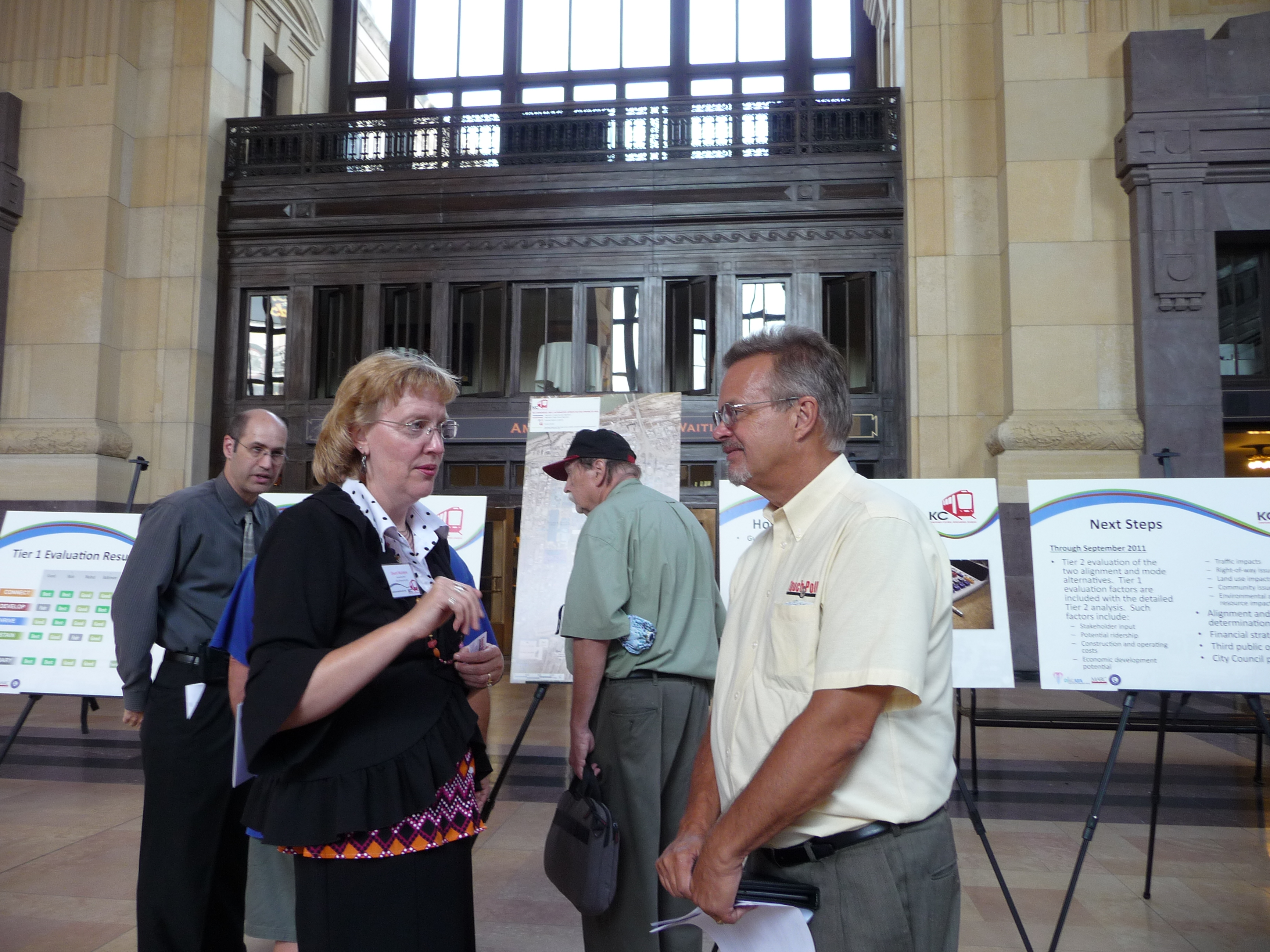
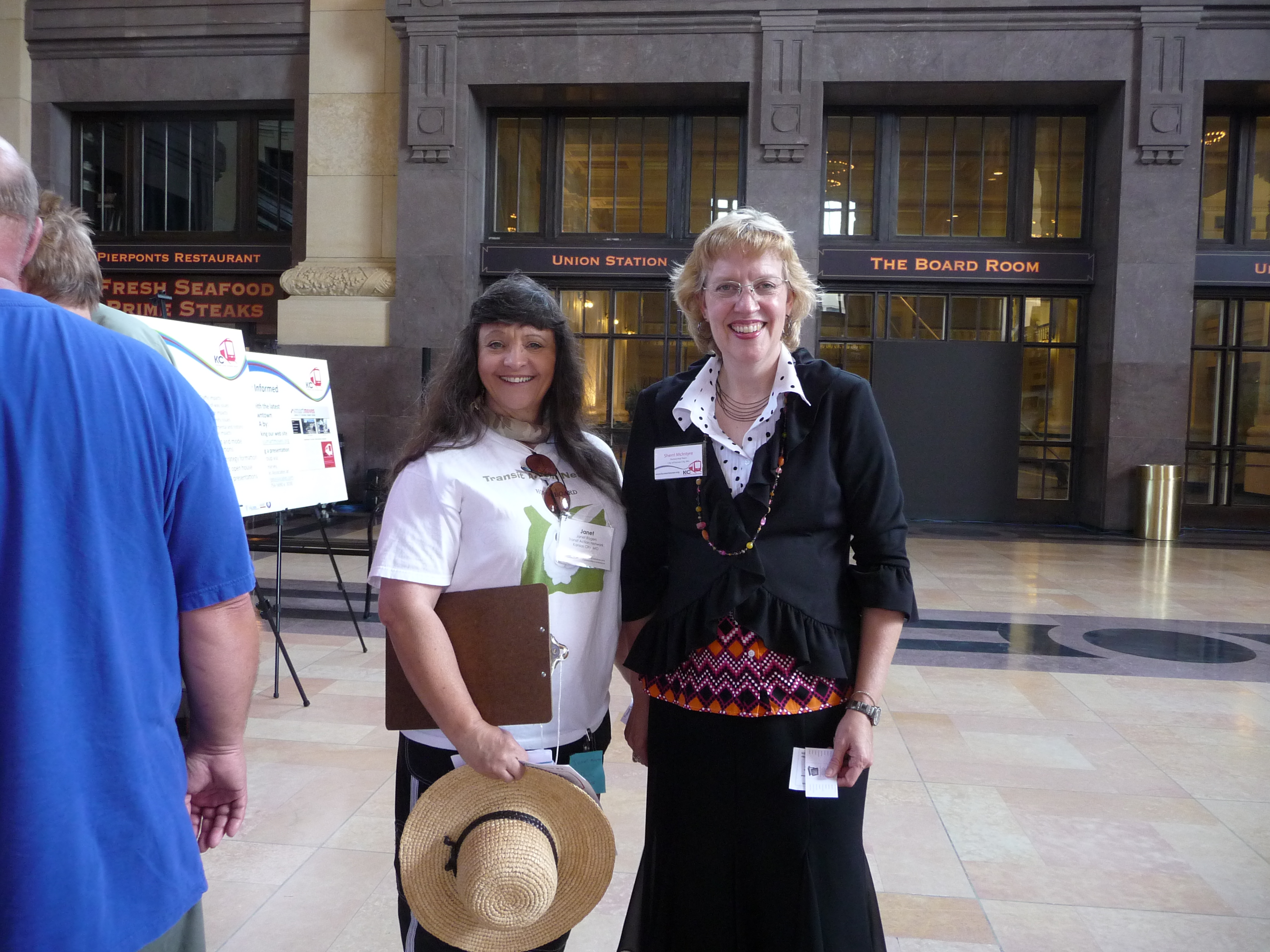
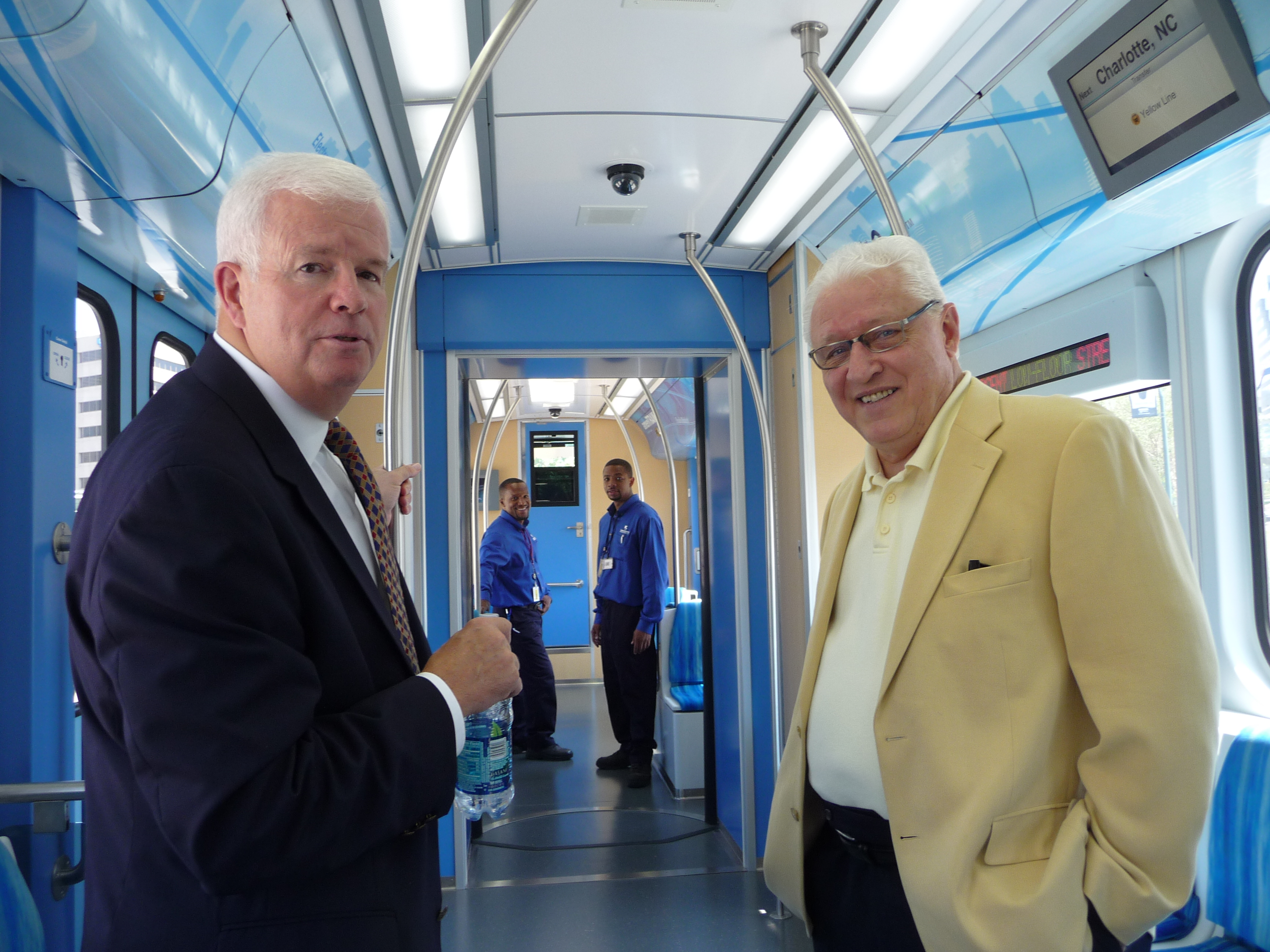
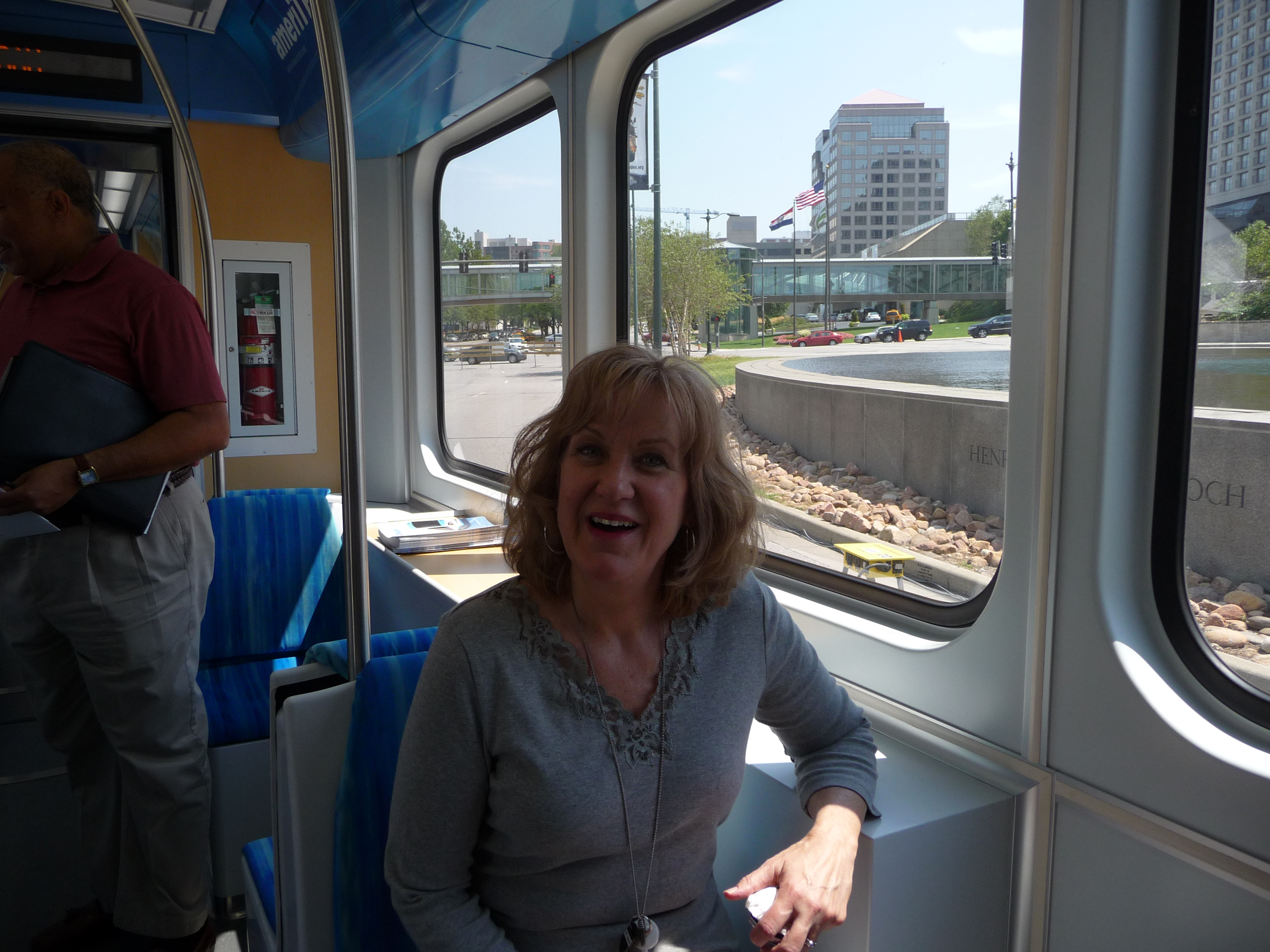
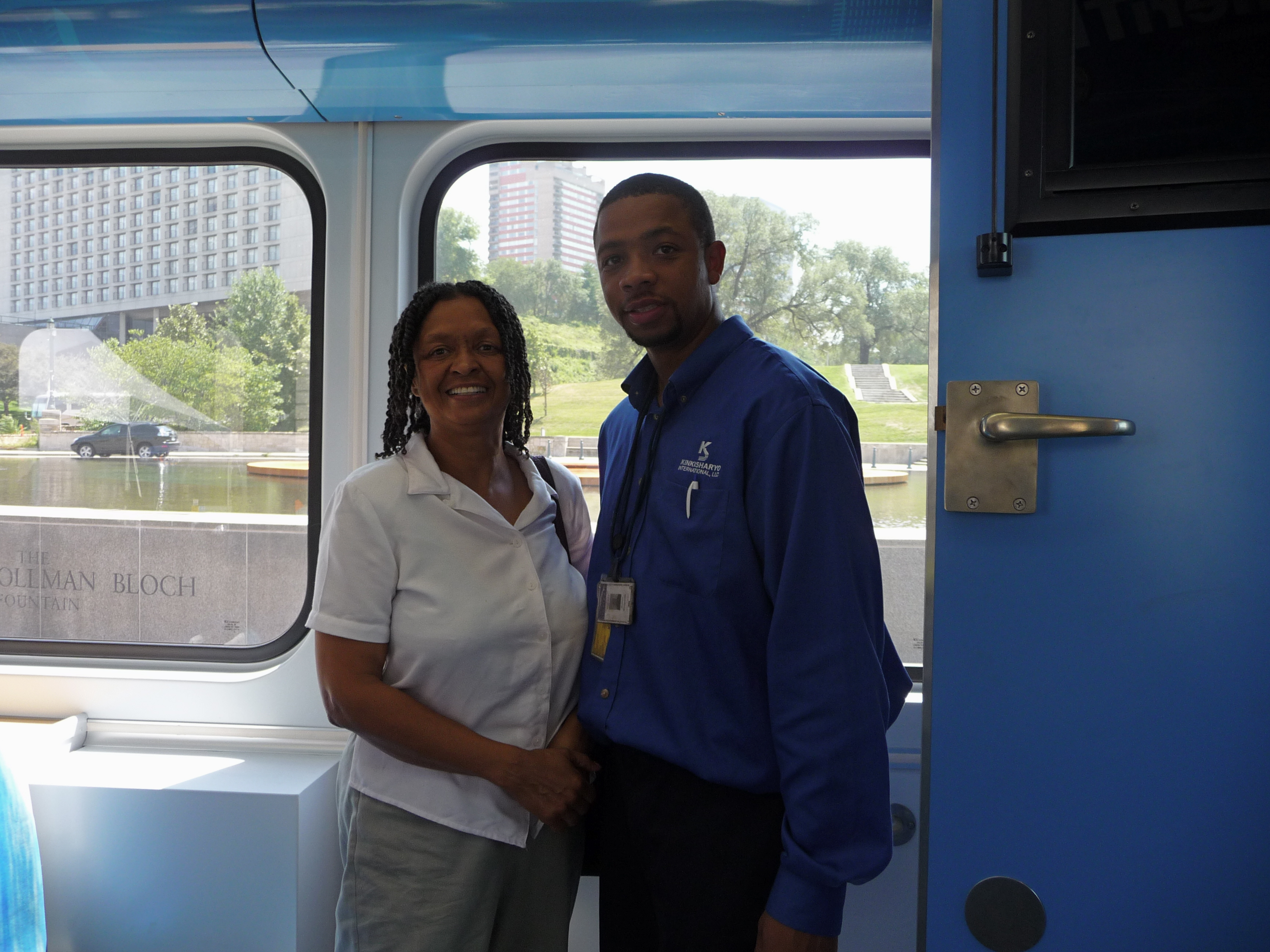
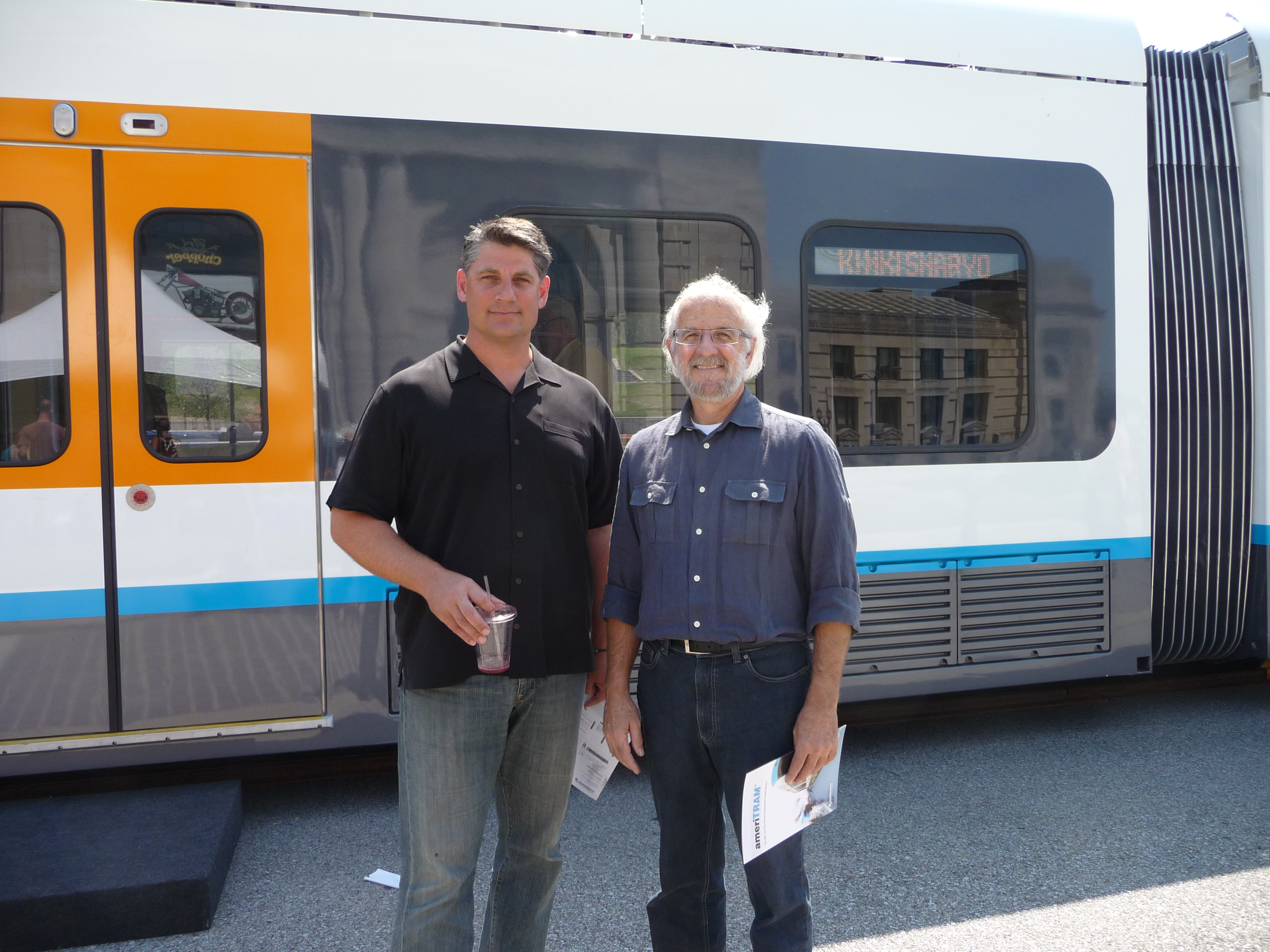
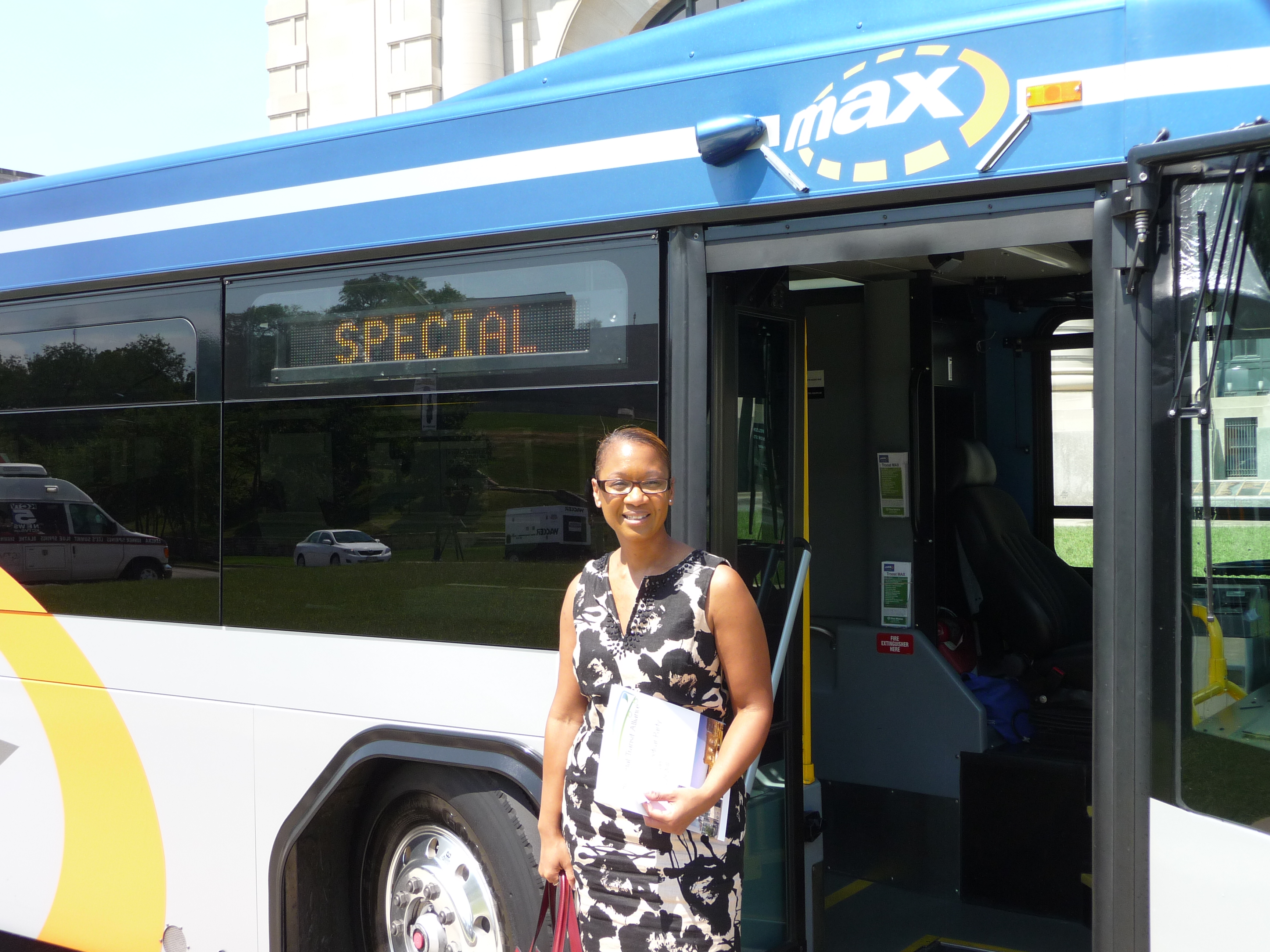
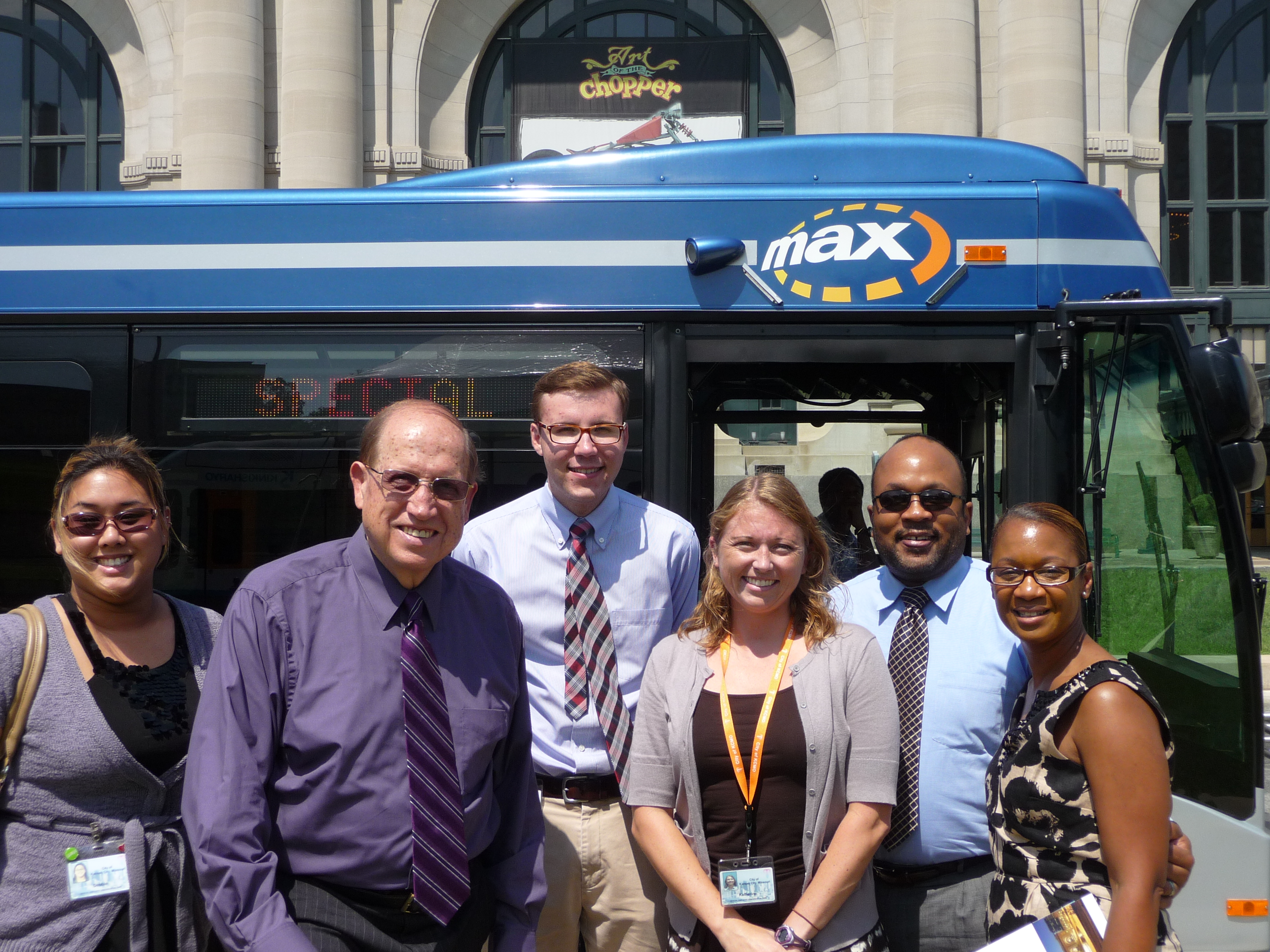
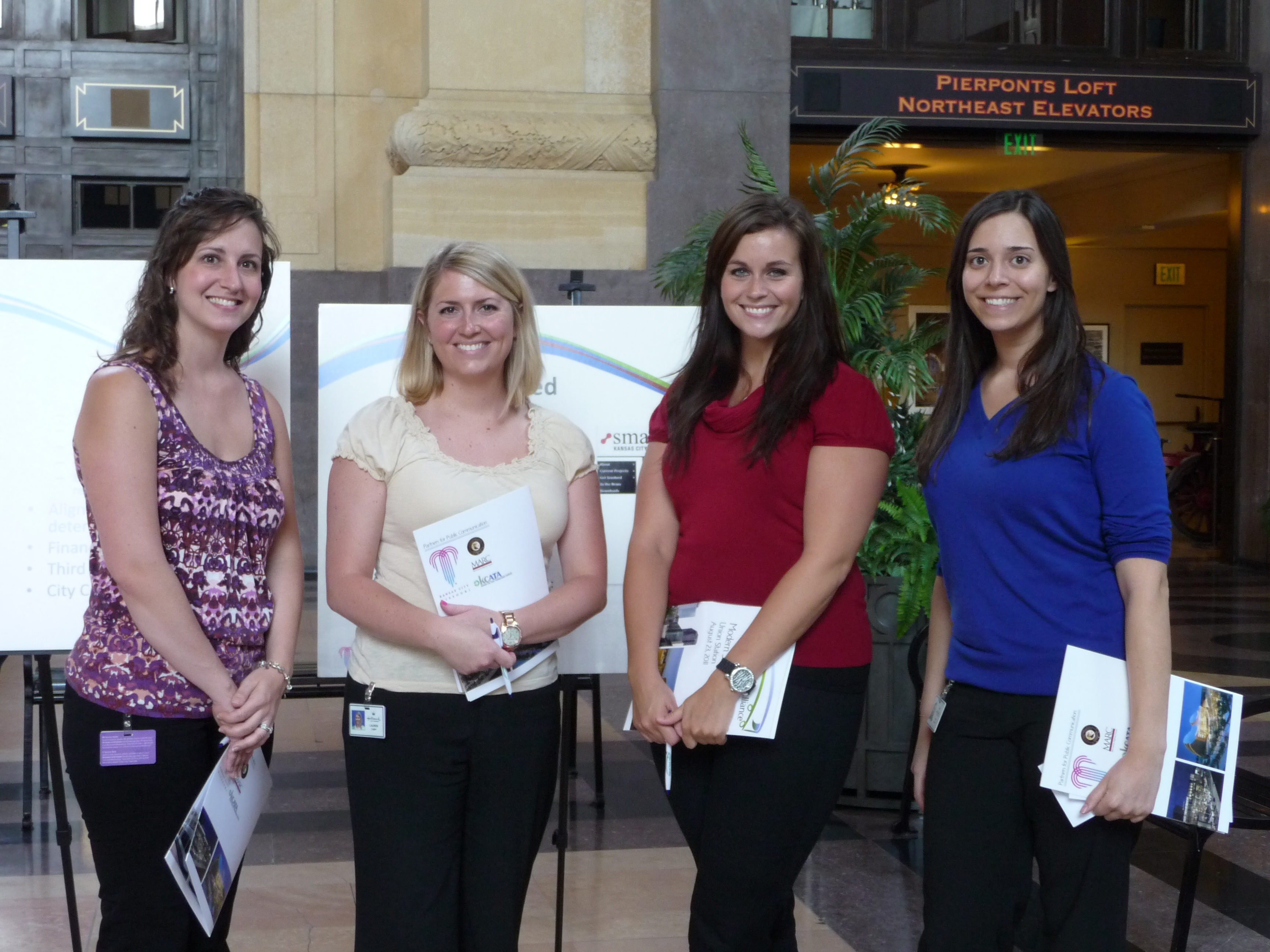
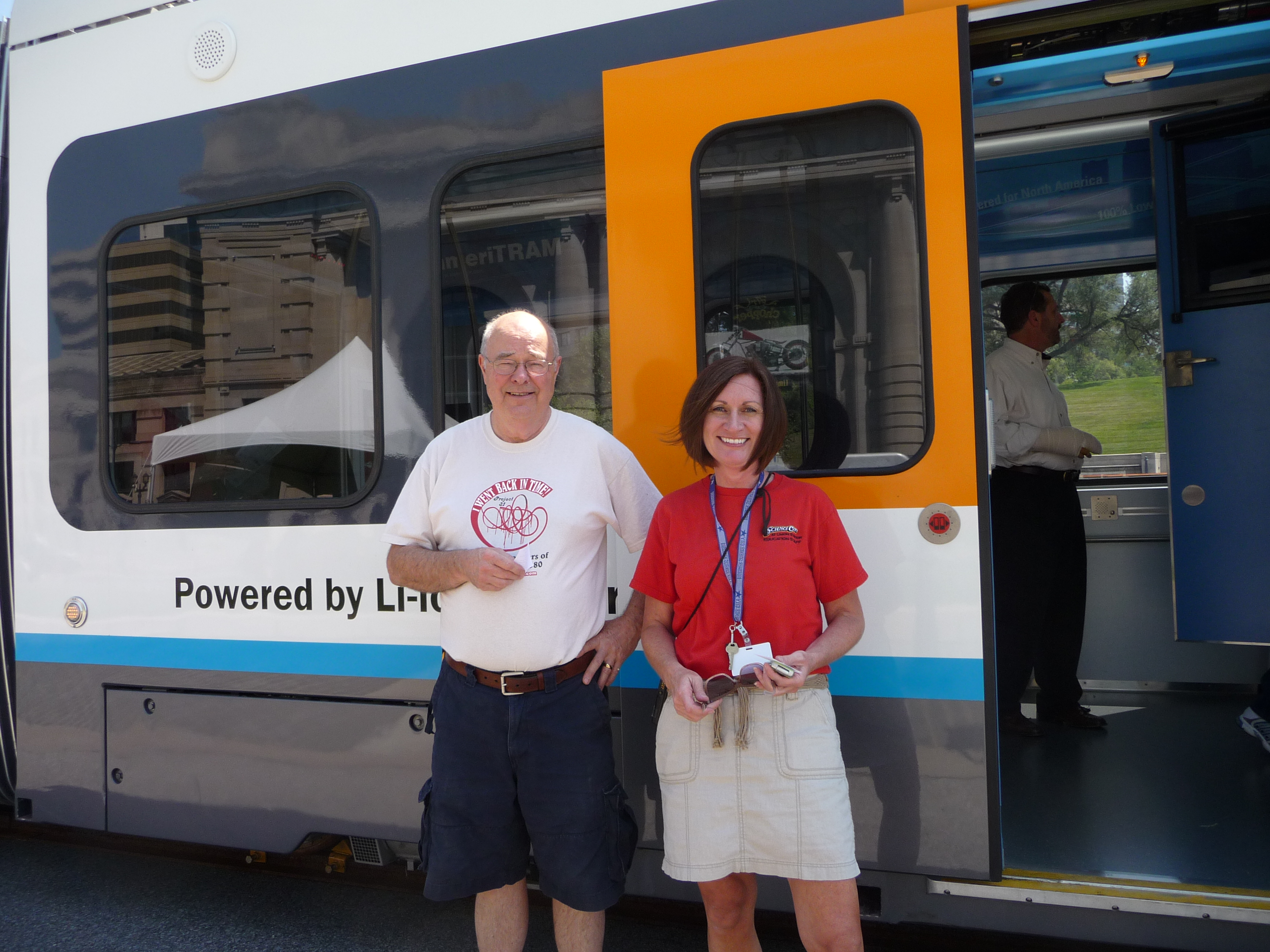
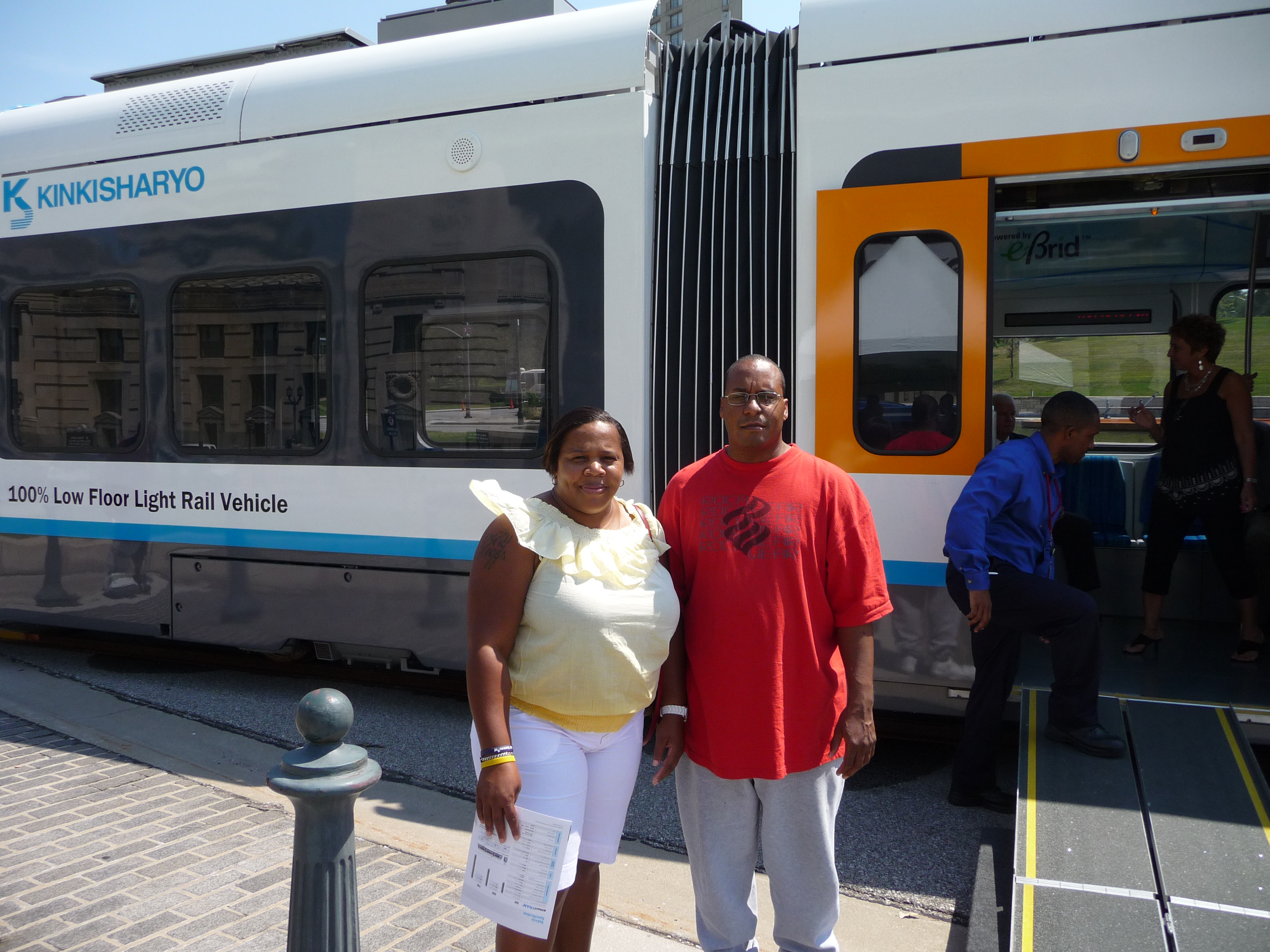
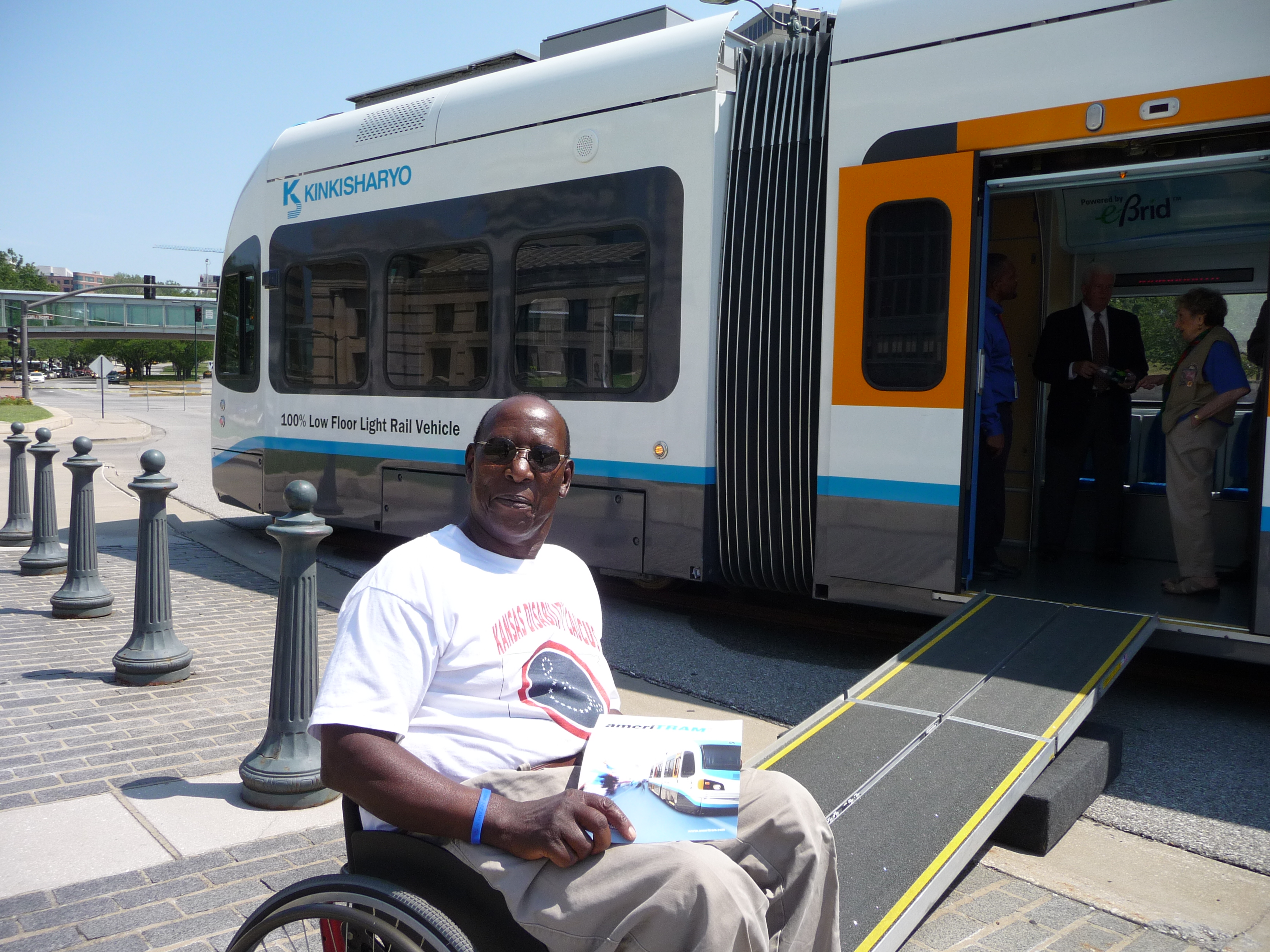
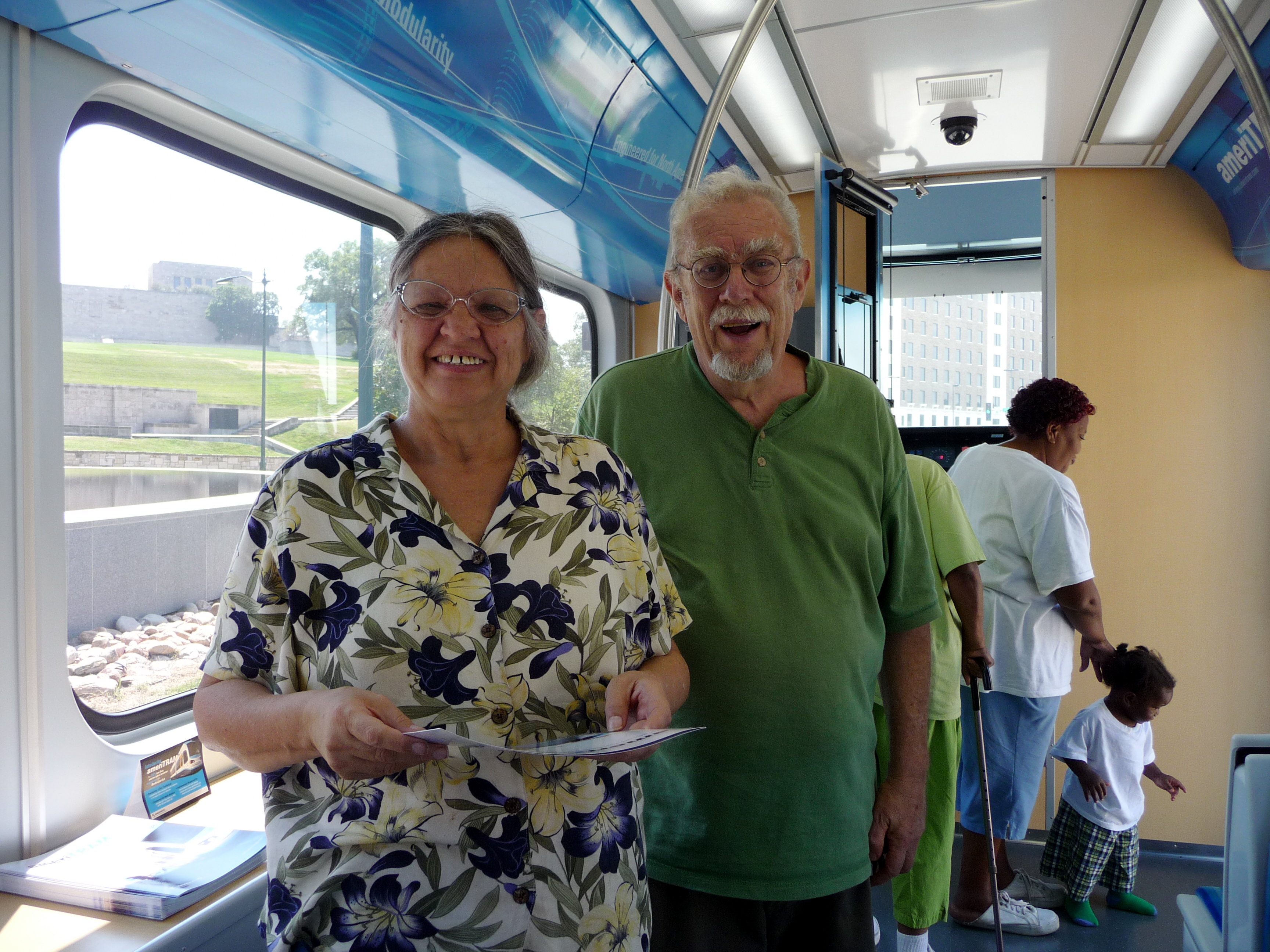
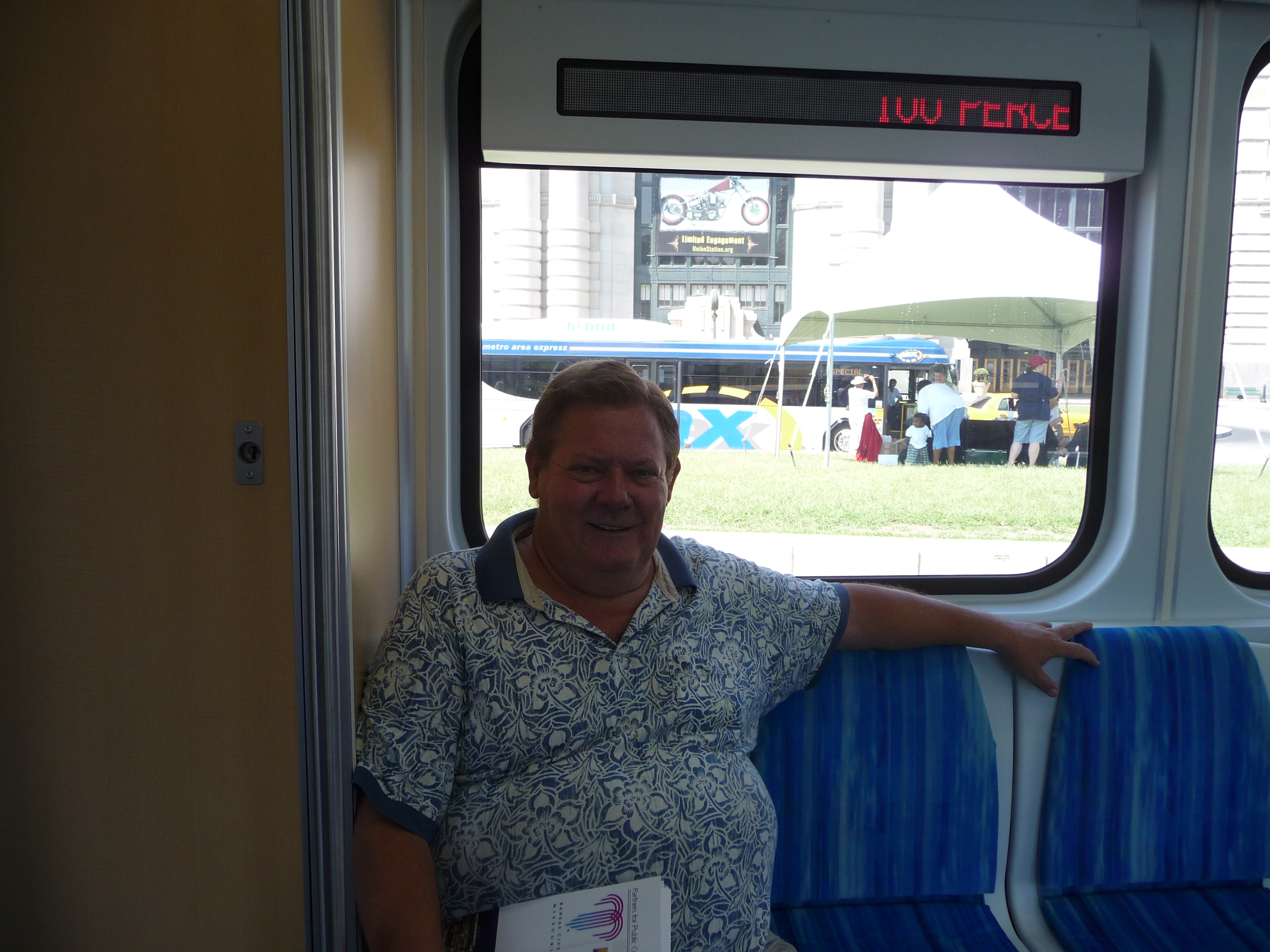
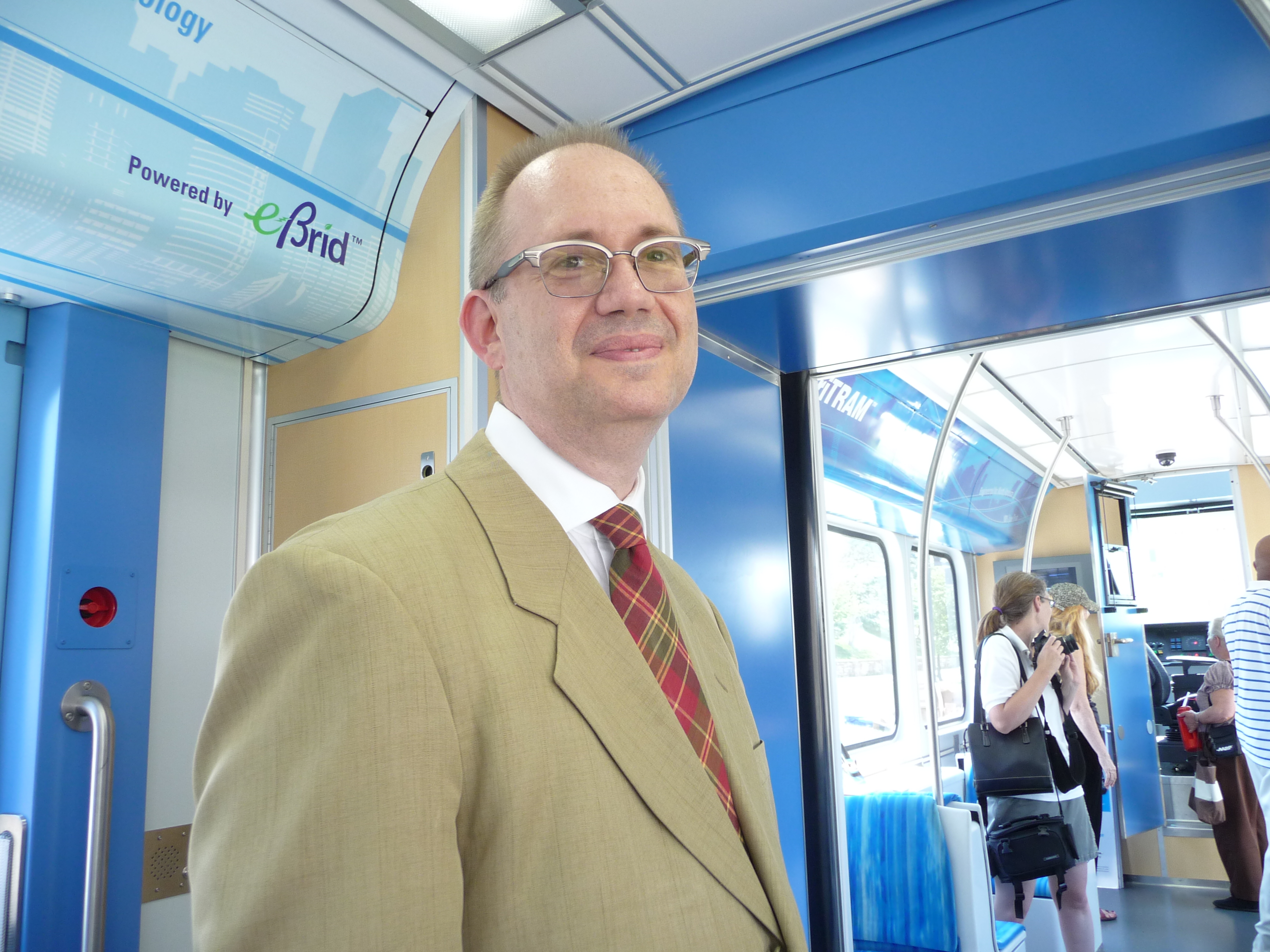
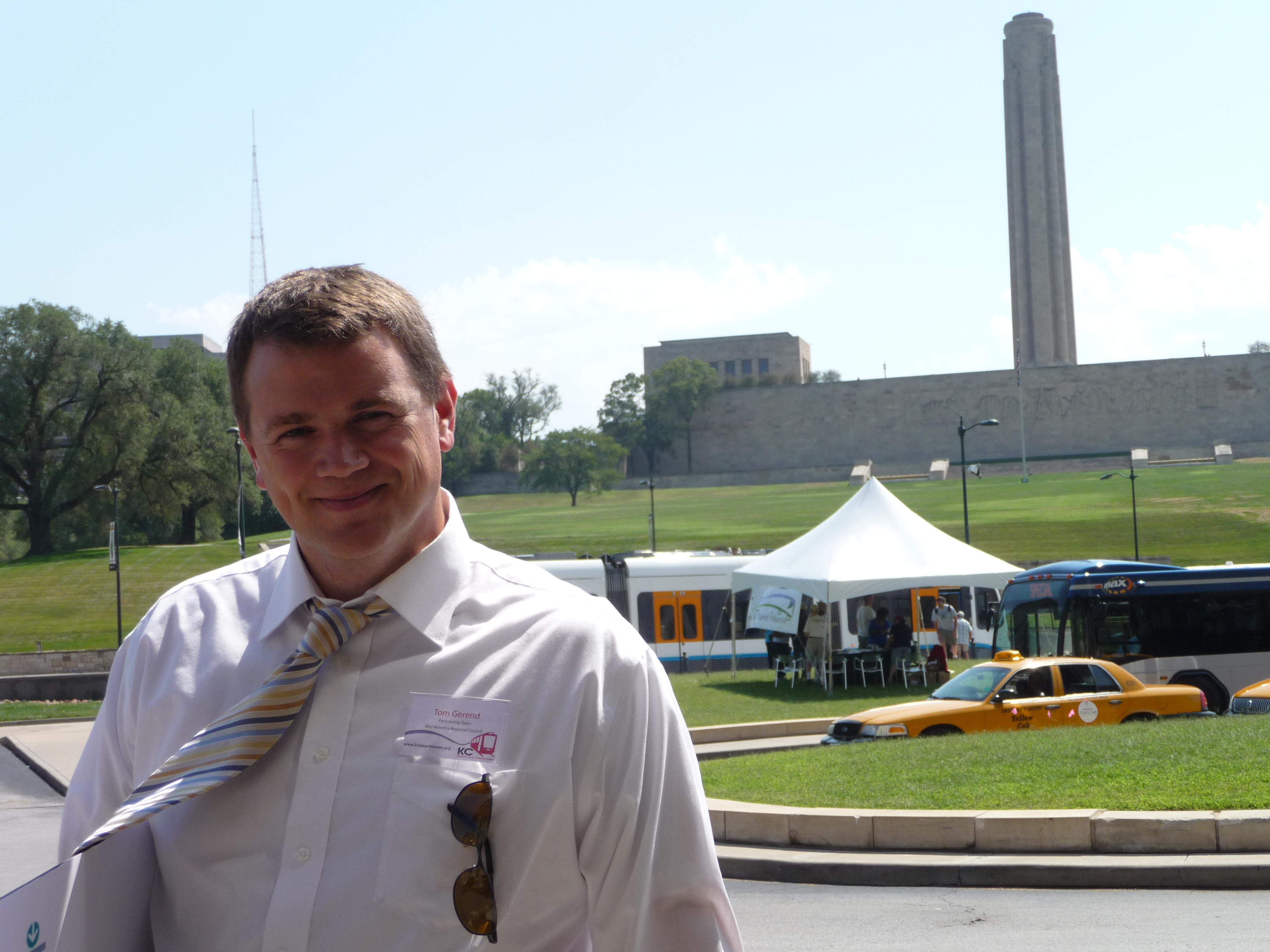
Inside Union Station or outside in the bright sun, Kansas City came out in droves to view a new Modern Streetcar, compare it to the new Hybrid MAX bus and find out more about the Downtown Corridor Alternatives Analysis (DCAA) at the second public open house. Transit Action Network advocates had a time great taking pictures and talking about transit with such an interesting and enthusiastic group of people.

Posted in Events, Local Transit Issues, Rail, Transit Studies | Tagged: | Leave a Comment »

Downtown Streetcar Would Be on Main or Grand

Posted by Transit Action Network on August 21, 2011


If a Downtown Streetcar line is built, it will be on Main Street or Grand Boulevard.

That was the big announcement from the Downtown Corridor Alternatives Analysis (DCAA) study team on Thursday, August 17, at the monthly meeting of the City’s Parking and Transportation Commission (PTC).  That body is acting as the study advisory committee for the DCAA.

Complete information has been posted on the project website maintained by Mid-America Regional Council:

http://www.kcsmartmoves.org/projects/downtowncorridor.aspx 

That site has links to all study documents, including:

+ The August 17 Technical Memorandum, which analyzes each potential route:

http://www.kcsmartmoves.org/pdf/downtownAA/KC-DCAA-Tier1-Screening-Tech-Memo.pdf

+ The August 17 consultant team presentation to PTC:

http://www.kcsmartmoves.org/pdf/downtownAA/KC-DCAA-Presentation-Parking-Transportation-Commission-8-17-11.pdf

+ A map of the two alignments for further study:

http://www.kcsmartmoves.org/pdf/downtownAA/KC-DCAA-Tier2-Alignment-Alternatives-Map.pdf

DCAA study manager Charlie Hales of HDR presented the recommendations to the Commission.  Seven possible routes were considered:  four were bi-directional routes (i.e., using the same street for both northbound and southbound tracks), and three were couplets (i.e., north on one street and south on another).  In all cases the end-points are 3rd and Grand on the north, and Pershing Road on the south.  The Grand route would terminate at Pershing and Main, while the Main route would terminate at Pershing and Grand.

Each of the two finalist routes has pluses and minuses. Grand offers the widest right-of-way (100 feet for nearly all of the distance), it is the straighter of the two, and it is closer to the government district and its concentration of jobs.  Main is closer to the geographic center of Downtown, closer to hotels, the Convention Center and Performing Arts Center, and closer to the center of the River Market district.  It also serves Union Station more directly.

Main gives less right-of-way to work with (about 60 feet), while Grand suffers from the prospect of having to be closed for major events at the Sprint Arena.  (That is a sticking point that the City never should have allowed to exist, in our opinion.  Letting a few transit vehicles through an on-street event should not be a big deal.)

With approval of these two potential routes by the PTC, the team will subject them to more intense study and present a recommendation for adoption at the September 21 meeting of PTC.

Selection of a route might be the most visible decision to be made, but it is far from the most important.  Other factors to get careful consideration include:

– What operating speed and level of service will be provided on the route?  Count us as among the many who have assumed from the beginning that this two-mile line would be the first segment of a longer rail line that would extend at least to the Plaza, and perhaps beyond.  We favor frequent service and as high a speed as can be accommodated in the corridor to make the service attractive.

– What fare collection mechanism will be used?  An off-board system is preferable since that would speed boarding and permit faster trips.  Some advocate making this a no-fare line — an attractive alternative but perhaps not practical.  Clearly a climb-on-board-and-put-cash-in-the-farebox system is undesirable.

– Would the streetcars travel in a reserved lane on the chosen street (preferable for a line that will ultimately serve as the last two miles of a longer line), or in “mixed traffic” (which may be acceptable for a local circulator line that might never run very fast).

– How will the streetcar work with existing transit routes?  KCATA has said it would reconfigure bus routes to work with the streetcar, but it’s not clear if that would be a tweaking of routes, or major shifts that might encourage more riders to use the streetcar to get to one end of the line or the other and then transfer to a bus for the rest of their trip.

– How will the streetcar be financed?  It’s been assumed all along that property owners and/or businesses and/or residents of the corridor would pick up a significant part of the cost of the line.  Just how that will happen is yet to be determined.

Those are among the questions that citizens should be asking at upcoming public meetings and events.

Formation of a Transportation Development District (TDD) is likely to be part of the funding mechanism, and under that arrangement only those most directly affected would go to the polls.  Out of concern for that question and the importance of building support from within the project area, Transit Action Network met early with leaders of the River Market Neighborhood Association, Downtown Neighborhood Association, and Crossroads Neighborhood Association.  Out of those meetings came Streetcar Neighbors:

http://www.facebook.com/pages/Streetcar-Neighbors/265998336746337

We expect that group to play an ongoing leadership role in shaping this project as it evolves.

Finally, while this study is often referred to as a Downtown Streetcar study, it is officially an alternatives analysis, and all modes are being actively considered and evaluated against one another, including an upgraded MAX bus line.

Posted in Local Transit Issues, Rail, Transit Studies | Tagged: | 1 Comment »

Modern Streetcar Comes to Downtown at Second Public Open House Aug 23

Posted by Transit Action Network on August 21, 2011


An ameriTram modern streetcar of the type that might one day travel along Main or Grand will be on display at Union Station all day on Tuesday, August 23.

http://www.kcsmartmoves.org/news/2011-08-18_dcaa_second_open_house.aspx

The display is part of the second open house at which the project team will have informational displays inside Union Station and people available to answer questions.  Our understanding is that the consultant team used its connections with the manufacturer to bring the car to Kansas City for display.  We salute the project team for bringing the streetcar here.

Where: Union Station

When: Aug 23

7 am to 7 pm – Modern Streetcar Exhibit

8 am to 6:30 pm – Second Public Open House by the Project Team in the Grand Hall

Other activities planned for the day:

11 am to 1 pm – Live Radio Remote

1 pm – KC Chiefs Raffle

5:30 pm – Speakers including Mayor Sly James and County Executive Mike Sanders followed by a performance by Quixotic Fusion in the KC Chamber Boardroom

Posted in Events, Rail, Transit Studies | Tagged: | Leave a Comment »

TAN Support for Downtown Streetcar and Streetcar Neighbors

Posted by Transit Action Network on August 18, 2011


Transit Action Network recently sent this letter to the Downtown Corridor Alternatives Analysis Project Team.

Residents of the Greater Downtown Kansas City area are passionate about improving the state of transit downtown. Evidence for the importance of transit to Downtown residents, and their desire to improve it, is seen in their consistent support for transit ballot initiatives. Transit is also a critical part of realizing the goals of the Greater Downtown Area Plan and extending the benefit of investments already made.

As transit plans have come and gone, disunity between interest groups has weakened previous proposals to the extent that Kansas City continues to sit on the sidelines of the modern transit revolution. However, the latest proposal for a Downtown Streetcar represents a tremendous opportunity to make a significant improvement for Downtown and a lasting contribution to the city’s transit culture.

A group of downtown residents have recently come together to found Streetcar Neighbors to support the deployment of a downtown streetcar.

The downtown streetcar is the most realistic opportunity yet to bring rail transit to Kansas City. TAN would therefore like to express our support for the streetcar project and for the work of Streetcar Neighbors in bringing it about. It is our belief that this plan is feasible, economically sensible and, most importantly, achievable. We would encourage the project team to be innovative and consider any local funding options that can help make the project a reality and to do so as quickly as is prudent, setting aggressive timelines to begin realizing the benefits of this system as soon as possible.

We also endorse the following recommendations of Streetcar Neighbors and downtown neighborhood associations and other downtown organizations:

·         The system should utilize modern streetcar technology, capable of delivering a rider experience comparable to light rail in its speed and comfort.

·         To reduce rider confusion, the route should utilize a single street for both directions of travel, with considerations made for the best solution for the ends of the route.

·         The route should serve the River Market neighborhood on the north and adequately serve Crown Center and Union Station on the south.

Summary:_______________________________

             1. Modern streetcar
            2. Single street
            3. River Market terminus
            4. Include Crown Center / Union Station
            5. Open to local funding options
            6. Support aggressive timeline

Mark McDowell

Chair, TAN Downtown Streetcar Working Group

Posted in Local Transit Issues, Rail | Tagged: | Leave a Comment »

Consultants Face Big Challenge Studying Regional Rapid Rail

Posted by Transit Action Network on August 16, 2011


Parsons Brinckerhoff  (PB), a highly-respected transit consulting firm, has begun work on the $1.2 million Jackson County Commuter Corridors Alternatives Analysis. This analysis will evaluate two corridors from the Regional Rapid Rail (RRR) concept — one through Blue Springs using the Kansas City Southern line, and one through Lee’s Summit using the old Rock Island line — and compare commuter rail to alternatives such as express buses.

 The RRR concept, widely presented around the region last year, proposed six commuter rail corridors using underutilized and abandoned rail lines to provide a rail system from the suburbs into Union Station. After preliminary review of the concept in MARC’s Smart Moves Transit Implementation Plan Phase II: Commuter Corridors Study, it was determined that only two of the corridors warranted further study in the near term. Studying the other corridors was postponed due either to insufficient ridership or being too costly given the projected ridership.

 The two corridors now being studied provide plenty of issues to resolve. Perhaps the biggest unresolved issue is the so-called “Common Line,” which the two routes would share. There is no underutilized track for the 7 miles between Leeds Junction (just west of the Truman Sports Complex)  and Union Station. Nor is there readily usable right of way for the 2 miles immediately east of Union Station.  Therefore, several alternatives are being considered. These include running on city streets (e.g., Truman Road) at a maximum speed of 25 mph, or perhaps along the I-70 right-of-way. The former requires moving or hardening utilities, while the later requires modifications to bridges and exit and entrance ramps. TAN doubts that projected ridership can justify the cost entailed in any of these alternatives.

 The Common Line is critical to the feasibility of the RRR system. If a cost effective solution to the Common Line remains elusive, or if a potential solution undermines operating speed, then the whole RRR concept falls apart.

 There have been two previous studies of commuter rail in the I-70 corridor through Blue Springs using existing rail. In both cases ridership was insufficient to justify the cost of using existing rail into downtown Kansas City.  The RRR concept and the most recent study take that conclusion — plus the freight railroads’ assertion that they will not allow commuter rail on existing tracks into Union Station — and propose a Common Line on new rail as the solution. 

 There are several other outstanding concerns from the Phase II study, and there have been lively and skeptical discussions within the MARC Transit Committee. TAN has been vocal in expressing our skepticism. Cost estimates, travel times, and the absence of credible ridership projections have generated great concern too. All of these issues remain today for PB to resolve.

 An Alternatives Analysis involves consideration of multiple modes. There are new technologies and innovative ways to make Bus Rapid Transit (BRT) and/or express buses compare favorably with rail.  Buses are efficient, cost-effective and can be used to effectively combat congestion. The fact that they can offer greater flexibility and a higher level of service for riders means that rail is not the only possible solution to our transit needs. Nor is rail necessarily more environmentally sustainable than modern buses, particularly where ridership is relatively low. 

 TAN has maintained a consistent position regarding transit service in commuter corridors. If rail is shown to be cost effective, to function well enough to attract additional commuters, and to qualify for FTA funding, then it should be implemented, along with the necessary local bus routes to support it. However, if rail is found not to be viable, and if express buses are again found to be the more feasible alternative, then the region should expand its commuter transit system using express buses. We should not continue to put off improving the region’s transit system just because rail isn’t practical at the present time. We need to build a system that serves commuters today, and that makes sense for our region for the future. The Alternatives Analysis should guide the region to an appropriate decision.

 TAN has sought and been granted a formal role on the AA Advisory Committee, and we have already met with the study team.  In addition, we’ll closely follow the study through our representation on MARC’s Transit Committee.

 What will be the best way to provide mobility from the suburbs into the central business district?  Stay tuned.  The Kansas City region definitely needs to improve its public transit system, and this study will help us decide how best to meet that need.

Posted in Local Transit Issues, Rail, Regional Transit Issue, Transit Studies | Tagged: , | 1 Comment »

Council Should Delay Chastain Vote

Posted by Transit Action Network on August 15, 2011


Councilman Russ Johnson is asking the full Council to defer action on an ordinance that would put Clay Chastain’s initiative petition on the ballot.  We understand the Council has sixty days to act, and that delay would move any such vote from November to early next year.  Transit Action Network fully supports delay because the initiative proposal is almost certainly unworkable, and because further discussion of it at this time would interfere with and confuse the current study and discussion related to a proposed Downtown Streetcar.  The streetcar appears to be eminently doable, and has a growing level of support within the River Market to Crown Center corridor.
Let the voters decide on the Chastain initiative — just not quite yet.

Posted in Local Transit Issues, Rail | Tagged: | Leave a Comment »

Grand Boulevard Streetscape Plan – 1st Community Meeting-Aug 17

Posted by Transit Action Network on August 12, 2011


The architectural firm BNIM and Kansas City, MO are in the first phase of visioning and planning for what the Grand Boulevard corridor might look like, and would like to have your participation in the process. The study area boundaries are generally defined as Grand Boulevard from Missouri River Levee Road at ASB Bridge to E. 28th Street and Main Street.

When: Wednesday, August 17th, 6-8pm

Where: UMB Bank Auditorium

1010 Grand Blvd, Kansas City, MO

Print the invitation and post it around town and at work. Invitation: 1st Community Meeting-Grand Blvd

Visit the project website  to learn more and view two slide shows about the project.

This project has potential to encourage multi-modal transit options, serve as a catalyst for economic development, improve connections to major activity centers, and serve as an icon and precedent for creating complete streets in Kansas City.  The project team is working closely with the Downtown Corridor Alternatives Analysis team to determine the best route for a potential streetcar. Your input is invaluable to the future of this project.

Posted in Events, Local Transit Issues | Leave a Comment »

EPA in the Lenexa Corporate Wilderness-update

Posted by Transit Action Network on August 9, 2011


As we reported in our recent article GSA and EPA Make a Bad Move, the current owner of the EPA building in Kansas City, Kansas, Urban America, protested the GSA bid process to the Government Accountability Office Bid Protest Forum. The GAO has published the results of that case. Urban America filed the case under the address name of 901 North 5th Street, LLC. To no ones surprise Urban America lost and the EPA will be moving to Lenexa.

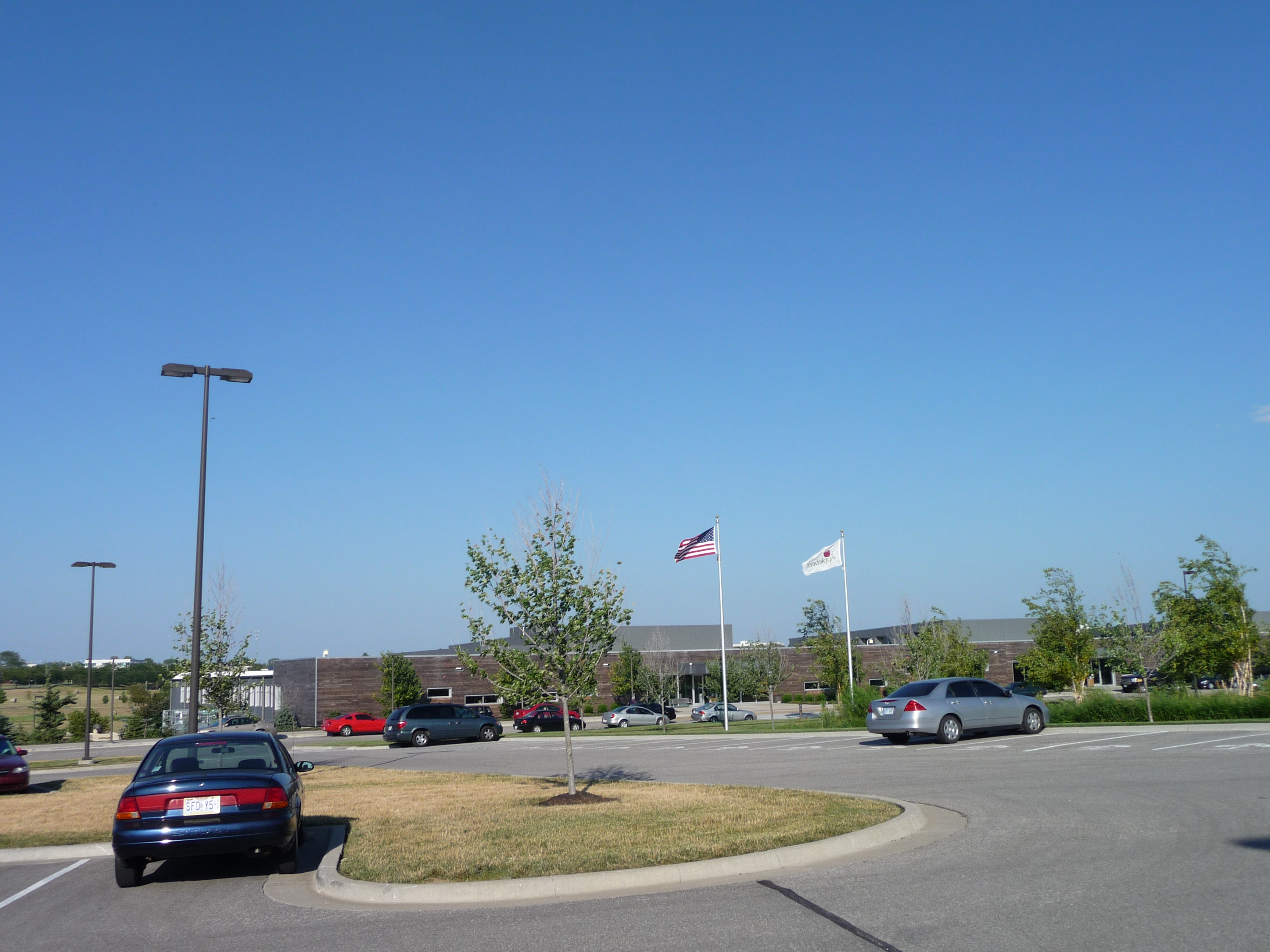
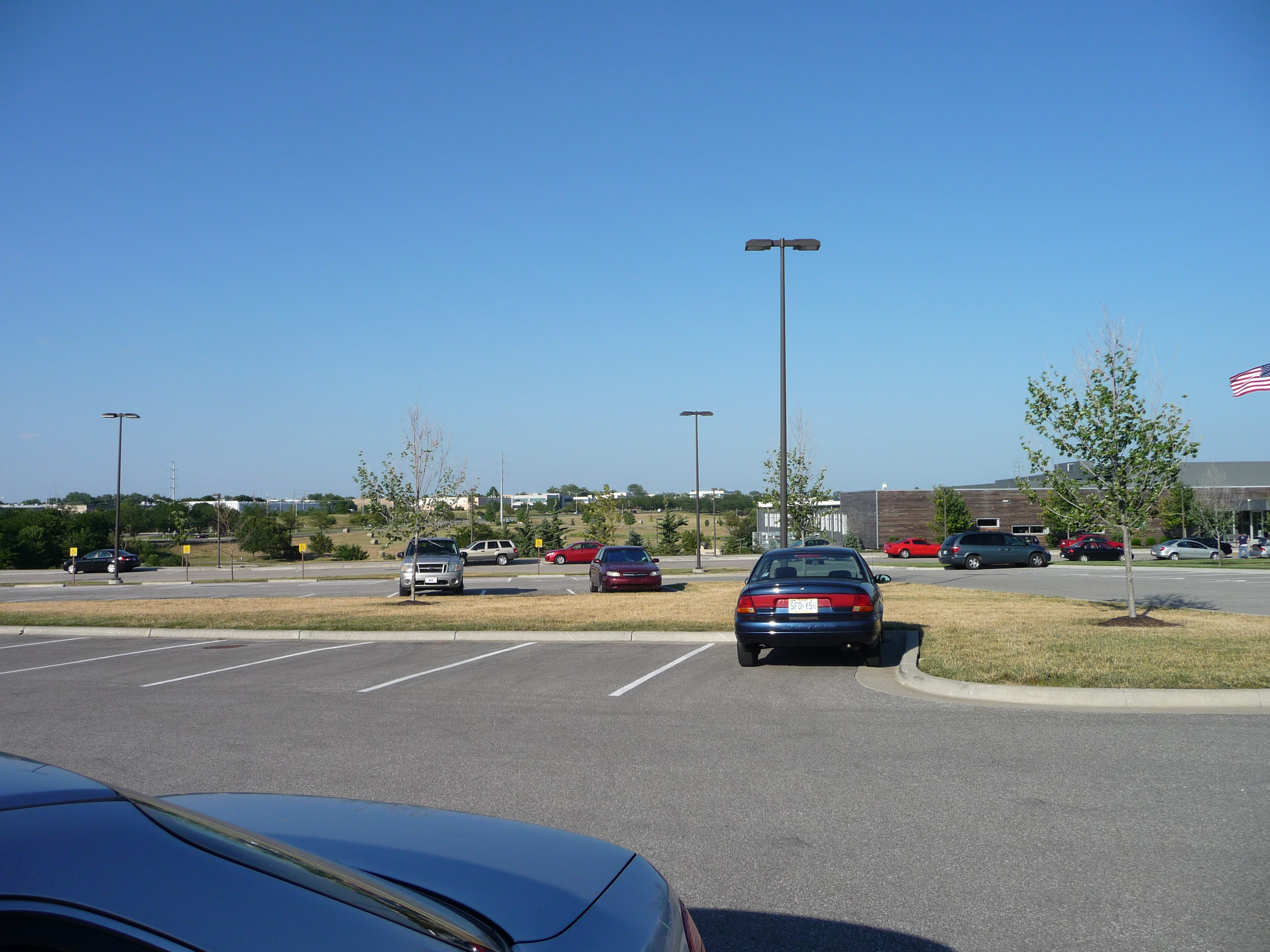
We feel so sorry for the EPA employees. This location site is awful, even if you drive. It is in the middle of nowhere in the far western suburbs of the region. The building is so far back from the street that you can barely see it at the end of the huge parking lot. They certainly aren’t going to walk to lunch or take transit to work. Walking down these busy streets would be dangerous since so many of them don’t have sidewalks.  These pictures were taken about half way into the parking lot.

Here is the short version of the result. The decision was made in two parts, both in favor of the GSA.

DIGEST

 1.  Protest that agency’s evaluation and selection decision were flawed is denied where the record shows that both the evaluation and the resulting selection decision were reasonable and consistent with the solicitation’s evaluation factors.

 2.  Protest that agency failed to comply with terms of Executive Order 12072 is dismissed; our Office does not normally review allegations of an agency’s failure to comply with executive branch policies.

See the complete GAO decisions. GAO Decision 901_NORTH_FIFTH_STREET__LLC vs GSA

In the report the GAO explains that Executive Order 12072 prescribes policies and directives regarding the planning, acquisition, utilization and management of federal facilities. Since it is not mentioned in the solicitation, GAO would not rule on it.

In law there are deadlines for bringing cases or objecting. All of the complaints about what was or was not in the solicitation should have been made before the submission deadline, but no one was paying attention. No one involved raised the red flag, challenged the selection area in the solicitation, questioned that multiple Presidential Executive Orders  were ignored, or complained that clearly defined governmental goals and principles were ignored before the bids were completed.

Hopefully two good things come out of this debacle.

1. Cities and companies take a proactive position to make sure government solicitations are in line with the current understanding of the requirements at the beginning of the process. GSA could have been challenged at that point and the solicitation requirements may have been changed.

2 These government offices are writing the siting recommendations that will incorporate the larger government sustainability goals that were ignored in this solicitation. They have already had two drafts.

U.S. Department of Transportation, U.S. General Services Administration, U.S. Environmental Protection Agency, U.S. Department of Housing and Urban Development, U.S. Department of Defense, U.S. Department of Homeland Security

They need to hurry up and implement the Recommendations for Siting Federal Facilities so GSA stops undermining many of the sustainability goals of the government.

Contact the EPA and GSA and tell them both to implement the “Recommendations for Sustainable Siting of Federal Facilities”.

 GSA

Washington D.C.- Administrator of the General Services Administration,

Martha N. Johnson (202) 501-0800  martha.johnson@gsa.gov

Two special email addresses have been established to collect comments about this move

Washington D.C. office kc-epa@gsa.gov

Local office kansasepa@gsa.gov

EPA 

Washington D.C.- Administrator for the Environmental Protection Agency

Lisa P. Jackson jackson.lisap@epa.gov

Local EPA Office Phone: (913) 551-7003

Region 7 EPA REGIONAL ADMINISTRATOR

Karl Brooks x7303  Brooks.Karl@epa.gov

Posted in Action, Local Transit Issues, National Transit Issues, Regional Transit Issue | 3 Comments »