Transit Action Network (TAN)

Advocates for Improved and Expanded Transit in the Kansas City Region.

Archive for the ‘Regional Transit Issue’ Category

It’s Not Just About 669 – Save The JO!

Posted by Transit Action Network on July 21, 2012


We’ve blogged about Johnson County Transit’s plan to eliminate Route 669.  But there are other essential routes on the chopping block, too. Here are entries that we previously posted on Flickr about three of the other routes that we believe deserve special consideration.  Only lack of time has kept us from posting about some of the other routes as well.

JCT Route 546 – Johnson Drive / Quivira — Save This Bus!

The Route 546 bus pauses at the 6000 Lamar Transit Hub in Mission at 6:14 am to exchange passengers with other routes. This particular bus brought 4 passengers from points in Shawnee and Lenexa. Route 546 previously went all the way to Downtown Kansas City, but it was truncated at 6000 Lamar in January, 2012, to cut costs. Passengers who previously had a single-seat ride to their Downtown destination now have to transfer. As a result, ridership has suffered, and on many days one of these little 12-14 passenger buses is used. In addition, these small buses ride like trucks, and that doesn’t encourage ridership, either. Route 546 is proposed for elimination effective January, 2013.

JCT Route 667 – Nall — Save This Bus!
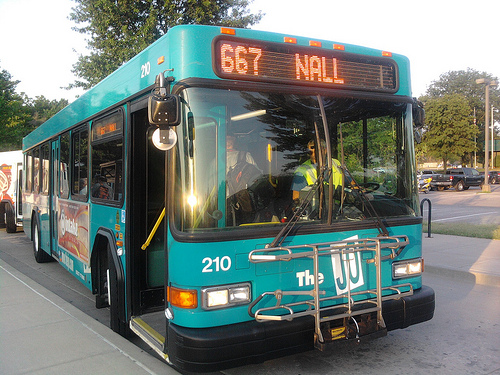
The first of two inbound morning trips of JCT Route 667 pauses at the 6000 Lamar Transit Hub in Mission at 6:49 am to exchange passengers with other JCT routes. This route is proposed for elimination effective January, 2013. This particular trip served about 13 passengers, 11 of whom boarded at 6000 Lamar or closer to its Downtown Kansas City final destination. Route 667 passes KU Med Center, where only one passenger got off. Low ridership has to be due, in part, to the fact that there is virtually no evidence of this route along the way: only six JO bus stop signs were spotted beyond this point for inbound (i.e., toward KU Med and Kansas City) riders, and none of those are within Wyandotte County where KU Med Center is located. First rule of public transit: Make the service visible.
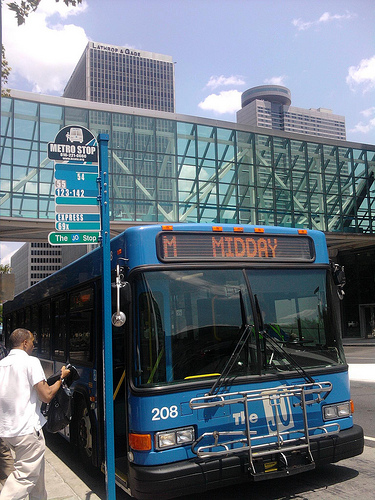
JCT Route 672 – Midday — Save This Bus!

The Route 672 – Midday bus stops to board passengers at Crown Center at 1:07 pm daily. Originally known as Route M – Midday, this route has long been a mystery. After all, what does “Midday” tell you about where it might take you? Nothing, right? It’s a wonder anybody rides it at all, yet it currently averages about 20 riders per day.

The Midday bus makes one daily round trip from the Great Mall in Olathe to Downtown Kansas City and back. Along the way it serves the Johnson County Courthouse in Olathe, Harvest Community Church park-and-ride lot on Strang Line Road, Johnson County Community College, Oak Park Mall (and park-and-ride), Metcalf South Shopping Center (and park-and-ride), the 6000 Lamar Transit Hub in Mission, the retail complex in Roeland Park, Central Library and Sprint Arena in Downtown Kansas City, Crown Center (Lego Land, SeaLife, Kaleidoscope, shopping, etc), Union Station (Science City, special exhibits, etc).

Route 672 is the only transit link between Kansas City’s Downtown / Crown Center corridor and Johnson County between 9 am and 3 pm. It’s significance is that when used in combination with one of the morning or afternoon commuter routes, Route 672 makes possible many half-day trips in either direction — to OPM for shopping, to JCCC for a class or cultural event, to Crown Center / Union Station for kid-friendly attractions. It also gives commuters the option of using transit when they plan a half workday. Trouble is, Johnson County Transit has never promoted these uses, or even the fact that Route 672 can be used in combination with the commuter routes. We’ve done that more than once, most recently for half-day trips to Union Station for the dinosaur exhibit two years ago: Take The JO to the Jurassic

Route 672 is proposed for elimination in January, 2013. Because it’s not a commuter route, it doesn’t have a core group of “regulars” to come to its defense. Instead, it serves occasional transit riders who use it for a variety of purposes. Thus, it needs all of us transit proponents to come to its defense if it’s to survive.  (If you’re a regular on one of The JO’s commuter routes, 672 is your backup — even though you might not be aware of it.) Instead of elimination, Route 672 needs a second trip — for example, in from Great Mall, out only as far as OPM or JCCC, then back to Downtown and back out to the Great Mall. That would be less than double the miles, but more than double the value to its current and many potential users. Come on, Johnson County Transit, don’t eliminate Route 672 before you’ve even given it a proper chance to succeed.

Please let the Board of County Commissioners know how important The JO is by attending the public hearing. Speakers will be allowed 3 minutes.

Johnson County Board of County Commissioners Public Budget Hearing
July 23rd @ 7 pm
Johnson County Administration Building, 111 S. Cherry, Olathe, KS 66061

If you miss the meeting:

Contact Johnson County Board of County Commissioners

  1. Phone: 913-715-0430
  2. Email contact form: http://bocc.jocogov.org/webform/contact-us

 Contact Johnson County Transit

  1. E-mail: Comments@thejo.com
  2. Mail: Johnson County Transit, 1701 West 56 Highway, Olathe, Kansas 66061
  3. Phone: 913-715-8255 – record your message

Deadline for public comment is July 30, 2012.

Posted in Action, Events, Local Transit Issues, Regional Transit Issue | Tagged: , | Leave a Comment »

Save The JO – Video #3 Comments From the JCT Public Meeting

Posted by Transit Action Network on July 20, 2012


Johnson County Transit held a public meeting on July 11th* to discuss the proposed 2013 eliminations and reductions to 90% of The JO routes. Reductions were made to routes at the beginning of 2012 and, unless something changes in the budget forecasts, additional eliminations are expected in 2014.  Listen to the concerns and stories of some of the participants and responses from Johnson County Transit (JCT) staff. 

Transit in Johnson County is headed in the wrong direction.

Please attend:
Johnson County Board of County Commissioners Public Budget Hearing
July 23rd @ 7 pm
Johnson County Administration Building, 111 S. Cherry, Olathe, KS 66061

Show your support to improve and expand The JO and tell your story to the Commissioners. Ask the Commission to support transit,  honor their commitment to replace the federal CMAQ funds for both the Connex and the 75th Street-Quivira routes, and find the necessary dedicated funding for the long-term health of transit in Johnson County.

Contact Johnson County Board of County Commissioners

  1. Phone: 913-715-0430
  2. Email contact form: http://bocc.jocogov.org/webform/contact-us

 Contact Johnson County Transit

  1. E-mail: Comments@thejo.com
  2. Mail: Johnson County Transit, 1701 West 56 Highway, Olathe, Kansas 66061
  3. Phone: 913-715-8255 – record your message

Deadline for public comment is July 30, 2012.

Powerpoint presentation from the public meeting. JO_ Public_Meeting 7_2012

JCT Strategic Plan Strategic Plan 2010

START report START_Final_Report_2011

*Note: The date of the public meeting was July 11, not July 16 as shown in the video.

Posted in Action, Events, Local Transit Issues, Regional Transit Issue, Videos-Transit | Tagged: , | Leave a Comment »

Why Eliminate Route 669?

Posted by Transit Action Network on July 17, 2012


Transit Action Network is at a loss to understand why Johnson County Transit (JCT) would propose to eliminate Route 669-I.

This route connects Kansas City, Missouri, and Kansas City, Kansas (KCK), with employment locations in Johnson County, including Southlake Business Park, Downtown Olathe, Villa St. Francis, and Lenexa City Hall.

At the beginning of this year, Route 680-V was eliminated and 669 was adjusted to serve Villa St. Francis near 127th and Strang Line as well as KCK. As a result, 669 ridership increased substantially.

KCK residents who work at Villa St. Francis wrote a letter to JCT and they have given us permission to publish it.

To: Cris Lowe – Community Relations Director – Johnson County Transit
 From: Villa St. Francis employees who ride 669I ROUTE ON A DAILY BASIS to and from our job at Villa St. Francis.

We, the employees of Villa St. Francis, wish to make our concerns known regarding the bus route cuts involving 669I that are to take place on January 2, 2013.

If you recall, last year about this time, we were again facing bus route changes.  JoCo Transit took away our job link bus that we had for approximately 14 years. Twenty of us, which by the way you have received all of our signatures in protest of the changes, paid for transportation to and from our job like everyone else.  You provided us with a quick route and we were taken care of in 20-30 minutes.  Straight down I-35 to 18th St. to Central Ave. at 16th and to 7th and Sandusky and done.  We Thank You for getting us to our destination quickly.

Then comes the so-called “Budget Cuts” and we are thrown into public transportation.  We were grateful to still have bus service.  Its been 5 months now, and we have adapted to the 4:03 [PM] pickup time [from VSF] getting us back to k.c.ks. at 5:03PM.  On days when traffic is heavy, we get to 6000 Lamar a little later and don’t have to sit there as long.  If we have a clearer run down I-35, we get to 6000 Lamar and just sit which seems like forever.  Plus, if we have to wait on other passengers, that also gets us away from 6000 Lamar later.  A lot of days we don’t get back to k.c.ks. until almost 5:10PM.

It must be said that our bus driver Ray is great.  He is the best heavy traffic driver and is so nice and patient.

Now, we are going through this again.  With riding the 669I bus, we found that there are a lot of people who ride this route.  All of us going to our jobs.  This bus is almost packed in the morning, and half that in the afternoon.  We all depend on the JoCo Transit.  It’s hard to believe that with all the people depending on the bus and riding daily that cuts are again having to be made.  People don’t have cars, but depend on transit to get them to their jobs.  People come from Missouri [Note: 669 originates at 10th and Main in Missouri] to Olathe and farther South depending on the bus to help get them there.

With the rough draft you proposed, you still have buses going back and forth from Missouri to 151st and Murlen for example.  You have to go through Kansas to get to Missouri.  Why cut our route which stops in k.c.ks.?  The 669I should stay in service.

So, we the employees at Villa St. Francis wish to be heard.  We ask you to consider providing Villa St. Francis employees with some transportation, having us leave VSF at 3:30PM and take the same route we had before straight down I35 to 18th St. to 16th and Central to 7th and Sandusky.  Our group doesn’t even need a larger bus.  We would be very grateful.  We just want something.  If this cannot be done, then we ask that you not change the current 669I route and give all of us at VSF and others a way to get to and from our jobs.  Thank you, and please take VSF into consideration when making your final decision.  Please do not cut the 669 route.  

Respectfully,
Villa St. Francis Employees

Route 669 is the only transit connection between downtown KCK and Johnson County. It starts at 10th and Main in Kansas City, Missouri, then to KCK and on to Lenexa and Olathe. The 669 service was re-routed in January 2012 to KCK. It is particularly disturbing that the KCK workers at Villa St. Francis first lost a bus service they had for 14 years, only to be told they might lose the only remaining KCK/JoCo transit option to work in 2013. This route and route 677-R are the two ”reverse commute” express routes to Johnson County, and they are both proposed for elimination. This gives riders the unfortunate impression that workers from Missouri and Wyandotte County are not welcome in Johnson County.

We have received communications from other workers who use this route to get to work. The following excerpt is from a rider who wrote to several Johnson County commissioners and lives in KCMO and uses this reverse commute bus.

I would also ask you to carefully consider that not all transit riders have “no other option” and that people like me, considered “choice” riders, use this vital public resource to help manage a rising cost of living. Since the JO has experienced considerable growth in ridership over the last year, its clear there are many reasons for people in Johnson County to choose public transportation. 

I’ve been without a car for 2 years in an effort to pay off my student loans and while it’s not always easy, it’s a sacrifice I’m willing to make in this tough economy. Many of the people I’ve met on I and D routes of the JO are a part of hard-working families, people who make the choice to spend over an hour, each way, on the bus to save money. I’ve met several nurses and Sprint engineers, warehouse workers and municipal employees from 3 cities who are all trying to squeeze a little more from their budget by using public transportation. Yes, we choose the bus but many choose it pay for sports teams for their kids, visiting nurse care for their elderly parents or to keep the one family car in good repair. We may be choice riders but if the choice is to pay the rising cost of gas or to pay for quality child care, the options are limited.

The proposed JO service eliminations for 2013 will make tough choices even tougher for people like me who aren’t looking for the easy way, who aren’t asking for a handout, who just want the chance to work in Johnson County. Eroding service levels when ridership is on the rise is not a sound approach and I hope your dedication to careful and serious consideration of the facts will lead to continuing current JO service levels at least.

Route 669 and Route 546-D both serve Lenexa City Hall, and both are proposed for elimination.  That would leave no transit to the 87th Street corridor of Lenexa. The Route 669 service area also includes the new EPA location on Renner Road. So instead of the EPA having limited transit to what is considered a “non-sustainable location” it would have NO transit at all. See our previous article.  GSA and EPA Make A Bad Move

Using information JCT made public, TAN evaluated route 669 and it compares favorably in performance measures to several routes being retained. In fact, it has a better farebox recovery ratio, lower annual cost per rider, and higher daily ridership per trip than routes 556, 575, 856, or 875 — all of which are proposed to be retained with slight modifications. It is important to compare the routes using measures such as riders per trip or cost per rider since the raw numbers can be misleading. Route 669 has only 4 trips per day (2 each way) so the ridership can look low compared to the 556, which has 20 trips per day. However when riders per trip or cost per rider are used then the routes can be compared in a fair manner.

If anything, this route should have increased service. When KCATA completed a comprehensive transit analysis last year, one of the recommendations from the national consulting firm, Nelson/Nygaard, was that commuter routes should have a minimum of 6 buses a day, three out in the morning and three returning in the evening. Four buses limit the ability to attract riders since there isn’t the flexibility to cover enough work hours, which is needed for a serious service. Despite this limitation, ridership is up.

When Johnson County cut its transit budget at the beginning of 2012, JCT made a round of service cuts. They tried to combine and re-route buses in order to cover the needs of the same population as in 2011. They hoped these changes wouldn’t hurt too many people. However, in a desperate attempt to do more with less, they ended up with some poorly designed routes and schedules which make it harder to use the system. Yet, ridership is up.

Now JCT is proposing to make even more severe cuts. Instead of some riders having long poorly designed routes, they won’t have a route at all. Significant populations and sections of the region won’t be served.

Politicians keep saying it is all about jobs. In this case we are talking about working people who may lose a job or have to look for a new one in this economy because they lose the ability to get to work.  If these cuts are implemented, riders on 18 of the 20 routes, whether they ride by necessity or by choice, will have to make personal decisions and ask if there is still enough transit in Johnson County to allow them to use the service. The answer will be NO for many of them. Transit provides access to jobs, helps the economy and improves the environment.

Johnson County is going in the wrong direction. Tell the commissioners to “Stop The Cuts” and start building a reasonable transit system that is worthy of one of the richest counties in the country.

See our action list to Save The JO and join our Facebook event to share your ideas and tell what you are doing to help. Watch our Save The JO video interviews.

Please attend the Johnson County Board of County Commissioners Public Budget Hearing, July 23rd @ 7 pm at the  Johnson County Administration Building, 111 S. Cherry, Olathe, KS 66061

Posted in Local Transit Issues, Regional Transit Issue | Tagged: , | Leave a Comment »

Save The JO – Video #2 Interview with Chuck Ferguson of Johnson County Transit

Posted by Transit Action Network on July 16, 2012


Chuck Ferguson is Deputy Transportation Director for Johnson County Transit. In this video Chuck explains the reasons for the proposed elimination of 9 of 20 bus routes (45% of The JO routes) and proposed modifications to another 45% of the routes. He also describes the reasoning for making so many of the cuts in 2013 instead of waiting to make the majority of the service changes in 2014 when the severe budget shortfalls are projected.  Based on the money available in the proposed 2013 budget, Johnson County Transit is proposing to make many of the service cuts a year earlier than needed.

Dismantling The JO to this extent is a budget problem not a ridership problem. Ridership is at an all time high and currently 12% higher than in 2011. If you care about the transit situation in Johnson County you must speak up.

Please attend the Johnson County Board of County Commissioners Public Budget Hearing, July 23rd @ 7 pm at the  Johnson County Administration Building, 111 S. Cherry, Olathe, KS 66061

If you can’t make the meeting please contact both Johnson County Transit and the Board of County Commissioners by July 30, 2012.

Contact Johnson County Board of County Commissioners

  1.  Phone: 913-715-0430
  2. Email contact form: http://bocc.jocogov.org/webform/contact-us
 Contact Johnson County Transit
  1. E-mail: Comments@thejo.com
  2. Mail: Johnson County Transit, 1701 West 56 Highway, Olathe, Kansas 66061
  3. Phone: 913-715-8255 – record your message

See our first video and read our earlier articles for more information.  Save the JO – Video #1

Save The JO – Contact JOCO CommissionersSpeak Out Against Proposed JO Service Cuts, and Attend The Public Meetings July 9 and 11 — “Save The JO!”

Posted in Local Transit Issues, Regional Transit Issue, Videos-Transit | Tagged: , | Leave a Comment »

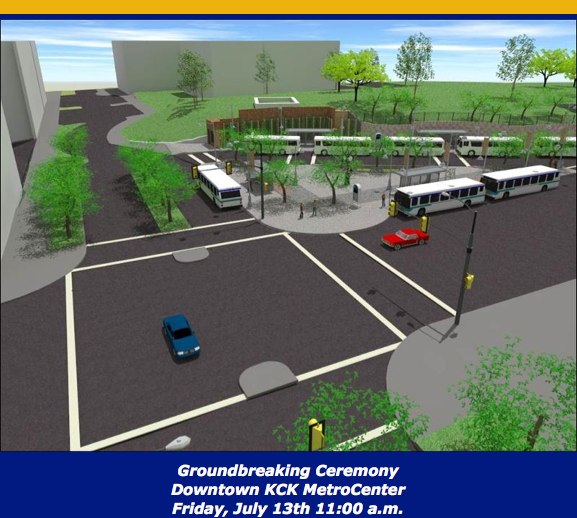
Attend Ground Breaking Events for the CONNEX Routes – July 13 and 18

Posted by Transit Action Network on July 11, 2012


TIGER Grants  were awarded in 2010  to build transportation infrastructure improvements along major transit corridors. In Kansas City, Kansas the Minnesota/State Ave Corridor received $10.5 million, and in Johnson County the Metcalf/ Shawnee Mission Parkway Corridor received $10.7 million.

Both communities are developing pre-Bus Rapid Transit (MAX) Routes , which are branded as CONNEX.

Design work is complete and construction is starting. Ground-breaking ceremonies are scheduled for July 13th and 18th.

Unified Government Transit Connex Metro Center
Friday July 13th @ 11 am
7th and Minnesota, Kansas City, Kansas

The improvements will be made along the transit corridor that begins at the 10th & Main MetroCenter in downtown Kansas City, MO,  travels west through Downtown Kansas City, KS,  continues on Minnesota Ave., then State Ave. and ends at Village West.

For more details, maps and drawings see the UGT website.

 Johnson County Transit Connex Mission Transit Center
Wednesday , July 18 @ 8:30 am
5251 Johnson Drive (old Cap Fed site) Mission, Kansas (location correction)

JCT Ground breaking information release MSMP_Groundbreaking

The improvements will be made along the transit corridor that begins at the Rosanna Square park-and-ride, travels north on Metcalf, east on Martway and then generally continues on Johnson Drive and Shawnee Mission Parkway into Kansas City, MO.

For more details, maps and drawings see the JCT project website and the Overland Park project website.

Posted in Events, Local Transit Issues, Regional Transit Issue | Tagged: , , | Leave a Comment »

Open Houses – U.S. 71 Transit Study – July 12 and 17

Posted by Transit Action Network on July 10, 2012


The U.S. 71 Transit Study is underway.  The project team and lead consultant are the same as for the Jackson County Commuter Corridors Alternatives Analysis. The project team consists of MARC, Jackson County, Kansas City, and KCATA. The lead project consulting firm is Parsons Brinckerhoff.  Transit Action Network has two advocates on the Stakeholder Advisory Panel.

The U.S. 71 corridor begins in the downtown loop of Kansas City, Mo., and runs south along U.S. 71/Bruce R. Watkins Dr. through Kansas City and Grandview to M-150 near the Cass County border. This heavily traveled corridor includes not only the U.S.71 highway facility, but also Prospect Avenue and adjacent railroad assets.

The study will build on and coordinate with the Jackson County Commuter Corridor Alternatives Analysis, which is studying the I-70 and Rock Island corridors. This study is funded largely by a $652,200 competitive grant from the Federal Highway Administration, which Jackson County acquired.

During the open houses, participants can tell the project partners whether enhanced transit is needed in the corridor and, if so, what their preferred transit option might be. A short update on the alternative analysis study will be given at 4:30 p.m. each day.

Visit the project Website. http://www.kcsmartmoves.org

Posted in Events, Local Transit Issues, Rail, Regional Transit Issue, Transit Studies | Tagged: , , , | Leave a Comment »

Save The JO — Video #1 Interview with JO Rider Henry Fortunato

Posted by Transit Action Network on July 9, 2012


Transit Action Network plans to produce several videos related to the Johnson County Transit proposed service reductions and modifications for January 2013. This video is the first in our series. Henry Fortunato, Director of Public Affairs for the Kansas City Public Library and a JO rider, discusses his personal views and concerns about the situation. (This is not the stated position of the Kansas City Public Library)

Please contact Johnson County Transit and the County Commissioners to stop these “voluntary cuts”.  See our previous articles for more information. Save The JO – Contact JOCO CommissionersSpeak Out Against Proposed JO Service Cuts, and Attend The Public Meetings July 9 and 11 — “Save The JO!”

Join our Facebook event page “Save The JO” to discuss what is happening and share your actions and ideas. On the event page you will already see comments about riders losing the ability to get to work and the artwork from children of the Westwood Christian Church in Johnson County who drew pictures to remind the adults to make calls to Save The JO. Have a look. Get involved!

Posted in Local Transit Issues, Regional Transit Issue, Videos-Transit | Tagged: , | Leave a Comment »

LIKE Us On Facebook

Posted by Transit Action Network on June 26, 2012


You have a new way to keep in touch with Transit Action Network and keep up with transit issues.

Since we got our nifty avatar for Twitter, we decided it was time to start a Facebook page.

Advantages of Facebook:

  • Our blog articles will be shared on Facebook, which makes them easy to share with your Facebook friends.
  • Facebook is a great platform to discuss transit issues — join in
  • Links to other interesting local and national articles about transit
  • Breaking transit news
  • Event pages for topical issues and events, which provide the transit community an online meeting place (Join our first event page “Save The JO”)
  • Facebook is great to share pictures and videos related to transit
  • It is a fast and easy way for us to share other important or interesting transit topics that might not be on the blog

LIKE us at www.facebook.com/TransitActionNetwork

JOIN our “Save The JO” Event.

Invite your friends. Share what you are doing, including who you have contacted and their response. Share how these proposed cuts would affect you. Post pictures of the people on your bus and tell how these cuts will affect them. Be sure to come to the public meetings. Add your ideas on what to do to save these routes. Organize.

http://www.facebook.com/events/141963052608035/

You still have three other great ways to keep in touch

1. The Transit Action Network website http://TransActionKC.com

  • The TAN website includes our in-depth analysis of local transit issues and our local videos on transit issues
  • In addition, follow a range of transit issues, including national transit issues, transit adventures and transit based travels
  • Sign up to receive an email whenever an article is posted, including a copy of the article. Sign-up in upper left-hand corner of the blog.
  • The emails are easy to forward to your email friends.
  • Post your comments on the blog. Your initial comment is moderated so there might be a delay.

2.  Follow us on Twitter – www.twitter.com/TransActionKC

  • Alerts about new blog posts
  • Breaking transit news
  • Retweets and links to interesting articles about transit
  • Ideas about where to go using transit in the Kansas City region
  • This and that about what’s going on in the local transit scene

3.  Email us at TransActionKC@gmail.com

Posted in Action, Events, Local Transit Issues, National Transit Issues, Regional Transit Issue | Leave a Comment »

Jackson County Transit Study Takes a New Direction

Posted by Transit Action Network on June 25, 2012


Calvin Williford, Jackson County Chief of Staff, recently wrote to the Jackson County Commuter Corridors Partner Team describing new developments related to the study currently underway.  He said completion of the current commuter corridors study would be postponed and the County would move forward with a comprehensive transit plan. Letter_Partnership _Team

For almost two years everyone said the study would be completed and a “Locally Preferred Alternative” (LPA) would be decided in the June 2012 time frame.  In a bold step, and with a growing understanding of transit needs, Jackson County decided to wait for more information. The county’s ambitious target date for having a conceptual countywide transit plan in place is the end of July.

Part of the reason for the postponement is that another study, this one in the Highway 71 / Grandview corridor, is just beginning and the County wants to gain an understanding of transit alternatives in that corridor before making any decisions since all three corridors are interrelated.

The biggest reason for the postponement, though, is that a new rail alternative has become available for consideration — the possibility of getting commuter rail to Union Station.  This new alternative uses the Kansas City Terminal (KCT) Railway tracks to get into the area just north of Union Station. These are the tracks that Amtrak uses. It will be a big deal if the County can get the railroad to consider this. In the past KCT has always rejected the idea of accommodating commuter rail, and the cost of putting new tracks in that corridor would require expanding a number of bridges at an estimated cost of $1 billion.

This new KCT alternative is not without concerns. There are capacity issues since so many freight trains use these tracks daily. Therefore a capacity analysis has to be done first to see if this alternative is workable before formally evaluating this corridor for commuter service as part of the AA.  Because of existing challenges, it was assumed from the beginning that KCT would not allow commuter rail on its tracks. No previous study has been completed to estimate costs, ridership numbers or travel-time savings to Union Station using this route.

Will this rail alternative have significantly better quantitative results than the Third and Grand alternative?  We don’t know. The 2007 study of commuter rail in the I-70 corridor concluded: “Possible conflicts at Union Station with a high volume of freight traffic and Amtrak passenger service have a significant likelihood of negatively impacting commuter rail reliability, which is not acceptable when building ridership.”  If capacity issues can be resolved, then this route should definitely be studied. This route would likely be shorter and provide a more desirable terminus — factors that could improve ridership forecasts.

Like the Third and Grand location, this route would require other transit service (such as the Downtown Streetcar) to provide access to the Central Business District (CBD). However, in contrast to the Third and Grand alternative, there are thousands of jobs in the vicinity of a terminal at Union Station. Since there isn’t a fast direct route from the highways to Union Station, commuter rail on the KCT tracks might compete favorably in travel time with driving, provided they can increase the speed of rail. Of course an express bus will likely still be faster to the Government District and the rest of the CBD.

So that leaves the question of cost. Can Jackson County persuade the railroads to bring the cost of access to their tracks down far enough that even if ridership projections are low and the travel time to the CBD is slow, the overall cost of getting to Union Station will be acceptable? Wait and see. The County is working very hard to put this together.

Williford’s letter also mentions Jackson County’s commitment to developing a comprehensive county-wide transit strategy that includes “rail, buses and a well-connected trails system”. The commuter corridors study process has raised the County’s awareness of the huge transit and trail gaps in the county, and considering a comprehensive package to take to voters is a great idea. In order to develop such a strategy, a number of groups have been convened to look at particular parts of an overall multi-modal plan. MARC is working with trails advocates to develop a detailed trails plan that satisfies multiple users, and the KCATA will be taking the lead in configuring and costing a more extensive bus system following the “Smart Moves” concept. Transit Action Network is part of a committee to identify the transit gaps. The original project team is working with the railroads on the capacity study to get into Union Station, but Third and Grand remains a fallback location for rail.

In a recent public meeting Williford talked about Jackson County’s serious “transit deficits” and made the following specific points:

  1. Every community that has developed rail transit has started first with a robust bus system. “Buses are the backbone of every transit system in the country,” he said, citing the “cost effectiveness” of buses over rail.
  2. Service for the mobility-impaired is inadequate.
  3. You can’t get from Kansas City to Independence after 6:00 at night.

Williford also said that while economic development is important, the county is placing greater emphasis on mobility than it did earlier. We think it’s great that the County’s understanding of the transit issues in the region has developed and expanded.

In order to create a comprehensive plan the County needs to fit all the pieces together with a financial package to pay for it. The County has taxing authority up to a one-cent sales tax. The full tax would raise approximately $80 million, derived almost equally from Kansas City and the rest of the county.

As part of this process, the County realized that parks and trails are really important to people. In the recently concluded session of the Missouri legislature the County successfully sought taxing authority for another ¼ cent sales tax for trails and parks. Such a tax could raise about $20 million.

Jackson County has taken on a huge challenge: Create a plan for commuter transit in three corridors, supplemental transit to fill numerous transit gaps throughout the county, and a set of parks and trails amenities. We hope they can come up with a great package at a cost that’ll be a “no-brainer” for voters to support.

Posted in Local Transit Issues, Rail, Regional Transit Issue, Transit Studies | Tagged: , , , | Leave a Comment »

Speak Out Against Proposed JO Service Cuts

Posted by Transit Action Network on June 19, 2012


“The proposed cuts would eliminate my ability to use the bus and without a car, I’d be entirely reliant on car pooling (to get to work). It’s very disheartening.”  — TAN advocate and JO rider when she saw the proposed cuts.

Johnson County Transit (JCT) has announced proposed service changes for 2013 (2013Change0614DRAFT). They plan to eliminate 8 routes and reduce or modify 9 other routes. There is time to save The JO. This is an  “opportunity” and “challenge” for riders to organize to both save and promote their routes, but be clear that these cuts are real and potentially permanent if they aren’t stopped.  There are public meetings with the Commissioners and Johnson County Transit but if you want to have an impact ACT NOW. Even if you don’t ride The JO but you care about transit in our region, please get involved.

1.    Contact the County Commissioners

  1. Although there are public hearings later in July, the Final Fiscal Year 2013 Budget discussions for the Commissioners are July 2-3, so contact them before that (continue to contact them after July 3rd)
  2. Tell them why The JO is important to you
  3. Ask them to make a long-term commitment to improving and expanding public transit in Johnson County
  4. Ask them to maintain, not cut, The JO service in 2013, since they are not cutting the funding in 2013
  5. Contact them at the phone numbers shown below or visit their website at http://bocc.jocogov.org/ and send an email.
  6. If you can, contact them again for a status report
Chairman: Ed Eilert (913) 715-0500
District 1: Ed Peterson  (913) 715- 0431
District 2: Jim Allen  (913) 715-0432
District 3: David Lindstrom (913) 715-0433
District 4: Jason Osterhaus (913) 715-0434
District 5: Michael Ashcraft (913) 715-0435
District 6: Calvin Hayden  (913) 715-0436
 

 2.    Use Social Media to contact both Johnson County Commissioners and JCT

  1. http://www.facebook.com/JohnsonCountyGovernment
  2. http://www.facebook.com/JoCoTheJO
  3. http://twitter.com/JohnsonCountyKS
  4. http://twitter.com/JoCoTheJO
  5. Let them know what you think about the proposed transit cuts
  6. Ask them to improve and expand public transit, not shrink it!

3.    Comments to JCT on proposed changes can be made via e-mail, phone, mail

  1. E-mail: Comments@thejo.com
  2. Mail: Johnson County Transit, 1701 West 56 Highway, Olathe, Kansas 66061
  3. Phone: 913-715-8255 – record your message

 4.    Contact your mayor or councilperson in Johnson County

  1. Tell your local officials how important The JO is to you.
  2. Ask your city officials to contact the County Commissioners and JCT to maintain, improve and expand The JO

5.    Organize your bus

  1. Sign a petition to save your bus and deliver it to Johnson County Commissioners and a copy to JCT
  2. Attend the public meetings as a group with signs and an organized presentation

6.    Write letters to the Editor of the KC Star

  1. http://www.kansascity.com/letters/
  2. Mail to The Star, 1729 Grand Blvd., Kansas City, MO. 64108.
  3. Letters can be up to 200 words

7.    Attend Public Hearings to be held by Johnson County Transit

a.    DATES and TIMES:

  • Monday July 9, 2012, 6:30 a.m. to 8:30 a.m.
  • Wednesday July 11, 2012, 4:30 p.m. to 6:30 p.m.

b.    LOCATION: Sylvester Powell Community Center at 6200 Martway in Mission, Kansas. (both hearings)

  1. Ask them not to make service cuts this year, since the budget doesn’t require it. These are “voluntary” cuts at this point. Don’t make major service cuts that aren’t absolutely necessary.
  2. Ask them to do a better job advertising the service. Several routes have poor ridership because no one knows they exist. Example: Route 667 is underused. Except for the new map/schedule poster at 6000 Lamar, the only visible evidence of this route is when one of the buses goes past.

8. EXTREMELY IMPORTANT: Attend the Final FY 2013 Budget public meeting with the Board of County Commissioners

a. DATE and TIME:  Monday July 23, 2012 at 7:00 p.m

b. LOCATION: BoCC meeting room, Johnson County Administration Building, 111 S. Cherry, Olathe, KS 66061

  1. Ask them to maintain The JO service level
  2. Ask them to expand and improve transit
  3. Tell them how important The JO is to people. (Without this public input, County budget cuts will be enacted for 2014 and beyond to match the reduced service levels.)

We previously described The JO’s budget problems (Save The JO – Contact JOCO Commissioners ). The 2013 budget being proposed has enough money for JCT to basically keep current service levels. Johnson County Transit (JCT) is cutting The JO service in 2013 because they’ve been told  that the money won’t be there in future years. At this point, these service reductions are mainly “voluntary”. Once the service is cut it will be much harder to get it back. We need to convince the Commissioners that one of the richest counties in the country needs to adequately fund public transit.

It will take public outcry to budge the County Commissioners and get them to reassure JCT that they will have ongoing funding to maintain service levels. The JO cuts are in response to direction from the Commissioners about the future.

A better solution involves the Johnson County Board of County Commissioners making a commitment to transit which improves and expands The JO. At present, The JO is primarily a commuter service into downtown Kansas City, but that service needs to expand to serve jobs, shopping, entertainment, education, medical and other activities within the county. Johnson County has been highly successful at attracting jobs, but it is almost impossible to get to most of those jobs by public transit. Johnson County’s lack of transit service is the main reason our region came out 90th of 100 cities in our ability to get to jobs using public transit in a 2011 Brookings Institution Report (How Our Region Should Respond to the Brookings Report). In addition to people who currently use The JO to get to work in Downtown Kansas City, more and more of the workers in Johnson County need this service to get to work.

Proposed service cuts for January 2013.

Routes Proposed for Elimination

  • Route 546/D – Johnson-Quivira
  • Route 667/E – Nall-Downtown
  • Route 669/I – KCK-Lenexa-Olathe
  • Route 672/M – JoCo-Downtown Midday
  • Route 676/P – Paola-Spring Hill-Olathe
  • Route 677/R – Downtown-Olathe
  • Route 810 – De Soto FlexRide
  • Route 816 – Spring Hill Shuttle

Routes Proposed for Service Modification and/or Reduction

  • Route 556 – Metcalf-Plaza: Modify route timing due to Transit Signal Priority; modify the 95th & Metcalf bus stop; modify service south of 119th Street.
  • Route 575 – 75th Street-Quivira: Eliminate five trips, reduce service frequency to 60 minutes during peak hours.
  • Route 660 – Antioch-Downtown: Eliminate earliest p.m. southbound trip; extend all trips to K-7 & Santa Fe.
  • Route 661 – Olathe Xpress: Adjust 5:55 a.m. northbound trip to start at 6:00 a.m.
  • Route 664 – Metcalf-Downtown: Eliminate two trips and adjust service to operate every 30 minutes, with “reverse commute” service every 60 minutes.
  • Route 670/L – Gardner-OP Xpress: Reduce “reverse commute” service and eliminate one southbound p.m. trip.
  • Route 673/N – South OP Xpress: Eliminate last southbound p.m. trip; add early southbound p.m. trip to reduce overcrowding.
  • Route 856 – Metcalf-Plaza Flex: Eliminate midday service south of 119th Street.
  • Route 875 – 75th Street-Quivira Flex: Consolidate the schedule to reduce travel time and allow less slack time for flex trips; adjust service frequency.

Additional information from the Johnson County Transportation Council meeting packet:

  • The Connex routes are being reduced with a goal to reduce service by $400,000 to ‘stretch’ the CMAQ funds through 2013. With the relocation of Wright Business College at 103rd and Metcalf, JCT had a 13% increase in ridership on the Connex routes during the first few weeks of the school term.
  • While not listed at this time, staff is also reviewing the impact of service reductions and/or elimination of the Route 812 – JO FLEX (operating within the City of Overland Park). At this point, staff’s primary concern is that Special Edition will be severely impacted by JO FLEX riders displaced by a potential reduction or elimination of the service.

Additional important JCT dates

  • July 30 – Deadline for submitting public input
  • July 30 – August 3 – JCT staff evaluate public input and prepare final service recommendations based on the estimated/proposed FY 2013 transit budget
  • August 9 – BOCC adopts FY 2013 Budget
  • August 14 – JCT staff presents final recommendations to JCTC at Council Meeting

Please contact your commissioners!!!

Posted in Action, Events, Local Transit Issues, Regional Transit Issue | Tagged: , , | Leave a Comment »

Save The JO – Contact JOCO Commissioners

Posted by Transit Action Network on June 8, 2012


Johnson County Transit, The JO, faces the very real possibility of significant budget cuts in the next few years. As a result The JO plans to begin cutting service next year. This will involve eliminating some routes and reducing frequency on others. Details should be available next week.

Please contact your Johnson County Commissioner and also Commission Chairman Ed Eilert and tell them how important The JO transit service is to you and why they should not just keep it but expand it.  Ridership increased 13% last year and has gone up over 12% since the beginning of this year. It doesn’t make sense to cut transit service in difficult economic times while ridership is increasing. Now is the time to increase transit funding, not cut it.

Contact them at the phone numbers shown below or visit the Johnson County website and send an email.

Chairman: Ed Eilert (913) 715-0500
District 1: Ed Peterson  (913) 715-0431
District 2: Jim Allen  (913) 715-0432
District 3: David Lindstrom (913) 715-0433
District 4: Jason Osterhaus (913) 715-0434
District 5: Michael Ashcraft (913) 715-0435
District 6: Calvin Hayden  (913) 715-0436

If you send an email, consider also sending a photo of the riders on your bus. Send it to us too. transactionkc@gmail.com

There has been a lot of newspaper coverage recently about the budget problems Johnson County Transit is facing. In the short-term, the County is doing the right thing by continuing the current budget levels for 2013. However, the County is not committed to maintaining this level of funding or service for the long-term, so Johnson County Transit is being given time to shrink the transit service over a couple of years beginning in 2013.

Unfortunately, many Johnson County Commissioners view commuter transit as a luxury rather than a basic public service. Other major metropolitan areas in America know that a good transit system is a necessity. While the popular image is Johnson County moves only by car, that picture is changing as the cost of driving continues to rise and Johnson County attracts more workers who need transit.

Commissioners rarely hear from the transit riders. Commuters are usually so busy with work and other responsibilities that they take the transit service for granted, expecting it to be there. However, Commissioners often feel that if you don’t speak up you must not exist and/or your needs must not be real. The Board of County Commissioners determines the transit budget for Johnson County Transit.  Decreasing the budget decreases transit service.

Johnson County Transit (JCT) and its governing board, Johnson County Transportation Council (JCTC), have worked diligently with the Commissioners and the County Manager the past couple of months to avert a 25-30% cut in service next January. Nevertheless service cuts are coming. The JO faces a multi-year budget crisis, and it reminds us that transit is not secure in Johnson County.

The JO faces budget cuts from three directions.

1.  The county initially proposed budget cuts of $700,000 from the 2012 level for 2013 – 2014. We have since been told that County support for transit will remain constant in 2013 – no county budget cuts are proposed at this point. Reductions are still in the works for future years. Therefore, JCT will start reducing service in anticipation of future budget cuts.

2.   Federal Congestion Mitigation Air Quality (CMAQ) funds and other federal grants will begin to expire in mid-2013. These grants have been used to increase service on the Metcalf / Shawnee Mission Parkway route (556/856) and to initiate the 75th Street route (575/875).  The county is allowing JCT to use its county reserve account to make up for these costs in 2013 and 2014, but it’s essential that the county pick up those costs in the future. CMAQ grants were provided as seed money contingent on a County commitment to assume the cost upon expiration.  Remind the commissioners of their commitment.

3.   A potential loss of $500,000 from the State budget has been pushed back to 2014. This potential loss is related to a re-allocation of state funds among transit agencies.*  If the State doesn’t remedy this situation, then the County should replace these funds rather than force excessive cutbacks in service.

In addition to working with the Commissioners, JCT is appealing to Lawrence Transit and KU to start paying a share of the popular 710-K-10 route.

JCT and JCTC can’t do everything though. They need riders to impress on the Commissioners the importance of transit.

Transit riders and friends of transit should attend the public hearing on the County budget on July 23rd and speak up about the need for transit. Please join us there.

Public Hearing: July 23rd at 7 PM.
Johnson County Administration Building
111 S. Cherry
Olathe, KS 66061
 

*Kansas uses a formula, which includes ridership numbers, to distribute State transit funds. Lawrence Transit started working cooperatively with the KU transit service. As a result, the KU ridership would be included in the State formula for allocation of transit funds to Lawrence Transit. It is anticipated that this large increase in ridership would result in Lawrence Transit receiving a substantially larger portion of the state funds. If this happens, it would cause a re-distribution of State transit funds away from all the other transit agencies.

Posted in Action, Local Transit Issues, Regional Transit Issue | Tagged: , | Leave a Comment »

TAN’s Position On Transit Alternatives For The I-70 Corridor In Jackson County

Posted by Transit Action Network on June 1, 2012


 Transit Action Network sent its position paper on the I-70 corridor of the Jackson County Commuters Corridors Alternatives Analysis to the Project Team and the Stakeholders. The following position is based on the April 2012 presentations by the Project Team. We understand the numbers are not final, but while we expect them to change to some extent, we do not anticipate they will change in orders of magnitude. Read the whole document TAN Position on I-70 Corridor

1. TAN favors developing Enhanced Express Bus service along the I-70 corridor.

2. Transit facilities should be located and designed to maximize development potential around them.

3. Jackson County should create a County Transit Authority to fund this and other expanded inter-city transit service, thereby relieving localities of this burden.

4. Jackson County should negotiate an agreement with the City of Kansas City to acquire the use of land adjacent to the northern edge of Kessler Park sufficient for a right-of-way for future commuter rail to Second and Grand.

5. Jackson County and Kansas City should develop a working relationship with the Kansas City Terminal Railway to preserve sufficient right-of-way to accommodate additional tracks east of Union Station, so that the possibility of additional rail access (freight and passenger) to the Union Station area is not further compromised.


Posted in County Transit Authority, Local Transit Issues, Rail, Regional Transit Issue, Transit Studies | Tagged: , , , | Leave a Comment »

Consultant Discusses the Preliminary Costs, Ridership and Time-Savings Estimates For The JCCCAA

Posted by Transit Action Network on May 29, 2012


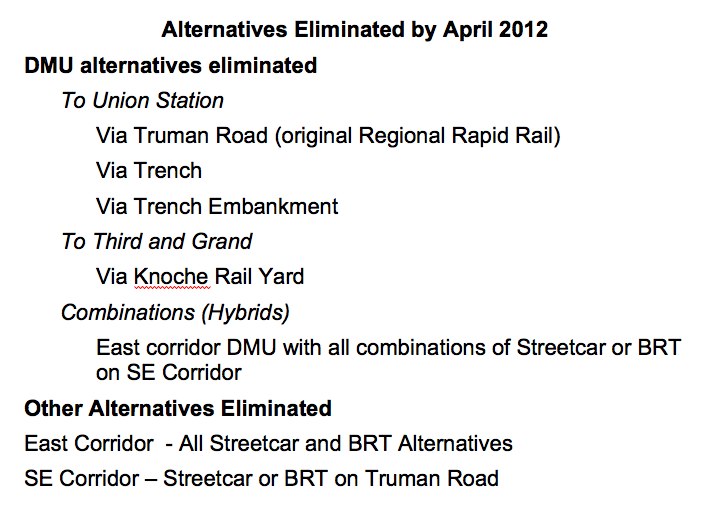
Lisa Koch, senior planner with Parsons Brinckerhoff, returns to discuss the Jackson County Corridor Alternatives Analysis (JCCCAA). Parsons Brinckerhoff released the first wave of quantitative information about the study at an open house the end of April. Lisa brings us up-to-date with the study and why several of the alternatives have been eliminated including the original Regional Rapid Rail commuter rail proposal. That alternative used existing rail right-of-ways in the east and southeast of the county and new track on city streets, including Truman Road, to terminate at the Freight House District, north of Union Station.

Click to Enlarge

Lisa describes the replacement commuter rail proposal, which terminates in the Third and Grand area. She provides information about the remaining alternatives in both the East (I-70) Corridor and the Southeast Corridor (the unused Rock Island right-of-way). For these preliminary estimates, Lisa comments on the high costs, low ridership numbers and the fact that the fixed guideway alternatives don’t provide any time savings over the highways by 2035.

Lisa describes the “right-sizing “ efforts the team is making to fine-tune the alternatives based on what they have learned.  When the alternatives have been revised, the partnership team, consisting of Jackson County, Kansas City, KCATA and MARC, will decide on a Locally Preferred Alternative, (LPA).

At the end of the interview Lisa discusses the economic development numbers for the rail alternative that were presented at the open house. MARC estimated these numbers as a 10% increase on the assessment value of existing properties within a ½ mile radius of the proposed rail stations.

Using property appreciation as a proxy for development around rail stations is a common methodology. This is not an estimate of the impact on jobs or sales tax revenue, but rather the appreciation benefits that existing property owners might see if their property is near a station. It does not represent a net benefit. It does not take into account decreases in property values commonly experienced by property owners between stations and by upper bracket residences near a rail line.

There are also concerns that rail does not create development, it merely moves development from one area to another, next to a rail line. There are some conditions in which appreciation does not occur, in particular, in areas with unlimited ability to sprawl. Property appreciation can be very large – or zero, depending on the circumstances.

TAN believes it is desirable to concentrate activity around stations of any type, bus or rail. Areas with transit-oriented (not created) development are highly desirable, exciting, well-integrated places to work, live, shop and play that make transit investments more cost-effective.  However, after the initial construction investment, successful economic development relies on many factors besides having a station.

For a better understanding of economic development related to property appreciation for transit, read this report by the National Association of Realtors.

Public Transit Boosts Property Values, If Conditions are Right

To view the display boards for the third open house, go to the project website, KCSmartMoves.

Transit Action Network previously reported on the JCCCAA Open House #3.  Read our evaluation of the current information: High Cost Combined with Low Ridership and Insignificant Time-Savings Hurts Rail in the Commuter Corridors Study

To follow the whole study, see the rest of our video series at TAN Videos on our website. The third interview discusses the DMU rail lines east of I-435.

Link to the first interview: MARC And Parsons Brinckerhoff Discuss The Current Status Of The Commuter Corridors Altenatives Analysis

Link to the second interview: Parsons Brinckerhoff Consultant Discusses Three Alternatives In The JCCCAA

Link to the third interview: Discussion About The Regional Rail Alternative for the JCCCAA

Link to the fourth interview: Enhanced Streetcar/DMU/BRT Combinations Are Discussed

Posted in Local Transit Issues, Rail, Regional Transit Issue, Transit Studies, Videos-Transit | Tagged: , , , | Leave a Comment »

It’s Time For Regional Discussion Of Transit

Posted by Transit Action Network on May 24, 2012


Transit Action Network doesn’t usually reply to items in the press, but we think Steve Rose’s column in yesterday’s Kansas City Star warrants a response.

The column, “Talk of Regional Transit Is Just Wasted Breath,” bears reading, even though we find it quite disappointing.

“Wasted breath?” Really?Johnson County, the richest and most populous county in Kansas, could find itself without a meaningful transit system of any kind in the next couple of years, falling behind Wichita and Topeka.  Yet instead of expressing concern, Mr. Rose dredges up 30-year-old biases and frames the current transit situation as Johnson County against the City of Kansas City. That involves a misconception: KCATA was created by the two states and Congress, and is independent of Kansas City.  Lacking taxing authority of its own, it provides transit service under contract with nearly a dozen municipalities.  Kansas City happens to contract for the most service.

Describing the transit cutbacks that Johnson County seems poised to impose on its citizens, Mr. Rose writes:

Where [Johnson County Transit Director] Alice [Amrein] is unrealistic is she told me she is contemplating recommending to the county commissioners that, along with the cutbacks, it may be worthwhile to contract some routes with the Kansas City Area Transportation Authority, otherwise known as the ATA.

Furthermore, Steve Klika, a member of the Johnson County Transportation Council and a representative on the ATA board, was reported in The Star [Mike Hendricks, May 13, “Deep cuts could mean drastic changes for The Jo bus system] as saying, “The only way transit is going to succeed in Kansas City is if it’s regionalized.”

These statements attributed to Ms. Amrein and Mr. Klika are not at all unreasonable. Indeed, prudence indicates that all options be explored. Mr. Rose goes on to quote Johnson County Commission Chairman Ed Eilert as saying, ““We would not turn over any funds to ATA. … Furthermore, we would not give up funding or operational control.”

Nobody is suggesting that. If KCATA were to operate (or even manage the operation of) transit routes in Johnson County it would be under a contract resulting from a competitive bidding process involving other potential transit operators.  That hardly constitutes “turning over” funds to KCATA, and it’s hardly a novel idea. In fact, the possibility of JCT once again contracting with KCATA has been under consideration for years, and KCATA has submitted bids to operate Johnson County transit routes as recently as just a couple of years ago. JCT elected to stay with its current contractor, First Transit.

Furthermore, Mr. Rose (and Mr. Eilert) might not be aware that KCATA already performs some basic transit support services under contract to Johnson County Transit.  These include operation of a Regional Transit Information Call Center and maintenance of a number of bus shelters and other facilities. The two agencies are currently working together to get basic information about The JO’s routes and schedules posted at key stops in Kansas City, and KCATA now accepts monthly passes issued by The JO on nearly all Metro routes including MAX.

Mr. Rose then quotes KCATA Board of Commissioners Chairman Robbie Makinen as saying, “I consider this a real opportunity to rekindle the seamless, regional transit discussion.”

Discussion? That makes perfect sense to us. We don’t know what Mr. Rose thinks seamless regional transit is, but we think it means transit that’s easier to understand and use.  That’s important not just in Jackson and Wyandotte counties, but even for Johnson County because thousands of people hold low-paying service jobs in Johnson County but can’t afford to live there. Others travel there to shop or pursue educational, recreational, cultural, and other opportunities.

Improving and expanding public transit service in the Kansas City region is Transit Action Network’s purpose for being. To accomplish this goal we need informed discussion of the current situation. Bringing up perceptions of how things may have been 30 years ago is simply not helpful.

Mr. Rose’s column could be just the thing that’s been needed to re-ignite serious dialog among public officials of the region to move us toward a public transit system that seamlessly serves the region’s citizens. If it does, then we’ll be among the first to say, “Thank you, Mr. Rose.”

Posted in Local Transit Issues, Regional Transit Issue | Tagged: , , | 3 Comments »

High Cost Combined with Low Ridership and Insignificant Time-Savings Hurts Rail in the Commuter Corridors Study

Posted by Transit Action Network on May 8, 2012


A lot of factors go into making a good transit project.  Most people will gladly tell you they prefer trains to buses. However, when ridership numbers, time savings and costs factors come into the picture, reality hits.  Are the ridership numbers sufficient to justify the cost? Does the project actually save commuters time? Will the project qualify for federal funds to help pay for such an expensive project?  How much would it require in local taxes?

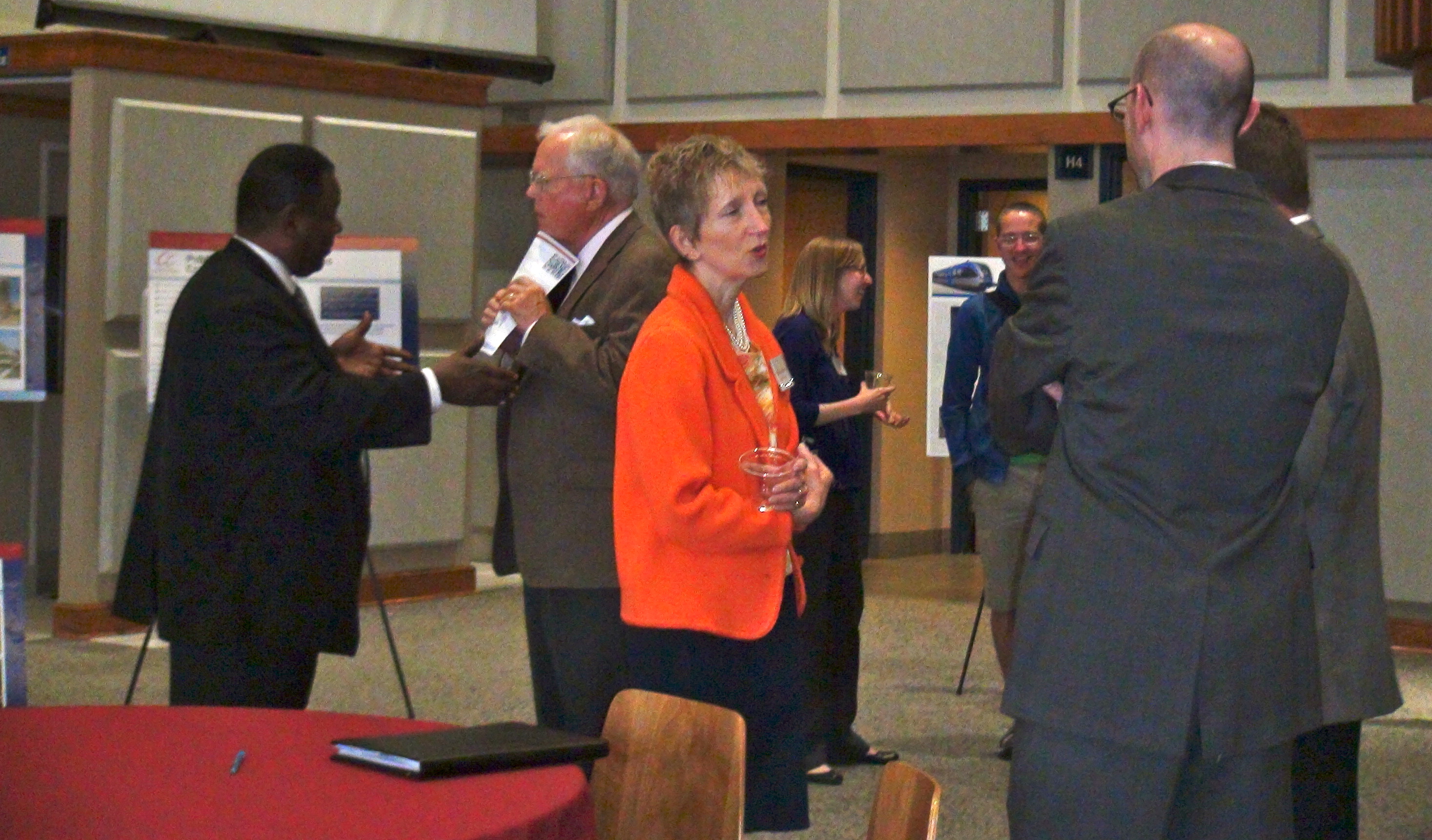
Open House #3 April 24 @ St Paul’s School of Theology

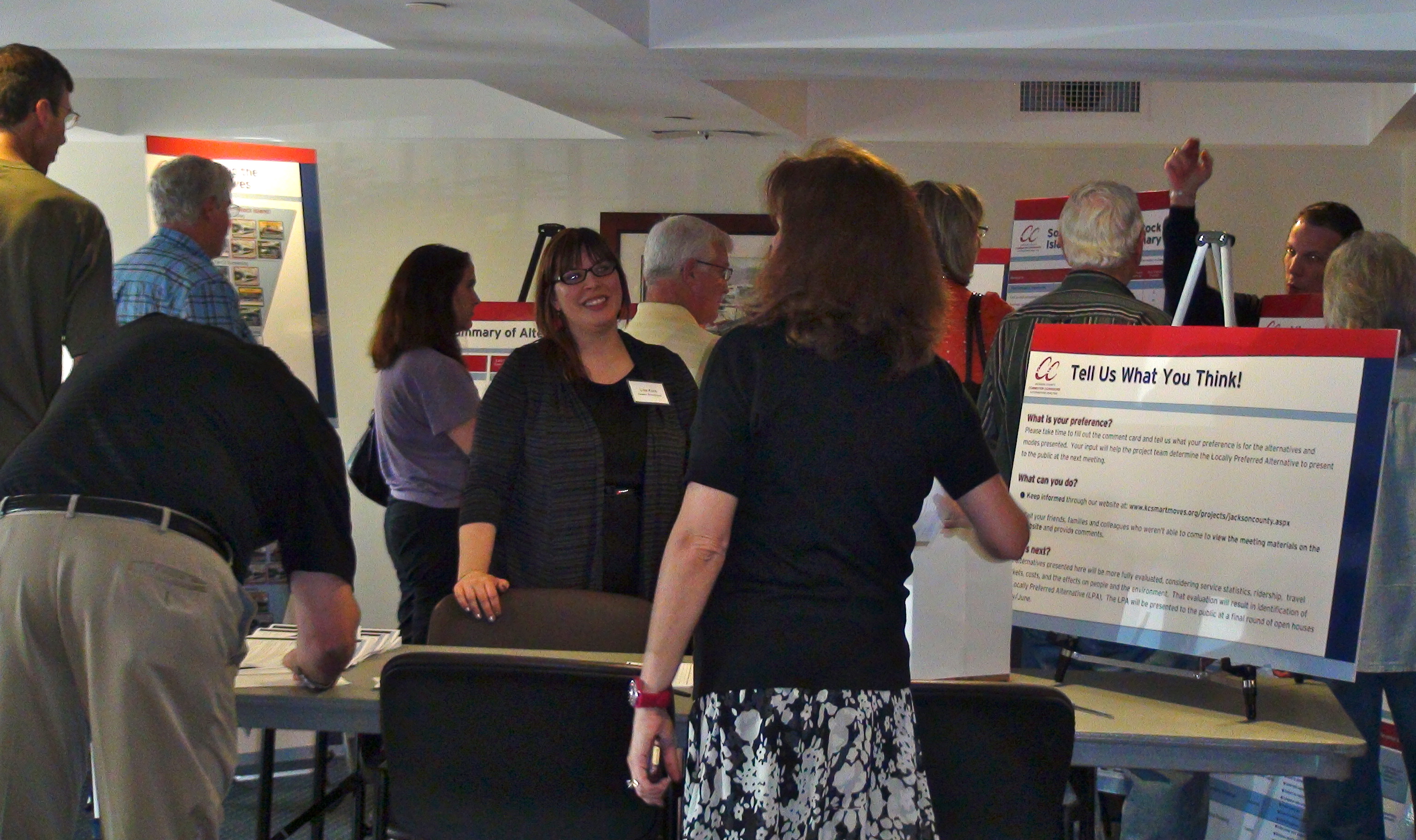
The Jackson County Commuter Corridors Alternatives Analysis (JCCCAA) is beginning to address some of these questions. The project team had its third series of open house meetings April 24-26. (See the Open House Display boards).  One more series is planned.

This open house provided the first look at quantitative results for the current commuter corridor study. The study is not complete and some of the numbers will change.

Some additional information is needed to understand the following information from the open house.

  1. The ridership numbers and travel time are forecasts for 2035. These are the numbers you can expect to see in 23 years.
  2. The dollar figures are for 2012.
  3. The model for forecasting congestion on I-70 only indicates an additional 3-5 minutes for travel time in 2035 over travel times today. The travel time for a car was not provided for comparison.

After evaluating the information from the open house, Transit Action Network’s preliminary conclusion is that, in all probability, none of the fixed guideway alternatives would qualify for federal funding due to the relatively high cost for the low ridership and the insignificant amount of time saved. The FTA uses these factors to measure cost-effectiveness. Of course, the numbers are being revised, but considerable improvements would be needed to change this assessment. Both of the commuter rail lines plus the Rock Island streetcar line and the Rock Island Bus Rapid Transit (BRT) alternatives are probably not cost-effective enough to receive capital funds for construction from the FTA.

A. I-70 Corridor from Oak Grove – Highlights

There are only two alternatives left in this corridor and they are basically the same as were studied in a 2007 Alternatives Analysis. Summary of 2007 I-70 Commuter Corridor AA

 EAST I-70 Corridor

Daily ridership by 2035

Total Capital Cost in millions

Total capital cost per rider based on annual ridership (260 days)

Travel time to 10th and Main from

Travel time in Minutes in 2035

Annual operating cost in millions

Express Bus

600

$35-$39

$237

Oak Grove

59

$3.6

DMU

1,150-2,800

$480-$600

$742-$1806

Oak Grove

61

$10.7

  1. One choice is an enhanced version of today’s highway express bus with more comfortable over-the-road coaches and significantly more service. In 2007 the recommendation was to improve the Express Buses. Compared to the 1,500 riders projected in the 2007 study, the 600 daily riders in the current study looks very low.

    Click to Enlarge I-70 corridor

  2. The second choice is a commuter train (Diesel Multiple Unit or DMU) that stays on the Kansas City Southern rail line toward the Northern Industrial District and then turns west and finishes at Third and Grand. There is a new alignment which is an improvement over the alignment in the 2007 study. There is a narrow strip of land owned by Kansas City, north of Cliff Drive by Kessler Park, that could be used instead of going through a rail yard. However, maximum daily ridership last time was 1,425 and right now this project is showing 1,150-2,800 daily riders. These ridership numbers are not significantly improved considering the project capital cost in 2007 was $102.8-168.9 million. More money is being projected for track improvements, which would increase the train speed and decrease the travel time.
  3. There is not a significant time savings for commuters using the train. The estimated time to 10th and Main from Oak Grove using the Express Bus is 59 minutes and getting to 10th and Main using the DMU plus a transfer to the streetcar is 61 minutes.

B. The Rock Island Corridor – Highlights

Four alternatives are still being considered, but they are not comparable situations.

SE corridor

Rock Island line

Daily ridership by 2035

Total Capital Cost in millions

Total capital cost per rider based on annual ridership (260 days)

Travel time to 10th and Main from

Travel time in Minutes in 2035

Annual operating cost in millions

Express Bus starts in Pleasant Hill

350

$35-$39

$407

Pleasant Hill

63rd and Raytown Road

60

48

$3.6

DMU starts in Pleasant Hill

500

$326-$413

$2,846

Pleasant Hill

65

$9.5

BRT Starts in Lee’s Summit

500

$230-$283

$1,962

63rd and Raytown Road

54

$3.2

SE Urban Corridor

Enhanced streetcar starts at 63rd street and Raytown road

1,850-2,700

$402-$538

$670-$977

63rd and Raytown Road

50

$6.1

  1. Only the Enhanced Express Bus and the Diesel Multiple Unit go to Pleasant Hill.

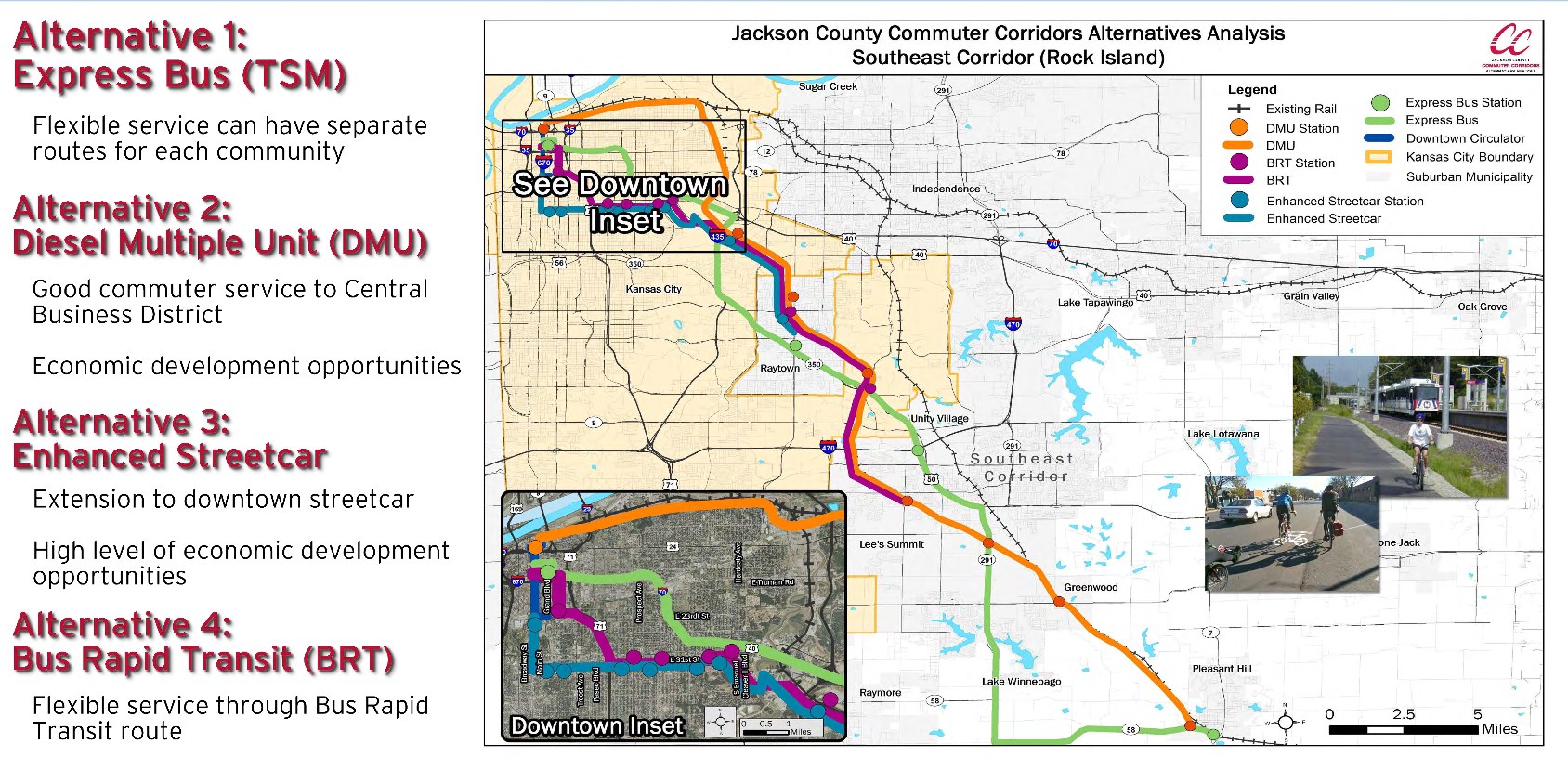
    Click to Enlarge SE Rock island Corridor

  2. The Express Bus is an enhanced version of today’s highway express bus with better coaches and significantly more service.
  3. The DMU travels on the Rock Island Line, then continues north toward the Northern Industrial District. North of St. John Avenue it merges with the I-70 corridor KCS line and the two lines share a common segment into Third and Grand. The cost for this line does not include the common rail section since the Rock Island DMU line would only be built if the I-70 DMU line were built.
  4. The Bus Rapid Transit (BRT) only goes to Lee’s Summit. It uses a new paved busway on the Rock Island line to the Sports Complex and then a fixed guideway (the two middle lanes of traffic get barriers to segregate the bus from other traffic) is built on Stadium Drive and Linwood Blvd. At Bruce R. Watkins Drive (Highway 71) it uses the freeway to get into Downtown.
  5. The Enhanced Streetcar is not really part of the commuter corridors since it has been shortened to start at 63rd Street and Raytown Road, which makes it more of an urban corridor route. The streetcar goes down Linwood Blvd in a fixed guideway (the two middle lanes of traffic get barriers to segregate the streetcar from other traffic). At Main Street it would operate in mixed traffic and turn north to meet the proposed Downtown Streetcar line at Pershing.  MARC’s Smart Moves plan consists of two types of corridors – urban corridors that serve the urban core and commuter corridors, which bring people into the city from the suburbs. In fact, the significantly larger ridership numbers projected for this “enhanced streetcar” alternative are from people in the urban core. The streetcar has significantly more riders than the BRT even though they both go down Linwood since the bulk of the streetcar ridership happens west of Highway 71 after the BRT turns north.  Because the streetcar makes several stops along Linwood and functions like an urban streetcar corridor, this alternative does not appear to serve suburban commuters very well.
  6. This is the first AA that has been done in the Rock Island commuter corridor so it is interesting to see such low ridership numbers.

    Open House #3 April 25 @ John Knox Village

  • Express bus – 350; DMU – 500; Bus Rapid Transit – 500. These ridership numbers are breathtakingly low and don’t warrant any rail investment. Even if the study increases the numbers they aren’t going to go up nearly enough to justify the cost of rail. The low ridership projections for the DMU in the Rock island corridor compared to the I-70 corridor is partly because this line doesn’t go through the main population centers of these cities and a lot of the route goes through industrial areas.

For commuters in the Southeast Corridor there are two bus possibilities:  Enhanced Express Bus from Pleasant Hill or Bus Rapid Transit from Lee’s Summit.

  1. To compare travel time between the two buses, look at the time from Raytown Road. The BRT time to 10th and Main is 54 minutes and the express bus from that location is 48 minutes. So the express bus is faster over the same distance.
  2. The Express Bus costs $35-39 million, while the BRT would entail paving the Rock Island line and establishing a fixed guideway on Linwood for a total of $230-283 million. Is the additional cost worth it for a slower travel time and only a few more people?

What about the Rock Island Streetcar? Even though the ridership is better than the other alternatives in this corridor, it is far too low for the cost.

To put this streetcar in perspective, compare it to the Downtown Streetcar project currently being planned.

Streetcar

Daily Ridership by 2035

Total Capital Cost in millions

Capital Cost per Rider-Total Capital Cost Divided by Annual Ridership based on 260 days. (JCCCAA method)

2 mile Downtown Streetcar

6,000

$101

$65

12 mile Rock Island Streetcar

1,850-2,700

$402-$538

$670-$977


Financing Transit in Jackson County

Once transit alternatives are selected for these corridors — i.e., once a “Locally Preferred Alternative” or LPA is determined, local funding has to be obtained.  This is true whether there is a federal contribution to the project or not.

Revenue Source

Uses

Rate/Method

Estimated Amount

Jackson County Sales Tax

Operating and Capital

1-cent sales tax (maximum)

$80 million annually

Jackson County Property tax

Operating and Capital

One mill

$82,500 annually

Farebox revenue

Operating

Fares

Typically 20% of operating costs

Federal Funding

Capital

5309 program for either New Starts (projects > $250 Million) or Bus and Bus Facilities

New Starts 30-50% of construction costs or Bus and Bus Facilities 80 %

Jackson County has special taxing authority allowing voters to approve up to a 1-cent sales tax for transit, which would collect about $80 million annually. Jackson County has significant transit needs, especially in eastern Jackson County.  Not only does commuter transit need to be improved and expanded, but transit is needed to get to other activity centers such as jobs, education, medical facilities, shopping and entertainment in areas other than downtown. (Only 14% of the region’s jobs are currently in the CBD).

Although a property tax is a possible funding source, it doesn’t raise much money.

TAN realizes the study isn’t finished and there will be changes, but the total annual cost is important to understand Jackson County’s ability to provide transit. The following numbers are based on the information presented at the April open house. We will re-do our analysis when adjusted numbers become available.

Estimated Rail and Fixed Guideway Annual Costs

Fixed guideways being studied in two corridors

TAN’s estimate of annualized capital debt service for rail (@4% interest for 25 years) in millions

Annual operating cost in millions

Total annual cost in millions

I-70 corridor DMU

$29-38

$11

$40-49

Rock Island DMU

$21-26

$10

$31-36

Rock island BRT

$15-18

$3

$18-21

SE Corridor streetcar

$29-34

$6

$35-40

Very preliminary conclusions:

Open House #3 April 24 @ John Knox Village

  1. Without federal assistance, Jackson County cannot pay for DMU rail lines in three Corridors. Study of a third corridor, the Highway 71 corridor to Grandview, is just getting under way.  It is possible that the annual costs for the DMUs in the first two corridors (as high as $49MM plus $36MM) could use up more than the 1-cent sales tax ($80 million annually) with nothing left to provide supporting bus services, much less transit to other parts of the county.
  2. Without significant federal funding, any fixed guideway options still being considered would be difficult to justify considering all the other transit needs and issues. The costs would be further complicated with a fixed guideway option in the Grandview corridor.
  3. Voters in Kansas City might object to paying a full 1-cent sales tax on commuter rail from eastern Jackson County without much benefit to taxpayers living within the City. In other words, for a transit tax to pass county-wide, there would have to be something in the package for Kansas City.
  4. Since rail projects are so expensive, most cities seek federal funding to help build projects. The FTA has only been funding large projects with a cost-effectiveness rating of at least Medium. Once a  project qualifies to be considered for federal funding, it still has to compete against other cities and recently the FTA has only been covering 30-50% of the cost of rail projects selected for funding. For perspective look at the FTA current Capital Investment Program Project Profiles.

Sample of FTA Current Commuter Rail Projects

Total project capital cost in millions

Projected Weekday ridership

Denver-Eagle Commuter Rail

$2,043.14

57,300

Orlando-Central Florida Commuter Rail Transit-Initial operating segment

$357.23

7,400

Weber County to Salt Lake Commuter Rail

$611.68

11,800

Providence, RI South County Commuter Rail (extension)

$49.15

3,500

Compare to the commuter rail being studied in Jackson County

I-70 DMU

$480-600

1,150-2,800

Rock Island DMU

$326-413(doesn’t include cost of common segment)

500

Additional very preliminary conclusions:

  1. The two DMU rail lines could cost a billion dollars to build (using high-end estimates of  $600MM plus $413MM).
  2. The capital and operating costs for the Enhanced Express Buses could be covered without federal funding, although federal dollars are much easier to get for this use. Bus projects can usually be funded without issuing bonds. Bonds were not needed for the Troost and Main Street MAX lines. The FTA often pays up to 80% of the capital cost for major improvements to bus systems. Using such an approach, there would be money for other transit services in Jackson County, even without using the full 1-cent sales tax.
  3. Jackson County could fund express buses plus a robust transit system to serve other needs in the county at the same time.
  4. TAN expects that a reasonable allocation of any county transit tax would have to clearly provide a transit benefit in the City of Kansas City. Population and sales tax revenue in Jackson County are about evenly split between Kansas City and the remainder of the county.

Summary

Open House #3 April 25 @ John Knox Village

The purpose of performing an Alternatives Analysis is to find the best transit solution to seek federal funds. Federal funds are particularly important when proposing a rail project since they are so expensive. Sometimes good plans don’t get federal funding because of intense competition, but if a plan doesn’t qualify for federal funds because it isn’t cost effective, then it probably should not be built.  Sometimes cities fund a very short 1-2 mile starter rail line but rarely are long rail lines successfully funded with only local money.

Are Jackson County taxpayers prepared to pay for major transit plans that are not sufficiently cost-effective to qualify for federal funding? We doubt it.

An out-of-town transit consultant spoke at the MARC Transit committee when the two current rail studies started. He advised people to remember that serious rail transit is about the need to move a lot of people. Non-serious rail transit is about wanting to have a train.

Transit consultants in Kansas City will tell you when they do major commuter rail studies in other cities they usually come upon a robust bus transit system that will not be able to efficiently meet demand in the next few years and needs the additional capacity that rail provides. When they come to Kansas City to study rail, no such demand exists. We don’t even have a transit system in eastern Jackson County let alone one that is bursting at the seams and needs to be upgraded to rail.

Bottom line: What is the best use of our current or potentially available public money? Where do we get the biggest transit bang for our buck? Transit Action Network is very pro-rail, but we are also realistic and cost conscious. We want to see a significant transit improvement emerge from this study, and we’re waiting for the next wave of information and for the Locally Preferred Alternative to be determined. We hope the decision will reflect the information gained from spending nearly three years and $2 million dollars studying commuter options to find the best solution for the transit needs in Jackson County. Every major metropolitan region needs a good transit system that is appropriate for the community.

Posted in Local Transit Issues, Rail, Regional Transit Issue, Transit Studies | Tagged: , , , | Leave a Comment »

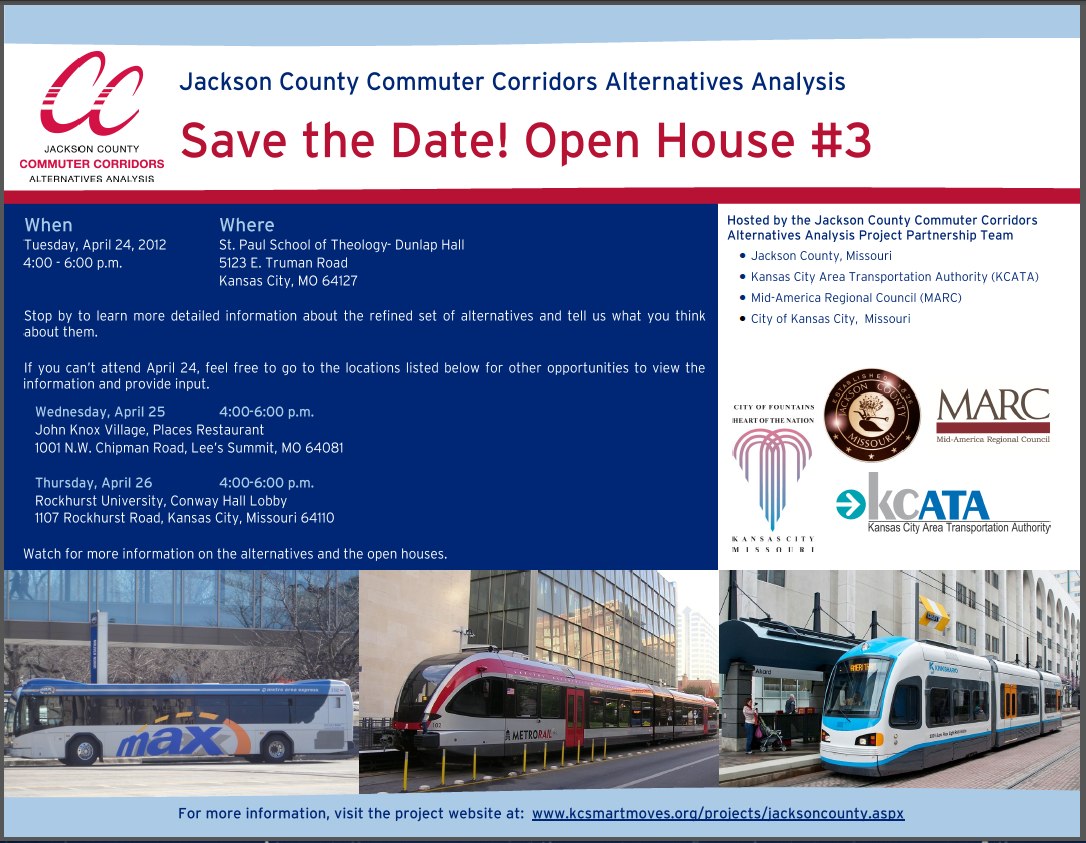
Don’t Miss Open House #3 – Jackson County Commuter Corridors Alternatives Analysis

Posted by Transit Action Network on April 13, 2012


Please evaluate the remaining alternatives and let the project team know your preferences based on the information currently available. Additional detailed information should be available, including a range of costs, ridership numbers, travel times and potential financing options. The study is not complete and your input is valuable. The project consultants expect to complete the study in early summer.

Posted in Local Transit Issues, Rail, Regional Transit Issue, Transit Studies | Tagged: , , , | Leave a Comment »

Missouri State Rail Plan Open House in Kansas City – April 11

Posted by Transit Action Network on April 6, 2012


MoDOT is about to finalize a statewide plan for rail service, both passenger and freight, and is holding another round of open house meetings to get comments. The Missouri State Rail Plan FINAL DRAFT, reflects  previous input from citizens, freight railroads operating in Missouri, shippers, and economic development and transportation agencies.

The plan is the Missouri Department of Transportation’s 20-year strategic framework for passenger and freight rail development in Missouri. Enhancing passenger rail and improving freight rail access are among the top recommendations.

MoDOT wants to know what you think. Join them at this upcoming public meeting.

Date: Wednesday, April 11, 2012

Time: 4:30 to 6:00 p.m., with a presentation at 4:45 p.m

Location: Mid-America Regional Council, Board Room, 600 Broadway St., Kansas City, MO

The meeting site is wheelchair-accessible.

The Invitation includes dates and locations for other open house meetings throughout the state.

For more information about the MSRP visit:

http://www.modot.org/othertransportation/rail/staterailplan.htm

Send online comments to staterailplan@modot.mo.gov

If you can’t attend this meeting, you can participate in the online meeting at www.morail.org April 10 through May 4, 2012.
Posted in Amtrak, Events, Rail, Regional Transit Issue | Leave a Comment »

Commuter Corridors Study Narrows Field of Alternatives

Posted by Transit Action Network on April 2, 2012


The  Stakeholders Advisory Panel for the Jackson County Commuter Corridors Alternatives Analysis (JCCCAA) met March 14. Parsons Brinckerhoff, the lead project consultants,updated information about the I-70 Corridor and the Rock Island Corridor. The Grandview corridor was not discussed. Potential alternatives for the Grandview corridor will be affected by the outcome of the Alternatives Analysis for the I-70 and Rock Island corridors.

The Federal Transit Administration (FTA) suggests the alternatives be evaluated using five primary perspectives (Stakeholder’s packet Nov 2011)

  • Effectiveness measures assess the extent to which the alternatives address the stated needs in the corridor.
  • Cost-effectiveness measures assess the extent to which the costs of the alternatives, both capital and operating, are commensurate with their anticipated benefits.
  • Feasibility measures the financial and technical feasibility of the alternatives. Financial measures assess the extent to which funding for the construction and operation of each alternative is considered to be readily available. Technical feasibility assesses potential engineering challenges or restrictions that could limit the viability of an alternative.
  • Impacts assess the extent to which the alternatives could present potential environmental and traffic issues that could be fatal flaws or otherwise influence the selection of a preferred alternative.
  • Equity assesses the extent to which an alternative’s costs and benefits are distributed fairly across different population groups

The consultants identified performance on the Common Segment, the section of the alignment where the two corridors come together and share the street or rail line, as a deciding factor in this level of evaluation.

Consultants evaluated the common segment for five items touching on three of the FTA perspectives.

Click To Enlarge

The “Poor” result in the common segment for Full Regional Rail is understandable if you consider the implications of running a large DMU (Diesel Multiple Unit) for miles on city streets and through neighborhoods. (See video  Discussion About The Regional Rail Alternative for the JCCCAA)  The DMU has the ability to run on freight lines as well as streets.

Last year TAN identified the Common Segment as the most challenging issue for the Regional Rail alternative. Once the rail leaves segregated rights-of-way and moves onto city streets many problems arise. (See Consultants Face Big Challenge Studying Regional Rapid Rail ).

For these criteria, TSM (Transportation Systems Management), which includes Enhanced Express Buses, and the BRT options look the best. However, there are additional criteria to be evaluated.

Eliminated

Full Regional Rail using a DMU on Truman Road or the Trench Embankment is eliminated.

Additional alternatives eliminated

All Rock Island Corridor Streetcar or BRT combinations with a DMU on the I-70 Corridor – These alternatives all require a forced transfer at the Truman Sports Complex. (See video about all eight combinations  Enhanced Streetcar/DMU/BRT Combinations Are Discussed). This issue affects four of the eight combination alternatives. (See combinations marked in yellow on  JCCCAA Modal Combinations Update March 2012)

Alternative at risk

The Enhanced Streetcar via Truman Road – Although in the common segment analysis the Streetcar via Linwood and the Streetcar via Truman Road look the same, the consultants said additional analysis suggests Linwood is a better choice than Truman Road. In the presentation, only the Linwood alignment is advanced to the next level of analysis at this point. (See combination marked in blue on JCCCAA Modal Combinations Update March 2012)

See Consultants JCCC AA March 2012 SAP Presentation. TSM including Enhanced Express Buses is included in the alternatives advancing for further evaluation although it isn’t listed on Slide 14.

Another Version of Rail Under Consideration

Since all of the original commuter rail alternatives using a DMU have been eliminated, another version of commuter rail that doesn’t use city streets or transfer at the Sports Complex is being re-considered.

In Tier One of the study the consultants looked at an alternative that kept the DMU on rail lines and went through the rail yard in the Northern Industrial District by the Missouri River before heading up to the River Market to Third St. and Grand Avenue.

This alternative was initially screened out in the Tier One screening because:

  • “This alignment has limited opportunity for stations, operates in a highly industrial area and constrained railroad environment. It is not as conducive to satisfying the project’s Purpose and Need as other options. “ (Stakeholder’s packet Nov 2011)

In 2007 this alignment, which goes through the Knoche rail yard, was studied for the I-70 corridor and rejected in the near term for commuter rail. Since then, significant changes have been made to that yard making it unsuitable for commuter rail. However, the Neff rail yard, which is slightly south of the Knoche rail yard, is being investigated for feasibility. If the consultants decide this alternative has potential they will add it for a Tier Two level analysis.

In this scenario, the rail alignment would stay on the Rock Island and KCS lines and come together in the vicinity of Rock Creek Junction, east of the rail yard. There are considerable challenges for this alignment including getting through the rail junction and the rail yard.

After discussions with both the consultant and MARC, here is the current situation:

Alternatives Eliminated

  • DMU using Trench or Trench Embankment
  • DMU on Truman Road (Full Regional Rail)
  • Alternatives that force a transfer outside of CBD (Central Business District

Alternative with significant challenges

  • Enhanced Streetcar via Truman Road

Alternatives advancing for further evaluation

  • TSM, including Enhanced Express Bus
  • Enhanced Streetcar via Linwood
  • BRT
  • Modal Combinations

Alternative receiving renewed consideration

  • DMU to River Market via rail yard (KCS and Rock Island)

Alternatives that are advanced in the study will go through further analysis such as ridership numbers, financial feasibility, constructability and economic development potential. Although everyone is impatient to get concrete numbers to compare alternatives, a study of this size would normally take a couple of years to complete and this study is being squeezed into a very short time frame. The consultants were only chosen in April of last year.

Project leader Shawn Dikes said Parsons Brinckerhoff is working to create a complete transit package, which would consist of the Locally Preferred Alternative (LPA) from this study as well as improved transit service to support the LPA. TAN feels it is extremely important to construct a complete transit package to take to the voters.

Besides the study update at the Stakeholders Advisory Panel meeting, there was a short talk by former Congressman Martin Frost about the Transportation Bill being debated in Congress.  He believes the final version will be similar to previous transportation bills, although the House Speaker is having a hard time getting his party to agree to a version that can pass the House. Michael Zuhl, a consultant with R&R Partners, gave a short talk about the transit education campaign for Jackson County.

The consultant team is pulling out all the stops to find the best alternative for commuters in Jackson County. They are trying multiple combinations of vehicles and lots of alternative alignments. Jackson County should feel comfortable that the process is working well and it should be happy to go to the voters with the Locally Preferred Alternative resulting from this study.

Proposed schedule

The Project Team met March 23 and County Executive Mike Sanders and Mayor Sly James went to Washington, D.C. to meet with officials about the transit initiatives underway. This level of cooperation and coordinated transit effort is unprecedented in our region.

Mid-April Stakeholder Advisory Panel

Late April – Public Workshop

4/27 Project Partnership Team meeting

5/25 Project Partnership Team Meeting

May/June – Public Workshop

Summer – Announcement of LPA

Posted in Local Transit Issues, Regional Transit Issue, Transit Studies | Tagged: , , , | Leave a Comment »

Great Bargain for JCT Commuters and A Step Forward for Seamless Transit

Posted by Transit Action Network on March 15, 2012


Two significant transit decisions are about to be implemented.

1.  Johnson County Transit (JCT) has decided to sell its monthly pass through its website.  The reported price is $67 (plus a small service fee), and sales begin in April for a May 1, 2012 start date. The JO Store

The JO will continue to sell its monthly pass to employers for re-sale to their employees.  Employers will continue to pay $63 per pass, and they generally discount the pass to their employees.

Availability of the monthly pass will be a significant cost saving for Johnson County commuters whose employers don’t sell passes.  Such commuters currently have to pay cash fares ($2.00 each way, or $88 for a 22-workday month), or use 10-ride passes ($18.00 for 10 rides, or $79.20 for a 22-workday month).

 2.  Kansas City Area Transportation Authority (KCATA) will accept the JCT monthly pass on all regular Metro buses (excluding premium-priced commuter routes). KCATA and JCT will allocate revenue from the JCT pass between themselves based on usage.  JCT monthly passes will be accepted on Metro buses beginning May 1, 2012.

Anyone can purchase the JCT monthly pass online to use on either system.
TAN advocates have worked for Seamless Transit for many years, and this development is clearly a step in the right direction.

The advantage to Johnson County residents is obvious: they can use Metro buses during the day for lunch trips or errands, or to get closer to home (e.g. to the Plaza or Waldo) before calling a family member, a friend, or a cab when they work late.  What’s more, Johnson County riders can drive to a Missouri location (such as Waldo) and use Metro buses to reach Missouri attractions on weekends.  (A free ride on a Metro bus compares favorably with a $30 parking fee for a Sprint Arena event.)

Missouri and Wyandotte County residents who also need to use The JO will have the option of purchasing the JCT monthly pass.  These riders will need to evaluate whether their savings will justify the higher up-front cost of the JCT monthly pass.  Riders who use transit only for commuting now pay $3.50 per day in cash fares ($1.50 going to work, $2.00 to return), or $77 per 22-workday month.  A rider who needs to be able to use Metro buses all week as well as commute to Johnson County currently pays $94 for a 22-workday month ($50 Metro pass plus $44 in cash fares on The JO).

Although JCT and KCATA have accepted each other’s transfers for several years, neither system has accepted the monthly bus pass of the other system until now.  The JCT monthly pass will be accepted on Metro buses but the Metro $50 monthly pass will not be accepted on JCT buses, mainly due to the large price difference. (Metro pass users may not know that they can ask for “a transfer to The JO” when they board.  KCATA normally does not issue transfers to its monthly pass users.)

The JCT monthly pass sale through their website and KCATA acceptance of the JCT monthly pass are positive steps toward Seamless Transit. Well over 500 JCT monthly pass holders will get automatic access to the extensive (7 days a week, 20 hours per day, service to five counties) Metro system at no additional cost.

Due to the large fare differential between the two systems and limited service provided by JCT, it will be interesting to track the sales numbers for the JCT monthly pass to see:

  • how many passes are sold to riders outside of Johnson County
  • what percentage of morning commuters from Kansas City to Johnson County use the JCT monthly pass (this direction is considered a reverse commute).

Transit Action Network welcomes a victory for Seamless Transit and will work to make sure that:

  • Metro riders are aware of their new option for access to The JO
  • JO riders make good use of their new access to the Metro system beginning May 1.

Posted in Local Transit Issues, Regional Transit Issue, Seamless Transit | Tagged: , | 1 Comment »

Enhanced Streetcar/DMU/BRT Combinations Are Discussed

Posted by Transit Action Network on February 24, 2012


The Partnership Team and consultants added eight additional alternatives to the Jackson County Commuter Corridors Alternatives Analysis (JCCCAA).  In the final interview of this series, Lisa Koch, senior planner with the lead consulting team Parsons Brinckerhoff, discusses these alternatives which include various combinations of three transit modes; Enhanced Streetcar, Diesel Multiple Unit (DMU) and Bus Rapid Transit (BRT). Maps of all the combinations are available below.

Lisa also describes the traffic control elements being planned for an Enhanced Streetcar to travel on the streets and how these elements differ from the ones used by the Regional Rail DMU alternative discussed in the previous interview.

For a closer look at the display board Lisa uses during the interview, see JCCCAA display-board-nov 2011 or print page 11 of the second open house display boards. JCCCAA-open-house-display-boards-nov 2011

Summary of JCCCAA Streetcar/DMU/BRT combinations being studied

Click to enlarge

Maps of all the Streetcar/DMU/BRT Combinations

A. Enhanced Streetcar/DMU – Linwood Alternative

B. Enhanced Streetcar (ALL) – Linwood Alternative

C. Enhanced Streetcar/DMU – Truman Road Alternative

D. Enhanced Streetcar (ALL) – Truman Road Alternative

E. BRT/DMU – Linwood Alternative

F. BRT (ALL) – LinwoodAlternative

G. BRT/DMU – Truman Road Alternative

H. BRT (ALL) – Truman Road Alternative

An alternatives analysis requires a substantial amount of work to evaluate the possible transit solutions for a corridor. The analysis includes a complex comparison process to decide which alternative is the best fit for our region at this time. Lisa has agreed to visit with TAN again to update us on status of the study and provide insight into the FTA process used to rate the alternatives.

TAN appreciates Tom Gerend of MARC and Lisa Koch of Parsons Brinckerhoff, along with Shockey Consulting and TranSystems, for making all of this information available to our viewers.

The next open house is March 13 -15 going to be re-scheduled.

Traffic Control Elements for RAIL on Streets in the JCCCAA

Link to the first interview: MARC And Parsons Brinckerhoff Discuss The Current Status Of The Commuter Corridors Altenatives Analysis

Link to the second interview: Parsons Brinckerhoff Consultant Discusses Three Alternatives In The JCCCAA

Link to the third interview: Discussion About The Regional Rail Alternative for the JCCCAA

Project website:  KCSmartMoves

Posted in Local Transit Issues, Rail, Regional Transit Issue, Transit Studies, Videos-Transit | Tagged: , , , | Leave a Comment »