Transit Action Network (TAN)

Advocates for Improved and Expanded Transit in the Kansas City Region.

Archive for the ‘Local Transit Issues’ Category

JCT Releases Revised Proposal for Cuts – Save The JO

Posted by Transit Action Network on August 28, 2012


Johnson County Transit (JCT) has released a Revised JCT Service Reductions Aug 14,2012 report for eliminations and reductions to its transit system.
Summary of the revised proposal:

Eliminate five routes (instead of nine)
Reduce/combine service on the four other routes that were proposed for elimination
Make additional schedule modifications on four other routes based on comments and service efficiencies.

Here are the original 9 routes slated for eliminations with some of our comments. Review the JCT report for additional information. Keep in mind that JCT is still reviewing the routes and could make more changes.

Routes Originally Proposed for Elimination

Three Routes Eliminated Totally
Route 676-P – Paola/Spring Hill/Olathe Eliminating this route and Route 816 will leave these communities and seniors without any transit. The Special Edition does not operate in Spring Hill and Paola.
Route 810 – DeSoto FlexRide This change will leave this community and seniors without any transit. The Special Edition does not operate in DeSoto.
Route 816 – Spring Hill Shuttle Eliminating this route and Route 676 will leave this community and seniors without any transit. The Special Edition does not operate in Spring Hill.
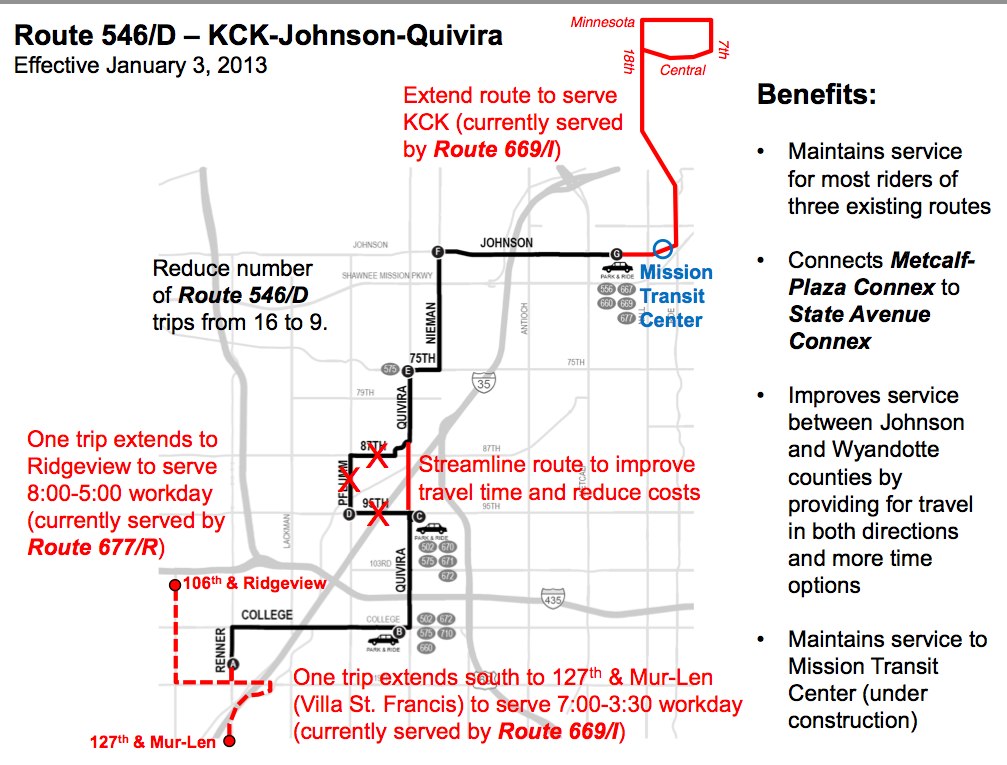
Eliminate 667-R and 669-I and combine with 546-D into one new route
Route 546-D – Johnson/Quivira, Route 677-R – Downtown/Olathe, Route 669-I – KCK/Lenexa/Olathe Eliminate current routes I, R and D but combine them into a new Route 546-D. The new Route 546-D would have only 9 trips instead of the current 16. The northern end would be in KCK. The southern end is usually at 116th and Renner. See the proposed map. One trip extends south to 127th & Mur-Len (Villa St. Francis) to serve 7:00-3:30 workday (currently served by Route 669/I) One trip extends to Ridgeview to serve 8:00-5:00 workday  (currently served by Route 677/R
Keep routes instead of eliminating them; make significant service reductions.
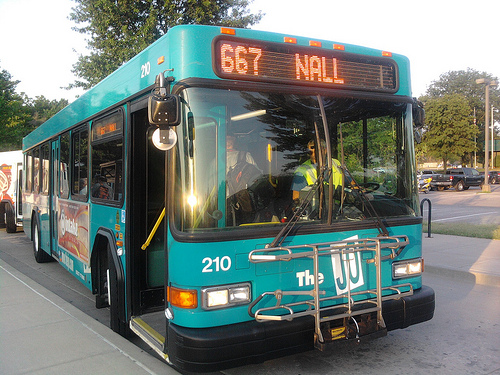
Route 66-E – Nall/Downtown – Reduce from 4 to 2 trips This reduces service between Johnson County and Wyandotte counties. This is the only JO service that goes to KU Med. Routes with only one morning and one evening trip are bound to fail. The national transit-consulting firm Nelson Nygaard recommends at least 6 trips (3 each way) to make a successful commuter route. If they must reduce service, JCT needs to consider other options in order to keep the four trips.
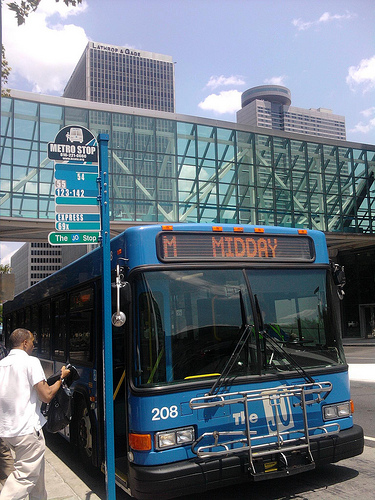
Route 672-M – JoCo/Downtown Midday – Keep but eliminate Metcalf portion of route The route would travel from Mission to OPM on Shawnee Mission Parkway, I-35, and US-69, instead of using Metcalf and 95th. This re-routing should save 10-15 minutes per trip. Transfers to Metcalf destinations can be made via 856 in Mission. South of Oak Park Mall, the route would remain unchanged. Downtown employees who want additional midday flexibility could take MAX to the Plaza and transfer to 856, or to Waldo and transfer to 875.
Route 812 JO Flex– Reduce from 3 days to 2 days This change is better than eliminating the route.

Transit Action Network knows that JCT is trying to combine routes and provide as much transit as possible for its current riders given the budgetary restrictions and instructions from the County Commissioners. We are also aware that unless the County makes significant budget changes, all of these routes and more may be eliminated in 2014.
click to enlarge

Below is the Commission’s transit priority list that JCT is directed to implement over the next two years as a result of a reduction in federal and state funds.

The Board of County Commissioners Transit priorities (in order of importance):

  • Protect the most vulnerable county residents by maintaining Special Edition and SWIFT services.
  • Support TIGER investments by maintaining service on the Metcalf and Shawnee Mission Parkway corridor
  • Maintain I-35 Xpress (Bus on Shoulder Routes)
  • Maintain K-10 Connector
  • Continue Local Services and Local Links

Our concern is the county’s lack of commitment to developing a full service transit system. In terms of transit, Johnson County thinks like a small city instead of a big wealthy county. Blue Springs, Missouri has a population of slightly over 50,000 people. For transit it normally considers an OATS bus for seniors and the disabled and a few commuter express buses as sufficient, although Blue Springs is  working very hard to get commuter rail. Johnson County, with a population of 544,000, has stated a position that supports a similar low level of bus transit, with one exception. They want to keep the new Metcalf/Shawnee Mission Parkway and 75th Street/Quivira CONNEX routes. So do we, but these routes need to be paid for with new county funds instead of transferring funds from the current transit system.  Johnson County accepted a $10.7 million TIGER grant from the federal government for improvements along the M/SMP corridor, and they would have to return the money if they cancelled these routes. Yet the county refuses to add new money to the transit budget to replace the three-year start up money the federal government gave them for operating expenses on these routes.

Board of Commissioners Chairman Ed Eilert complains about the cost per rider and farebox recovery ratio on some of these routes, yet he knows that the main CONNEX service has far worse performance numbers than nearly all of the regular routes they are proposing to eliminate, such as Routes 669-I, 667-E, 672-M and the JO Flex.

Routes originally proposed for elimination Example: Farebox recovery ratio
672-M 17%
669-I 15%
667-E 14%
JO Flex 11%
Major CONNEX Route – protected
556 Metcalf/Plaza 9%
856 Metcalf/Plaza Flex 7%

The disingenuous nature of the Commission’s priorities is very concerning. Providing transit for seniors is at the top of their list, yet eliminating the local service in Spring Hill, Paola and DeSoto will leave their elderly populations stranded once again, since the Special Edition bus doesn’t service those areas.

The county won’t eliminate all of the proposed routes at this point in time or they might be in violation of Title VI of the Federal Civil Rights Act. The Act says if you receive federal funds, you can’t eliminate service to minority and low-income populations in a discriminatory manner. Of the original proposed eliminations, routes 546-D – Johnson/Quivira, 667-E – Nall/ Downtown, and 669-I – KCK/Lenexa/Olathe have significant service to areas with higher percentages of minority and low-income populations. These routes would be eliminated based on the Commission’s directions to JCT.

You still have time to comment to the Commission on the changes being proposed. Final BoCC action is planned for October 18.

Contact Johnson County Board of County Commissioners

  1. Phone: 913-715-0430
  2. Email contact form: http://bocc.jocogov.org/webform/contact-us
  3. Chairman: Ed Eilert (913) 715-0500
  4. District 1: Ed Peterson  (913) 715-0431
  5. District 2: Jim Allen  (913) 715-0432
  6. District 3: David Lindstrom (913) 715-0433
  7. District 4: Jason Osterhaus (913) 715-0434
  8. District 5: Michael Ashcraft (913) 715-0435
  9. District 6: Calvin Hayden  (913) 715-0436

JCT Tentative Timeline –

• Joint JCTC/BoCC meeting on August 30, 2012, 11 am, Board of County Commission’s hearing room on the third floor of the County Administration Building in Olathe
• Present final recommendations at JCTC meeting on September 18, 2012
• Submit JCT/JCTC recommendations to BoCC on October 4, 2012.
• Agenda Review: October 11
• Final BoCC Action: October 18
• Final changes posted the week of October 22, 2012
• Changes will begin operation on January 2, 2013

The Johnson County Transportation Council (JCTC) meeting on September 18 will be held at 5:30 pm at Sylvester Powell: 6200 Martway, Mission, KS so that more people can be present to hear the presentation of the final recommendations and hear the discussion.

Posted in Action, Events, Local Transit Issues, Regional Transit Issue | Tagged: , | Leave a Comment »

Public Open House – US 40 Highway Corridor – AUG 28, 29 and 30

Posted by Transit Action Network on August 24, 2012


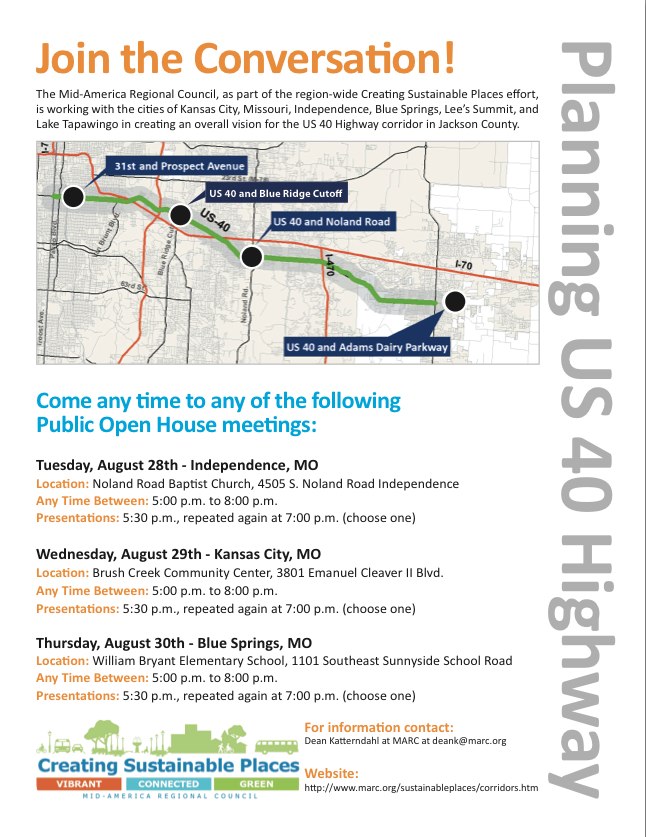
Provide input for the region-wide development process to create sustainable places. There will be public meetings on each of the six corridors being worked on. This meeting is for the US 40 Highway corridor, which extends from 31st and Prospect in Kansas City, MO, to US 40 and Adams Dairy Parkway in Blue Springs, MO. Sustainable places create transportation corridors that accommodate different modes of travel — walking, biking, transit and auto.

Click to enlarge

Tuesday, August 28th – Independence, MO

Location: Noland Road Baptist Church, 4505 S. Noland Road Independence
Any Time Between: 5:00 p.m. to 8:00 p.m.
Presentations: 5:30 p.m., repeated again at 7:00 p.m. (choose one)
 

Wednesday, August 29th – Kansas City, MO

Location: Brush Creek Community Center, 3801 Emanuel Cleaver II Blvd.
Any Time Between: 5:00 p.m. to 8:00 p.m.
Presentations: 5:30 p.m., repeated again at 7:00 p.m. (choose one)
 

Thursday, August 30th – Blue Springs, MO

Location: William Bryant Elementary School, 1101 Southeast Sunnyside School Road
Any Time Between: 5:00 p.m. to 8:00 p.m.
Presentations: 5:30 p.m., repeated again at 7:00 p.m. (choose one)
 

This community meeting is related to the $4.25 million grant Mid-America Regional Council (MARC) received from HUD to help create sustainable places in the Kansas City region.  Print and post the Flyer.CSP_Flyer_40 Highway Meetings

Visit MARC’s website to learn more about this process. The CSP initiative includes plans and demonstration projects in six key corridors in the Kansas City region: State Avenue, North Oak, U.S. 40, Rock Island, Central City and Shawnee Mission.

Posted in Events, Local Transit Issues | Tagged: | Leave a Comment »

Save The JO Video #7 – Seniors Speak Up

Posted by Transit Action Network on August 17, 2012


Route #812 is The JO Flex service in Overland Park. It doesn’t cover a lot of Johnson County but it is a necessity for the people who depend on it. Watch seniors at Santa Fe Towers Apartments speak about their situation and concerns about the proposed elimination of this service.

The JO flex service covers a rectangle from 75th Street on the north, Lamar on the east, 95th  Street on the south and Quivira on the west. The service is limited between 10 a.m. and 2 p.m. on Monday, Wednesday and Friday. You don’t have to qualify to ride the #812, since it is available to anyone in the service area. Two very large retirement communities are significant users of the route, Overland Towers and Santa Fe Towers Apartments.

The JO Flex is more cost-effective than the new showcase CONNEX route #556 that JCT will retain. The JO Flex has better farebox recovery, cost per rider and ridership per trip than the CONNEX route.

The County Commissioners have said elderly, disabled and low-income populations will have the Special Edition, which is a shared ride program, providing transportation for registered and qualified residents of Johnson County. Usually you can’t call the day before to schedule a ride because the service is already full. The Special Edition only uses buses with a capacity of 10-12 people, where the JO Flex uses larger more comfortable buses. The JO Flex fare is $1, so a trip to the grocery store is $2. The Special Edition fare is $5, so the same trip would cost $10. Switching all of The JO Flex riders over to the more expensive, smaller, over-crowded Special Edition seems like a losing proposition.

Please keep the more affordable Route #812 JO Flex.

Contact Johnson County Board of County Commissioners

  1. Phone: 913-715-0430
  2. Email contact form: http://bocc.jocogov.org/webform/contact-us

Posted in Action, Local Transit Issues, Regional Transit Issue | Tagged: , | Leave a Comment »

All About Smog – One More Reason to Save the JO

Posted by Transit Action Network on August 14, 2012


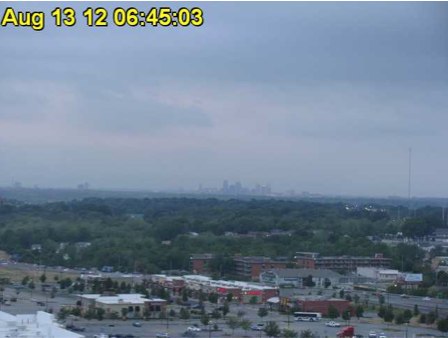
This is a Missouri Dept. of Natural Resources photo from August 13, 2012 from Blue Ridge Mall looking at downtown Kansas City. The KCPT tower, right-middle of the photo, is 3 miles away and the downtown skyline is 8 miles away. On a bad day, you can’t see the tower and on a really bad day even the skyline disappears from view. So what is smog?

The term “smog” was coined at the turn of the century to describe the hazy horizon of industrialized European cities, but around the 1950s, vehicle emissions began to take the place of factories in creating this noxious mixture of “smoke” and “fog”. Smog is a haze we see today during our hot and humid summers. This combination of ground-level ozone, nitrogen dioxide, hydrocarbons and dust particles is monitored regularly and regulated by the US EPA due to increasing health concerns for sensitive populations like children, the elderly and people with allergies or asthma.

In Kansas City, emergency room visits and hospital admissions increase significantly when ground-level ozone concentrations are high. Ground-level ozone irritates the eyes and nose, causes inflammation, difficulty breathing and even chest pain. It is formed by emissions from vehicles, power plants and other sources mixing with heat and sunlight, which is why summer is the most troublesome for air quality. Poor air quality knows no political boundaries, though, and smog will often creep northward with the warm, south winds of summer.

There is something we can all do to help. With daily work commutes averaging around 20 miles, multiple highway corridors, and abundant parking, it’s easy to see why so many folks in the Kansas City area drive to work. It’s also easy to see how our routines are contributing nearly half of the ozone forming emissions that contribute to poor air quality. Leaving your car at home even twice a week can save over 270 pounds of harmful ozone-forming emissions.

The MidAmerica Regional Council’s RideShare Connection is hosting the Green Commute Challenge now through September 28th to help raise awareness of air quality issues, reduce use of single-occupant vehicles in the peak summer season, and encourage transit use across the metro area through an employer-based contest. Thirty teams have joined from across the Kansas City area and over 900 people are taking the challenge to use alternative transportation.

Between bicycling, riding the bus or carpooling to work, and walking or simply staying in for lunch, the challenge has already reduced emissions by over 250,000 pounds. That’s like taking 14,000 cars off the road for a day. During the 12-week challenge, participants track their trips online and earn points. It’s a great way to see how our individual choices can add up to big benefits and many participants are using public transportation to earn serious points for their teams.

We can all do our part for air quality and using transit is a great way to start. And you don’t have to wait for national fuel efficiency standards or alternative energy sector growth to help! Compared to other household actions, using transit can reduce emissions by more than 10 fold.  A robust public transportation system is one of the very best investments any community can make to minimize emissions and reduce greenhouse gases. Transit can’t beat bicycling or other no-emission commutes, but modern buses are often hybrids using natural gas, biodiesel and other low emission fuels. The KCATA Metro MAX has several hybrid and clean diesel vehicles and both KCATA and The JO will be adding natural gas vehicles to their fleet.

Does being a transit rider make you an air quality hero? It depends who you ask but there’s no doubt that reducing even a few solitary commuting trips in your car can help reduce greenhouse gas emissions that contribute to global climate change and poor local air quality. Kansas City had 18 Ozone Alert days already in 2012, up from only 9 last year and 4 in 2010. We’ve exceeded ozone concentration standards 16 times this year and we’re setting a pace to top the last 2 years combined for quantifiable poor air quality. Poor air quality affects everyone’s health and it can make doing business more expensive as tighter regulations are enacted to meet basic national standards.

When local budgets get tight and cuts seem imminent, priorities have to be defined to guide the process, but with growing concerns about air quality and the human health impacts a very clear reality in the Kansas City metro area, you have to ask: why is public transportation not a priority in Johnson County? How can eliminating bus routes by 45% (and reducing service on another 45% of routes) serve our collective goals for air quality when it is the first, best way to reduce harmful ozone-causing emissions? We don’t believe cutting bus services voluntarily is in the best interest of Johnson County or the collective community when it comes to air quality issues or the kind of reliable public transportation system the public increasingly demands.

It’s not too late to improve air quality in Kansas City. From alternative fuel blends and hybrid vehicles to using low emissions paint in our homes and native landscaping in our yards, people across the metro are doing so much to reduce harmful greenhouse gases and ground-level ozone in our community. Using transit is one of the most effective things you can do to help ease air pollution and prevent smog from ever forming. The only question is: if you live or work in Johnson County, will you still have the transit option in 2013?

Contact Johnson County Board of County Commissioners

  1. Phone: 913-715-0430
  2. Email contact form: http://bocc.jocogov.org/webform/contact-us

http://finances.msn.com/saving-money-advice/6804691

http://www.marc.org/Environment/airQ/pdf/FAQfourpage.pdf

http://www.dnr.mo.gov/env/esp/aqm/kccam.htm

http://www.apta.com/gap/letters/2010/Pages/100728_obama.aspx

http://www.marc.org/Environment/airQ/pdf/ozonereports/O3WeeklySummary.pdf

Posted in Action, Local Transit Issues, Regional Transit Issue | Tagged: , , , | Leave a Comment »

Streetcar TDD Vote Passed!

Posted by Transit Action Network on August 1, 2012


The unofficial results are in for the creation of the Downtown Streetcar Transportation Development District (TDD).

318 YES, 141 NO.  Congratulations.  The TDD will be created.

Posted in Events, Local Transit Issues, Rail | Tagged: | Leave a Comment »

Streetcar Ballots Due 5 PM July 31

Posted by Transit Action Network on July 30, 2012


Get your ballots in!!! If you haven’t returned your ballot to vote on creating the Transportation Development District (TDD) for the downtown streetcar, the deadline is quickly approaching.

The ballots are due in Jackson County Courthouse by 5 pm July 31. That does NOT mean postmarked by that time. The ballots must be physically present. The election board is going to count the ballots on Aug 1.

The county had received 405 ballots as of last Thursday night. A significant number of the 555 ballots requested had not been received.

At this point, please do NOT mail your ballot.

Either:

1. hand deliver it to Jackson County Courthouse, 415 East 12th Street, Kansas City, Missouri 64106 or

2. if you need the ballot picked up, message Streetcar Neighbors on Facebook and they will pick it up and deliver the ballot for you.

If you didn’t watch our video the KC Streetcar Stroll in May, you may want to watch it now.

Posted in Action, Local Transit Issues, Rail, Regional Transit Issue | Tagged: | Leave a Comment »

Save The JO – Video #6 – The Solution – Interview with Steve Klika

Posted by Transit Action Network on July 27, 2012


Steve Klika, Chair of the Strategic Transit Action Recommendation Taskforce (START) spoke with Transit Action Network about the 2011 recommendations of this Taskforce. Steve has a long-term commitment to transit. He is the Johnson County representative on the KCATA Board of Commissioners and former Chair of the Johnson County Transportation Council.

Although the Johnson County Board of County Commissioners is currently struggling with its commitment to transit and the transit budget, this Taskforce provided recommendations to implement a phased-in comprehensive county-wide transit system based on the Johnson County Transit Strategic Plan. The Taskforce also provided a list of financing options. Johnson County residents developed this plan specifically for Johnson County.

The long-term transit solution for Johnson County already exists. We ask the Johnson County Board of County Commissioners to move forward with this transit plan rather than dismantling The JO over the next two years. Please begin by rejecting the proposed plan to eliminate or reduce 90% of the routes in 2013.  We believe Johnson County is moving in the wrong direction and deserves an excellent transit system on par with the rest of Johnson County services.

START_Final_Report_2011

START_Final_Discussion_2011

Strategic Plan Prelim 2011

JO Proposed Eliminations and Reductions for 2013 – Public Meeting Presentation

The deadline for public comment is July 30, 2012. Please speak up for transit.

Contact Johnson County Board of County Commissioners

  1.  Phone: 913-715-0430
  2.  Email contact form: http://bocc.jocogov.org/webform/contact-us

Contact Johnson County Transit

  1. E-mail: Comments@thejo.com
  2. Mail: Johnson County Transit, 1701 West 56 Highway, Olathe, Kansas 66061
  3. Phone: 913-715-8255 – record your message

See all of our articles and videos related to this issue. The articles started on June 8 with  Save The JO – Contact JOCO Commissioners and the videos are all on our TAN Videos page. Everything is also collected on our Facebook event page for Save The JO.

Posted in Local Transit Issues, Regional Transit Issue, Videos-Transit | Tagged: , | 1 Comment »

Save The JO – Transit Advocates Speak Up At The JoCo Public Budget Hearing

Posted by Transit Action Network on July 26, 2012


The Johnson County Board of County Commissioners probably got a surprise at the Public Budget Hearing Monday night. Nine of the eleven people who testified at the hearing did so because of the transit budget and proposed plans to eliminate or reduce 90% of The JO routes in 2013.  Unfortunately for transit riders, participation was very difficult since the Johnson County Administration Building is hard to get to on transit and it is impossible to use transit to get home afterwards.

Jonothan Walker, President, ATU Local 1287

The Commissioners heard a wide range of perspectives and concerns but they all agreed on one point – find the money to keep The JO running.  Speakers were concerned about job losses, the environment, the elderly and disabled, social equity issues, the potential of losing the young professional class of workers, the County’s failure to honor its commitment to replace federal CMAQ funds and much more. Two of the testimonies are posted on our Save the Jo Facebook event page. The whole budget hearing is posted on the county website The individual testimonies start after the County Managers presentation at the 19 minute mark. The County Manager makes it very clear that Johnson County has the lowest mill levy in Kansas. Not having money for transit and other services in Johnson County is a self-imposed austerity. According to the County Manager, Johnson Countians pay an average of .58 percent of their household income on county taxes.

Martin Rivarola, City of Mission

The operating cost for the current 20 routes is $5.7 million* with only $2 million coming from the county and the County Commission is currently saying they can’t afford any more than that. Of course, not all of the Commissioners agree. The JO riders pay over $1.1 million of the service. Of course that number will go down if nine routes are eliminated. The rest, $2.6 million, is federal and state money. Much of this large subsidy is going to disappear over the next two years but currently the Commission doesn’t plan to replace it. Normally the bulk of transit operating expenses has to come from local sources.

Rev. Bobby Love, MORE2

A lot of the federal money is related to federal Congestion Mitigation Air Quality (CMAQ) funds used as seed money to start the CONNEX routes. The federal government doesn’t normally pay operating expenses. After three years the CMAQ money is finished and the money has to be replaced locally to keep the routes.

The Commission understands it commitment to replace the CMAQ funds for new routes with additional money. In previous administrations the Commission has been fiscally responsible and provided those new funds. This time the Commission is keeping the CONNEX routes and spending $10.7 million of additional federal money for major infrastructure improvements for this service through a TIGER grant, but they aren’t adding the new operating money. We don’t think that is a fiscally responsible decision. If the Commission wasn’t going to provide the operating cost for the CONNEX routes, they shouldn’t have started the routes and applied for the TIGER grant.  As a result, it appears that many routes must be eliminated or reduced to make up the difference. The CONNEX is potentially a great new service but the County needs to pay for it without dismantling The JO.
Joe Walker, Pastor Westwood Christian Church

Carol Guenther, JO bus rider

JO ridership is growing by 12%. While an increasing number of county residents are opting for public transportation, Johnson County Commissioners are dismantling what little transit is left. While the one-occupant car may be the current transportation mode of choice, you don’t need to look out very far to see fuel supply constraints, worse traffic congestion and more air pollution – none of which enhances the view of Johnson County as a quiet refuge for those seeking tree-lined streets, responsive government and effective planning.

For perspective on the county’s funding commitment to transit, the Kansas City, MO contract with KCATA this year is over $46 million. The residents of KCMO have a 7/8-cent sales tax to provide transit. JoCo residents pay extremely little in property tax to get the JO.

Johnson County prides itself on education, infrastructure and services but if you want transit you have to pay for it. Johnson County deserves a real transit system that stands a chance of winning people out of their cars. Tomorrow, we’ll post a video about a real solution for a comprehensive county-wide transit system. A plan already exists that was created just for Johnson County by Johnson County residents.

Jim Courtney, Executive Director, Mr. Goodscents Foundation

Janet Rogers, Transit Action Network

Sheila Styron, Public Policy Coordinator, The Whole Person

Ron McLinden, JO bus rider, Transit Action Network

The deadline for public comment is July 30, 2012. Please speak up for transit.

Contact Johnson County Board of County Commissioners

  1. 1.    Phone: 913-715-0430
  2. 2.    Email contact form: http://bocc.jocogov.org/webform/contact-us

Contact Johnson County Transit

  1. E-mail: Comments@thejo.com
  2. Mail: Johnson County Transit, 1701 West 56 Highway, Olathe, Kansas 66061
  3. Phone: 913-715-8255 – record your message

*Figures are based on the Johnson County Transportation Council meeting packet for April 2012.

Powerpoint presentation JO Proposed Eliminations and Reductions – Public Meeting 7-11-12

Posted in Events, Local Transit Issues, Meeting Reports, Regional Transit Issue | Tagged: , | Leave a Comment »

Public Budget Hearing – Unified Government of Wyandotte County – July 30

Posted by Transit Action Network on July 26, 2012


Unified Government of Wyandotte County and Kansas City, Kansas Departments of Budget and Community Development are holding a public budget hearing.  The purpose of this meeting is to request public comment for the upcoming Unified Government’s revised 2012 and proposed 2013 budgets.

Where: Unified Government Board of Commissioners Chambers
Lobby of the Municipal Office Building
701 N 7th St
Kansas City , KS 66101
 
When: Monday evening, July 30, 2012 at 5:00 p.m.

If you ride the buses in Wyandotte County or are a transit supporter, please attend the hearing and encourage the Commission to continue to expand and improve transit in Wyandotte County.

Posted in Action, Events, Local Transit Issues, Regional Transit Issue | Tagged: | Leave a Comment »

Save The JO – Videos #4 and #5 Interviews with Johnson County Commissioners

Posted by Transit Action Network on July 22, 2012


Johnson County Commissioners Eilert and Peterson spoke with Transit Action Network about the eliminations and reductions proposed for January 2013 to The JO.

The commissioners have very different views on:

  • the role of transit in Johnson County
  • how to fund transit
  • how to respond to citizens’ vision for multi-modal transportation, sustainability and a better environment
  • the County’s commitment to the working poor who need The JO to get to work

Can Johnson County afford a small commuter transit system only if it is heavily subsidized by federal and state funds? We wouldn’t expect that to be the case from one of the richest counties in America*. It is the loss of federal and state funds, and the Commission’s current failure to replace those funds, that is causing the severe budget problems that will mainly hit in 2014.

One way to deal with the loss of the federal and state money is to eliminate and reduce most of the transit routes in Johnson County over a couple of years. The other way is to get the money and keep the transit.

Everyone from JCT staff to Commissioner Eilert said they are proposing cuts in 2013 so they don’t have such large cuts in 2014.  Unless Johnson County changes direction, they aren’t done shrinking the transit system. They say they trying to ease in the cuts to lessen the negativity that would result from doing it all at once in 2014.

Timeline for eliminations and reductions:
2012 Service reductions and modifications
2013 Proposed route eliminations (45% of all routes gone) and service reductions (45% of routes modified)
2014 Expect significant additional eliminations and/or reductions based on comments by staff and Commissioner Eilert


Please let the Board of County Commissioners know how important The JO is by attending the public hearing. Speakers will be allowed 3 minutes.

Johnson County Board of County Commissioners Public Budget Hearing
July 23rd @ 7 pm
Johnson County Administration Building, 111 S. Cherry, Olathe, KS 66061

If you miss the meeting:

Contact Johnson County Board of County Commissioners

  1. Phone: 913-715-0430
  2. Email contact form: http://bocc.jocogov.org/webform/contact-us

 Contact Johnson County Transit

  1. E-mail: Comments@thejo.com
  2. Mail: Johnson County Transit, 1701 West 56 Highway, Olathe, Kansas 66061
  3. Phone: 913-715-8255 – record your message
Deadline for public comment is July 30, 2012.
JO Public Meeting_Proposed Eliminations and Reductions for 2013
START_Final_Report_2011
START_Final_Discussion_2011
Strategic_Plan_Prelim_2011

We have numerous blog articles about this issue starting on June 8th with  Save The JO – Contact JOCO Commissioners

All of our videos are available on our TAN Videos page.

*Wealthiest Counties in The U.S. (Per Capita Income) based upon income tax returns from the Internal Revenue Service’s Individual Master File (IMF). Johnson County is listed as #42 http://www.amerifound.com/wealthiest_counties_in_america.html

Posted in Action, Events, Local Transit Issues, Regional Transit Issue, Videos-Transit | Tagged: , | Leave a Comment »

It’s Not Just About 669 – Save The JO!

Posted by Transit Action Network on July 21, 2012


We’ve blogged about Johnson County Transit’s plan to eliminate Route 669.  But there are other essential routes on the chopping block, too. Here are entries that we previously posted on Flickr about three of the other routes that we believe deserve special consideration.  Only lack of time has kept us from posting about some of the other routes as well.

JCT Route 546 – Johnson Drive / Quivira — Save This Bus!

The Route 546 bus pauses at the 6000 Lamar Transit Hub in Mission at 6:14 am to exchange passengers with other routes. This particular bus brought 4 passengers from points in Shawnee and Lenexa. Route 546 previously went all the way to Downtown Kansas City, but it was truncated at 6000 Lamar in January, 2012, to cut costs. Passengers who previously had a single-seat ride to their Downtown destination now have to transfer. As a result, ridership has suffered, and on many days one of these little 12-14 passenger buses is used. In addition, these small buses ride like trucks, and that doesn’t encourage ridership, either. Route 546 is proposed for elimination effective January, 2013.

JCT Route 667 – Nall — Save This Bus!

The first of two inbound morning trips of JCT Route 667 pauses at the 6000 Lamar Transit Hub in Mission at 6:49 am to exchange passengers with other JCT routes. This route is proposed for elimination effective January, 2013. This particular trip served about 13 passengers, 11 of whom boarded at 6000 Lamar or closer to its Downtown Kansas City final destination. Route 667 passes KU Med Center, where only one passenger got off. Low ridership has to be due, in part, to the fact that there is virtually no evidence of this route along the way: only six JO bus stop signs were spotted beyond this point for inbound (i.e., toward KU Med and Kansas City) riders, and none of those are within Wyandotte County where KU Med Center is located. First rule of public transit: Make the service visible.

JCT Route 672 – Midday — Save This Bus!

The Route 672 – Midday bus stops to board passengers at Crown Center at 1:07 pm daily. Originally known as Route M – Midday, this route has long been a mystery. After all, what does “Midday” tell you about where it might take you? Nothing, right? It’s a wonder anybody rides it at all, yet it currently averages about 20 riders per day.

The Midday bus makes one daily round trip from the Great Mall in Olathe to Downtown Kansas City and back. Along the way it serves the Johnson County Courthouse in Olathe, Harvest Community Church park-and-ride lot on Strang Line Road, Johnson County Community College, Oak Park Mall (and park-and-ride), Metcalf South Shopping Center (and park-and-ride), the 6000 Lamar Transit Hub in Mission, the retail complex in Roeland Park, Central Library and Sprint Arena in Downtown Kansas City, Crown Center (Lego Land, SeaLife, Kaleidoscope, shopping, etc), Union Station (Science City, special exhibits, etc).

Route 672 is the only transit link between Kansas City’s Downtown / Crown Center corridor and Johnson County between 9 am and 3 pm. It’s significance is that when used in combination with one of the morning or afternoon commuter routes, Route 672 makes possible many half-day trips in either direction — to OPM for shopping, to JCCC for a class or cultural event, to Crown Center / Union Station for kid-friendly attractions. It also gives commuters the option of using transit when they plan a half workday. Trouble is, Johnson County Transit has never promoted these uses, or even the fact that Route 672 can be used in combination with the commuter routes. We’ve done that more than once, most recently for half-day trips to Union Station for the dinosaur exhibit two years ago: Take The JO to the Jurassic

Route 672 is proposed for elimination in January, 2013. Because it’s not a commuter route, it doesn’t have a core group of “regulars” to come to its defense. Instead, it serves occasional transit riders who use it for a variety of purposes. Thus, it needs all of us transit proponents to come to its defense if it’s to survive.  (If you’re a regular on one of The JO’s commuter routes, 672 is your backup — even though you might not be aware of it.) Instead of elimination, Route 672 needs a second trip — for example, in from Great Mall, out only as far as OPM or JCCC, then back to Downtown and back out to the Great Mall. That would be less than double the miles, but more than double the value to its current and many potential users. Come on, Johnson County Transit, don’t eliminate Route 672 before you’ve even given it a proper chance to succeed.

Please let the Board of County Commissioners know how important The JO is by attending the public hearing. Speakers will be allowed 3 minutes.

Johnson County Board of County Commissioners Public Budget Hearing
July 23rd @ 7 pm
Johnson County Administration Building, 111 S. Cherry, Olathe, KS 66061

If you miss the meeting:

Contact Johnson County Board of County Commissioners

  1. Phone: 913-715-0430
  2. Email contact form: http://bocc.jocogov.org/webform/contact-us

 Contact Johnson County Transit

  1. E-mail: Comments@thejo.com
  2. Mail: Johnson County Transit, 1701 West 56 Highway, Olathe, Kansas 66061
  3. Phone: 913-715-8255 – record your message

Deadline for public comment is July 30, 2012.

Posted in Action, Events, Local Transit Issues, Regional Transit Issue | Tagged: , | Leave a Comment »

Save The JO – Video #3 Comments From the JCT Public Meeting

Posted by Transit Action Network on July 20, 2012


Johnson County Transit held a public meeting on July 11th* to discuss the proposed 2013 eliminations and reductions to 90% of The JO routes. Reductions were made to routes at the beginning of 2012 and, unless something changes in the budget forecasts, additional eliminations are expected in 2014.  Listen to the concerns and stories of some of the participants and responses from Johnson County Transit (JCT) staff. 

Transit in Johnson County is headed in the wrong direction.

Please attend:
Johnson County Board of County Commissioners Public Budget Hearing
July 23rd @ 7 pm
Johnson County Administration Building, 111 S. Cherry, Olathe, KS 66061

Show your support to improve and expand The JO and tell your story to the Commissioners. Ask the Commission to support transit,  honor their commitment to replace the federal CMAQ funds for both the Connex and the 75th Street-Quivira routes, and find the necessary dedicated funding for the long-term health of transit in Johnson County.

Contact Johnson County Board of County Commissioners

  1. Phone: 913-715-0430
  2. Email contact form: http://bocc.jocogov.org/webform/contact-us

 Contact Johnson County Transit

  1. E-mail: Comments@thejo.com
  2. Mail: Johnson County Transit, 1701 West 56 Highway, Olathe, Kansas 66061
  3. Phone: 913-715-8255 – record your message

Deadline for public comment is July 30, 2012.

Powerpoint presentation from the public meeting. JO_ Public_Meeting 7_2012

JCT Strategic Plan Strategic Plan 2010

START report START_Final_Report_2011

*Note: The date of the public meeting was July 11, not July 16 as shown in the video.

Posted in Action, Events, Local Transit Issues, Regional Transit Issue, Videos-Transit | Tagged: , | Leave a Comment »

Why Eliminate Route 669?

Posted by Transit Action Network on July 17, 2012


Transit Action Network is at a loss to understand why Johnson County Transit (JCT) would propose to eliminate Route 669-I.

This route connects Kansas City, Missouri, and Kansas City, Kansas (KCK), with employment locations in Johnson County, including Southlake Business Park, Downtown Olathe, Villa St. Francis, and Lenexa City Hall.

At the beginning of this year, Route 680-V was eliminated and 669 was adjusted to serve Villa St. Francis near 127th and Strang Line as well as KCK. As a result, 669 ridership increased substantially.

KCK residents who work at Villa St. Francis wrote a letter to JCT and they have given us permission to publish it.

To: Cris Lowe – Community Relations Director – Johnson County Transit
 From: Villa St. Francis employees who ride 669I ROUTE ON A DAILY BASIS to and from our job at Villa St. Francis.

We, the employees of Villa St. Francis, wish to make our concerns known regarding the bus route cuts involving 669I that are to take place on January 2, 2013.

If you recall, last year about this time, we were again facing bus route changes.  JoCo Transit took away our job link bus that we had for approximately 14 years. Twenty of us, which by the way you have received all of our signatures in protest of the changes, paid for transportation to and from our job like everyone else.  You provided us with a quick route and we were taken care of in 20-30 minutes.  Straight down I-35 to 18th St. to Central Ave. at 16th and to 7th and Sandusky and done.  We Thank You for getting us to our destination quickly.

Then comes the so-called “Budget Cuts” and we are thrown into public transportation.  We were grateful to still have bus service.  Its been 5 months now, and we have adapted to the 4:03 [PM] pickup time [from VSF] getting us back to k.c.ks. at 5:03PM.  On days when traffic is heavy, we get to 6000 Lamar a little later and don’t have to sit there as long.  If we have a clearer run down I-35, we get to 6000 Lamar and just sit which seems like forever.  Plus, if we have to wait on other passengers, that also gets us away from 6000 Lamar later.  A lot of days we don’t get back to k.c.ks. until almost 5:10PM.

It must be said that our bus driver Ray is great.  He is the best heavy traffic driver and is so nice and patient.

Now, we are going through this again.  With riding the 669I bus, we found that there are a lot of people who ride this route.  All of us going to our jobs.  This bus is almost packed in the morning, and half that in the afternoon.  We all depend on the JoCo Transit.  It’s hard to believe that with all the people depending on the bus and riding daily that cuts are again having to be made.  People don’t have cars, but depend on transit to get them to their jobs.  People come from Missouri [Note: 669 originates at 10th and Main in Missouri] to Olathe and farther South depending on the bus to help get them there.

With the rough draft you proposed, you still have buses going back and forth from Missouri to 151st and Murlen for example.  You have to go through Kansas to get to Missouri.  Why cut our route which stops in k.c.ks.?  The 669I should stay in service.

So, we the employees at Villa St. Francis wish to be heard.  We ask you to consider providing Villa St. Francis employees with some transportation, having us leave VSF at 3:30PM and take the same route we had before straight down I35 to 18th St. to 16th and Central to 7th and Sandusky.  Our group doesn’t even need a larger bus.  We would be very grateful.  We just want something.  If this cannot be done, then we ask that you not change the current 669I route and give all of us at VSF and others a way to get to and from our jobs.  Thank you, and please take VSF into consideration when making your final decision.  Please do not cut the 669 route.  

Respectfully,
Villa St. Francis Employees

Route 669 is the only transit connection between downtown KCK and Johnson County. It starts at 10th and Main in Kansas City, Missouri, then to KCK and on to Lenexa and Olathe. The 669 service was re-routed in January 2012 to KCK. It is particularly disturbing that the KCK workers at Villa St. Francis first lost a bus service they had for 14 years, only to be told they might lose the only remaining KCK/JoCo transit option to work in 2013. This route and route 677-R are the two ”reverse commute” express routes to Johnson County, and they are both proposed for elimination. This gives riders the unfortunate impression that workers from Missouri and Wyandotte County are not welcome in Johnson County.

We have received communications from other workers who use this route to get to work. The following excerpt is from a rider who wrote to several Johnson County commissioners and lives in KCMO and uses this reverse commute bus.

I would also ask you to carefully consider that not all transit riders have “no other option” and that people like me, considered “choice” riders, use this vital public resource to help manage a rising cost of living. Since the JO has experienced considerable growth in ridership over the last year, its clear there are many reasons for people in Johnson County to choose public transportation. 

I’ve been without a car for 2 years in an effort to pay off my student loans and while it’s not always easy, it’s a sacrifice I’m willing to make in this tough economy. Many of the people I’ve met on I and D routes of the JO are a part of hard-working families, people who make the choice to spend over an hour, each way, on the bus to save money. I’ve met several nurses and Sprint engineers, warehouse workers and municipal employees from 3 cities who are all trying to squeeze a little more from their budget by using public transportation. Yes, we choose the bus but many choose it pay for sports teams for their kids, visiting nurse care for their elderly parents or to keep the one family car in good repair. We may be choice riders but if the choice is to pay the rising cost of gas or to pay for quality child care, the options are limited.

The proposed JO service eliminations for 2013 will make tough choices even tougher for people like me who aren’t looking for the easy way, who aren’t asking for a handout, who just want the chance to work in Johnson County. Eroding service levels when ridership is on the rise is not a sound approach and I hope your dedication to careful and serious consideration of the facts will lead to continuing current JO service levels at least.

Route 669 and Route 546-D both serve Lenexa City Hall, and both are proposed for elimination.  That would leave no transit to the 87th Street corridor of Lenexa. The Route 669 service area also includes the new EPA location on Renner Road. So instead of the EPA having limited transit to what is considered a “non-sustainable location” it would have NO transit at all. See our previous article.  GSA and EPA Make A Bad Move

Using information JCT made public, TAN evaluated route 669 and it compares favorably in performance measures to several routes being retained. In fact, it has a better farebox recovery ratio, lower annual cost per rider, and higher daily ridership per trip than routes 556, 575, 856, or 875 — all of which are proposed to be retained with slight modifications. It is important to compare the routes using measures such as riders per trip or cost per rider since the raw numbers can be misleading. Route 669 has only 4 trips per day (2 each way) so the ridership can look low compared to the 556, which has 20 trips per day. However when riders per trip or cost per rider are used then the routes can be compared in a fair manner.

If anything, this route should have increased service. When KCATA completed a comprehensive transit analysis last year, one of the recommendations from the national consulting firm, Nelson/Nygaard, was that commuter routes should have a minimum of 6 buses a day, three out in the morning and three returning in the evening. Four buses limit the ability to attract riders since there isn’t the flexibility to cover enough work hours, which is needed for a serious service. Despite this limitation, ridership is up.

When Johnson County cut its transit budget at the beginning of 2012, JCT made a round of service cuts. They tried to combine and re-route buses in order to cover the needs of the same population as in 2011. They hoped these changes wouldn’t hurt too many people. However, in a desperate attempt to do more with less, they ended up with some poorly designed routes and schedules which make it harder to use the system. Yet, ridership is up.

Now JCT is proposing to make even more severe cuts. Instead of some riders having long poorly designed routes, they won’t have a route at all. Significant populations and sections of the region won’t be served.

Politicians keep saying it is all about jobs. In this case we are talking about working people who may lose a job or have to look for a new one in this economy because they lose the ability to get to work.  If these cuts are implemented, riders on 18 of the 20 routes, whether they ride by necessity or by choice, will have to make personal decisions and ask if there is still enough transit in Johnson County to allow them to use the service. The answer will be NO for many of them. Transit provides access to jobs, helps the economy and improves the environment.

Johnson County is going in the wrong direction. Tell the commissioners to “Stop The Cuts” and start building a reasonable transit system that is worthy of one of the richest counties in the country.

See our action list to Save The JO and join our Facebook event to share your ideas and tell what you are doing to help. Watch our Save The JO video interviews.

Please attend the Johnson County Board of County Commissioners Public Budget Hearing, July 23rd @ 7 pm at the  Johnson County Administration Building, 111 S. Cherry, Olathe, KS 66061

Posted in Local Transit Issues, Regional Transit Issue | Tagged: , | Leave a Comment »

Save The JO – Video #2 Interview with Chuck Ferguson of Johnson County Transit

Posted by Transit Action Network on July 16, 2012


Chuck Ferguson is Deputy Transportation Director for Johnson County Transit. In this video Chuck explains the reasons for the proposed elimination of 9 of 20 bus routes (45% of The JO routes) and proposed modifications to another 45% of the routes. He also describes the reasoning for making so many of the cuts in 2013 instead of waiting to make the majority of the service changes in 2014 when the severe budget shortfalls are projected.  Based on the money available in the proposed 2013 budget, Johnson County Transit is proposing to make many of the service cuts a year earlier than needed.

Dismantling The JO to this extent is a budget problem not a ridership problem. Ridership is at an all time high and currently 12% higher than in 2011. If you care about the transit situation in Johnson County you must speak up.

Please attend the Johnson County Board of County Commissioners Public Budget Hearing, July 23rd @ 7 pm at the  Johnson County Administration Building, 111 S. Cherry, Olathe, KS 66061

If you can’t make the meeting please contact both Johnson County Transit and the Board of County Commissioners by July 30, 2012.

Contact Johnson County Board of County Commissioners

  1.  Phone: 913-715-0430
  2. Email contact form: http://bocc.jocogov.org/webform/contact-us
 Contact Johnson County Transit
  1. E-mail: Comments@thejo.com
  2. Mail: Johnson County Transit, 1701 West 56 Highway, Olathe, Kansas 66061
  3. Phone: 913-715-8255 – record your message

See our first video and read our earlier articles for more information.  Save the JO – Video #1

Save The JO – Contact JOCO CommissionersSpeak Out Against Proposed JO Service Cuts, and Attend The Public Meetings July 9 and 11 — “Save The JO!”

Posted in Local Transit Issues, Regional Transit Issue, Videos-Transit | Tagged: , | Leave a Comment »

Attend Ground Breaking Events for the CONNEX Routes – July 13 and 18

Posted by Transit Action Network on July 11, 2012


TIGER Grants  were awarded in 2010  to build transportation infrastructure improvements along major transit corridors. In Kansas City, Kansas the Minnesota/State Ave Corridor received $10.5 million, and in Johnson County the Metcalf/ Shawnee Mission Parkway Corridor received $10.7 million.

Both communities are developing pre-Bus Rapid Transit (MAX) Routes , which are branded as CONNEX.

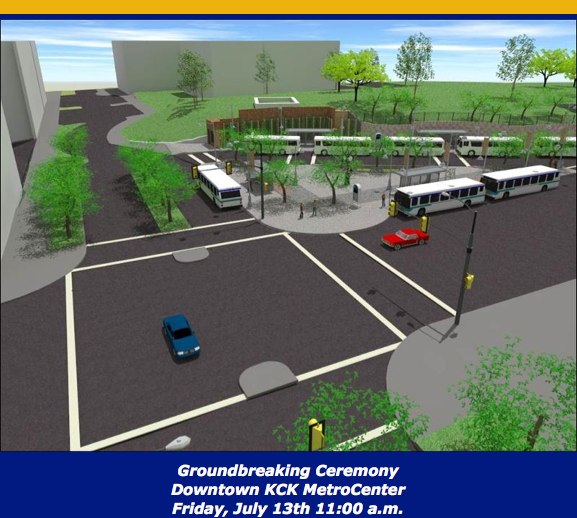
Design work is complete and construction is starting. Ground-breaking ceremonies are scheduled for July 13th and 18th.

Unified Government Transit Connex Metro Center
Friday July 13th @ 11 am
7th and Minnesota, Kansas City, Kansas

The improvements will be made along the transit corridor that begins at the 10th & Main MetroCenter in downtown Kansas City, MO,  travels west through Downtown Kansas City, KS,  continues on Minnesota Ave., then State Ave. and ends at Village West.

For more details, maps and drawings see the UGT website.

 Johnson County Transit Connex Mission Transit Center
Wednesday , July 18 @ 8:30 am
5251 Johnson Drive (old Cap Fed site) Mission, Kansas (location correction)

JCT Ground breaking information release MSMP_Groundbreaking

The improvements will be made along the transit corridor that begins at the Rosanna Square park-and-ride, travels north on Metcalf, east on Martway and then generally continues on Johnson Drive and Shawnee Mission Parkway into Kansas City, MO.

For more details, maps and drawings see the JCT project website and the Overland Park project website.

Posted in Events, Local Transit Issues, Regional Transit Issue | Tagged: , , | Leave a Comment »

Open Houses – U.S. 71 Transit Study – July 12 and 17

Posted by Transit Action Network on July 10, 2012


The U.S. 71 Transit Study is underway.  The project team and lead consultant are the same as for the Jackson County Commuter Corridors Alternatives Analysis. The project team consists of MARC, Jackson County, Kansas City, and KCATA. The lead project consulting firm is Parsons Brinckerhoff.  Transit Action Network has two advocates on the Stakeholder Advisory Panel.

The U.S. 71 corridor begins in the downtown loop of Kansas City, Mo., and runs south along U.S. 71/Bruce R. Watkins Dr. through Kansas City and Grandview to M-150 near the Cass County border. This heavily traveled corridor includes not only the U.S.71 highway facility, but also Prospect Avenue and adjacent railroad assets.

The study will build on and coordinate with the Jackson County Commuter Corridor Alternatives Analysis, which is studying the I-70 and Rock Island corridors. This study is funded largely by a $652,200 competitive grant from the Federal Highway Administration, which Jackson County acquired.

During the open houses, participants can tell the project partners whether enhanced transit is needed in the corridor and, if so, what their preferred transit option might be. A short update on the alternative analysis study will be given at 4:30 p.m. each day.

Visit the project Website. http://www.kcsmartmoves.org

Posted in Events, Local Transit Issues, Rail, Regional Transit Issue, Transit Studies | Tagged: , , , | Leave a Comment »

Save The JO — Video #1 Interview with JO Rider Henry Fortunato

Posted by Transit Action Network on July 9, 2012


Transit Action Network plans to produce several videos related to the Johnson County Transit proposed service reductions and modifications for January 2013. This video is the first in our series. Henry Fortunato, Director of Public Affairs for the Kansas City Public Library and a JO rider, discusses his personal views and concerns about the situation. (This is not the stated position of the Kansas City Public Library)

Please contact Johnson County Transit and the County Commissioners to stop these “voluntary cuts”.  See our previous articles for more information. Save The JO – Contact JOCO CommissionersSpeak Out Against Proposed JO Service Cuts, and Attend The Public Meetings July 9 and 11 — “Save The JO!”

Join our Facebook event page “Save The JO” to discuss what is happening and share your actions and ideas. On the event page you will already see comments about riders losing the ability to get to work and the artwork from children of the Westwood Christian Church in Johnson County who drew pictures to remind the adults to make calls to Save The JO. Have a look. Get involved!

Posted in Local Transit Issues, Regional Transit Issue, Videos-Transit | Tagged: , | Leave a Comment »

Attend The Public Meetings July 9 and 11 — “Save The JO!”

Posted by Transit Action Network on July 8, 2012


Please remember to attend this weeks public meetings with Johnson County Transit (JCT) regarding the severe service eliminations and reductions proposed for January 2013. The final decision on service reductions will be made the beginning of August. You can’t wait to object.

Johnson County has 20 transit routes. They are proposing to eliminate 8 routes and make service modifications to 9 routes.

This issue is important to all JO riders. Your route could be in the next round of cuts.

  • The Board of County Commissioners Transit priority order is:
    1. Protecting the most vulnerable county residents by holding harmless both the Special Edition and SWIFT services;
    2. Supporting the TIGER investments along the Metcalf Avenue and Shawnee Mission Parkway corridors by maintaining the Connex service;
    3. I-35 Xpress;
    4. Supporting the K-10 Connector, an express commuter service between Lawrence and Overland Park; and
    5. Supporting Local Link services operating within specific Johnson County cities.

No other routes are safe.

Read our previous posts. Save The JO – Contact JOCO Commissioners and Speak Out Against Proposed JO Service Cuts

Attend Public Hearings held by Johnson County Transit

a.    DATES and TIMES:

  • Monday July 9, 2012, 6:30 a.m. to 8:30 a.m.
  • Wednesday July 11, 2012, 4:30 p.m. to 6:30 p.m.

b.    LOCATION: Sylvester Powell Community Center at 6200 Martway in Mission, Kansas. (both hearings)

If you can’t make one of the meetings this week, please contact both Johnson County Transit and the Board of County Commissioners to express your displeasure about the service cuts. If they don’t hear from people, they assume it doesn’t matter if the routes are cut.

Comments to JCT on proposed changes can be made via e-mail, phone, mail

  1. E-mail: Comments@thejo.com
  2. Mail: Johnson County Transit, 1701 West 56 Highway, Olathe, Kansas 66061
  3. Phone: 913-715-8255 – record your message

Comments for the Board of Commissioners can be made at 913-715-0430 or email the county using the county contact form and choose the category ALL in order to send your message to the whole Board of County Commissioners.

Later in the month: Please Attend the Final FY 2013 Budget public meeting with the Board of County Commissioners

Budgetary issues are the reason for the proposed service reductions.

a. DATE and TIME:  Monday July 23, 2012 at 7:00 p.m

b. LOCATION: BoCC meeting room, Johnson County Administration Building, 111 S. Cherry, Olathe, KS 66061

Posted in Action, Events, Local Transit Issues | Tagged: , | 2 Comments »

Independence Revises Its Local Transit Routes – IndeBus

Posted by Transit Action Network on June 29, 2012


Independence changes its local routes effective July 2, 2012. Along with new buses and a new contract operator, First Transit, the routes are changing significantly. Fares will remain the same.

View schedules and maps, and watch a video explaining the system at the IndeBus page on the Independence website.

The shift from KCATA to First Transit for the local routes will cost Independence about $14,000 more than previously, but the city calculates a 30% increase in transit miles and 30% more hours of service by eliminating the current 2-hour break in the middle of the day. Service will run until about 6:00 pm.

First Transit will also operate the local para-transit (IndeAccess), and local senior service (IndeAcess+) transportation services within Independence. These services replace the local Dial-A-Ride service. There is a new photo ID and coupon program for qualified riders. KCATA will continue to provide the Share-A-Fare para-transit service from Independence into Kansas City and Share-A-Fare services will continue to be available in most of Independence.

KCATA will continue to provide inter-city service connecting Independence to Kansas City on routes 24 and 15X (previously the 24X). Check the new Metro schedules.

Beginning July 2nd, all questions for IndeBus, IndeAccess, and IndeAccess+ will be answered by First Transit at 461-IBUS (4287).  For questions related to the 24 and 15x Routes or ShareAFare, riders can continue to call the KCATA Regional Call Center. Independence is currently including transfer information in its local training for the 461-IBUS call center.  First Transit operators should work through alternatives for transfers and trips with riders. Independence is not contracting with the Regional Call Center to provide information about their local buses. The Regional Call Center can answer questions about all the Metro services.

Explaining the route changes and new operator, Independence Director of Community Development Jennifer Clark said, “Independence is responding to rider demand and interests. This is a rider focused model and reflects the best interests of the community.”

Improvements to the system include having a full time employee responsible for the Transit Center at Truman and Noland Roads to make sure it is clean and functioning. In addition, the new local buses will have two wheelchair slots instead of one. Buses all have GPS, and an app from TransLoc will be available for real-time information about buses using a smart phones. Check the city website to download the app in July.

At this point there is a compatibility problem between the Metro and IndeBus fareboxes, but the two system operators are working with the farebox vendor to resolve the problem. The solution may not be in place by July 2nd, in which case riders using both systems will be instructed on how to use a transfer or monthly pass.

For more information watch Clark’s presentation about the new transit system to the Independence City Council on June 25. Her presentation starts at 24:36 minutes into the video and lasts about 17 minutes.

The City Council Transit Committee plans to initiate a public input process. Although it hasn’t been defined yet, it will represent a mix of interests such as riders, residents and businesses, and will report back to the Transit Committee on matters such as efficiency of operations and customer satisfaction. We think this committee is a good idea, and that all transit agencies should have a similar stakeholder committee that meets regularly to provide feedback.

One cloud still hanging over the new service is whether Independence will receive a share of federal funds that come to the Kansas City region through KCATA for its local routes. Currently the cost of the transit service provided to Independence by KCATA is offset by approximately $600,000 annually,  $400,000 of which is allocated for local routes.

Two issues affect this money.

  1. KCATA is in the process of defining a formula to distribute or apply these federal funds throughout the region, and Independence may qualify for less money under the new formula, especially since they are using a private operator.
  2. Section 13c of the Federal Transit Law protects public transportation workers if operations are shifted to a private provider. This law could be used to prevent Independence from receiving this money for the local routes.  Jonothan Walker, president of local 1287 of the Amalgamated Transit Union, has told us the ATU is working on several fronts, including monitoring Independence’s use of these federal funds.  “None of the new service shall receive funding except private. If Independence tries to use it (federal funds) for expansion of lines and for private use, they may find our ATU International legal team involved.” See our previous article for more information Independence Ponders Transit Options (Dec 6, 2011).

Independence was aware of these funding issues before contracting with First Transit, and is monitoring the funding situation.  TAN is concerned that if the federal funding is withheld from Independence, it would have a negative impact on transit service in Independence. We hope that Independence has a plan to deal with that situation if it happens, and that Independence riders are well served by their new local routes.

Posted in Local Transit Issues | Tagged: , | 1 Comment »

LIKE Us On Facebook

Posted by Transit Action Network on June 26, 2012


You have a new way to keep in touch with Transit Action Network and keep up with transit issues.

Since we got our nifty avatar for Twitter, we decided it was time to start a Facebook page.

Advantages of Facebook:

  • Our blog articles will be shared on Facebook, which makes them easy to share with your Facebook friends.
  • Facebook is a great platform to discuss transit issues — join in
  • Links to other interesting local and national articles about transit
  • Breaking transit news
  • Event pages for topical issues and events, which provide the transit community an online meeting place (Join our first event page “Save The JO”)
  • Facebook is great to share pictures and videos related to transit
  • It is a fast and easy way for us to share other important or interesting transit topics that might not be on the blog

LIKE us at www.facebook.com/TransitActionNetwork

JOIN our “Save The JO” Event.

Invite your friends. Share what you are doing, including who you have contacted and their response. Share how these proposed cuts would affect you. Post pictures of the people on your bus and tell how these cuts will affect them. Be sure to come to the public meetings. Add your ideas on what to do to save these routes. Organize.

http://www.facebook.com/events/141963052608035/

You still have three other great ways to keep in touch

1. The Transit Action Network website http://TransActionKC.com

  • The TAN website includes our in-depth analysis of local transit issues and our local videos on transit issues
  • In addition, follow a range of transit issues, including national transit issues, transit adventures and transit based travels
  • Sign up to receive an email whenever an article is posted, including a copy of the article. Sign-up in upper left-hand corner of the blog.
  • The emails are easy to forward to your email friends.
  • Post your comments on the blog. Your initial comment is moderated so there might be a delay.

2.  Follow us on Twitter – www.twitter.com/TransActionKC

  • Alerts about new blog posts
  • Breaking transit news
  • Retweets and links to interesting articles about transit
  • Ideas about where to go using transit in the Kansas City region
  • This and that about what’s going on in the local transit scene

3.  Email us at TransActionKC@gmail.com

Posted in Action, Events, Local Transit Issues, National Transit Issues, Regional Transit Issue | Leave a Comment »