Transit Action Network (TAN)

Advocates for Improved and Expanded Transit in the Kansas City Region.

Archive for the ‘Local Transit Issues’ Category

MARC Transit Committee Meeting 5/4/11

Posted by Transit Action Network on May 16, 2011


MARC Transit Committee Meeting 5/4/11

1. Tom Gerend, MARC Assistant Director of Transportation, gave a short update on the Downtown Corridor (Streetcar) Alternatives Analysis.

Tom clarified the report in the KC Star about the line costing $25 million per mile.  It is important to distinguish between single and double tracked routes.

  • This $25 million cost is more relevant to single track routes, like a loop.
  • This study is looking at tracks running in both directions, double tracked.  The route may be 2 miles long but there are 4 miles of track.
  • The cost per track mile will vary greatly depending on whether the track bed is built to a streetcar or a light rail standard.
  • All of these options are going to be studied.
  • NOTE: A previous streetcar presentation at the Transit Committee by a different consultant estimated the cost of a streetcar with double tracks and built to light rail standards at $40 million per route mile, an estimate of $80 million for a two-mile route with these characteristics.

2. Mark Swope, Olsson Associates, gave an update of the Smart Moves Implementation Phase III Study.

  • This study brings together the Phase I Urban Corridors Bus Rapid Transit study, Phase II Commuter Corridors/Commuter Rail Study and Local Services, including paratransit. The regional plan will detail preferred service strategies and include a corresponding financial analysis including developing financial funding scenarios.
  • Mark presented information breaking down both operating and capital costs by county through 2020 using the transit scenarios from the previous studies.

3. After the main meeting the Seamless Transit Workgroup met to continue discussions related to making transit work more easily for riders.

  • KCATA and JCT have been working together to post additional JCT schedule information.
  • KCATA and JCT are discussing the possibility of a reciprocity agreement to allow riders to use monthly passes on either service.
  • JCT is working on improvements to “basic passenger infrastructure” at bus stops, including improved signs, route and schedule information, and concrete pads to connect sidewalks to the street. Bus stops with a higher level of service would get additional amenities.
  • In the discussion regarding real-time information through mobile devices, the transit providers explained that they use different technologies to communicate with riders. In the near term, any real-time information will be provided separately.

Next meeting June 1


Posted in Local Transit Issues, Meeting Reports, Transit Studies | Tagged: , , | Leave a Comment »

KCATA Board of Commissioners Meeting 4/27/11

Posted by Transit Action Network on May 5, 2011


1. During public comment, Ron McLinden, Transit Action Network, asked the board to initiate a unilateral 90-day trial period in which KCATA honors Johnson County Transit monthly passes on Main Street MAX buses.  A limited trial could be implemented at little or no cost, and would be an important symbolic step toward improving the region’s transit system by making transit a more viable option for more people.  The Board agreed to consider the request.

2.The board authorized a contract to purchase eight 2011 Dodge Caravan passenger vans for use in the KCATA”s AdVantage Vanpool Program. The eight vehicles in the current fleet of 33 vehicles have exceeded their 100,000-mile and four-year useful life. The AdVantage Vanpool Program is available to commuters who either reside or work in a community supporting the KCATA through service agreements, and who do not have access to existing public transit services for their commute trip.

View the program http://www.kcata.org/rider_guide/advantage_vanpool_program/

(Unfortunately, the money is for replacement vans only. No additional vans are being added to the vanpool although there is a waiting list and we are in a period of high demand due to high gas prices. This program is great for groups of 6 or more people who want to ride together to work and other forms of public transit are not available: example-people who live in Lee’s Summit but work close to the airport)

3. The Board of Commissioners authorized a cooperative agreement for a KU Medical Center Area Transit Study toward the goal of improving transit service for those working in and around the medical center and improving connections between current transit routes.

The study arose from discussions between Mayor Reardon of Kansas City, Kansas, and Mayor Foster of Roeland Park about improving transit service for those working in and around the medical center and improving connections between current transit routes.

KCATA, MARC, Johnson County Transit, the City of Roeland Park, and the Unified Government have jointly developed a scope for a consultant to analyze options to improve transit services to KU Medical Center for nearby residents, employees, and visitors and to improve transit connections.

HNTB has been selected to conduct the study under their on-call services contract with KCATA, at an estimated cost of $72,500. The study is to be completed this fall. Federal planning funds will be used for 80% of the cost with remaining local funds to be provided by the Unified Government, Johnson County Transit, the City of Roeland Park, and KCATA.

4. The Board of Commissioners authorized a service contract with the City of Kansas City, Missouri, from May 1, 2011, to April 30, 2012, with a City contribution of $43.1 million.

From the 1/2 cent sales tax the contract includes $19.9 million for Metro, $1.9 million for Share-A- Fare and $40.2 thousand to fund specialized services for reverse-commute job transportation. There is $21.3 million from the 3/8-cent sales tax for public transportation.

This contract is an increase of 6.2% over last years contract. Part of that increase is due to the ordinance passed in December 2010 to restore funding to public transit and part is due to higher sales tax revenues.

Keep in mind that this contract is still less than the 2004/2005 Kansas City contract.

Share-A-Fare Price Increases 2011

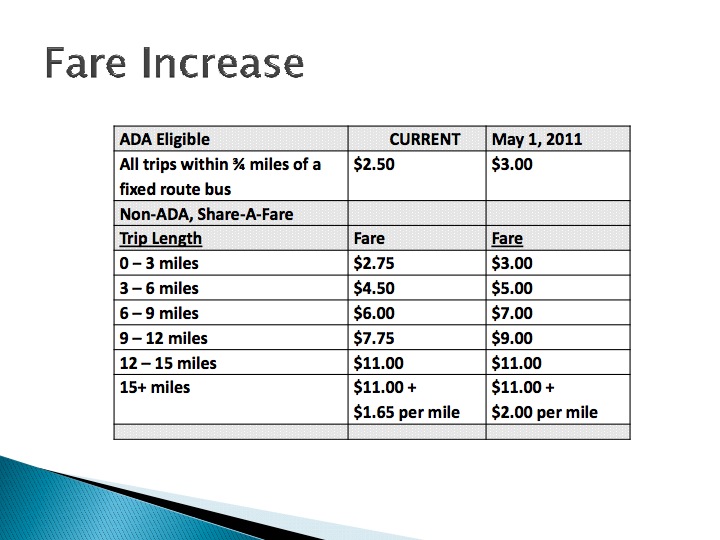
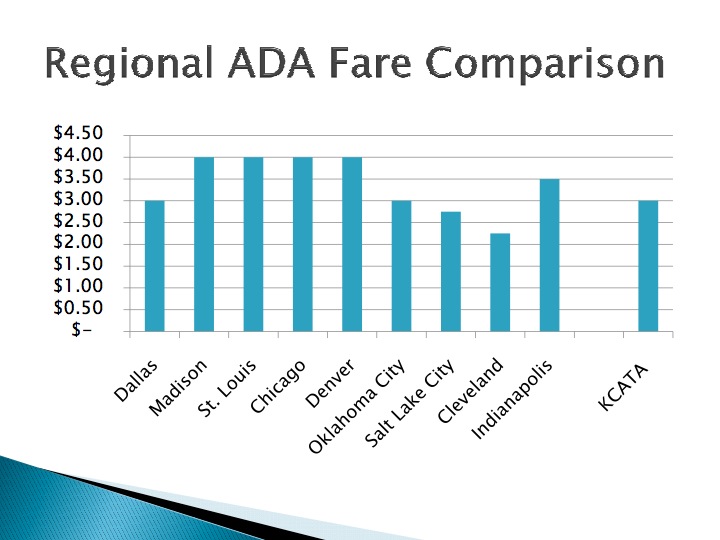
5.Bryan Beck, KCATA’s Director of ADA Compliance and Customer Service, provided an update on the fare increase from $2.50 to $3 per ADA eligible ride for the Share-A-Fare program, including the results of two public meetings and additional public input.  He presented general information and a service review of the Share-A-Fare program. See the full presentation- SAF Update 

6. Cindy Baker, KCATA Director of Marketing,  made a presentation on the State Avenue corridor project, funded by TIGER grants. It is in the design phase and the design team will soon be meeting with Advisory Council, stakeholders, and the general public. One component of this phase is the branding that will go hand in hand with design and then implementation. This project includes transit infrastructure improvements that could serve as a precursor to a future MAX line.

Johnson County Transit is in a similar situation with their Shawnee Mission Parkway/Metcalf route, also a TIGER-funded improved-transit corridor, but not full BRT service.

The JO has been working with consultants and the public to brand their new line. They have opted to call it “The JO Connex”. KCATA, Unified Government, and Johnson County Transit are all amenable to developing a regional brand, called “Connex,” that would represent a family of routes that include enhanced transit amenities, but do not increase service levels to MAX standards.

Next meeting May 25, 2011.

Posted in Local Transit Issues, Meeting Reports, Transit Studies | Tagged: , , , | Leave a Comment »

Future Downtown Streetcar could be in the Hands of Downtown Residents

Posted by Transit Action Network on April 25, 2011


Come hear about a Transportation Development District. Presented by Mark McDowell and TAN.

Downtown Neighborhood Association April Meeting | 04.27.11 | 7:00 pm | Central Library | Film Vault

http://www.dnakcmo.org/dna-events.html

Posted in Events, Local Transit Issues, Rail | Tagged: | Leave a Comment »

Streetcar Study Off to Fast Start

Posted by Transit Action Network on April 20, 2011


A Downtown Streetcar “Alternatives Analysis” (AA) study is on a fast track to completion, according to Charlie Hales, project manager for lead consultant HDR.  That’s our conclusion based on Hales’ presentation to the Kansas City Parking and Transportation Commission today.  The Commission, chaired by Councilwoman Jan Marcason will be the “primary sounding board” guiding the study.

Hales, who has had extensive rail transit experience in Portland and other cities, said though the federal funding situation is uncertain, the best way to get such funding is to have a plan ready when the next money becomes available.

The study timetable is ambitious:
– June – Statement of purpose and need, plus identification of initial alternatives.
– August – Alternatives evaluation and financing options.
– September – Draft of a Locally Preferred Alternative (LPA) report.
– November – Formal recommendation of a single Locally Preferred Alternative.

The FTA has awarded $400 million in grants for streetcar projects in the past 15 months through the TIGER and “Urban Circulator” programs, Hales said, and USDOT Secretary Ray LaHood really likes streetcar projects.  Getting the current study done will enable Kansas City to be “nimble” in applying for FTA “new starts” or “small starts” money, or other federal money that may become available.  Some transportation funding, for example, has recently been turned back by other grantees, and that money — even high-speed rail money — could conceivably be redirected to a streetcar project such as ours.

The Downtown Streetcar study will follow the FTA’s formal process, which requires consideration of reasonable options for both route and mode, but will seek a so-called “categorical exclusion” (a category of project considered not to have major environmental impacts) to simplify the “environmental screen” required in the FTA process.  Issues such as event-related street closures (e.g., at Sprint Arena and Crown Center), utility location requirements, the strength of bridges over the freeways, and where to locate a maintenance facility are among those to be addressed in the study.  Other factors include ridership forecasts (estimates based on travel demand models as well as “off-model” considerations) and financing options.

Hales noted that the study will build on a number of recent and ongoing local studies, including the Greater Downtown Area Plan, KCATA’s Comprehensive Service Analysis, the region’s Urban Corridors Study, and the Grand Boulevard Vision, plus all of the light rail planning work that’s been done in past years.  The streetcar study will be coordinated with the Commuter Corridors study (not yet underway), which will consider commuter rail in two major corridors.

Keeping the project manageable is important, too.  When projects fail, Hales said, it’s not for engineering reasons.  Rather, it’s for political reasons.  Thus, every effort will be made to keep all stakeholders involved, to limit expectations, and to avoid a key mistake of past Kansas City rail studies, letting the scope of the project expand.  Holding the project to just two miles gives it the highest likelihood of success, based on past voter response.  (It’s widely expected that funding for this project would come largely from within the streetcar corridor, and thus a citywide vote would not be required.)  This also keeps it small enough that the city might be able to finance it without federal assistance, should that become necessary.

KCATA General Manager Mark Huffer noted that a bill has been introduced in the Missouri Senate that would allow a Transportation Development District (TDD) to be set up specifically for transit, and that would simplify the makeup of the TDD’s governing body.  That bill (which might not be critical) might or might not get through the General Assembly this year.

Assistant City Manager Sherri McIntyre will oversee the project for the City.  She said she looks forward to guiding the study to completion and then getting the project built.

Said Chairman Marcason: “I’m the most optimistic that I’ve ever been (about getting a rail transit project done).”

Posted in Local Transit Issues, Rail, Transit Studies | Tagged: , , | Leave a Comment »

Downtown Trends and Transit- Is a Streetcar in Kansas City’s future?

Posted by Transit Action Network on April 18, 2011


Downtown areas are being revitalized all over America.

The 2011 March-April edition of the magazine The Futurist looks at current trends in an article titled “The “American Dream” Moves Downtown”.

Although the Renaissance in many downtown areas came with light rail, read streetcar for KC.  Portland is leading the way in using streetcars, which helps other cities see their potential.

Times are changing, as are attitudes in KC. The corridor from the River Market to Crown Center has lots of activities and major attractions with more and more people actually living in the area. Demand for more effective inner city transit from the people who will use it may finally have arrived. It certainly has arrived in other cities around the country.

The trend includes more than just rail. Other aspects of enhanced downtown areas include restoring and enhancing natural settings with small to mid-size parks, urban ornamental or vegetable gardens (like the one at 18th and Broadway), integrating commercial and residential functions in multi-use buildings and changing public infrastructure to favor people over cars.

Since transit is considered a major component of this trend it is often called “Transit-Oriented Development” or TOD, which has mixed use, relatively dense development that emphasizes walk-ability.

KC already has some of the improvements mentioned in the article and the new zoning code that went into effect January 2011 will help with others.

The new study for a two-mile long streetcar is starting. If a good plan emerges from the study, let’s hope we find a way to finance building it as well as operate it.

Posted in Local Transit Issues, Rail | Tagged: | Leave a Comment »

Transit Consultant Chosen for Commuter Corridors Alternatives Analysis

Posted by Transit Action Network on April 7, 2011


April 6. It was announced at the MARC Transit Committee that Parsons Brinckerhoff will be recommended to conduct the Commuter Corridors Alternatives Analysis in Jackson County. Parsons Brinckerhoff (PB) is considered one of the world’s leading planning, engineering, and program and construction management organizations.

PB founder William Barclay Parsons was chief engineer for the original New York City subway.

PB has designed 30,000 miles of heavy and light rail systems, automated guideways, commuter rail and busways.

The PB team consists of Nelson\Nygaard, Olsson Associates and Shockey Consulting. PB has a local office in Lenexa, Kansas.

From MARC’s  Request for Proposal (RFP):

For the purposes of this Alternatives Analysis, the two commuter corridors to be studied run through multiple jurisdictions. The I-70 Commuter Corridor runs from the heart of Kansas City, Mo and extends east paralleling the Kansas City Southern railroad through Independence, Blue Springs, Grain Valley, and Oak Grove in Jackson County and east to Odessa in neighboring Lafayette County. The Rock Island Corridor begins in the heart of Kansas City, Missouri, sharing a common corridor segment with the I-70 corridor approximately to the eastern edge of Kansas City, Mo, and then follows the old Rock Island rail corridor through Raytown, Kansas City, Lee’s Summit, and Greenwood in Jackson County and further south to Pleasant Hill in Cass County.  Both corridors run proximal to two heavily-traveled roadways, Interstate I-70 and Highway 350 (Blue Parkway), and through cities experiencing a growing residential population.

Several activity centers, including Downtown Kansas City, MO, Truman Sports Complex, and multiple town centers fall within in these corridors. Downtown Kansas City, Mo is the expected terminus of the various alternatives that will be considered in this Alternative Analysis, therefore this AA is to be closely coordinated and integrated with the Downtown Kansas City, Missouri Corridor Alternatives Analysis. In addition, this AA is to be closely coordinated with the Missouri Department of Transportation’s (MoDOT) Second Tier Environmental Impact Statement (EIS) for the I-70 corridor (I-470 to the Kansas/Missouri state line, including the downtown loop).

Existing transit service in downtown primarily focuses on bringing persons from outlying parts of Kansas City and the region to and from downtown. These commuter services continue to be needed, especially in Jackson County. Previous studies have indicated that the I-70 commuter corridor would greatly benefit from additional service, potentially through additional travel options such as expanded express bus or rail.  The Rock Island corridor is currently served by a commuter express bus on Blue Parkway and cities along this corridor have interest in increasing service to meet growing demand and looking at potential options in the Rock Island Rail alignment.  This rail alignment also connects to Missouri’s statewide Katy Trail in Pleasant Hill, formerly the Missouri-Kansas-Texas Railroad, therefore any use of the Rock Island rail alignment would likely include a trail extension into Kansas City, making it a multiuse corridor.

MARC, KCATA, the City of Kansas City, Mo and Jackson County intend to build on previous efforts and complete an Alternatives Analysis for both the I-70 and Rock Island Corridors. The intent will be to use the AA results to secure funding for implementation and potentially apply for federal funds–New Starts, Small Starts, or other federal sources. 

Specific consultant activity will be limited to the I-70 and Rock Island/M-350 corridors within Jackson County and portions of Lafayette and Cass Counties in Missouri. A more specific study corridor will be further defined by the Project Partnership Team with input from the study advisory committee.

The purpose of the study will be to determine the preferred alternative including specific alignments for the option best meeting current and future transportation needs while also helping to shape, support and focus future economic development and revitalization of activity centers for each corridor.

The recommendation will be submitted at the next MARC Board meeting for approval.

Posted in Local Transit Issues, Rail, Transit Studies | Tagged: , | Leave a Comment »

KCATA Announces “How to Ride Clinics”

Posted by Transit Action Network on March 31, 2011


Spread the word. KCATA wants to save you thousands of dollars a year.

As gas prices rise, public transit becomes more and more attractive.  During the month of April receive one-on-one help learning about The Metro at KCATA How to Ride Clinics. New riders at the clinics will get a free 3-day pass.

How-to-Ride clinics will take place on the following days, locations and times.

  • April 2: Blue Ridge Crossing Shopping Center, North side of parking lot, 10 a.m. – 1 p.m.
  • April 9: City Market, Park-and-Ride at 3rd & Grand, 9 a.m. – noon
  • April 9: Costco, Linwood & Gillham, West side of parking lot, 1 – 4 p.m.
  • April 16: Waldo, 75th & Wornall, on the far side of the CVS parking lot, 10 a.m. – 1 p.m.

If you can’t make it to a clinic, check out the Starter Kit for New Riders and begin riding The Metro and MAX .

Posted in Events, Local Transit Issues | Tagged: | 2 Comments »

Loss of E-TAX could devastate KCMO Transit

Posted by Transit Action Network on March 29, 2011


Transit Action Network strongly supports retention of the Kansas City Earnings Tax in the special election on April 5.

We all worked hard to protect transit funding last year.  During that process members of the city council, the mayor’s staff, and the interim city manager were all very candid about the impact losing the E-TAX would have on the ordinance they passed in December 2010 to restore transit funding.

We were told that loss of the Earnings Tax would place an extraordinary financial strain on the city, and that extraordinary measures would have to be taken. The transit funding ordinance (Ordinance 100951) would be rescinded, and the city would use the 1/2-cent transportation sales tax to replace E-TAX revenue used for non-transit transportation purposes.

This would deal a devastating blow to transit, and significant transit service cuts would have to be made.

If you care about transit — if you care about providing access to jobs and many other opportunities, vote YES on April 5 to retain the Earnings Tax!

Posted in Action, Local Transit Issues | 1 Comment »

Transit Consultant Chosen for Downtown Corridor Alternatives Analysis

Posted by Transit Action Network on March 24, 2011


Modern StreetCar

March 22. The MARC Board approved authorization to execute an agreement with HDR to do the Alternatives Analysis (AA) for the downtown corridor. HDR is an international employee-owned architecture, engineering and consulting firm. They have an excellent reputation working on transit projects and HDR has been heavily involved in streetcar implementation, especially in Portland. They have a KCMO office at 4435 Main.

The HDR team includes Nelson/Nygaard, Patti Banks, Burns & McDonnell, Polsinelli Shugahart, HG Consult, and Architectural & Historical Research.

From MARC’s  Request for Proposal (RFP):

For the purposes of this Alternatives Analysis, the downtown corridor is in Kansas City, Missouri and extends from the Rivermarket on the north, through the Central Business District and the Crossroads areas to Crown Center on the south.  This is the center of the bi-state region and includes the region’s largest concentrations of employment, regionally significant activity centers and a growing residential population.

Downtown is the current regional hub for transit services and the expected terminus for future regional rail being studied in a separate Alternatives Analysis that is to be coordinated with this effort. There is significant transit service downtown, including two BRT lines terminating downtown, but existing services primarily focus on bringing persons from outlying parts of the city and region in and out of downtown. There is a significant and growing need for transit service focused on conveniently moving people within downtown and connecting the downtown activity centers, employment centers, residential areas and transit hubs. This need will heighten with any future introduction of regional or commuter rail.”

Modern streetcar and a variety of alternatives will be considered to meet the current and future needs.

Read KCATA’s  Kansas City Streetcar Concept

The AA is expected to be completed by Jan 2012.

Posted in Local Transit Issues, Rail, Transit Studies | Tagged: , | Leave a Comment »

KC City Council Candidates Transit Forum

Posted by Transit Action Network on March 14, 2011


Transit Action Network (TAN) is providing this transit forum for KC Council Candidates to assist voters in making informed decisions regarding candidates’ positions on transit matters for the City of Kansas City. We will not endorse any candidate through our website or other communication efforts.

We believe these questions will need to be addressed during the next council term, although they deal with transit issues that have both short-term and long-term time horizons.

We greatly appreciate the effort and thoughtful answers of the candidates who replied.  All candidates were contacted.

Click here for city council candidates’ responses.  KC City Council Transit Forum 3/14/2011

TAN looks forward to working with the successful candidates on transit issues.

Public Comment: TAN is serious about getting improved and expanded transit in the Kansas City Region.  We welcome diverse views on transit that are presented in a civil manner. This is a moderated blog-site and only transit-related comments or questions will be posted.

Dick Davis-1st District

Aaron Benefield-2nd District

Ed Ford-2nd district At Large

Ed Ford-2nd District At Large

Melba Curls 3rd District At Large

Jan Marcason-4th District

Michael Brooks-5th District

Ken Bacchus-5th District

Cindy Circo 5th District At Large

John Sharp-6th District

Scott Taylor-6th District At Large

Tracy Ward-6th District At Large

Posted in Local Transit Issues | Tagged: | Leave a Comment »

Mayoral Candidates on Transit and Upcoming City Council Transit Forum

Posted by Transit Action Network on March 11, 2011


Transit Action Network (TAN) is re-posting the mayoral transit forum for candidates Mike Burke and Sly James to assist voters in making informed decisions regarding candidates’ positions on transit matters for the City of Kansas City and its surrounding Metro area. We will not endorse any candidate through our website or other communication efforts.

Sly James

Mike Burke

We greatly appreciate the effort and thoughtful answers of these candidates.

We believe these questions will need to be addressed during the next mayoral term, although they deal with transit issues that have both short-term and long-term time horizons.

Early next week we will post our transit forum for City Council candidates. They have all been contacted and asked to respond to four transit questions.

Click here for mayoral candidates responses.   Sly James and Mike Burke on Transit

Public Comment: TAN is serious about getting improved and expanded transit in the Kansas City Region.  We welcome diverse views on transit that are presented in a civil manner. This is a moderated blog-site and only transit-related comments or questions will be posted.

Posted in Local Transit Issues | Tagged: | Leave a Comment »

KCATA Board Of Commissioners Meeting 2/23/11

Posted by Transit Action Network on March 7, 2011


1. Congratulations to Robbie Makinen for being elected the new KCATA Chairman of the Board of Commissioners. Mr Makinen is Economic Development Coordinator for Jackson County and the Jackson County representative on the Board.

2.. The Board of Commissioners approved the KCATA FY 2012 federal appropriations funding request of $6 million in federal transit capital funds for new buses.

The primary categories from which federal funds are derived are formula funds and discretionary funds.  Congress and the President have announced that there will be no discretionary funds or “earmarks” for FY 2012.  KCATA has traditionally been very successful in attaining discretionary funds for bus replacement and other critical capital needs. While Congress has committed to eliminating earmarks in 2012, KCATA’s Congressional delegation has requested that KCATA’s priorities for capital funding for fiscal year 2012 be submitted to them, nevertheless.

KCATA staff met with Senator Blunt’s staff. They requested that KCATA submit normal earmark request forms to help the Senator prioritize capital needs around the State.  Sustaining basic services and maintaining the existing fleet are the highest priorities for 2012.  With more than 30 buses in need of replacement, KCATA has an ongoing need to replace buses that have exceeded their useful life.

3. The Board of Commissioners approved the revised strategic priorities. Two documents were presented.


KCATA Strategic Priorities 2011

The first document identified the updated Strategic Priorities and Mission and Vision Statements, as well as priority areas identified by senior staff.  The document intends to capture the overall strategic direction for the Authority.  Although it can be updated periodically, the vision and overall priorities are intended to remain relatively stable over time.

The second document, KCATA 2011 Blueprint – Feb 23, 2011, identified a series of actions that support the priorities.  Mark Huffer pointed out that many of these action items will carry over into subsequent years, others are part of daily operations, and others will be completed in 2011. This document should be updated on an annual basis, as existing projects get completed and new ones are identified.

Three items of particular interest on the blueprint were discussed.

a. Under Technology -The 5 year strategic plan for technology development. The new Smart Card technology available for fare boxes provides more flexibility and information. Also, the new generation of riders has higher expectations for KCATA to provide real-time information though mobile devices.

b. Under Capital Improvements-KCATA needs to revise the Fleet Replacement Plan due to the possibility of losing funding.

c. Under Environmental Responsibility-The need to develop a board policy toward alternative fuels was discussed. There is concern about compressed natural gas (CNG) because of its volatility. The current KCATA facilities would not be suitable for CNG. Also 2011 diesel emissions are comparable to CNG emissions. Cost, danger, return on investment and volatility all need to be considered.

4. Mell Henderson of MARC and Mark Swope of Olsson Associates briefed the board on the current Smart Moves update, planned activities and expected outcomes. Smart Moves is the long-term regional vision for improving and expanding transit in the metropolitan area. MARC is leading an update focused on strategies for implementing the transit improvements envisioned in Smart Moves. This current work will build upon previous regional transit planning work. Public engagement is expected by May.   Regional Transit Implementation Plan Phase III Presentation 2/23/2011

5 Bill Brown, federal lobbyist for the Missouri Public Transit Association, attended the meeting to provide the Board with his perspective on the current Washington landscape and what the public transit industry should expect and be prepared for in 2012 and beyond.

The Presidents proposed 2012 budget calls for a significant increase in funding for public transit, high-speed rail, and Amtrak.  The Administration also proposes fundamental changes to the transit funding, as well as several new programs.  Conversely, several House committees are proposing drastic budget cuts for many domestic programs, including transit in 2012.

In the meantime, the 2011 federal budget has not been approved.  The transportation authorization bill expired in 2009 and there are no signs that a new bill is imminent. The Administration and Congress say there will be no earmarks this year – a source of funding that has been very important to KCATA.  All these considerations lead to great uncertainty in regards to planning and funding new transit projects.

Bill was adamant, in his opinion, that funding for high-speed rail will be cut.

6. UMKC students voted in favor of a new activity fee. Students will receive a KCATA bus pass for $14/term ($28/year). This pass goes into effect Fall 2011. It will generate over $186,000 per year for KCATA and will be reviewed in one year.

Posted in Local Transit Issues | Tagged: | Leave a Comment »

KCATA Board of Commissioners meeting 1/26/11

Posted by Transit Action Network on February 11, 2011


1. Kansas City has released the Preliminary Budget for Fiscal Year 2011-12.

KCATA budget from the ½ cent transportation fund is $1.98 million more than the previous budget. (Note: This is 75% of the revenue after TIF and City administration costs.)  General Manager Mark Huffer reported that he has been told that the city may be able to reach the 95% mark required by the new ordinance as soon as next year, which would be a year earlier than required.

2. The Board of Commissioners authorized a Memorandum of Understanding (MOU) with MARC, the City of Kansas City, Missouri and Jackson County concerning implementation of the regional Alternatives Analysis (AA) Studies using $1.8 million in federal grant funding.

The MOU allocates the funding as follows:

Corridor Study Federal Funds Local Funds Source of Match
Downtown Streetcar AA $540,000 $135,000 Kansas City, Missouri
Commuter Corridors AA $1,260,000 $315,000 Jackson County

Other key points in the MOU are as follows:

• MARC will serve as FTA grant recipient,

• MARC, KCATA, the City of Kansas City and Jackson County will serve as a partnership team overseeing AA efforts,

• KCATA and the City will lead the downtown streetcar AA, and

• MARC and Jackson County will lead the commuter corridors AA

3. KCATA has $10.4 million in a federal grant for public transit improvements in the State Avenue corridor, which extends from the 10th and Main Street transit center in downtown Kansas City, Missouri, through downtown Kansas City, Kansas, to the Village West area in western Wyandotte County.

Key components of the project include:

• 7th Street and Minnesota Avenue Transit Center

• 47th and State Avenue (Indian Springs) Transit Center/Park & Ride

• State Avenue Corridor Transit & Access Improvements

• State Avenue Corridor Branding

The Board authorized a contract with BHC Rhodes, Inc., for Architectural and Engineering (A&E) Design Services for State Avenue Corridor Transit Improvements.

4. Update on the Comprehensive Service Analysis – Nelson Nygaard

The CSA is an in-depth, technical study of the system’s effectiveness and will result in system-wide and route-level recommendations for improved efficiencies and service delivery.

Mr. Geoff Slater, Project Manager with Nelson Nygaard, provided a project update and discussed the next efforts of the CSA.

Public involvement is scheduled spring or early summer. See the presentation KCATA_CSABoard0111.

5.  Emerick Cross, Interim Transit Manager of Unified Government Transit in Wyandotte County thanked KCATA for its help in the recently completed Comprehensive Service Analysis. See the 2010-UG Transit Comprehensive Service Analysis.

Posted in Local Transit Issues, Meeting Reports, Transit Studies | Tagged: , , | Leave a Comment »

KC Mayoral Transit Forum Day 6

Posted by Transit Action Network on February 5, 2011


Questions 6    Kansas City receives almost nothing for transit from Missouri. A new Federal Transportation Bill is due in Congress. How will you work with the legislature to increase Kansas City’s share of transit funding

a.     at the state level?

b.     at the federal level?

Sly_ James

Sly James www.slyjamesformayor.com

First, I will work with our state and federal representatives to generate a cogent legislative plan.  I will communicate regularly with our representatives, not simply when we need something from them.  Building stronger relationships with these representatives is key.  As mayor, I will work to ensure that we work together with our state and federal representatives to achieve realistic goals, both short and long-term.  I am proud to be endorsed by State Representative Jason Kander.

Second, we will fully utilize our city’s state and federal lobbyists.  Political and economic realities indicate that funding from the state and federal governments will be scare.  Federal earmarks should be considered a thing of the past, requiring our lobbyists to advocate for programmatic legislative solutions that would help a medium-size city like Kansas City to benefit from any Federal Transportation Bill.  For example, our lobbyists must advocate for state and federal funding formulas that benefit cities like Kansas City.  This would have been helpful for Kansas City when the U.S. Congress was drafting the Federal Stimulus Legislation.  If we had advocated for more beneficial federal funding formulas, lobbying with similar cities, we could have received a greater share of the funds.

Finally, as mayor, I will forge stronger relationships with regional governmental leaders, from Topeka to St. Louis.  I will reach out to government and business leaders on both sides of State Line to work together lobbying for regional solutions.

Henry_Klein

Henry Klein www.kleinforkansascity.com

a. For a host of reasons, we have not been getting our share of state funding.  St. Louis seems to understand how to secure funds much better than we do.  That has to change.

b. Our best avenue for this is going to be with our lobbyists and with congressional representatives.

Deb Hermann

Deb Hermann www.debhermannformayor.com

a. Again, a regionaI, coordinated effort is necessary.  Transit needs to be a priority.  I will be very engaged in Jefferson City.

b. Similarly, it is only fair that the federal government begin to provide support as they do for other municipalities.  Transit needs to be a priority and the effort regional.

Mike Burke

Mike Burke www.burke4kc.com

One of my first actions as mayor would be to revamp how the city lobbies in Washington and Jefferson City.  We need a more regional approach to issues such as transit that impact our region.  The city should reach out to suburban governments and chambers to form a joint lobbying position.

Jim Rowland http://jimrowland.com

Jim Rowland

a. In general, not just on transit issues, Kansas City frequently loses out to St. Louis in winning funds from the State.  This is directly attributable to a lack of leadership from the current mayor, who has been unnecessarily antagonistic.  I will work collaboratively with Kansas City’s legislative delegation and people from around the state to protect our city’s interests.  I have always believed that real leadership is about bringing a diverse group of people together and uniting them around a common purpose.  I will be a frequent presence in Jefferson City, cultivating relationships, and stressing Kansas City’s economic importance to the state.

b. Kansas City is fortunate to be represented by several excellent members of Congress.  Again, new leadership that is capable of working with—rather than against—others will be essential.  I have a proven record of bringing people together to get things done, and will use that skill set in our federal lobbying efforts.  If we are to achieve real progress on transit in Kansas City, support from the federal government will be essential.  Securing that support will be a high priority for me.

Mayor Mark Funkhouser

Mayor Funkhouser www.reelectmayorfunkhouser.com

a. Our state lobbyists are working hard with our state representatives and senators to make sure KC gets the fair share of what transit funding might be available.

b. Kansas City is actively seeking federal transit funding. That was the source of the $27 million for the Troost Max line and the sidewalk and road reconstruction in the Green Impact Zone in 2010. U.S. House Transportation and Infrastructure Committee Chairman James L. Oberstar visited Kansas City in October 2010 to hear about Kansas City’s transit and infrastructure needs.  The City is working aggressively with our federal lobbyists to secure more federal funding for city transit.

TAN hopes you have benefited from this online transit forum. Please continue to comment and ask questions regarding the candidate’s responses. We will inform the candidates of additional comments or questions throughout the campaign. We thank the candidates for their participation in this forum and encourage them to read the comments and answer questions from our readers.


Posted in Local Transit Issues | Tagged: | Leave a Comment »

KC Mayoral Transit Forum Day 5

Posted by Transit Action Network on February 4, 2011


Question 5   Jackson County, MARC, and KCATA will consider alternatives for improving commuter transit service within Jackson County through a federal Alternatives Analysis study, which should be concluded within the next two and a half years. The study will evaluate various bus and rail alternatives from Blue Springs and Lee’s Summit to downtown Kansas City.

a.    Would you support implementation of the preferred alternative from this study regardless of whether the choice is bus or rail? Please explain your answer.

b.    Would you support a countywide tax to support implementation of the preferred alternative from this study?

c.     If so, what would be needed to assure Kansas City voters’ support?

d.     If you would not support a countywide tax, please explain why.

Deb Hermann

Deb Hermann www.debhermannformayor.com

a. There is not yet a concrete proposal to comment on.  I am more interested in a comprehensive transit program that serves the most citizens whether bus, rail, or a combination of both.  This is critical to the quality of life of our citizens, economic development, and the environment.  I am very interested in the commuter rail proposal of Jackson County Executive Mike Sanders and would hope that this proposal gets very serious study.

b. See above

c. Confident and strong support from the political and civic community is imperative and the first priority.  Our citizens have been confused by a myriad of plans and varied support of the leadership.  We need a plan we all can get behind and convey that to our citizens.

All citizens need to understand how any plan will make life better for everyone in Kansas City.

d. See above

Mike Burke

Mike Burke www.burke4kc.com

a. I support the Alternatives Analysis study for commuter rail and eagerly await its findings.  I believe that a commuter rail system must be complimented by a well-planned hub and feeder system and would want to make sure that the system served Kansas City residents as well as suburban commuters.

b. If the system meets the above criteria, I would support a tax to fund it.

Jim Rowland

Jim Rowland http://jimrowland.com

a. Provided that the study is conducted in an impartial, objective, rigorous, and scientific way, I would support its outcome.  I strongly believe that public policy should be guided by empirical data and serious analysis.  Analysis should not be used to simply justify a pre-determined conclusion, but to help us determine the best strategy for achieving our goals.

b. If the elected officials of Jackson County feel that a countywide tax is necessary, I would not oppose them.

c. Just as in any tax vote, Kansas Citians would need to be assured that the tax would help solve an important problem, that Kansas City would be treated fairly in the deal, and that the revenues generated would be well-spent.

Mayor Mark Funkhouser

Mayor Funkhouser www.reelectmayorfunkhouser.com

a. I support the transit study. However, I think the study should be a part of what, ultimately, must be a regional transit network. Jackson County’s commuter proposal could be an important part of a regional system.

b. It would depend on the study results and the feasibility of its inclusion in a regional system.

Sly_ James

Sly James www.slyjamesformayor.com

My support and advocacy for public transit has always been driven by facts and whether or not I support the preferred alternative will be based on the contents of the study’s results.  I am not biased in one way or the other when it comes to bus or rail as a preferred mode of transit.

Although I do not support any tax increases at this time due to the budget crisis we’re facing in Kansas City and the ongoing economic recession, I am a transit advocate and will be supportive of thoughtful proposals to improve public transit.

To be clear, we have a lot of work to do with Kansas City and Jackson County voters before we ask them to open up their pocketbooks for a new tax.

First, we must restore trust in City Hall and confidence that we are spending tax dollars wisely. As I mentioned before, I will make sure that money goes to the purpose specified by voters.  For example, I will make sure that the tax revenue voters devoted to the KCATA gets to the KCATA.  Withholding such devoted funds breeds the type of widespread distrust of City Hall that must be fixed.

Henry_Klein

Henry Klein www.kleinforkansascity.com

a. Yes, provided that the return on investment (roi) was better from the one chosen.

b.  Possibly, again provided the return on investment made sense.

c.  The issue here is simply that we have to assure voters that the overall cost of the system is something we can afford and provides a net overall positive good to the city and the county.

Day 6   State and Federal Transit Issues

Posted in Local Transit Issues | Tagged: | 1 Comment »

KC Mayoral Transit Forum Day 4

Posted by Transit Action Network on February 3, 2011


Questions 4   Expansion of transit service outside Kansas City has been under discussion for some time, and one approach is for counties to establish their own transit funding mechanisms.  Suppose Jackson County were to propose a 1/10-cent countywide sales tax to fund transit improvements in the near term. The tax would primarily, though not exclusively, fund intra-regional buses in commuter corridors.

a.    Would you support county tax levies for transit?

b.    If so, what would be needed to assure Kansas City voters’ support?

c.     If you would not support county tax levies for transit, please explain why.

Mike Burke

Mike Burke www.burke4kc.com

a. If Jackson County proposed a transit tax and a startup system, I would need to know how it interfaced with city transit systems and what form of governance before I could endorse it. I would also want to make sure that a one county tax would not adversely impact the ability to develop a more comprehensive multicounty system.

Jim Rowland

Jim Rowland http://jimrowland.com

a. I will work collaboratively with Jackson County and other metropolitan governments to find solutions on this issue.  Whether the County would move forward with an initiative like the one outlined above is for its elected leaders to determine.  I am concerned about taxes in general, in that some people view them as the only solution.  I was able to create comprehensive Citywide recycling without a tax increase after previous councils failed multiple times with implementing the program through a sales tax election. I mention this only to demonstrate the point that it is sometimes possible to achieve our goals without making taxation the option of first resort.

b. Just as in any tax vote, Kansas Citians would need to be assured that the tax would help solve an important problem, that Kansas City would be treated fairly in the deal, and that the revenues generated would be well-spent.

Mayor Mark Funkhouser

Mayor Funkhouser www.reelectmayorfunkhouser.com

a. While individual county taxes would help with the funding gap, transit needs to be addressed by the region collectively.  I support an integrated, regional, multi-modal public mass transit system. I would consider supporting a ballot measure for a regional dedicated tax for mass transit if it met the following criteria:

  • Funded by the entire region.
  • Integrated into the existing transportation network.
  • Multi-modal, including commuter rail, modern streetcars, light rail, bus, BRT, and bicycle and pedestrian trails.
  • Centered on downtown Kansas City, Missouri.
  • Robust enough to provide excellent access to all major nodes and employment centers in the region.

I support MARC’s regional Smart Moves initiative. We, as a region, should work collaboratively under the leadership of MARC, in order to aggressively seek federal funding and work with our federal delegation for more federal funding for public transit.

Sly_ James

Sly James www.slyjamesformayor.com

Although I do not support any tax increases at this time, I do not want to take this idea off of the table.  Our transit system is a regionally utilized service and should be improved, and funded, accordingly.

I’ve been a strong advocate for public transit and will continue to be as mayor.  However, we need to restore the public’s trust in City Hall before we ask for additional tax dollars.  The city’s plan to withhold $5.4 million in tax revenue intended for KCATA is simply unacceptable and represents a systemic problem with the way our city conducts business.  Withholding funds that have been allocated by voters for a specific purpose continues to breed the type of widespread distrust of City Hall that must be fixed.  Our budget must always reflect the priorities of the citizens of Kansas City, not simply the priorities of our bureaucracy.

Henry_Klein

Henry Klein www.kleinforkansascity.com

a. I would be willing to consider it.

b.That the return on investment to the city exceeded the cost.

Deb Hermann

Deb Hermann www.debhermannformayor.com

a. My support would depend upon how such proposed coverage paid for by the tax affected all of Kansas City and its residents.  I would expect that if support is regional, so should be the governing process.

b. The political and civic community must provide a united front with strong support.  Again, it would depend upon how equivalent that tax was to the transit coverage provided.  The governing process would also have to be fair to all our residents.

Day 5 The Jackson County Commuter Corridor Alternatives Analysis

Posted in Local Transit Issues | Tagged: | Leave a Comment »

KC Mayoral Transit Forum Day 3

Posted by Transit Action Network on February 2, 2011


Question 3   Money is the main barrier to improving transit in the Northland and other outlying areas. How would you address this problem without decreasing transit service in the central core?

Mayor Mark Funkhouser

Mayor Funkhouser www.reelectmayorfunkhouser.com

Kansas City successfully won $27 million in federal funding for the Troost MAX bus Line. This is a good example of how we expand our bus service with funding sources that don’t come directly from the city taxpayers. We must continue to pursue regional funding and actively seek federal funding for transit.

Sly_ James

Sly James www.slyjamesformayor.com

As mayor, I will consider transit improvements as part of a long-term, comprehensive plan that brings to the table neighborhoods, businesses, regional governments, school district officials, and other civic leaders from every part of the city to create a plan that benefits every part of the city and one that considers the special and specific needs of the diverse areas of the city.

Henry_Klein

Henry Klein www.kleinforkansascity.com

I would like to use this question to present to TAN the alternative proposal I made to the RTA this past week.  In presenting this plan, I would like both TAN, RTA and the city as a whole to consider another option for a 21st Century transit idea that could be implemented very fast, very affordably, offer dramatically increased frequency and prevent us from the kinds of disappointments we have had in the past in expanding our transit options.  The plan below can both stand on its own or “plug and play” with both the streetcar and/or Jackson County commuter transit proposals.

The points to the plan include –
1) Rightsizing the Equipment/Buses used in the System.  Currently, we do not have the correct size buses for the routes we run.
2) Expanded Use of Hybrid/NG/Electric buses – the same factors that will potentially drive greater ridership could also raise our costs to prohibitive levels.  In conjunction with the other points of this plan, we will likely need to get special federal support.  This support will likely be come if we have a comprehensive plan such as this.
3) Integration with BRT (bus rapid transit) plans on both sides of the stateline
4) An ATA run “Private Investment for Public Good” routes extension
a) Specifically – we create two systems – one that we run as we currently do, and a second, where we bid out certain routes to the private sector so as to expand the system
5) Creating Alternatives to 1 and 2 car ownership through partnerships such as ZipCar
a) Making certain that Zipcar stations are conveniently and strategically located within the transit system
6) An NRG style electric refueling system like the one being set up in Houston
a) Specifically, NRG will be installing charging stations for electric cars in homes as well as have recharging stations throughout Houston.   Consumers will pay $80/month for this.  When you match this to the cost of fossil fuel (gasoline), this becomes an interesting and viable alternative.

Note: All of this would be tremendously helpful in transit to/from the Northland.

Deb Hermann

Deb Hermann www.debhermannformayor.com

If we expect a tax to be acceptable to our residents, then the coverage paid for by that tax will need to be sufficient to cover all of the City.  If the coverage is only of the downtown and Jackson County, then the voters of Clay and Platte County will not accept it.  We will need to find some method of providing service to those residents.

Again, legislative efforts need to be more aggressive and regional.

Mike Burke

Mike Burke www.burke4kc.com

The Northland needs a more centrally located and inviting transit hub where Max lines and feed  routes connect. Efficiencies could be achieved through right sizing equipment and routes.

Jim Rowland

Jim Rowland http://jimrowland.com

Money to finance transit expansion is certainly one issue, but it is closely related to the issue of density.  Expanding transit offerings in the Northland and other outlying areas is so expensive because these areas are low in density, especially when compared with the central city.  My administration will work to heighten density in strategic places and ways, in order to provide the “market” needed to make transit a cost-effective option.  As noted above, we also must work on promoting a culture where transit is a logical, viable option.

Retaining current service levels in the central city is absolutely essential, because a sizable population in the central city relies on public transit as their primary mode of transportation to work, home, and play.

Day 4 we start regional questions!

Posted in Local Transit Issues | Tagged: | 1 Comment »

KC Mayoral Transit Forum Day 2

Posted by Transit Action Network on February 1, 2011


Question 2   Kansas City and KCATA will evaluate a proposed downtown streetcar through a federal Alternatives Analysis within the next year or so. If it qualifies for federal support, Kansas City will need to identify funding for the city’s share of the capital cost and for operations.

a.    If you support the proposed downtown streetcar, how should it be funded? Please explain your funding choice.

b.    If you do not support the proposed downtown streetcar, please explain why.

Henry_Klein

Henry Klein www.kleinforkansascity.com

a. Since the alternatives study has just been funded, I’m going to need to see more from the study including feasibility.  I am very concerned both about the ultimate cost of the downtown streetcar – both in terms of cost to build and cost to maintain.  I could be persuaded to support this but I need to see the cost benefit analysis.

Deb Hermann

Deb Hermann www.debhermannformayor.com

a. Funding alternatives from the general fund are difficult, especially with the current budget.  However, the huge cost of building and maintaining roads in Kansas City has to be included in the conversations about transit and the streetcar.  The optimal method would be some sort of regional tax where it was supported by a multi-county area.  It will probably require a mix of revenue sources.  We will need to be diligent and creative.

Our legislative (federal and state) efforts could be more aggressive, strategic and effective.  We need to have a regional legislative transit (including the street car) effort.

Mike Burke

Mike Burke www.burke4kc.com

a. While I support the concept of a downtown streetcar, I will defer judgment on funding until the Alternatives Analysis is complete.  I believe that the question of funding a transit system is not a piecemeal proposition.  We should look at funding an integrated system, not individual components.

Jim Rowland

Jim Rowland http://jimrowland.com

a. If the downtown streetcar receives federal funding, I would be supportive of it and identify a funding source for it.  Even if selected for federal funding, it would likely be several years before those dollars materialized, during which time the City’s financial picture may change substantially.  Depending on the financial conditions of the City, I would consider funding capital costs through the capital improvements program, the General Fund, or the transit tax.  Although I am strongly supportive of transit initiatives, including the downtown streetcar, I do not believe that the City should be called upon to bear the whole cost of these efforts by itself.

Mayor Mark Funkhouser

Mayor Funkhouser www.reelectmayorfunkhouser.com

a. A voter-approved, regional tax should be dedicated for this project.

Sly_ James

Sly James www.slyjamesformayor.com

a. To be clear, while I support the idea of a downtown streetcar, I am generally hesitant about committing our city to any new, costly enterprise.  We have an ongoing budget crisis, a multi-million dollar backlog of deferred maintenance, and a mandated combined sewer overhaul project that will cost at least $2.5 billion over the next 25 years.

Having said that, if a downtown streetcar provides a short-term benefit while also providing part of a long-term solution to our public transit needs, it is worth consideration.  I would want to be convinced, of course, that such a project would pay for itself over time and generate revenue for the city.

One of the challenges I believe we face with any large-scale project is that our citizens don’t trust how we are taking in money or giving it out. With that in mind, I will re-establish the Citizens’ Commission on Municipal Revenue.

Posted in Local Transit Issues | Tagged: | 2 Comments »

KC Mayoral Transit Forum Day 1-updated

Posted by Transit Action Network on January 31, 2011


Transit Action Network (TAN) is hosting this transit forum to assist voters in making informed decisions regarding candidates’ positions on transit matters for the City of Kansas City and its surrounding Metro area. We will not endorse any candidate through our website or other communication efforts.

All seven of the mayoral candidates were invited to respond to six transit-related questions confronting the city and the metro region. We greatly appreciate the effort and thoughtful answers of the  candidates.

We believe these questions will need to be addressed during the next mayoral term, although they deal with transit issues that have both short-term and long-term time horizons.

Each candidate’s response to one of the questions will be posted on our blog over a six-day period beginning January 31.

Public Comment: TAN is serious about getting improved and expanded transit in the Kansas City Region.  We welcome diverse views on transit that are presented in a civil manner. This is a moderated blog-site and only transit-related comments or questions will be posted.

Question 1. The city council recently passed an ordinance to restore funding to the transit system from the ½ cent transportation fund.

a.    Do you support continued city funding of public transit as an essential city service?  If not, please explain why.

b.    What non-financial actions can be taken to create a more transit friendly Kansas City?

Jim Rowland

Jim Rowland http://jimrowland.com

a) Yes, I support continued municipal funding of public transit as an essential City service.  I supported the move to restore the funding that was being diverted from the KCATA; the diversion of those resources was a betrayal of the people’s trust.

b) We should do everything possible to make the planning and zoning process more friendly towards transit and walkability.  Over the course of the campaign, I have issued two policy papers, “The Open for Business Initiative” and “A Sustainable Future,” that contain fresh ideas on job creation and municipal environmental policy (see Website). I strongly believe that we should incentivize and encourage high density (which is essential to effective transit) and mixed-income, mixed-use neighborhoods (which rely on and contribute to transit use).

Mass transit is the way of the future, but its adoption by Kansas Citians will require a cultural change.  Economic factors will assist in accelerating its acceptance. However, real change will come from when our children use mass transit. A concept such as encouraging students to choose public transit to commute to school and work by including transit passes in tuition fees at a discounted rate should be implemented.

Mayor Mark Funkhouser

Mayor Funkhouser www.reelectmayorfunkhouser.com

a.    Yes, I met representatives from your group and supported the restoration of the ATA funding.

b.    Establish a regional transit NGO, whose major duties include:

1) Raising funds from regional stakeholders for regional transit.

2) Coordinating regional municipalities and non-governmental entities for regional transit.

3) Community outreach and education for an integrated, regional, multi-modal public mass transit system.

Sly_ James

Sly James www.slyjamesformayor.com

a. I support continued city funding of public transit because I believe it is essential for our city and our citizens.  The fact is, without a quality public transportation system, employees can’t get to work and that hinders our ability to create jobs and grow our city’s economy.

b. To create a more transit friendly city, City Hall needs leadership.  The good news is that leadership is free.  I am a veteran of the U.S. Marines, a small business owner, and a successful mediator and as mayor, I will use these skills to create a multi-year financial plan, which will include systematic improvements for our transit system.  I grew up at 44th and Montgall, riding the bus to and from Bishop Hogan High School at Meyer Blvd and Troost.  After returning from the Marine Corps, I attended Rockhurst College, taking the bus to my job near K.U. Medical Center and back daily.  As a candidate for mayor, I sometimes ride the bus and speak with other riders about the issues important to them. From my own experience and through listening to our citizens, I understand the need and value of our public transportation system and its strengths and weaknesses.

Henry_Klein

Henry Klein www.kleinforkansascity.com

a.    Yes, I support the continued funding.  If anything, I would say we are still underfunded on transit.  Please see my proposals on this subject in a later question.

b.    Primary, Kansas City’s ATA needs to be better represented in Jeff City and Washington.  I will comment more on this in question 6.


Updated for Additional Responses

Deb Hermann

Deb Hermann www.debhermannformayor.com

a. Yes, Public Transit is an essential city service.

b. As the City performs other services, such as obtaining ROW, redesigning streets, approving subdivision plats, etc, it should take into consideration present and future transit needs and desires and make those approvals that are consistent with those needs.

Channel 2 could be used more effectively to promote transit, car-pooling and other transit friendly messages.


Mike Burke

Mike Burke www.burke4kc.com

a. A comprehensive transit system is vital to the future of Kansas City.  As we face the imminent prospect of increased gasoline prices the needs become more urgent.  I support continued City funding for transit.

b. I would like to explore more convenient ways for businesses to encourage employee ridership, perhaps through a card swipe system on busses that would allow for employees to ride free. This would be cheaper than paid parking.

Posted in Local Transit Issues | Tagged: | 3 Comments »

Preparations for Two Transit Studies Move Forward

Posted by Transit Action Network on January 8, 2011


Jan 7, 2011: The major agenda item at a Kansas City, Missouri, Parking and Transportation Commission meeting this afternoon was a report on the downtown streetcar concept by Mark Huffer (general manager, KCATA), Dick Jarrold (project engineer, KCATA), and John Dobies (HNTB).  It was largely the same presentation that Dobies gave to MARC’s Transit Committee last month.  The line is expected to run from River Market to Crown Center along Main Street, and would be the first phase of a streetcar / light rail system that would extend farther south to the Plaza.  One of the issues identified was whether this line would be “serious transportation” or a tourist-oriented line.  Presenters articulated a clear bias toward the “serious transportation” purpose (though there would obviously be tourist implications).  We strongly agree.

Huffer confirmed that the streetcar and commuter corridors Alternatives Analysis studies (AA’s) will be done separately, albeit in a coordinated manner. The $1.8 million that the region has received from the FTA for the studies https://transactionkc.com/2010/12/22/commuter-rail-maybe-maybe-not-1-8-million-to-study-transit-corridors/ is 90% of the $2 million requested, so each study is expected to receive 90% of the original request.  Thus, the downtown streetcar study would receive $540 thousand and the commuter corridor study $1.26 million.

KCMO and KCATA expect to coordinate and provide the local match for the streetcar study, and the ATA has already written a draft scope of services in preparation for issuing an RFP (request for proposals) next month.  They will meet with the FTA on January 20 to work out details, and they hope to get the KCATA Board of Commissioners to approve the draft scope this month.  If all goes well, KCATA could select a consultant as early as April, and the study will likely take about 10 months.  The streetcar AA can move forward quickly because so much of the 2007-08 light rail AA work is applicable.  There’s also a sense of urgency because Kansas City has a shot at getting “small starts” money from the FTA under the current administration — if they decide to pursue federal funding.  This two-mile segment is part of the 14-mile light rail line that was turned down by voters in 2008, and is widely considered the segment most likely to be eligible for federal funding.

The commuter corridors AA for two lines — one to Blue Springs and beyond, and the other to Lee’s Summit and beyond — is much more complicated and will involve a much larger group of stakeholders, including several local jurisdictions, MoDOT, transit agencies, inner-city neighborhoods, transit advocates, trail proponents, the railroads, etc.  It will be coordinated jointly by Jackson County and MARC with Jackson County providing the local match, and it could easily take a couple of years to complete. They will also meet with the FTA on January 20.

Posted in Local Transit Issues, Rail, Transit Studies | Tagged: , , , | 3 Comments »