Transit Action Network (TAN)

Advocates for Improved and Expanded Transit in the Kansas City Region.

Posts Tagged ‘KCATA’

We Rank 90th of 100 – Is Anybody Surprised?

Posted by Transit Action Network on May 22, 2011


Last week the Brookings Institution released a report, Missed Opportunity: Transit and Jobs in Metropolitan America, examining the ability of America’s 100 largest cities to get people to work by transit. It should come as no surprise to residents of the Kansas City region that we came in 90th.

Click on table to enlarge

MARC has posted a preliminary response in their online newsletter, Transportation Matters

KCATA General Manager Mark Huffer has also responded to the study on the KCATA website.    KCATA Responds To Brookings Institution Report

The Brookings report is not about quality, as Huffer notes. The KCATA customer satisfaction is over 90%, its buses are on time over 92% of the time and the cost per mile is significantly under the national average.

This report is about quantity of transit service. We don’t have enough transit in the region to get people to work. This problem directly relates to a lack of transit funding. Our region provides very little money for transit compared to our peer cities. Mr. Huffer cites the need for a regional funding mechanism, and TAN agrees wholeheartedly.  MARC proposed a regional transit concept and funding strategy over 10 years ago with Smart Moves. Some parts of that plan are gradually being implemented, like the MAX buses, but funding has remained elusive. Nothing major can change without more money.

The big question is how the region will respond to being ranked 90th.  Will the region’s leaders shrug and proceed with business as usual?  Or will they take the ranking seriously as a challenge to our viability as an urban region, roll up their sleeves, and confront the problem.

We have an abundance of ‘good intentions’ already in place including MARC’s new policy direction regarding future development, a new Long Range Transportation Plan, the recent HUD Sustainable Communities Planning grant, the First Suburbs Coalition, Imagine KC, multiple Alternatives Analysis studies, multiple phases of Smart Moves, and even a broad-based regional commitment to being America’s Green Region. But are they enough?  Will good intentions translate into actions?

We have not developed a transit system relevant to our region’s population or our situation. The Kansas City region has sprawled out in every direction, and therefore lacks the density needed for some of the more capital-intensive transit infrastructure investments. Unfortunately, jobs have sprawled along with residents and retail, and “job sprawl” is especially hard to serve by transit. Even better transit to downtown would address only part of the problem since fewer than 14% of the region’s jobs are now located in Kansas City’s Central Business District.

Getting people to jobs that are dispersed all over the region makes for a daunting task for our underfunded transit agencies.

What do we do?  The Brookings Institution makes three main recommendations, but will we move to implement them?

  • Transportation leaders should make access to jobs an explicit priority in spending and service decisions, especially given the budget pressures they face.
  • Metro leaders should coordinate land-use, economic-development, and housing strategies with transit decisions to ensure transit reaches more people and more jobs efficiently.
  • Federal officials should collect and publicize standardized transit data to enable public, private and nonprofit entities to make more informed decisions and maximize the benefits of transit for labor markets.

Transit Action Network offers the following preliminary recommendations for MARC and the region:

– Evaluate the methodology used by Brookings to be sure it doesn’t misrepresent us.

– View this low ranking as a challenge to improve public transit and, at least as important, assure that most of the region’s future development is accessible by transit.

– Accept that we have not provided a realistic transit choice for getting most people to work, and increase our efforts to get broad-based transit funding, perhaps county-by-county.

– Acknowledge the “good intentions” that the region has in place, but carefully examine whether they are enough, and then adopt new policies and actions as necessary.

– Adopt and implement a set of measures to track our progress toward improving our ranking. If we measure it, we have a lot better chance of making progress.

The Brookings report and a regional response will be the major issue for discussion at the June meeting of MARC’s Transit Committee.  TAN will be there and actively participating in the discussion.

Posted in Action, Local Transit Issues, Regional Transit Issue | Tagged: , | Leave a Comment »

MARC Transit Committee Meeting 5/4/11

Posted by Transit Action Network on May 16, 2011


MARC Transit Committee Meeting 5/4/11

1. Tom Gerend, MARC Assistant Director of Transportation, gave a short update on the Downtown Corridor (Streetcar) Alternatives Analysis.

Tom clarified the report in the KC Star about the line costing $25 million per mile.  It is important to distinguish between single and double tracked routes.

  • This $25 million cost is more relevant to single track routes, like a loop.
  • This study is looking at tracks running in both directions, double tracked.  The route may be 2 miles long but there are 4 miles of track.
  • The cost per track mile will vary greatly depending on whether the track bed is built to a streetcar or a light rail standard.
  • All of these options are going to be studied.
  • NOTE: A previous streetcar presentation at the Transit Committee by a different consultant estimated the cost of a streetcar with double tracks and built to light rail standards at $40 million per route mile, an estimate of $80 million for a two-mile route with these characteristics.

2. Mark Swope, Olsson Associates, gave an update of the Smart Moves Implementation Phase III Study.

  • This study brings together the Phase I Urban Corridors Bus Rapid Transit study, Phase II Commuter Corridors/Commuter Rail Study and Local Services, including paratransit. The regional plan will detail preferred service strategies and include a corresponding financial analysis including developing financial funding scenarios.
  • Mark presented information breaking down both operating and capital costs by county through 2020 using the transit scenarios from the previous studies.

3. After the main meeting the Seamless Transit Workgroup met to continue discussions related to making transit work more easily for riders.

  • KCATA and JCT have been working together to post additional JCT schedule information.
  • KCATA and JCT are discussing the possibility of a reciprocity agreement to allow riders to use monthly passes on either service.
  • JCT is working on improvements to “basic passenger infrastructure” at bus stops, including improved signs, route and schedule information, and concrete pads to connect sidewalks to the street. Bus stops with a higher level of service would get additional amenities.
  • In the discussion regarding real-time information through mobile devices, the transit providers explained that they use different technologies to communicate with riders. In the near term, any real-time information will be provided separately.

Next meeting June 1


Posted in Local Transit Issues, Meeting Reports, Transit Studies | Tagged: , , | Leave a Comment »

KCATA Board of Commissioners Meeting 4/27/11

Posted by Transit Action Network on May 5, 2011


1. During public comment, Ron McLinden, Transit Action Network, asked the board to initiate a unilateral 90-day trial period in which KCATA honors Johnson County Transit monthly passes on Main Street MAX buses.  A limited trial could be implemented at little or no cost, and would be an important symbolic step toward improving the region’s transit system by making transit a more viable option for more people.  The Board agreed to consider the request.

2.The board authorized a contract to purchase eight 2011 Dodge Caravan passenger vans for use in the KCATA”s AdVantage Vanpool Program. The eight vehicles in the current fleet of 33 vehicles have exceeded their 100,000-mile and four-year useful life. The AdVantage Vanpool Program is available to commuters who either reside or work in a community supporting the KCATA through service agreements, and who do not have access to existing public transit services for their commute trip.

View the program http://www.kcata.org/rider_guide/advantage_vanpool_program/

(Unfortunately, the money is for replacement vans only. No additional vans are being added to the vanpool although there is a waiting list and we are in a period of high demand due to high gas prices. This program is great for groups of 6 or more people who want to ride together to work and other forms of public transit are not available: example-people who live in Lee’s Summit but work close to the airport)

3. The Board of Commissioners authorized a cooperative agreement for a KU Medical Center Area Transit Study toward the goal of improving transit service for those working in and around the medical center and improving connections between current transit routes.

The study arose from discussions between Mayor Reardon of Kansas City, Kansas, and Mayor Foster of Roeland Park about improving transit service for those working in and around the medical center and improving connections between current transit routes.

KCATA, MARC, Johnson County Transit, the City of Roeland Park, and the Unified Government have jointly developed a scope for a consultant to analyze options to improve transit services to KU Medical Center for nearby residents, employees, and visitors and to improve transit connections.

HNTB has been selected to conduct the study under their on-call services contract with KCATA, at an estimated cost of $72,500. The study is to be completed this fall. Federal planning funds will be used for 80% of the cost with remaining local funds to be provided by the Unified Government, Johnson County Transit, the City of Roeland Park, and KCATA.

4. The Board of Commissioners authorized a service contract with the City of Kansas City, Missouri, from May 1, 2011, to April 30, 2012, with a City contribution of $43.1 million.

From the 1/2 cent sales tax the contract includes $19.9 million for Metro, $1.9 million for Share-A- Fare and $40.2 thousand to fund specialized services for reverse-commute job transportation. There is $21.3 million from the 3/8-cent sales tax for public transportation.

This contract is an increase of 6.2% over last years contract. Part of that increase is due to the ordinance passed in December 2010 to restore funding to public transit and part is due to higher sales tax revenues.

Keep in mind that this contract is still less than the 2004/2005 Kansas City contract.

Share-A-Fare Price Increases 2011

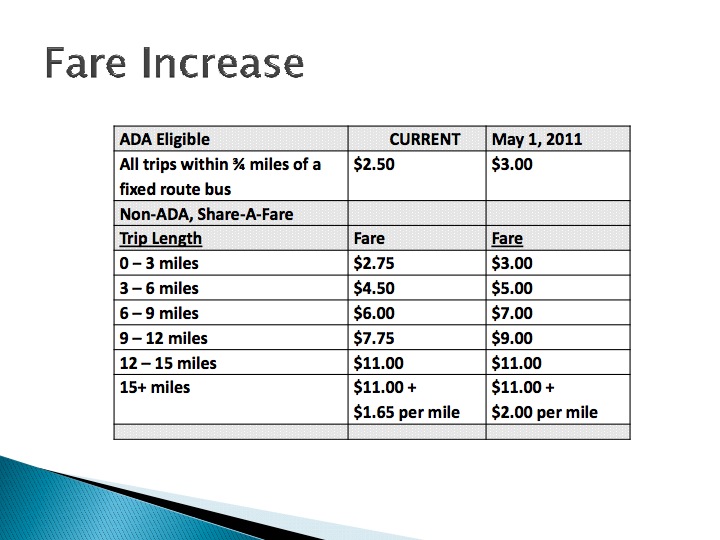
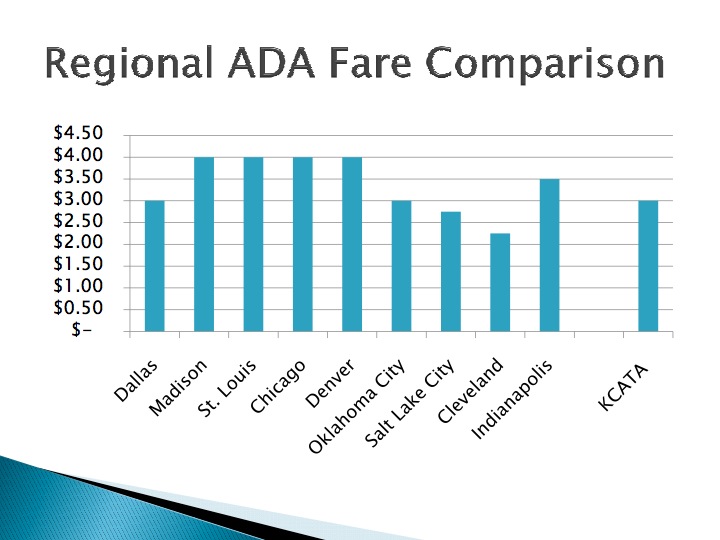
5.Bryan Beck, KCATA’s Director of ADA Compliance and Customer Service, provided an update on the fare increase from $2.50 to $3 per ADA eligible ride for the Share-A-Fare program, including the results of two public meetings and additional public input.  He presented general information and a service review of the Share-A-Fare program. See the full presentation- SAF Update 

6. Cindy Baker, KCATA Director of Marketing,  made a presentation on the State Avenue corridor project, funded by TIGER grants. It is in the design phase and the design team will soon be meeting with Advisory Council, stakeholders, and the general public. One component of this phase is the branding that will go hand in hand with design and then implementation. This project includes transit infrastructure improvements that could serve as a precursor to a future MAX line.

Johnson County Transit is in a similar situation with their Shawnee Mission Parkway/Metcalf route, also a TIGER-funded improved-transit corridor, but not full BRT service.

The JO has been working with consultants and the public to brand their new line. They have opted to call it “The JO Connex”. KCATA, Unified Government, and Johnson County Transit are all amenable to developing a regional brand, called “Connex,” that would represent a family of routes that include enhanced transit amenities, but do not increase service levels to MAX standards.

Next meeting May 25, 2011.

Posted in Local Transit Issues, Meeting Reports, Transit Studies | Tagged: , , , | Leave a Comment »

Streetcar Study Off to Fast Start

Posted by Transit Action Network on April 20, 2011


A Downtown Streetcar “Alternatives Analysis” (AA) study is on a fast track to completion, according to Charlie Hales, project manager for lead consultant HDR.  That’s our conclusion based on Hales’ presentation to the Kansas City Parking and Transportation Commission today.  The Commission, chaired by Councilwoman Jan Marcason will be the “primary sounding board” guiding the study.

Hales, who has had extensive rail transit experience in Portland and other cities, said though the federal funding situation is uncertain, the best way to get such funding is to have a plan ready when the next money becomes available.

The study timetable is ambitious:
– June – Statement of purpose and need, plus identification of initial alternatives.
– August – Alternatives evaluation and financing options.
– September – Draft of a Locally Preferred Alternative (LPA) report.
– November – Formal recommendation of a single Locally Preferred Alternative.

The FTA has awarded $400 million in grants for streetcar projects in the past 15 months through the TIGER and “Urban Circulator” programs, Hales said, and USDOT Secretary Ray LaHood really likes streetcar projects.  Getting the current study done will enable Kansas City to be “nimble” in applying for FTA “new starts” or “small starts” money, or other federal money that may become available.  Some transportation funding, for example, has recently been turned back by other grantees, and that money — even high-speed rail money — could conceivably be redirected to a streetcar project such as ours.

The Downtown Streetcar study will follow the FTA’s formal process, which requires consideration of reasonable options for both route and mode, but will seek a so-called “categorical exclusion” (a category of project considered not to have major environmental impacts) to simplify the “environmental screen” required in the FTA process.  Issues such as event-related street closures (e.g., at Sprint Arena and Crown Center), utility location requirements, the strength of bridges over the freeways, and where to locate a maintenance facility are among those to be addressed in the study.  Other factors include ridership forecasts (estimates based on travel demand models as well as “off-model” considerations) and financing options.

Hales noted that the study will build on a number of recent and ongoing local studies, including the Greater Downtown Area Plan, KCATA’s Comprehensive Service Analysis, the region’s Urban Corridors Study, and the Grand Boulevard Vision, plus all of the light rail planning work that’s been done in past years.  The streetcar study will be coordinated with the Commuter Corridors study (not yet underway), which will consider commuter rail in two major corridors.

Keeping the project manageable is important, too.  When projects fail, Hales said, it’s not for engineering reasons.  Rather, it’s for political reasons.  Thus, every effort will be made to keep all stakeholders involved, to limit expectations, and to avoid a key mistake of past Kansas City rail studies, letting the scope of the project expand.  Holding the project to just two miles gives it the highest likelihood of success, based on past voter response.  (It’s widely expected that funding for this project would come largely from within the streetcar corridor, and thus a citywide vote would not be required.)  This also keeps it small enough that the city might be able to finance it without federal assistance, should that become necessary.

KCATA General Manager Mark Huffer noted that a bill has been introduced in the Missouri Senate that would allow a Transportation Development District (TDD) to be set up specifically for transit, and that would simplify the makeup of the TDD’s governing body.  That bill (which might not be critical) might or might not get through the General Assembly this year.

Assistant City Manager Sherri McIntyre will oversee the project for the City.  She said she looks forward to guiding the study to completion and then getting the project built.

Said Chairman Marcason: “I’m the most optimistic that I’ve ever been (about getting a rail transit project done).”

Posted in Local Transit Issues, Rail, Transit Studies | Tagged: , , | Leave a Comment »

KCATA Board of Commissioners Meeting 3/23/11

Posted by Transit Action Network on April 10, 2011


1. Michael Graham, Director of Finance, presented financial data for 2010 and key performance statistics. The service reduction and fare increase in 2009 affected 2010 results.

KEY PERFORMANCE STATISTICS

Annual
2008

2009

2010

Metro Expense/Mile 

National Average (BUS) 2008

$6.45

$9.08

$6.48

$7.10

Passenger Boardings per Customer Complaint

6,921

8,142

8,931

Vehicle Accidents/Million Miles

39.23

42.50

36.70

On-time Performance

92.64%

92.08%

Miles/Mechanical Failure 

National Average 2008

8,578

7,644

9,298

8,729

Scheduled miles operated in 2010 were 9.7 million compared to 10.3 million in 2009.

Passenger revenue for the Metro decreased to $10,933,000 for 2010 which is $276,409, or 2.5% under 2009.  Average weekday ridership for the year decreased 2.3% to 50,007 compared to the previous year’s average of 51,156.

The average ridership for Saturday and Sunday decreased 3.0% and 9.8% respectively.

Total operating expenses for 2010 are $68,941,469, coming in $2,466,032 or 3.5% under budget.

KCATA is starting to see an increase in ridership as gasoline prices are rising.

2 Michael Graham updated the Board on the current fuel market and potential budget impacts. He was assisted by David Zarfoss, the representative from Mansfield Oil.

Diesel fuel prices have increased dramatically over the past month.

KCATA has approximately 50% of the 2011 diesel fuel requirement locked in at an average price of $2.38 per gallon.

The fixed price contracts cover fuel through June and most of July.  The remaining 50% of diesel fuel that is not locked in at fixed prices is budgeted at $2.50 per gallon.  The daily market price on March 10 was $3.21 and rising.

Michael and David discussed the factors affecting diesel prices. Purchasing factors have changed recently.

David commented that although diesel prices are rising, the refineries are in the process of making massive increases to capacity, which should calm the market and help bring the prices down.

Since KCATA has fixed price contracts though part of July it is not purchasing new contracts at these prices but is waiting to see what happens. KCATA has plans for a fuel surcharge of 25¢ when their diesel prices exceed $3.

The next meeting is April 27.

Posted in Meeting Reports | Tagged: | Leave a Comment »

KCATA Announces “How to Ride Clinics”

Posted by Transit Action Network on March 31, 2011


Spread the word. KCATA wants to save you thousands of dollars a year.

As gas prices rise, public transit becomes more and more attractive.  During the month of April receive one-on-one help learning about The Metro at KCATA How to Ride Clinics. New riders at the clinics will get a free 3-day pass.

How-to-Ride clinics will take place on the following days, locations and times.

  • April 2: Blue Ridge Crossing Shopping Center, North side of parking lot, 10 a.m. – 1 p.m.
  • April 9: City Market, Park-and-Ride at 3rd & Grand, 9 a.m. – noon
  • April 9: Costco, Linwood & Gillham, West side of parking lot, 1 – 4 p.m.
  • April 16: Waldo, 75th & Wornall, on the far side of the CVS parking lot, 10 a.m. – 1 p.m.

If you can’t make it to a clinic, check out the Starter Kit for New Riders and begin riding The Metro and MAX .

Posted in Events, Local Transit Issues | Tagged: | 2 Comments »

KCATA Board Of Commissioners Meeting 2/23/11

Posted by Transit Action Network on March 7, 2011


1. Congratulations to Robbie Makinen for being elected the new KCATA Chairman of the Board of Commissioners. Mr Makinen is Economic Development Coordinator for Jackson County and the Jackson County representative on the Board.

2.. The Board of Commissioners approved the KCATA FY 2012 federal appropriations funding request of $6 million in federal transit capital funds for new buses.

The primary categories from which federal funds are derived are formula funds and discretionary funds.  Congress and the President have announced that there will be no discretionary funds or “earmarks” for FY 2012.  KCATA has traditionally been very successful in attaining discretionary funds for bus replacement and other critical capital needs. While Congress has committed to eliminating earmarks in 2012, KCATA’s Congressional delegation has requested that KCATA’s priorities for capital funding for fiscal year 2012 be submitted to them, nevertheless.

KCATA staff met with Senator Blunt’s staff. They requested that KCATA submit normal earmark request forms to help the Senator prioritize capital needs around the State.  Sustaining basic services and maintaining the existing fleet are the highest priorities for 2012.  With more than 30 buses in need of replacement, KCATA has an ongoing need to replace buses that have exceeded their useful life.

3. The Board of Commissioners approved the revised strategic priorities. Two documents were presented.


KCATA Strategic Priorities 2011

The first document identified the updated Strategic Priorities and Mission and Vision Statements, as well as priority areas identified by senior staff.  The document intends to capture the overall strategic direction for the Authority.  Although it can be updated periodically, the vision and overall priorities are intended to remain relatively stable over time.

The second document, KCATA 2011 Blueprint – Feb 23, 2011, identified a series of actions that support the priorities.  Mark Huffer pointed out that many of these action items will carry over into subsequent years, others are part of daily operations, and others will be completed in 2011. This document should be updated on an annual basis, as existing projects get completed and new ones are identified.

Three items of particular interest on the blueprint were discussed.

a. Under Technology -The 5 year strategic plan for technology development. The new Smart Card technology available for fare boxes provides more flexibility and information. Also, the new generation of riders has higher expectations for KCATA to provide real-time information though mobile devices.

b. Under Capital Improvements-KCATA needs to revise the Fleet Replacement Plan due to the possibility of losing funding.

c. Under Environmental Responsibility-The need to develop a board policy toward alternative fuels was discussed. There is concern about compressed natural gas (CNG) because of its volatility. The current KCATA facilities would not be suitable for CNG. Also 2011 diesel emissions are comparable to CNG emissions. Cost, danger, return on investment and volatility all need to be considered.

4. Mell Henderson of MARC and Mark Swope of Olsson Associates briefed the board on the current Smart Moves update, planned activities and expected outcomes. Smart Moves is the long-term regional vision for improving and expanding transit in the metropolitan area. MARC is leading an update focused on strategies for implementing the transit improvements envisioned in Smart Moves. This current work will build upon previous regional transit planning work. Public engagement is expected by May.   Regional Transit Implementation Plan Phase III Presentation 2/23/2011

5 Bill Brown, federal lobbyist for the Missouri Public Transit Association, attended the meeting to provide the Board with his perspective on the current Washington landscape and what the public transit industry should expect and be prepared for in 2012 and beyond.

The Presidents proposed 2012 budget calls for a significant increase in funding for public transit, high-speed rail, and Amtrak.  The Administration also proposes fundamental changes to the transit funding, as well as several new programs.  Conversely, several House committees are proposing drastic budget cuts for many domestic programs, including transit in 2012.

In the meantime, the 2011 federal budget has not been approved.  The transportation authorization bill expired in 2009 and there are no signs that a new bill is imminent. The Administration and Congress say there will be no earmarks this year – a source of funding that has been very important to KCATA.  All these considerations lead to great uncertainty in regards to planning and funding new transit projects.

Bill was adamant, in his opinion, that funding for high-speed rail will be cut.

6. UMKC students voted in favor of a new activity fee. Students will receive a KCATA bus pass for $14/term ($28/year). This pass goes into effect Fall 2011. It will generate over $186,000 per year for KCATA and will be reviewed in one year.

Posted in Local Transit Issues | Tagged: | Leave a Comment »

KCATA Board of Commissioners meeting 1/26/11

Posted by Transit Action Network on February 11, 2011


1. Kansas City has released the Preliminary Budget for Fiscal Year 2011-12.

KCATA budget from the ½ cent transportation fund is $1.98 million more than the previous budget. (Note: This is 75% of the revenue after TIF and City administration costs.)  General Manager Mark Huffer reported that he has been told that the city may be able to reach the 95% mark required by the new ordinance as soon as next year, which would be a year earlier than required.

2. The Board of Commissioners authorized a Memorandum of Understanding (MOU) with MARC, the City of Kansas City, Missouri and Jackson County concerning implementation of the regional Alternatives Analysis (AA) Studies using $1.8 million in federal grant funding.

The MOU allocates the funding as follows:

Corridor Study Federal Funds Local Funds Source of Match
Downtown Streetcar AA $540,000 $135,000 Kansas City, Missouri
Commuter Corridors AA $1,260,000 $315,000 Jackson County

Other key points in the MOU are as follows:

• MARC will serve as FTA grant recipient,

• MARC, KCATA, the City of Kansas City and Jackson County will serve as a partnership team overseeing AA efforts,

• KCATA and the City will lead the downtown streetcar AA, and

• MARC and Jackson County will lead the commuter corridors AA

3. KCATA has $10.4 million in a federal grant for public transit improvements in the State Avenue corridor, which extends from the 10th and Main Street transit center in downtown Kansas City, Missouri, through downtown Kansas City, Kansas, to the Village West area in western Wyandotte County.

Key components of the project include:

• 7th Street and Minnesota Avenue Transit Center

• 47th and State Avenue (Indian Springs) Transit Center/Park & Ride

• State Avenue Corridor Transit & Access Improvements

• State Avenue Corridor Branding

The Board authorized a contract with BHC Rhodes, Inc., for Architectural and Engineering (A&E) Design Services for State Avenue Corridor Transit Improvements.

4. Update on the Comprehensive Service Analysis – Nelson Nygaard

The CSA is an in-depth, technical study of the system’s effectiveness and will result in system-wide and route-level recommendations for improved efficiencies and service delivery.

Mr. Geoff Slater, Project Manager with Nelson Nygaard, provided a project update and discussed the next efforts of the CSA.

Public involvement is scheduled spring or early summer. See the presentation KCATA_CSABoard0111.

5.  Emerick Cross, Interim Transit Manager of Unified Government Transit in Wyandotte County thanked KCATA for its help in the recently completed Comprehensive Service Analysis. See the 2010-UG Transit Comprehensive Service Analysis.

Posted in Local Transit Issues, Meeting Reports, Transit Studies | Tagged: , , | Leave a Comment »

Preparations for Two Transit Studies Move Forward

Posted by Transit Action Network on January 8, 2011


Jan 7, 2011: The major agenda item at a Kansas City, Missouri, Parking and Transportation Commission meeting this afternoon was a report on the downtown streetcar concept by Mark Huffer (general manager, KCATA), Dick Jarrold (project engineer, KCATA), and John Dobies (HNTB).  It was largely the same presentation that Dobies gave to MARC’s Transit Committee last month.  The line is expected to run from River Market to Crown Center along Main Street, and would be the first phase of a streetcar / light rail system that would extend farther south to the Plaza.  One of the issues identified was whether this line would be “serious transportation” or a tourist-oriented line.  Presenters articulated a clear bias toward the “serious transportation” purpose (though there would obviously be tourist implications).  We strongly agree.

Huffer confirmed that the streetcar and commuter corridors Alternatives Analysis studies (AA’s) will be done separately, albeit in a coordinated manner. The $1.8 million that the region has received from the FTA for the studies https://transactionkc.com/2010/12/22/commuter-rail-maybe-maybe-not-1-8-million-to-study-transit-corridors/ is 90% of the $2 million requested, so each study is expected to receive 90% of the original request.  Thus, the downtown streetcar study would receive $540 thousand and the commuter corridor study $1.26 million.

KCMO and KCATA expect to coordinate and provide the local match for the streetcar study, and the ATA has already written a draft scope of services in preparation for issuing an RFP (request for proposals) next month.  They will meet with the FTA on January 20 to work out details, and they hope to get the KCATA Board of Commissioners to approve the draft scope this month.  If all goes well, KCATA could select a consultant as early as April, and the study will likely take about 10 months.  The streetcar AA can move forward quickly because so much of the 2007-08 light rail AA work is applicable.  There’s also a sense of urgency because Kansas City has a shot at getting “small starts” money from the FTA under the current administration — if they decide to pursue federal funding.  This two-mile segment is part of the 14-mile light rail line that was turned down by voters in 2008, and is widely considered the segment most likely to be eligible for federal funding.

The commuter corridors AA for two lines — one to Blue Springs and beyond, and the other to Lee’s Summit and beyond — is much more complicated and will involve a much larger group of stakeholders, including several local jurisdictions, MoDOT, transit agencies, inner-city neighborhoods, transit advocates, trail proponents, the railroads, etc.  It will be coordinated jointly by Jackson County and MARC with Jackson County providing the local match, and it could easily take a couple of years to complete. They will also meet with the FTA on January 20.

Posted in Local Transit Issues, Rail, Transit Studies | Tagged: , , , | 3 Comments »

A Great Victory for Transit!

Posted by Transit Action Network on December 18, 2010


On Thursday December 16, 2010, Kansas City passed an ordinance to restore funding from the ½ cent transportation sales tax to public transit.

The vote in the legislative session was 11-1 in favor of substitute Ordinance 100951. This ordinance directs the city manager and budget office to give public transit at least 95 % of the receipts from this sales tax (after TIF and city administrative fees). The compromise that enabled so many council members and the mayor to support the ordinance is a 3-year phase in period. The process will be incremental and start with the May 1, 2011 budget.  Full restoration will to be completed by May 1, 2014.

This change will amount to an additional $3.5 -$4 million a year for transit when fully implemented.  This is the biggest victory for transit in Kansas City since the vote for the 3/8-cent sales tax.

Transit Action Network (TAN) thanks everyone who worked to pass this ordinance.

TAN would particularly like to acknowledge these efforts:

  • David Martin exposed the problem in The Pitch in September to provide public awareness of the problem.
  • MORE2 (Metropolitan Organization for Racial and Economic Equity) participated in the meetings we had with the acting city manager as well as the council members and the mayor’s chief of staff. They spread the word to their member churches and other organizations.
  • KCATA and the KCATA Board of Commissioners played a major role in promoting the ordinance. KCATA General Manager, Mark Huffer, presented an excellent slide show to the committee that really made the funding problems clear.
  • At the Nov 18th Transportation and Infrastructure (T & I) committee meeting 10 organizations representing over 160,000 people plus all of the transit riders spoke in favor of the transit ordinance. They were the KCATA, KCATA Board of Commissioners, MORE2, Amalgamated Transit Union, AFL-CIO, The Whole Person, Alphapointe, RTA, AARP and of course Transit Action Network.
  • A committee of the Downtown Council sent a letter endorsing the ordinance.
  • The Ivanhoe, Blue Hills and Oak Park neighborhood associations provided support from these communities.

Our blog and tweets brought more people on board, as did the social networking efforts of other transit friendly groups.

All of the above groups generated phone calls, email messages and signatures that poured into City Hall. A lot of direct contact was made with council members too.

Brad Cooper and Lynn Horsley of the Kansas City Star wrote several articles about the ordinance and transit funding issues.

Chris Hernandez of NBC Action News CH41 covered the T & I committee meeting on Nov 18.

Council members Terry Riley, John Sharp, Beth Gottstein, Cathy Jolly and Ed Ford supported this issue immediately. When they saw the budget trends in our meetings they understood a change had to be made to limit the city diverting so much of this sales tax to other uses.

Councilman Ed Ford introduced the ordinance and was the “point man” in making this happen. When the ordinance went to the legislative session in the afternoon it had seven co-sponsors, all of the council members mentioned above as well as Melba Curls and Bill Skaggs from the T & I Committee. Councilmen Riley, chair of the T & I committee, and Ford worked closely on this issue and both of them spoke forcefully for the ordinance at the legislative session Thursday. The other council members didn’t see the final language for the ordinance until then so we were extremely pleased that there was such overwhelming support for the final version.

We appreciate Councilman Ford’s acknowledgment of TAN’s leadership role in this effort in his comments during the legislative session.

We thank Mayor Funkhouser, Council Members, acting City Manager Troy Schulte and staff for finding a compromise that was acceptable to everyone.

Transit gets the security of receiving the money from the 1/2 cent transportation sales tax and the budget office gets some time to make this change. WIN-WIN.

News story in the KC Star:  http://bit.ly/hjcUKH

Transportation and Infrastructure Committee meeting Dec 16, 2011

(Note: video link not available at this time. This blog will be updated when it is available)

Link to City Council Legislative Session Dec 16, 2011(click on 100951 to go directly to this ordinance)

http://kansascity.granicus.com/MediaPlayer.php?view_id=2&clip_id=4905

Posted in Action, Local Transit Issues | Tagged: , , | Leave a Comment »

The Scoop on Kansas City Transit Funding

Posted by Transit Action Network on December 14, 2010


Why did such a large diverse group of Transit Supporters show up at the November 18 Kansas City Transportation & Infrastructure Committee meeting to support Ordinance 100951 to restore funding to transit?

City Government has been diverting an excessive and increasing amount of money from the ½ cent Transportation Fund to non-transit uses.

  • This is crippling transit. In 2009 KCATA reduced service by 9.5% and increased fares 20% in order to sustain an even lower level of service.
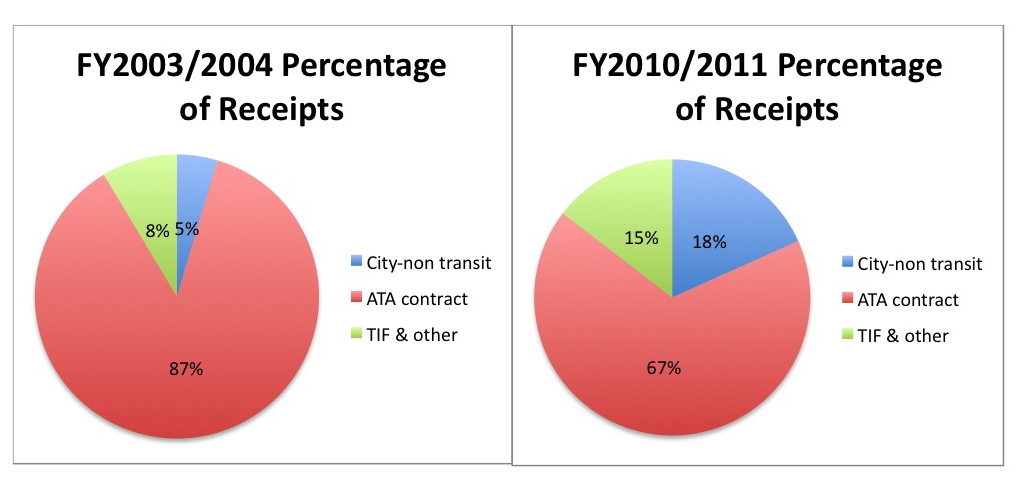
  • (Click on pie chart to enlarge.)
  • The city has gone from diverting less than 5% in FY2003/2004 to over 18% in FY2010/2011

Transit Supporters are aware of the budget pressures caused by the recession. The city has made a lot of very difficult decisions. But adequate transit is a basic city service that should be protected as a city priority. The proposed ordinance would reaffirm the city’s commitment to provide reasonable transit service to the community.

  • This is an issue of fairness, social equity, and keeping faith with the voters.
  • It honors the voter’s support for transit when they passed the supplemental 3/8 cent sales tax.
  • Transit affects people’s ability to get and maintain jobs. The national organization, Transportation Equity Network (TEN) has a new report explaining how MORE TRANSIT=MORE JOBS. 65% of the trips on our public transit system are related to work or looking for work.
  • In addition to jobs, transit provides vital connections to education, medical care, worship, shopping, entertainment and a vast array of personal activities.
  • The significant cuts to transit service have unfairly affected the people who require transit, such as the elderly and the disabled.
  • The ordinance confirms the City Council’s commitment to make Kansas City a “Green” and “Sustainable” place to live.
  • However much the City needs additional funds in times of recession, the ½ cent transportation tax shouldn’t be raided to subsidize non-transit activities.

Why do we need Ordinance 100951?

  • The pattern of shifting more and more money to non-transit uses is likely to continue without the ordinance.
  • It is much too easy to just keep diverting money from this fund for other purposes. The city currently diverts over 18%. What is to keep them from going to 25% or 30%?
  • Rather than using the 3/8 cent sales tax to improve transit as voters intended, the city is, in effect, using the 3/8 cent sales tax to replace the 1/2 cent sales tax.
  • In the current budget the 3/8-cent sales tax is providing more money for transit than the ½ cent sales tax.

Kansas City Funding for Public Transit during the recession

Funding for Public Transit

FY 2008/2009

FY 2010/2011

Decrease

1/2 cent sales tax

26,349,787

19,870,641

(6,479,146)

3/8 cent sales tax

23,263,353

20,734,48

(2,528,868)

Total

49,613,140

40,605,126

$(9,008,014)

  • One third of the  $9 million decrease in transit funding over the last two years is a result of the city siphoning off additional money to non-transit uses. The remainder is due to lower collection rates during the recession.
  • The City is unlikely to help transit from other city revenue sources, so we need to make sure transit gets most of this sales tax revenue.

What does the proposed ordinance actually do?

  • The ordinance directs the budget office on how to allocate proceeds of the ½ cent transportation tax. (See footnotes)
  • There will be no change in the amount of the money available for the budget, just clear direction from the City Council that certain funds be used for transit.
  • Non-transit activities will revert to receiving 5% of the funding like they did when voters overwhelmingly voted for expanded and improved transit in 2003. The remainder will again go to transit.

Will this proposed ordinance cure the financial woes of the KCATA?

  • This ordinance will not totally mend all the financial woes of the KCATA since sales tax receipts are still low.
  • Without this ordinance, Mark Huffer, General Manager of KCATA, pointed out that service cuts of 25%-35% are looming as early as 2014, when the KCATA Reserve Fund would be exhausted.

Is there opposition to the Ordinance?

  • Some concerns have been expressed about losing “flexibility” in the budgeting process. However, considering that the transit system suffered a tremendous financial reduction from the decline in sales tax, maintaining the City’s ability to continue diverting huge amounts of money away from the transit system shouldn’t be called “flexibility”.
  • There is some concern about how to replace the money for non-transit activities that would return to transit. The non-transit activities could return to previous funding methods before the 1/2 cent transportation fund was used so heavily to subsidize their activities.

What can we do?

  • At the next Transportation and Infrastructure Committee meeting on December 16, the committee will make a recommendation on the ordinance to the full council. Please contact your city council members and the mayor to support Ordinance 100951 and restore funding to the transit system.
  • Contact information can be found here.

o   http://kcmo.org/CKCMO/CityOfficials/index.htm

Footnotes:

How will the ordinance be calculated?

  • The proposed ordinance will create a new calculation. Both TIF (Tax Incremental Financing) and city administration fees are deducted first. These currently total about 15% of this sales tax. The 95%Transit/5% Public Works split will happen after TIF and the city administration fees are deducted.

How did TAN get all of this budget information?

  • The Kansas City Budget is online. Choose the appropriate budget from the box in the upper right corner on this link.  Next click on any of the icons that appear. Then open or download the PDF file. It is over 500 pages long. From the FY 2010-1011 Adopted Budget TAN mainly used the Budget by Department and the Schedules.

o   http://www.kcmo.org/CKCMO/Depts/CityManagersOffice/Office%20of%20Management%20and%20Budget/index.htm

Related articles can be found on this blog by using Category “Action” or tag “KC Ordinance”

Posted in Action, Local Transit Issues | Tagged: , , | 1 Comment »

Alert! Date Changed for hearing on Ordiance 100951 – DEC 16

Posted by Transit Action Network on December 11, 2010


Alert! At the Transportation and Infrastructure Committee meeting on Dec. 9, Councilman Riley announced that Ordinance 100951 will be addressed next week on DECEMBER 16.  Additional testimony will be allowed. The Transportation and Infrastructure Committee meeting will be at 9 am on the 10th floor of City Hall.

Posted in Action, Local Transit Issues | Tagged: , , | Leave a Comment »

Change of Date for Committee Vote on Ordinance 100951

Posted by Transit Action Network on December 8, 2010


A decision on transit Ordinance 100951 will not happen tomorrow, December 9, 2010. Councilman Riley, Chair of the Transportation and Infrastructure Committee, intends to hold the ordinance, which restores funding to transit from the ½ cent sales transportation tax, to allow staff additional time to provide a plan to the Council.

We have been told that staff will provide a plan addressing the budget implications if the ordinance passes on the non-transit activities that are currently using that money.

Of course passing the ordinance would start to address the huge shortfall in the public transit budget.

The next discussion of the ordinance is planned for Jan. 6, 2011. The Council will not meet for two weeks over the holidays. On Jan 6th staff will present information concerning the budget.

We are pursuing permission to provide additional public testimony on Jan 6.

Posted in Action, Local Transit Issues | Tagged: , , | Leave a Comment »

Seamless Transit – Two Small Steps

Posted by Transit Action Network on December 7, 2010


MAX pylon at the Waldo stop

It’s been on our agenda for a long time, but we first wrote about “seamless transit” back in May http://bit.ly/abH9n1.  We consider it an issue because there are invisible barriers to transit riders who need to move about the region using buses operated by the three transit agencies.

Closeup of MAX pylon at Waldo stop


Two recent developments move the region a little closer to achieving seamless transit.

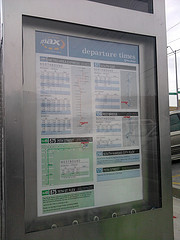
[1] – Johnson County Transit initiated a new bus route (575/875) in July http://bit.ly/fUembw connecting Waldo with Johnson County Community College via 75th Street and Quivira Road.  However, there was no evidence of the service at Waldo, except when a bus was actually there.  In response to our request to its Board of Commissioners in August http://bit.ly/goLu99, KCATA has posted a map and schedule for Route 575/875 at the Waldo MAX stop.  To our knowledge this is the first time a map and schedule for a Johnson County Transit route has been posted in Missouri.  Our hats are off to the KCATA and JCT staff who made this happen.  We hope a similar posting for Route 556/856 at the Plaza MAX stop will follow.  And then maybe something at 10th and Main where dozens of JCT buses stop every weekday.

Close-up of the map and schedule displayed on the MAX pylon.  JCT Route 575/875 is shown in the green panel at the lower left of the poster.

[2] – Mid-America Regional Council has convened a Seamless Transit Work Group within its Transit Committee.  Through this group, Transit Action Network will work with MARC and transit agency staff, plus representatives of other organizations, to define seamless transit — making the region’s transit network easier to use is a first working definition — and to outline steps the transit agencies should take to achieve it.

Two small steps for transit agencies and MARC.  Two giant leaps toward seamless transit.

http://bit.ly/abH9n1

Posted in Local Transit Issues, Seamless Transit | Tagged: , , | Leave a Comment »

Transit Supporters Unite at KC City Hall 11/18/2010

Posted by Transit Action Network on November 23, 2010


Transit Action Network and nine other groups united last Thursday to testify at the Transportation and Infrastructure Committee meeting to endorse Ordinance 100951. The ordinance was introduced by Councilman Ed Ford and co-sponsored by Council members Gottstein and Sharp.

This ordinance would help restore funding to transit. The city has diverted money to other purposes against the obvious intentions of the citizens who voted in 2003 and 2008 for an additional sales tax to improve and expand transit. In 2003 the city took $1.9 million from the 1/2 cent transportation tax for non-transit purposes and in 2010 they are taking $ 5.2 million.  This shift in city budgeting has left a big hole in the transit budget.

Mark Huffer, General Manager of KCATA, started the testimony by providing a very informative slide show about the financial difficulties of KCATA, which are partly caused by the recession and partly caused by City Council budget decisions.  After his presentation, there were presentations by representatives of the ATA Board of Commissioners, MORE2, Amalgamated Transit Union, AFL-CIO, The Whole Person, Alphapointe, RTA, AARP and of course Transit Action Network (TAN).

These presentations provided a huge outpouring of support from transit professionals, transit advocates, religious and social equity networks, and representatives from organizations representing the disabled, the elderly and the unions.

When we began meeting with the acting city manager and the council members in August, we were told repeatedly that they never heard from transit. We don’t think they can say that after Thursday.

The head of the Public Works department expressed concern about the ordinance.  Of course his department has benefited from the money diverted to non-transit projects. However, transit has taken an unfair share of the burden in this recession. Transit suffered by losing funding from both the downturn in sales tax receipts and the excessive amounts of money diverted by the city to non-transit purposes.

Links to media coverage

Video of Nov 18 City Council hearing on 100951 is on the City website at http://bit.ly/bdfR9X.  Public testimony begins about 22 min into this 48 min clip.

Recent press about Ordinance 100951:

Nov 14 Star story http://bit.ly/cscKLd

Nov 18 Star editorial http://bit.ly/c2aIvG

Nov 18 Ch41 story http://bit.ly/9Lzyyy with 2m05s news clip

Nov 19 Star story http://bit.ly/csLEPn

Please contact your city council members and the mayor to support Ordinance 100951 and restore funding to the transit system.

Contact information. http://kcmo.org/CKCMO/CityOfficials/index.htm

After Thanksgiving: What does this ordinance really do and why is the transit community so adamant about it?

Posted in Action, Local Transit Issues | Tagged: , , | Leave a Comment »

KCMO Ordinance Would Protect Transit Funding

Posted by Transit Action Network on November 10, 2010


Transit Action Network (TAN) is very pleased to announce that Councilman Ed Ford introduced KCMO Ordinance NO. 100951 to the city council last week. The ordinance was co-sponsored by Council members Ford, Sharp and Gottstein.

This ordinance would restore transit funding and restrict what the city can use for non-transit projects. It limits the City’s use of the 1/2-cent transportation tax for non-transit related purposes to 5%. Currently, KCMO is using approximately 18% for such purposes, or in excess of $5M. Although the City has the legal right to do so, we believe it is inconsistent with the voters’ desire to improve finances for public transit, as evidenced by their overwhelming support for the 3/8-cent transit sales tax in the elections of 2003 and 2008.

TAN started working to get an ordinance to restrict the city’s use of the 1/2-cent transportation sales tax in August when we met with the acting city manager Troy Schulte. Subsequently we have met with city council members and the mayor’s chief of staff. MORE2 (Metro Organization for Racial and Economic Equity) has participated in these meetings with city officials and we have worked together closely on this effort.

TAN requested limiting non-transit expenditures to 4%, so this proposed ordinance is consistent with our request. We have been working with KCATA, which also made the same request.

We will be testifying in favor of this ordinance Thursday, November 18th at the Transportation and Infrastructure Committee meeting at 9 am, 10th floor of City Hall.

The first step in passage of this ordinance is for the committee to support the ordinance and send it to the whole city council. If that happens, then the city council needs to pass the ordinance. Seven votes are needed in the full council to pass the ordinance.

Committee members are Councilpersons Riley, Curls, Jolly, and Skaggs. Please let them know that you are in favor of this ordinance.

It is also appropriate to contact other Council offices and simply let them know you are in support of this ordinance.

We are reaching out to other organizations and Kansas City neighborhoods to encourage the city to adopt this ordinance.

ORDINANCE NO. 100951

Amending Chapter 68, Article VII, Code of Ordinances of Kansas City, Missouri entitled “Sales Taxes,” to enact a new section which provides for the distribution of the transportation tax.

BE IT ORDAINED BY THE COUNCIL THAT:

Section 1: That Chapter 68, Article VII, Code of Ordinances of Kansas City, Missouri, entitled “Sales Taxes,” is hereby amended by enacting a new section 68-472.1, entitled “Distribution of tax,” to read as follows:

Sec. 68-472.1 Distribution of tax.  At least ninety-five percent of the sales tax for transportation imposed by Sec. 68-471 of this article and deposited in the City’s Public Mass Transportation Trust Fund shall be appropriated and paid by the City to the Kansas City Area Transportation Authority for purposes as provided in RSMo. 92.400 – 92.421 inclusive. Any portion of this appropriation and payment in excess of that designated by contract as being due the Kansas City Area Transportation Authority for performing its contractual obligations to the City shall be utilized by the Kansas City Area Transportation Authority for its general purposes in providing a public mass transportation system.

Please do not hesitate to contact TAN if you need to discuss this issue. We appreciate your help.

Email: TransActionKC@gmail.com

Link to ordinance on the city website.

http://tinyurl.com/3xmuhfm

Posted in Action, Local Transit Issues | Tagged: , , | 2 Comments »

Update on KC transit funding 10/4/2010

Posted by Transit Action Network on October 5, 2010


Kansas City has been diverting the half-cent sales tax money away from transit for several years.  As a result, transit service was cut last year by 9.5 percent and fares were increased 20 percent.

Transit Action Network (TAN) is asking the Kansas City city council to pass an ordinance to limit the city’s non-transit use of the ½ cent sales tax that feeds the Public Mass Transportation Fund. We would like to see a limit in the range of 4%-5%, which would be in line with the amount the city used for these items when the voters enacted the supplemental 3/8-cent transit sales tax.

The city’s use for non-transit related projects has grown from under 5% in 2003 to over 18% in 2010.

Even in this recession, the city is receiving more in sales tax than it did in 2003, yet public transit is getting $5 million less this year than in 2003. The money is going to road related projects instead of transit.

Transit Action Network has already met with nine council members and acting City Manager Troy Schulte. A member of MORE2 (Metropolitan Organization for Racial and Economic Equity) has been part of the delegation at nearly all of these meetings. We are working with MORE2 because this issue affects getting to and maintaining jobs, which is important to both our groups.

We have met with: Troy Schulte, Cindy Circo, Beth Gottstein, Terry Riley, John Sharp, Jan Marcason, Bill Skaggs, Cathy Jolly, Ed Ford and Melba Curls.  We have meetings scheduled with the remaining council members.

We updated the Kansas City Area Transportation Authority Board of Commissioners at their September 22 meeting.

We are also making arrangements to speak at neighborhood associations to expand the awareness of this problem. We have already scheduled presentations for the Ivanhoe and Blue Hills neighborhoods.

This is also a sustainability issue. The city needs to make its actions match its green value system. The city has adopted numerous green initiatives and improving transit is a major component of sustainability. You can’t get to sustainability by de-funding transit.

TAN members spoke last March at the city council’s budget hearings, but we learned that was too late.  Now is the time to speak out about the budget if there is any hope of affecting it.

When we met with Troy Schulte in August he advised us to RAISE THE LEVEL OF DISCUSSION ABOUT TRANSIT, and he reminded us that the SQUEAKY WHEEL GETS GREASED.

So we’re beginning to squeak.  Loudly.

Some council members didn’t know about this issue and needed to do some research.  Some are ready to support limiting the city’s use of these funds.  Only one has been adamant about “not hamstringing the budget!”

We don’t’ think the way to fix the city’s other problems is to create a new problem by gutting the transit system.

If you haven’t contacted your councilperson and the mayor, please do so.  You can get their email address or phone number at http://kcmo.org/CKCMO/CityOfficials/

Posted in Action, Local Transit Issues | Tagged: , , | 3 Comments »

KCATA Does a Cameo Drive-by for Bridge Dedication

Posted by Transit Action Network on October 2, 2010


Assistant District Engineer Linda Clark of MoDOT presided over the ceremonies, which included Congressman Emanuel Cleaver II, plus a number of state, county, and city officials, and well over a hundred walkers and cyclists.

A new bike/ped pathway on the Heart of America Bridge across the Missouri River was dedicated on October 1, 2010.  The project has been on the wish list of local cyclists and walkers for many years, and its construction was accelerated using American Recovery and Reinvestment Act (federal stimulus) money.  What’s the transit connection?  For starters, people from south of the river who work an evening shift in North Kansas City can now take transit to work and have a safe way to get back across the river after transit service ends.

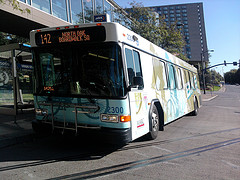
The KCATA's walk/bike "wrapped" bus made a cameo drive-by appearance during the HOA Bridge ped/bike pathway dedication. This photo was taken later in the day near Union Station.

Thanks to our close working relationship, Transit Action Network was able to get the ATA to assign their special “Walk There / Bike There” bus to Route 142 so it would pass by (cue the cheers and waves) during the dedication ceremony.  Our thanks to Cindy Baker and her colleagues at the ATA who made this “cameo appearance” possible.

Posted in Local Transit Issues | Tagged: | Leave a Comment »

KC is Crippling Its Transit System …. and how to fix the 2011/2012 transit budget

Posted by Transit Action Network on September 15, 2010


Kansas City has not been fully funding the transit system for several years. Instead, the city is systematically diverting funds previously used for transit to non-transit projects, such as traffic signals.

The transit system is funded by two different sales taxes. The 1/2-cent sales tax feeds the Public Mass Transportation Fund (PMTF). This fund is where the problem exists. The 3/8-cent sales tax is a transit-dedicated fund so the transit system gets those monies.

Since the 1/2-cent sales tax is for TRANSPORTATION, not TRANSIT, it is legal to use the money on things like traffic engineering or road signs. However, this fund has been the foundation of transit funding in the city since it was originally passed. When voters approved the 3/8-cent sales tax it was supposed to supplement the 1/2-cent tax to provide greater transit in the City. Soon after the passage of the new tax the City started diverting more and more of this money to other projects. When the supplemental tax was passed the KCATA was receiving 87% of the money from the PMTF. By the time the recession hit KCATA was only getting 80% of the money and the city’s portion had risen from under 5% to over 9%.

Then the recession hit in late 2008. What happened in the next budget? The transit funding was severely cut to 69% of the receipts while the city’s portion rose to 15%. Of course people expected to see reductions in service, after all this was a huge economic downturn. Therefore, people just bit the bullet and accepted the transit situation without a whimper. The City continues to siphon off more money for non-transit uses. It may be legal but it sure isn’t right!

When the 2009/2010 Budget was announced the KCATA had to scramble to adjust to the severe last minute cut. It reduced service nearly 10% and raised fares 20%. The sales tax receipts are more today than they were in 2003 yet the KCATA is receiving $5 million less from this fund.

The KCATA cannot maintain the current level of reduced service with the money it is receiving from the City. So how is KCATA funding the transit system at this level? By exhausting its reserve account. When the 3/8-cent sales tax passed the KCATA started a reserve account. They could see the trend of the City’s budgeting for the PMTF even before the huge shock with the 2009/2010 Budget. This reserve had been allowed to grow. With the reduced service and higher fares, KCATA calculates it can survive at the current level of service by using up the reserve until the end of 2013 when the money will be depleted. At that point KCATA might have to cut service another 35% unless things change.

This is a really ineffective way to fund a transit system. Transit funding might have to fluctuate with sales tax receipts, TIF obligations and city administrative fees, but it should not be subjected to city bureaucrats or city officials utilizing the money for non-transit related projects.

No business can manage effectively with wild fluctuations in revenue, especially when those fluctuations are not caused by the economy. If we want the KCATA to expand and improve transit we have to make sure they receive the funds they were intended them to have.

Transit Action Network wants to regain some sanity in transit funding. By putting a legal cap on what the city can use for non-transit projects, the PMTF can once again be the foundation for transit funding and the KCATA can regain the necessary confidence about it’s future funding to once again begin to plan for transit expansion.  That security would allow KCATA to implement the recommendations that come out of the Comprehensive Service Analysis currently underway.  KCATA could also feel comfortable maintaining a reasonable reserve amount.

Transit Action Network is already meeting with city council members. We have partnered with the Metropolitan Organization for Racial and Economic Equity (MORE2) to help bring about this change. We have started making appointments with neighborhood leaders in the Green Impact Zone. We hope to mobilize the residents of Kansas City to stand up for the transit system.

Let your council members and the mayor know you are concerned about this situation and encourage them to create a legal cap to restrict funding non-transit projects in the PMTF. Our solution is stated below in a document we are delivering to the council and the mayor. Or just ask them to implement the legal cap on non-transit projects proposed by the Transit Action Network (TAN).

We will be posting updates to this effort on this blog as well as on our twitter account http://twitter.com/transactionkc.

Document for City Council Members and the Mayor

TRANSIT ACTION NETWORK

Issue: 2011/2012 Budget for the 1/2 cent Public Mass Transportation Fund

Our Position: The City has diverted an increasing and excessive amount of the 1/2-cent Public Mass Transportation Fund away from transit to non-transit projects. We believe the non-transit portion of this fund should be legally capped at 4 percent of Total Revenues (Sales Tax Receipts less TIF). This cap will assure that the separate 3/8-cent Transit Sales Tax supplements the 1/2-cent Sales Tax to improve and expand transit for Kansas City’s citizens.

History:

Kansas City 1/2 cent Public Mass Transportation Fund
Budget 2003/2004 2008/2009 2009/2010 2010/2011

Receipts

$28,789,178 32,560,000 31,218,750 29,600,000

City-non transit

1,333,411 3,083,561 4,813,252 5,413,196

ATA contract

$24,976,506 26,349,787 21,551,903 19,870,641

% of receipts

City %

4.63 9.38 15.42 18.29

ATA %

86.76 80.19 69.04 67.13
  • Drastic cuts to transit funding are crippling the transit system

In 2003/2004 the 1/2-cent tax generated $29 million, and $25 million (86.7%) was used for transit. The city used $1.3 million (4.6%) of revenue for non-transit purposes.

The City began diverting large amounts from this fund to non-transit projects after passage of the 3/8-cent transit sales tax in 2003.  This trend began well before the current “revenue crunch” and had already reached 9.4% of receipts by the 2008/2009 Budget.

Receipts estimates for 2010/2011 are $29.6 million but transit will receive only $19.9 million or 67% (significantly less than in 2003/2004), while the city will increase its take to $5.4 million or 18.3%.

People expect to see cuts to transit services during severe recessions. Unfortunately, this expectation provided the cover necessary to nearly double the percentage used for non-transit projects to 18.3% in the 2010/2011 Budget as compared to 9.4% in the 2008/2009 budget by cutting transit funding.

When voters approved an additional 3/8-cent transit sales tax in 2003, and renewed it in 2008, they expected it to supplement the 1/2-cent tax, not replace it.  Whereas the 3/8-cent transit sales tax was to increase transit, transit service has actually been shrinking and fares have been increased 20% because of the diversion of the 1/2 cent transportation funds.  The City is not keeping faith with the electorate.

This budgetary trend jeopardizes the City’s ability to increase sales taxes for additional transit, such as a streetcar, or to receive emergency funding for transit services from state and/or federal sources.

The trend of using less of the sales tax receipts for transit and more for non-transit appears to be systematic and intentional and we believe this needs to be reversed.

  • Jobs

In a recent survey by ETC Institute, 65% of local transit trips are for job related activities such as commuting to work or seeking employment.

A recent report from Transit Equity Network (TEN), More Transit=More Jobs, shows that there is more job creation with increased levels of transit funding than there is with funding roads.

  • Sustainability

Kansas City has recently adopted strong policies in support of sustainability and has undertaken a number of green initiatives.  Transit is an integral part of making Kansas City sustainable and green.  Diverting 1/2-cent sales tax revenues away from transit is not consistent with the Council’s adopted policies.

Contact:

Transit Action Network

Website: http://TransActionKC.com

Email: TransActionKC@gmail.com

Read David Martin’s Transit Article in the Pitch 9/15/10 

KC’s lousy bus service stems in part from City Hall’s lousy budgeting

http://www.pitch.com/2010-09-16/news/kcata-bus-service-still-lousy/

Posted in Action, Local Transit Issues | Tagged: , , | 1 Comment »

KCATA Aug 2010 Board of Commissioners Meeting

Posted by Transit Action Network on September 14, 2010


KCATA Troost Bus

August 18, 2010

A. Michael Graham, Director of Finance, reported on the Second Quarter Financial Performance. Several Key Performance Statistics were presented.

2nd Quarter Key Performance Statistics for period ending June 30, 2010

Annual YTD
2008 2009 2009 2010
1. Metro Expense/Mile

National Avg. 2008

$6.45

$9.20

$6.48 $6.31 $6.80
2. Passenger Boardings per Customer Complaint 6,921 8,142 8,633 7,843
3. Vehicle Accidents/Million Miles 39.23 42.5 41.72 38.66
4. On-Time Performance 92.2% 93.4%
5. Miles/Mechanical Failure

National Avg. 2008

8,578

7,644

9,298 9,228 8,942

1.    The lower number the better. KCATA expenses are significantly lower than the national average. 2008 is the most current national data. Of course 2008 was the year of the high diesel prices so that average may come down. This item is typically lower than the national average. The 2006 national expense per mile was somewhere between $8.50 and $8.75.

2.    The higher the number the better.  2010 YTD is worse than last year at this point. The extreme weather and snowfall early in the year had an impact on this number.

3.    The lower number the better.

4.    The higher the number the better. This is the first year ATA is publishing this number. They have automated this function with their GPS (Global Positioning System) and AVL (Automatic Vehicle Locator) systems so these figures are the result of computerized readings from all the buses not just a random sample of supervisor readings.

5.    The higher the better.

B. ATA cannot maintain the current level of service based on the City’s funding. If Kansas City continues the current funding level, then ATA will exhaust its reserve account at the end of 2013 causing severe service cuts of up to 35%.

C. Public Input: KCATA has added public input as a regular agenda item for its Board of Commissioners meetings. If you have a concern or comment that can’t be dealt with in another manner and feel that this is the best forum then you may request permission to speak. There is a request form to fill out in advance of the meeting.

Here are the rules:

KCATA Board of Commissioners Meeting Public Comment Instructions

  • Individuals desiring to address the Board of Commissioners must complete a REQUEST TO SPEAK form*, which will be submitted to the General Manager prior to the meeting.
  • Individuals must be recognized by the Chairperson, prior to speaking.
  • Remarks will be addressed to the Board as a whole and not to individual Board members.
  • Public comment will be limited to three (3) minutes, unless additional time is granted by the Chair.
  • Total public input on any subject may be limited to a fixed period by the Board Chair.
  • Once the Board moves to other items on the agenda, visitors should NOT address the Board, unless requested to do so by the Chair.
  • Individuals will be expected to provide public input in a professional and constructive manner.  Attempts to present public input in a disruptive manner will not be allowed.

*In lieu of a REQUEST TO SPEAK form, interested parties are welcome to contact Cheryl Floyd by email at least 24 hours prior to the appropriate Board meeting with the following information:

  • Date of Board meeting
  • Name
  • Organization
  • Address
  • City, State, Zip
  • Phone
  • Email

Cheryl D. Floyd
Executive Assistant to the General Manager
Assistant Secretary to the Board of Commissioners
Kansas City Area Transportation Authority
1200 E. 18th Street
Kansas City, MO 64108
P: 816-346-0211
F: 816-346-0253
E: cfloyd@kcata.org

Posted in Meeting Reports | Tagged: | 1 Comment »