Transit Action Network (TAN)

Advocates for Improved and Expanded Transit in the Kansas City Region.

Jackson County Transit Studies Open House Nov. 27

Posted by Transit Action Network on November 21, 2012


Click to Enlarge

Join us at the last open house for the  Jackson County Commuter Corridors Alternatives Analysis, which covers the  I-70 and Rock Island Corridors. The last Stakeholder Advisory Panel meeting is being held the morning of Nov. 27 and this public gathering is on the same evening.  Learn about the final recommendations being made toward determining an LPA, “Locally Preferred Alternative”  and provide your input for the Partnership Team.

Where: River Market Event Place
            140 Walnut Street, Kansas City, MO
When: Anytime between 4 pm and 6 pm on Nov 27, 2012

This open house provides information on all three corridors being studied; I-70, Rock Island and US 71. The US 71 Transit Study is ongoing.

There will be prizes and giveaways, too!

TAN advocates Janet Rogers and Mark McDowell have enjoyed serving on the JCCC AA Stakeholder Advisory Panel and they continue to serve on the Stakeholder Advisory Panel for the  US 71 Transit Study.

Posted in Events, Local Transit Issues, Regional Transit Issue, Transit Studies | Tagged: , , , | Leave a Comment »

Our Request to KCMO: Move Transit Funding Closer to Goal in Next Budget

Posted by Transit Action Network on November 16, 2012


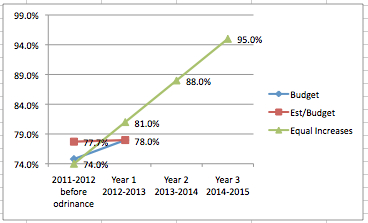
In late 2010, Transit Action Network initiated and led a campaign to restore transit funding from the Public Mass Transportation Fund (1/2-cent city transportation sales tax).  We were successful in getting Ordinance 100951 passed. The Ordinance increases the share of revenue going to the Kansas City Area Transportation Authority back to the 95% level it received before voter approval of the 3/8-cent transit sales tax in 2003. Full implementation to 95% is due in the budget for FY 2014-2015, beginning May 2014.

In 2010,  KCATA was receiving only 74% of the ½ cent sales tax. The ordinance has three years to be fully implemented.  From 74% to 95% is a 21% increase. Over the three years of implementation, that would be 7% per year if increased in equal amounts.

One year has passed and KCATA currently receives only 4% more than in the pre-100951 budget. The city is working on the second budget (FY 2013-2014) and we would like to see KCATA receive closer to 88% of the Total Available Resources. That would be 14% higher than when the ordinance was enacted and would represent a more consistent phased increase.

We recently sent a letter to the Mayor, City Council and City Manager asking for the upcoming budget to move significantly closer to the May 2014 goal, in conformance with Ordinance 100951. (2012 Letter and copy of Ordinance to Mayor and Council)

KCATA Share of the Public Mass Transportation Fund

Graph based on Public Mass Transportation Fund budget page for FY 2012-2013

Percentage equals Pass Through Payments1 times 100 divided by Total Available Resources.

1This is the amount KCATA receives, see budget page.

Follow us on Twitter Twitter.com/transactionkc

Join us on Facebook Facebook.com/TransitActionNetwork

Posted in Local Transit Issues | Tagged: , , | Leave a Comment »

Sanders Renews Commitment to Public Transit

Posted by Transit Action Network on November 5, 2012


County Executive Mike Sanders left it until the end in his annual State of the County Address last Friday, but he left no doubt that he’s still committed to public transit.

Speaking to a standing room only crowd in the Greater Kansas City Chamber of Commerce Board Room at Union Station, Sanders spoke with pride of guiding principles for his administration, one of which is that we don’t borrow from the promise of the future to meet the needs of today.  Jackson County balanced the budget without raising taxes, he said, and is one of only six Missouri counties with a Double-A bond rating.

In introducing Sanders, Kansas City Mayor Sly James spoke optimistically of the election currently underway to fund a Downtown Streetcar.  Construction begins next year, James said, with fare-free operation beginning in 2015.  Though he didn’t say so explicitly, the Streetcar project might not be underway at all were it not for Sanders’ leadership on regional transit.

An introductory video emphasized the close working relationships between Jackson County and the mayors of the county’s principal municipalities.  Transit, specifically plans for a comprehensive regional transit system, was cited as one of the areas of common agreement.

Sanders invoked inspiring imagery a number of times during his speech.  We face new and serious challenges, he said, but America was built on courage and imagination, not fear.

Sanders spoke of expansion of the existing County trail system, and said extension of that system into Kansas City would begin next year with strong support from Kansas City Councilwoman Cindy Circo.

Finally he got to transit.

We meet in an iconic structure, he said, one that illustrates the power of transportation to connect us.  No initiative has the potential to shape our future more than to build a modern, efficient public transit system.  Sanders compared building a comprehensive transit system in Jackson County to the Interstate Highway System that President Dwight D. Eisenhower launched in 1955.

Such a system is needed to meet Jackson County’s transportation needs, he said, and it must be our next great enterprise to build a system of rail, buses, and trails so future generations will have greater choice in how they get around.  Young people want and demand rail and other public transit options.

Sanders also cited a recent Brookings Institution report that ranked Kansas City 94th out of 100 urban areas in its ability to provide its citizens access to jobs and other opportunities by transit.

The process of constructing a World Class public transit system is complicated, Sanders said — an obvious reference to current discussions with the freight railroads over use of their tracks for getting commuter trains to Union Station.

We need to invest the time it takes to plan a great system, he said.  It’s not about getting transit done fast, it’s about getting it done right.

Through an unprecedented collaboration, Jackson County Mayors are in agreement, and are speaking with one voice.  A solution on transit is within reach, and it’s clear that Mike Sanders’ commitment is still there.

On reflection, it seems notable that Sanders did not make any specific reference to commuter rail.  Nor did he mention a possible target date for submitting a Trails and Transit funding measure to the voters, perhaps because there are a lot of details yet to be worked out.  (See our blog post, Jackson County Transit Studies Update – Our Current Assessment)  Speaking with reporters afterward, he mentioned August or November next year as possible dates.  That’s consistent with information we’ve had for several months.

Posted in Local Transit Issues, Rail, Regional Transit Issue | Tagged: | Leave a Comment »

KCATA Route 175 on Metcalf Avenue?

Posted by Transit Action Network on October 24, 2012


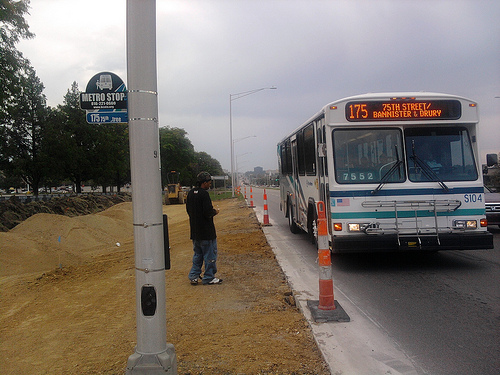
Metro Route 175

Transit Trivia: How many places along Metcalf Avenue can you find a posted bus schedule?

Did you know that KCATA (The Metro) operates a route deep into Johnson County? Route 175 has six daily round trips that go south from Ward Parkway Shopping Center (88th and State Line) along State Line, 95th Street, and Metcalf to the Sprint Campus, Menorah Hospital, and St. Luke’s South Hospital. There are about 80 riders daily. (One person making a round trip counts as two riders.)

In this view, the second northbound afternoon Route 175 trip stops to board another rider (plus your humble snapshot taker) at the southeast corner of 95th and Metcalf.

Note the bus stop sign, and the frame for the bus schedule below it on the light pole. This schedule, along with one across the street on the southwest corner of the intersection, are the only places we know of where one can find a bus schedule posted along Metcalf.

That’s the answer to the trivia question: TWO.

What irony that the only bus schedule along Metcalf — the street that’s being prepared for Johnson County’s “Connex” service next spring — is provided by KCATA, and it’s only about their Route 175.

Oh — about all that dirt: This is the site of one of the new Connex bus stops. It’ll have a shelter and a digital sign that’ll tell you when the next bus arrives. Off to the left is the Metcalf South Shopping Center. The JO’s park-and-ride lot will be relocated to this corner from its current location on the east side of the shopping center next to the Glenwood Arts Theater. Another Connex stop and shelter will be constructed on the west side of Metcalf, just south of 95th Street.

Posted in Local Transit Issues, Regional Transit Issue | Tagged: , | Leave a Comment »

Jackson County Transit Studies Update – Our Current Assessment

Posted by Transit Action Network on October 15, 2012


There was no surprise when Jackson County announced that it would not put a transit tax measure on the ballot this November. There are still too many unknowns, and a comprehensive package will take more time to develop. Better to do this right than fast.

One of the big unknowns is location of a downtown terminus for commuter rail. The Jackson County Commuter Corridors Alternatives Analysis for the I-70 and Rock Island corridors, which has been underway  for over a year, is currently on hold. The County would like to move the downtown terminus from Third and Grand, the option presented to the public in April, to Union Station. That’s good, because nearly everyone really wants commuter trains to go there, and that’s the location identified for commuter rail in Kansas City’s comprehensive plan, FOCUS.

The sticking point has been getting the Kansas City Terminal Railway to agree to allow commuter trains on their tracks.  These are the tracks that Amtrak trains already use.  Once the Terminal (and its owners, primarily the Burlington Northern Santa Fe and Union Pacific) agree they are open to that possibility, a capacity analysis will have to be done to determine if commuter trains can be sandwiched in among all the freight and Amtrak trains.

Actually, it’s a little more complicated than that: whereas there’s some flexibility in freight train schedules, frequent delays for a commuter train could lead to loss of riders and failure of the whole commuter rail endeavor, so the railroads would have to commit to a pretty exacting schedule for the commuter trains.  As of this writing, a capacity analysis has not yet been done.

For commuter rail into Union Station to work, the railroads have to:

  • agree in principle that commuter trains on their tracks would be OK
  • complete a capacity analysis to determine that it’s feasible, and
  • develop detailed cost estimates.

Meanwhile, Jackson County continues to work on more-detailed cost estimates for getting trains to a terminal at Third and Grand.

While that’s going on, the US 71 Corridor Transit Study is proceeding in the first phase of its evaluation process.

In addition to studying the I-70, Rock Island, and US 71 corridors to identify a locally preferred alternative in each, Jackson County is fleshing out the rest of a county-wide transit and trails plan to take to the voters. 

That plan would:

  1. Fill in many of the bus transit needs in the county. All rail systems need a robust bus system to support them and Jackson County doesn’t have that outside of Kansas City, Missouri. MARC’s Smart Moves transit concept is the basis for filling in the missing transit links in the county, and Transit Action Network advocates Janet Rogers and Ron McLinden are working with a team that includes Jackson County, Kansas City, KCATA, and consultants to help define the transit part of the package.
  2. Develop a plan to connect and complete a Jackson County trails system. No longer would there be “trails to nowhere,” but “trails to everywhere.” The County has been working with trail and bike advocates, using MARC’s MetroGreen plan as the basis for the trails component.

Assuming voters approved a one-cent sales tax  — nobody at the County will verify that this is the target amount — that would raise only about $80 million per year. Given that limitation, the County will have to make some tough choices because they can’t afford to do everything that’s currently being considered.

Right now we consider the following as likely components of a trails and transit package to be submitted to the voters:

  • Probably one commuter rail line using the Kansas City Southern tracks in the I-70 corridor
  • Implementation of many of the service components of the region’s Smart Moves transit plan
  • Bus Rapid Transit (MAX style service) on Prospect
  • Transit connections linking municipalities throughout the County
  • Upgraded Express Bus Services in all three major corridors (including I-70, even if commuter rail is developed in that corridor)
  • Build out of a complete network of trails as envisioned in MetroGreen.

We anticipate seeing such a package submitted to the voters sometime in 2013, though perhaps not until the second half of the year.

Posted in Local Transit Issues, Rail, Regional Transit Issue, Transit Studies | Tagged: , , , | Leave a Comment »

Registration Open -12th Annual New Partners for Smart Growth Conference, February 7-9, 2013

Posted by Transit Action Network on October 12, 2012


Registration is now open for the 12th Annual New Partners for Smart Growth Conference, February 7-9, 2013 in Kansas City, MO.

The multi-disciplinary program includes over 90 plenaries, breakouts, workshops and trainings, and will feature cutting-edge policies and programs, projects, best practices, as well as strategies and implementation tools that address the challenges of implementing smart growth development principles.

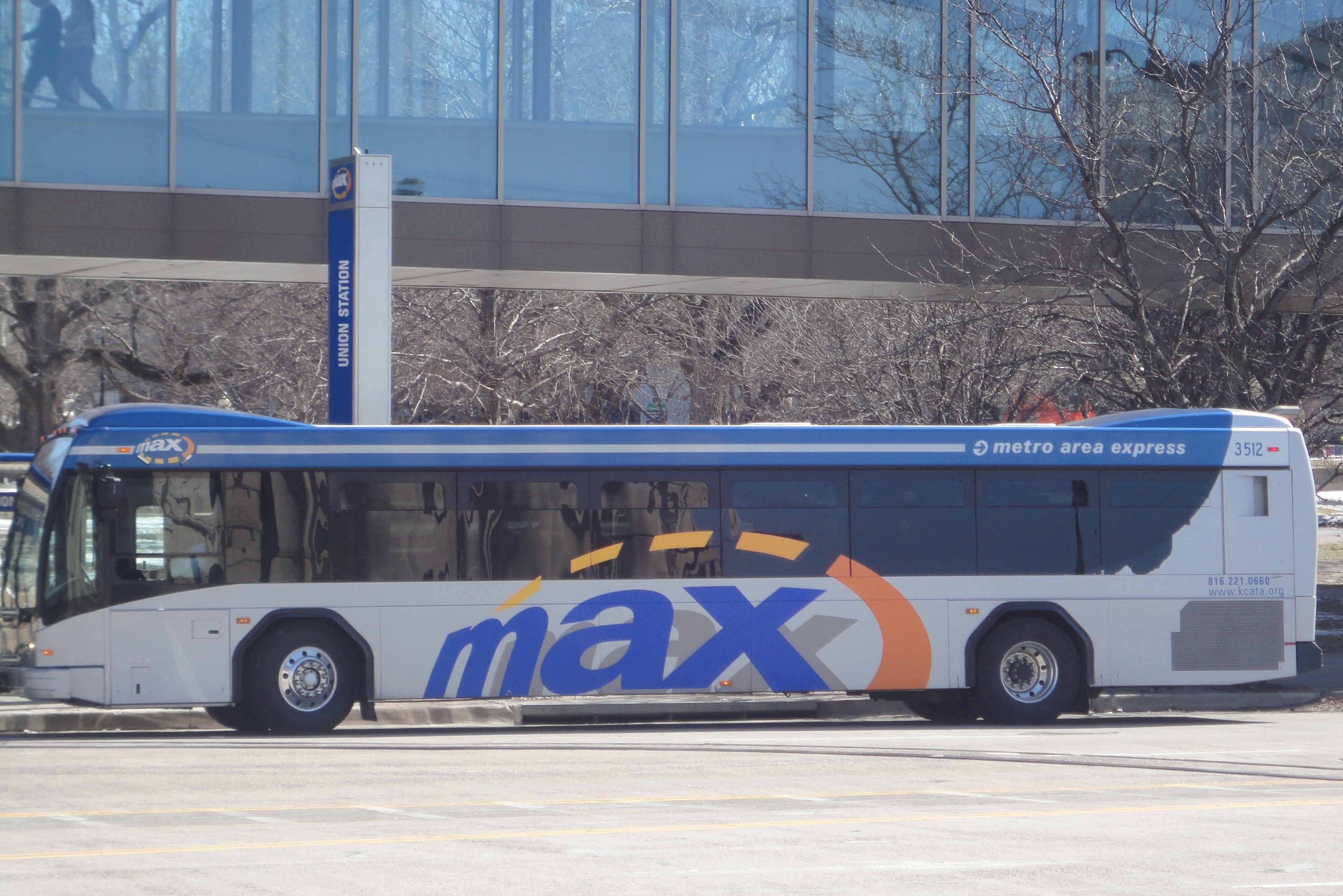
KCATA, FTA, and Transit Action Network are sponsoring the tour  Low Cost/High Benefit BRT – The Kansas City MAX. Be sure to attend the conference, sign up for this tour on the MAX and learn how to implement a MAX system, including equitable development, environmental justice issues, planning, design, engineering and funding strategies.

Other conference features include:

  • 15 tours of local model projects;
  • Coordinated networking opportunities;
  • Professional Continuing Education Accreditation;
  • Additional optional pre-conference workshops and tours;
  • So much more!

The official hotel room rate for our group is $119 (single/double) until January 14, 2013 at 5:00pm CDT. After that date, the group rate is subject to availability and is not guaranteed.

To make your reservations at the Marriott Kansas City Downtown Hotel, call 1-877-303-0104 and indicate that you are attending the New Partners Conference. You can also make your New Partners Conference hotel reservations online through  Marriott Kansas City Downtown Hotel Reservations. 

Visit www.NewPartners.org  for more details on the conference program, tours, special events and opportunities, featured speakers, travel and hotel information, local attractions, and to REGISTER NOW!

Posted in Events, Local Transit Issues, National Transit Issues | Tagged: | Leave a Comment »

Transit Riders Get More Saturday Seats On Popular KCK Route

Posted by Transit Action Network on October 5, 2012


Loretta Jackson-Cowans, Kathy Darcy and Janet Rogers testified at the UG budget hearing in July 2012

There’ll be fewer people standing on Route 101 Minnesota / State Ave. buses beginning October 6.  That’s because the Metro will use bigger buses on Saturdays.

Route 101 buses run less frequently on Saturdays — hourly instead of every 30 minutes — and many passengers were having to stand as they did their weekly errands for grocery shopping and other purposes.  Add strollers and shopping carts to the riders, and things were getting pretty crowded.

Transit Action Network advocates Loretta Jackson-Cowans, Kathy Darcy, and Janet Rogers testified about the overcrowding at the Unified Government’s budget hearing on July 30, 2012.  That testimony, added to the fact that this route gets the most complaints from Wyandotte County riders, convinced the Commissioners to provide more money for 40-passenger buses instead of 23-passenger buses on Saturdays.  Speaking up really does matter.

Transit industry standards consider 125% of seated capacity as the maximum desirable load on buses.  When loads routinely exceed that level, the condition needs to be remedied. For a 23-seat bus, 29 passengers is the upper level, and that level was being exceeded regularly.

Not only is overcrowding a safety hazard for riders, but it has a dampening effect on ridership as people are discouraged from riding due to sardine-can-like conditions.

This “problem” is actually a sign of success. It shows how popular and important Route 101 is, and that it certainly deserves to be upgraded to the “Connex” service next year. In the meantime,  Commissioners of the Unified Government of Wyandotte County agreed to upgrade to large buses, and we are pleased to see the upgrade happen the very next quarter.

TAN is glad we could help, and we appreciate the data provided by Metro staff.

Enjoy the extra seats!

Follow us on Twitter: https://twitter.com/transactionkc

Like us on Facebook: http://www.facebook.com/TransitActionNetwork

Posted in Local Transit Issues | Tagged: , | Leave a Comment »

Route 142 – 3rd and Grand and Zona Rosa? Check Out All the Metro Changes

Posted by Transit Action Network on September 27, 2012


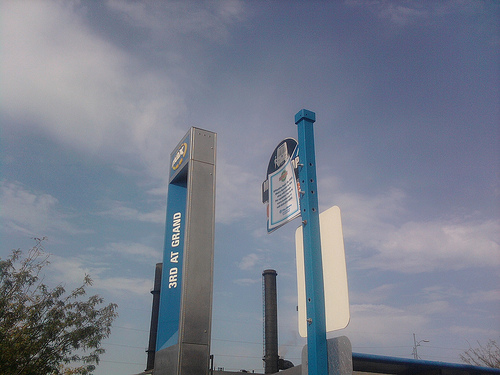
Did you see the notice taped over the bus stop sign at the 3rd and Grand MAX Station? It’s evidence of good things to come. Really good things.

Beginning on Sunday, September 30, KCATA Route 142 – North Oak will change. Here’s what’s in store:
– Route 142 will operate seven days a week.
– Hours of operation will be extended into the evening.
– Buses will run more often during much of the day.
– Buses will stop at the 3rd and Grand park-and-ride lot / MAX Station for direct connections to Main Street MAX and access to Bike-Share.
– Buses will operate both north and south on Grand, making it easier to find your bus for the return trip.
– Buses will continue to go south through Crown Center to 27th and Grand.
– And finally — Ta-Dah! – Route 142 will go all the way up to Zona Rosa.

Put it all together and you have the makings of an almost guaranteed surge in ridership.

This change to Route 142 represents a significant improvement in transit service for the Northland — maybe the most significant ever!

What’s more, North Oak is one of the transit corridors in the region identified for major improvements with money from both the TIGER Grant (2009) and the more recent Creating Sustainable Places program.

What’s not to like?

Big changes are happening on the Metro this Sunday as KCATA rolls out more of the route and schedule changes resulting from the Comprehensive Service Analysis. Check out all the changes to see how they affect you.  Metro Changes.

For further information about Route 142:
Bulletin from KCATA
www.kcata.org/rider_bulletins/142-north_oak_adds_zona_ros…
New route map
www.kcata.org/images/uploads/142mwk.gif
New schedule:
www.kcata.org/images/uploads/142.pdf

Posted in Local Transit Issues, Regional Transit Issue | Tagged: | Leave a Comment »

Attend the KC Downtown Streetcar Authority Meeting – Sept 26

Posted by Transit Action Network on September 25, 2012


The KC Downtown Streetcar Authority meetings are open to the public. Feel free to attend and hear the discussions.

Next meeting:

When: Wednesday, Sept. 26, 2012, 11-12:30 p.m.
Where: Helzberg Auditorium, Central Library, 10th and Main, Kansas City MO.
The Authority will start discussions about the fare structure and choosing an operator.

Posted in Events, Local Transit Issues, Rail | Tagged: | Leave a Comment »

Metcalf Connex – I-435 and Metcalf

Posted by Transit Action Network on September 24, 2012


This photo looks northeast from the southwest corner of I-435 (EB off-ramp) and Metcalf.

Putting bus service on Metcalf — much less a premium service such as Johnson County Transit’s pre-BRT* “Connex” service — is a challenge.

There is no sidewalk on the west side of Metcalf between 107th and 110th. Sidewalks are under construction along other segments of Metcalf (including the east side of Metcalf through this interchange), but there’s no evidence of it here. Not yet, anyway. Moreover, there’s no evidence — not yet, anyway — that there will be a crosswalk with pedestrian signals. This off-ramp has five lanes — three for left turns and two for right. The crossing distance is roughly 90 feet, 22.5 seconds at the 4-feet-per-second standard walking speed used by traffic engineers.

For transit to work there need to be sidewalks along both sides of the transit street. That’s especially true for a BRT route where stops are a half-mile or a mile apart.

In addition, there need to be good sidewalk approaches along cross streets, in addition to links to buildings that front on the transit street itself.

Those are tall orders for a part of our region that was built with moving cars as the number one guiding design principle.

This view looks almost empty but even at 2:51 in the afternoon there’s a LOT of traffic.

And signal cycles are long: two minutes or more. Imagine waiting to cross Metcalf to catch your bus. You see it approaching in the distance, but by the time you get a WALK light and get across the street your bus has already passed. Next bus in 30 minutes, if you’re lucky.

There’s no question that transit improvements being made along Metcalf using the federal TIGER (Transportation Investments Generating Economic Recovery) grant awarded to JCT in 2009 will make the corridor look more attractive, and will actually raise the visibility of transit on Metcalf. Attractive bus shelters with real-time schedule signs will be placed at stops, and traffic signal priority (TSP) will be installed to help buses get through signalized intersections quicker.

Still, it’s going to be tough to give Metcalf the look and feel of a transit street.

For transit to work there, Metcalf needs to be totally re-conceptualized and rebuilt south of 87th Street.

Overland Park has its work cut out for it.

Related photos:
Site of SB Connex stop at 110th and Metcalf.
www.flickr.com/photos/58867268@N03/8010260167/

Preparation for NB Connex stop at 110th and Metcalf.
www.flickr.com/photos/58867268@N03/8010267924/

*BRT = Bus Rapid Transit’

Posted in Local Transit Issues | Tagged: , | 2 Comments »

Attend Johnson County Transportation Council Meeting Sept. 18 – 5:30 pm

Posted by Transit Action Network on September 14, 2012


The Johnson County Transportation Council meeting will discuss the REVISED proposed eliminations and reductions to service, effective Jan 2, 2013.  A public comment section is on the agenda. Please attend and make your feelings known about the proposed changes. The council changed its regular meeting time in response to comments received about the service reductions. JCTC wants to hear from you.

Johnson County Transportation Council Meeting

Where: Sylvester Powell Community Center
6200 Martway in Mission
Kansas 66202
 
When: Sept 18th @ 5:30 pm to 7:30 pm

Meeting packet agenda JCTCpacket20120918

Revised Proposal for Eliminations and Reductions JCTC20120814ServiceReductionRec

Previous blog article JCT Releases Revised Proposal for Cuts – Save The JO

Posted in Events, Local Transit Issues, Regional Transit Issue | Tagged: , | Leave a Comment »

Attend Forum on Transit at All Souls Unitarian Universalist Church – Sunday, Sept 16 at 10am

Posted by Transit Action Network on September 14, 2012


The Sunday morning Forum at All Souls Unitarian Universalist Church is well-known and respected as a great place to learn about and discuss major issues in the community.  The All Souls mission for the Forum is “to afford a platform for the discussion of significant issues, especially those which involve ethical values in the contemporary world.”

The Forum is free and open to the public. This Sunday’s presentation is:

Where Do We Go From Here?

Public transit in the KC metro area and the controversies surrounding it

by Janet Rogers, co-founder of Transit Action Network

 All Souls Unitarian Universalist Church
4501 Walnut Street
Kansas City, Mo. 64111

Forum starts at 10 a.m.

Janet will provide an overview of the current state of transit in the KC Region, the near term vision for transit including the Downtown Streetcar and the Jackson County’s comprehensive transit vision, controversies plaguing transit and a long-term perspective on where we go from here.

According to KKFI 90.1FM radio: “The All Souls Unitarian Universalist Forum, Kansas City’s longest ongoing conversation, has offered a platform for the discussion of significant issues since 1943. Guest speakers typically focus on issues of political, social justice, moral, educational and artistic significance. Each presentation is followed by questions and discussion.”

KKFI 90.1FM broadcasts the forums on Thursdays at noon.  The broadcasts are several weeks behind the actual presentation.

Forum, September 16, 10 a.m., Bragg Auditorium

Posted in Events, Local Transit Issues, Regional Transit Issue | Leave a Comment »

US 71 Transit Study – Video of Open House

Posted by Transit Action Network on September 10, 2012


The Jackson County US 71 Transit Study, an Alternatives Analysis, started in June and is the third transit corridor to be studied as the County works to complete a transit package to put before voters. Completion is scheduled for the end of the year.

There have been two Stakeholder meetings (Janet Rogers and Mark McDowell both represent TAN) and a public meeting. Until a final decision has been made for locally preferred alternatives in the three corridors, nothing can go forward.

The US 71 corridor originates in downtown Kansas City, Missouri and extends south of the downtown area, terminating in Belton, Missouri. The corridor generally parallels U.S. 71 crossing Kansas City (MO), Grandview and Belton and is being evaluated as a potential addition to the Jackson County Commuter Corridors Alternatives Analysis, a transit study that has been in progress since 2011, which consists of the I-70 corridor and the Rock Island corridor.

This corridor is very congested and portions of US 71 between 51st and 75th are particularly slow. Current transit service on U.S. 71 and parallel service on Prospect provide transit access for the area, but scheduled travel times are almost double the travel time of the automobile.

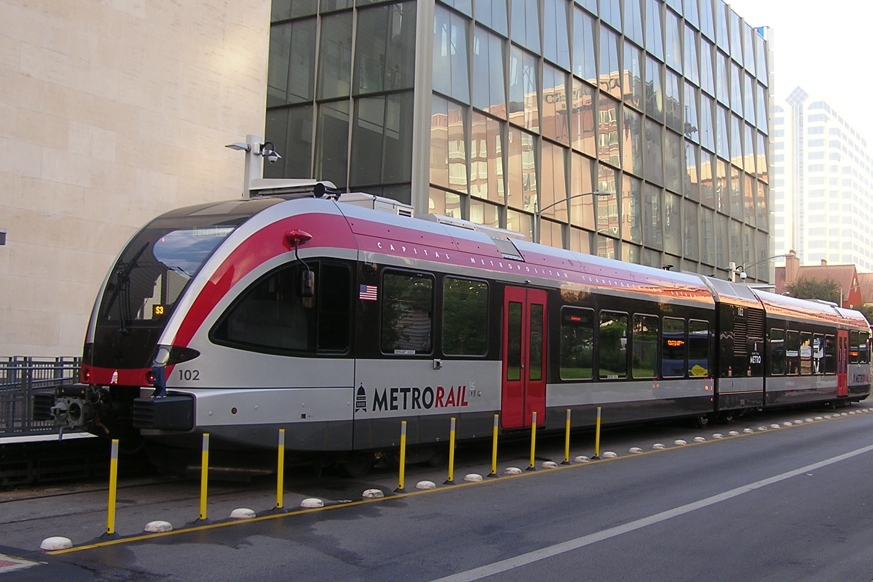
The US 71 corridor study is benefiting from the work already done in the other corridors. This study is considering Express Buses, Bus Rapid Transit (BRT), streetcars and commuter rail. Just a reminder that the commuter rail is not electrified light rail. It is a diesel vehicle, Diesel Multiple Unit (DMU), which operates on existing freight lines or new tracks.

The project team, Jackson County, MARC, KCATA and Kansas City, Missouri  and the consulting team, Parsons Brinckerhoff, are all the same as the previous study.

The study is in Phase I, which provides the purpose and needs statement and does an initial evaluation of the alternatives to decide which ones will go through to Phase II.

The first two alternatives advance automatically to Phase II

1. NO Build  – do nothing plus

  • all capital improvements identified in the fiscally constrained MARC 2040 Long Range Transportation Plan (LRTP) that will be implemented by 2035.
  • the existing bus network augmented with the recommendations listed in the KCATA Comprehensive Service Analysis Key Corridor Network.

2. TSM (Transportation Systems Management)

Everything in No Build plus

  • capital improvements and bus network enhancements.
  • an expansion of KC Scout Intelligent Transportation Systems.
  • New park and ride lots
  • Capital bus enhancements on U.S. 71 (such as bus on shoulder), which will be identified and evaluated as part of Tier 2.
  • New intermodal transfer point in vicinity of Hillcrest and Bannister Road.
  • Seven U.S. 71 / Prospect BRT station pairs.
  • Extension of local bus service along Prospect to Bannister Road and Blue Ridge.
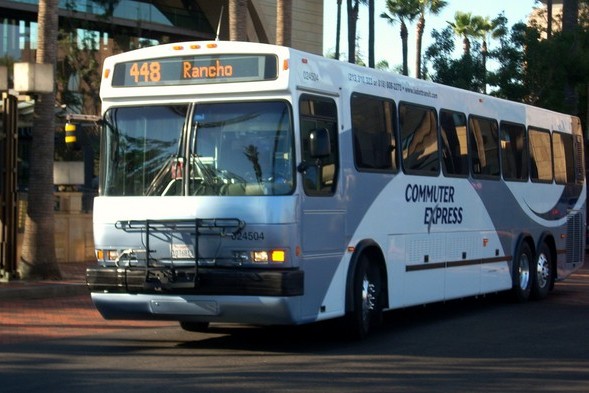
  • Extension of Express Bus service (Route #471) from current terminus Point at U.S. 71 & Red ·  Bridge Road to U.S. 71 & M-150. The extended service would serve park and ride lots at U.S.
  • 71/M-150 and at Truman Corners Shopping Center. Number of trips would be increased from 5 AM and 5 PM to 8 AM and 8 PM.

Three additional alternatives to be evaluated for advancement to Phase II

Alternative 1: Bus Rapid Transit (BRT)

  1. Two alignments are anticipated for the BRT alternative–a Commuter BRT on U.S. 71 and an Urban BRT on Prospect.
    1. US 71 Commuter BRT connects M-150 in Grandview with the 10th and Main Transit Center.
    2. Prospect Urban BRT connects Bannister Road in south KC with the 10th and Main Transit Center.

Alternative 2: Enhanced Streetcar Alternative

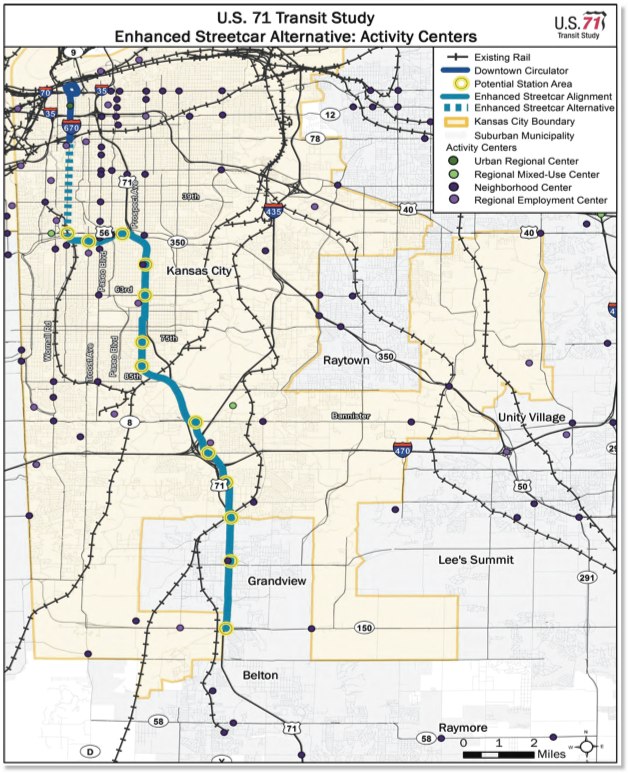
The enhanced streetcar would serve a third phase of the KC streetcar system (phase II would be to the Plaza). The streetcar would travel on the west side of US 71 and ends at M-150. A feeder bus network would also be a part of this alignment.

We expect the streetcar alternative to be eliminated because it is so expensive and probably wouldn’t qualify for federal funds to help us pay for it. We expect the projected ridership to be too low to make the line cost-effective by FTA standards. If it is advanced to Phase II it will be because the partners want to do the cost and ridership analysis for future reference.

Alternative 3: Diesel Multiple Unit Alternative

The alignment for the DMU Commuter Service South Line runs from the Jackson County Line to Leeds Junction. South of Leeds Junction the rail travels with limited stops on KCS track to its destination near M-150 in Grandview. North of Leeds Junction, it shares a common line with the Rock Island Corridor alternative, and farther north those lines combine with the I-70 corridor into downtown.  The two possible alignments for the DMU Commuter Service Common Line into downtown run from:

a. Leeds Junction to the River Market

b. Leeds Junction to Union Station via the Trench

The DMU alignment crosses nearly 80 bridge structures. About 20 of those would require improvement of some kind, up to and including replacement.

The stations along this alignment are limited due to various complications, including physical challenges and the lack of population and employment density.

The U.S 71 corridor has a large low-income population. The ability to provide improved access to work opportunities is an important goal of the enhanced transit system.

There will be additional public involvement as the study progresses.

US71 – combined alternatives – Click to Enlarge

US71 – BRT -Click to Enlarge

US71 – Streetcar- Click to Enlarge

US71 – DMU – Click to Enlarge

For more detail, review the information from the public open house materials and fill out the comment form.

http://www.kcsmartmoves.org/projects/us71transitstudy-openhouse1.aspx

Posted in Local Transit Issues, Rail, Regional Transit Issue, Transit Studies | Tagged: , , , | Leave a Comment »

KC Downtown Streetcar And The Funding Election

Posted by Transit Action Network on August 29, 2012


If you live in the newly created downtown Transportation Development District (TDD) get ready to pick up you next ballot to vote for funding the downtown streetcar. The TDD board decided on another mail-in election, just like the first election.

Click to enlarge TDD

The second election consists of two questions.

The first question is for the 1-cent retail sales tax.

The second question is for special assessments on property:

  • Residential property — 70 cents per $100 of assessed value
  • Property for non-profits — 40 cents per $100 of property assessed between $300,000 and $50 million
  • Commercial property — 48 cents per $100 of assessed value
  • Municipal (city) property — $1.04 per $100 of assessed value
  • Commercial surface parking lots — fee of 15 cents per space per day

You need to vote yes on both questions. Both questions have to pass for a successful outcome.

Important dates and times:

  • August 31 @ 8 am  – Ballot request period starts. Request ballot from Jackson County Courthouse (or print it from the Judge’s Ruling document below)
  • October 2 @ 5 p.m. Deadline to return completed ballot request and proof of voter registration
  • October 30 – Ballots mailed
  • December 11 @ 5 pm – Ballots due at Jackson County Courthouse

Attend Streetcar Neighbors Ballot Application Breakfast this Friday, August 31 at 7 a.m. at LATTeLAND – 12th St.

The TDD Board consists of Mayor Sly James, Port Authority Chair George Wolf, residential property owner Matthew Staub, and commercial property owner Jeff Krum (CFO of Boulevard Brewing Company). Mayor James and Matthew Staub are co-chairs of the TDD Board.

The Kansas City Streetcar Authority, formed on Aug. 3, consists of downtown stakeholders and city appointees. It’s role is contracting streetcar operations and consulting on remaining engineering and construction activities with Public Works.

As soon as the second election is final, the city can issue bonds and start construction. Operation is planned for 2015.

Judge’s Ruling: KC Streetcar Order for Funding Election

The ballot application is Exhibit B of the Judge’s Ruling. Print, fill out and return the ballot request by 5 p.m. on October 2, 2012 along with proof of voter registration to:

Jackson County Court Administrator
Attn: TDD Ballot Application
415 East 12th Street, Third Floor, Room 303
Kansas City, MO 64106

Proof of voter registration can be a current copy of your voter registration card or go to www.kceb.org and print proof of registration using the “Check Your Voter Status” box.

Posted in Action, Events, Local Transit Issues, Rail | Tagged: | Leave a Comment »

JCT Releases Revised Proposal for Cuts – Save The JO

Posted by Transit Action Network on August 28, 2012


Johnson County Transit (JCT) has released a Revised JCT Service Reductions Aug 14,2012 report for eliminations and reductions to its transit system.

Summary of the revised proposal:

Eliminate five routes (instead of nine)
Reduce/combine service on the four other routes that were proposed for elimination
Make additional schedule modifications on four other routes based on comments and service efficiencies.

Here are the original 9 routes slated for eliminations with some of our comments. Review the JCT report for additional information. Keep in mind that JCT is still reviewing the routes and could make more changes.

Routes Originally Proposed for Elimination

Three Routes Eliminated Totally
Route 676-P – Paola/Spring Hill/Olathe Eliminating this route and Route 816 will leave these communities and seniors without any transit. The Special Edition does not operate in Spring Hill and Paola.
Route 810 – DeSoto FlexRide This change will leave this community and seniors without any transit. The Special Edition does not operate in DeSoto.
Route 816 – Spring Hill Shuttle Eliminating this route and Route 676 will leave this community and seniors without any transit. The Special Edition does not operate in Spring Hill.
Eliminate 667-R and 669-I and combine with 546-D into one new route
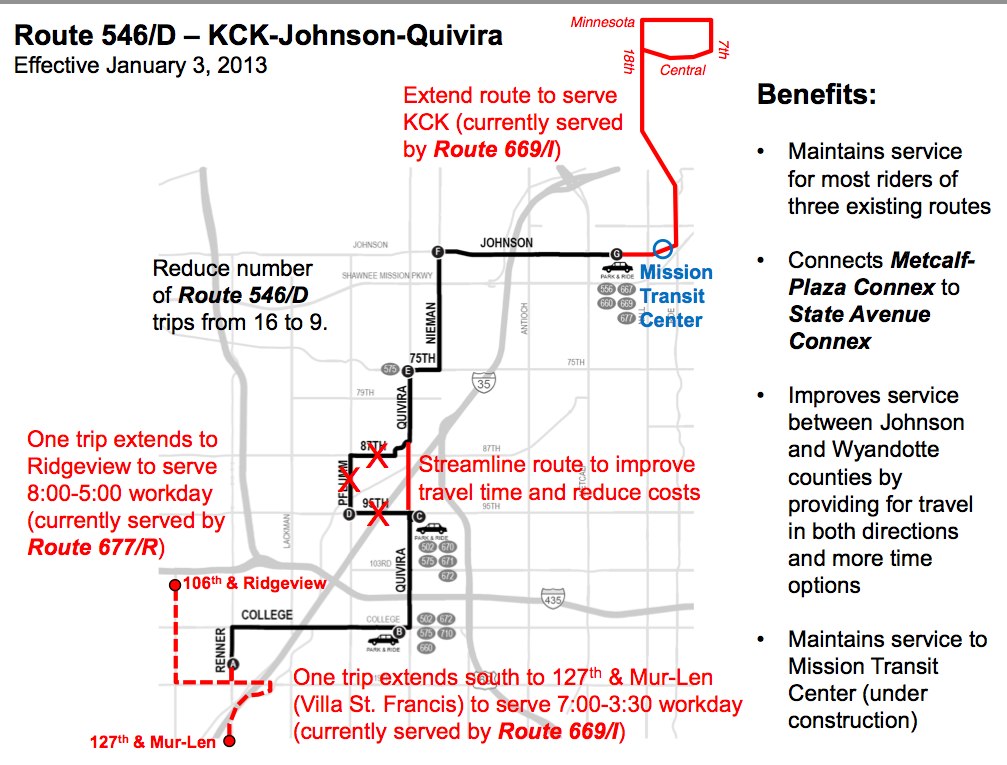
Route 546-D – Johnson/Quivira, Route 677-R – Downtown/Olathe, Route 669-I – KCK/Lenexa/Olathe Eliminate current routes I, R and D but combine them into a new Route 546-D. The new Route 546-D would have only 9 trips instead of the current 16. The northern end would be in KCK. The southern end is usually at 116th and Renner. See the proposed map. One trip extends south to 127th & Mur-Len (Villa St. Francis) to serve 7:00-3:30 workday (currently served by Route 669/I) One trip extends to Ridgeview to serve 8:00-5:00 workday  (currently served by Route 677/R
Keep routes instead of eliminating them; make significant service reductions.
Route 66-E – Nall/Downtown – Reduce from 4 to 2 trips This reduces service between Johnson County and Wyandotte counties. This is the only JO service that goes to KU Med. Routes with only one morning and one evening trip are bound to fail. The national transit-consulting firm Nelson Nygaard recommends at least 6 trips (3 each way) to make a successful commuter route. If they must reduce service, JCT needs to consider other options in order to keep the four trips.
Route 672-M – JoCo/Downtown Midday – Keep but eliminate Metcalf portion of route The route would travel from Mission to OPM on Shawnee Mission Parkway, I-35, and US-69, instead of using Metcalf and 95th. This re-routing should save 10-15 minutes per trip. Transfers to Metcalf destinations can be made via 856 in Mission. South of Oak Park Mall, the route would remain unchanged. Downtown employees who want additional midday flexibility could take MAX to the Plaza and transfer to 856, or to Waldo and transfer to 875.
Route 812 JO Flex– Reduce from 3 days to 2 days This change is better than eliminating the route.

Transit Action Network knows that JCT is trying to combine routes and provide as much transit as possible for its current riders given the budgetary restrictions and instructions from the County Commissioners. We are also aware that unless the County makes significant budget changes, all of these routes and more may be eliminated in 2014.

click to enlarge

Below is the Commission’s transit priority list that JCT is directed to implement over the next two years as a result of a reduction in federal and state funds.

The Board of County Commissioners Transit priorities (in order of importance):

  • Protect the most vulnerable county residents by maintaining Special Edition and SWIFT services.
  • Support TIGER investments by maintaining service on the Metcalf and Shawnee Mission Parkway corridor
  • Maintain I-35 Xpress (Bus on Shoulder Routes)
  • Maintain K-10 Connector
  • Continue Local Services and Local Links

Our concern is the county’s lack of commitment to developing a full service transit system. In terms of transit, Johnson County thinks like a small city instead of a big wealthy county. Blue Springs, Missouri has a population of slightly over 50,000 people. For transit it normally considers an OATS bus for seniors and the disabled and a few commuter express buses as sufficient, although Blue Springs is  working very hard to get commuter rail. Johnson County, with a population of 544,000, has stated a position that supports a similar low level of bus transit, with one exception. They want to keep the new Metcalf/Shawnee Mission Parkway and 75th Street/Quivira CONNEX routes. So do we, but these routes need to be paid for with new county funds instead of transferring funds from the current transit system.  Johnson County accepted a $10.7 million TIGER grant from the federal government for improvements along the M/SMP corridor, and they would have to return the money if they cancelled these routes. Yet the county refuses to add new money to the transit budget to replace the three-year start up money the federal government gave them for operating expenses on these routes.

Board of Commissioners Chairman Ed Eilert complains about the cost per rider and farebox recovery ratio on some of these routes, yet he knows that the main CONNEX service has far worse performance numbers than nearly all of the regular routes they are proposing to eliminate, such as Routes 669-I, 667-E, 672-M and the JO Flex.

Routes originally proposed for elimination Example: Farebox recovery ratio
672-M 17%
669-I 15%
667-E 14%
JO Flex 11%
Major CONNEX Route – protected
556 Metcalf/Plaza 9%
856 Metcalf/Plaza Flex 7%

The disingenuous nature of the Commission’s priorities is very concerning. Providing transit for seniors is at the top of their list, yet eliminating the local service in Spring Hill, Paola and DeSoto will leave their elderly populations stranded once again, since the Special Edition bus doesn’t service those areas.

The county won’t eliminate all of the proposed routes at this point in time or they might be in violation of Title VI of the Federal Civil Rights Act. The Act says if you receive federal funds, you can’t eliminate service to minority and low-income populations in a discriminatory manner. Of the original proposed eliminations, routes 546-D – Johnson/Quivira, 667-E – Nall/ Downtown, and 669-I – KCK/Lenexa/Olathe have significant service to areas with higher percentages of minority and low-income populations. These routes would be eliminated based on the Commission’s directions to JCT.

You still have time to comment to the Commission on the changes being proposed. Final BoCC action is planned for October 18.

Contact Johnson County Board of County Commissioners

  1. Phone: 913-715-0430
  2. Email contact form: http://bocc.jocogov.org/webform/contact-us
  3. Chairman: Ed Eilert (913) 715-0500
  4. District 1: Ed Peterson  (913) 715-0431
  5. District 2: Jim Allen  (913) 715-0432
  6. District 3: David Lindstrom (913) 715-0433
  7. District 4: Jason Osterhaus (913) 715-0434
  8. District 5: Michael Ashcraft (913) 715-0435
  9. District 6: Calvin Hayden  (913) 715-0436

JCT Tentative Timeline –

• Joint JCTC/BoCC meeting on August 30, 2012, 11 am, Board of County Commission’s hearing room on the third floor of the County Administration Building in Olathe
• Present final recommendations at JCTC meeting on September 18, 2012
• Submit JCT/JCTC recommendations to BoCC on October 4, 2012.
• Agenda Review: October 11
• Final BoCC Action: October 18
• Final changes posted the week of October 22, 2012
• Changes will begin operation on January 2, 2013

The Johnson County Transportation Council (JCTC) meeting on September 18 will be held at 5:30 pm at Sylvester Powell: 6200 Martway, Mission, KS so that more people can be present to hear the presentation of the final recommendations and hear the discussion.

Posted in Action, Events, Local Transit Issues, Regional Transit Issue | Tagged: , | Leave a Comment »

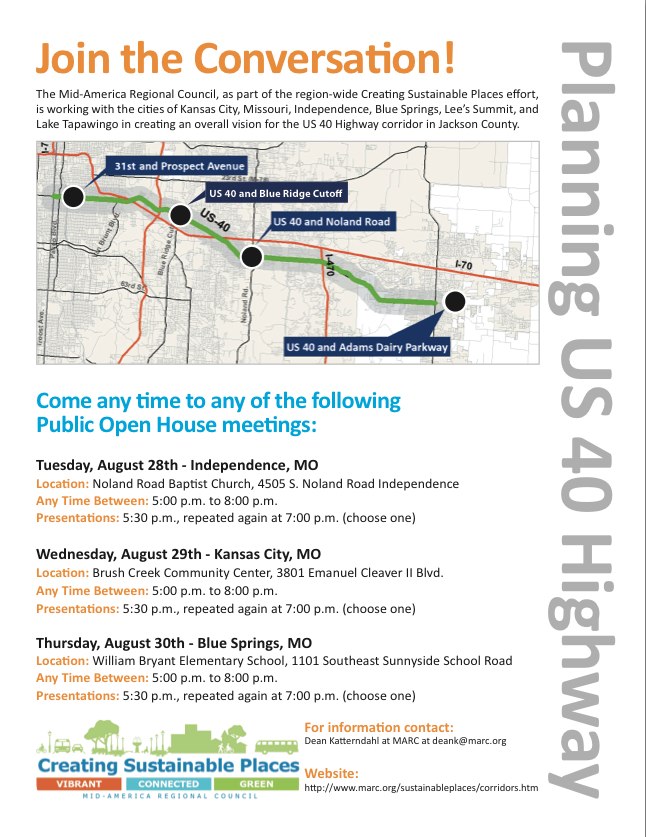
Public Open House – US 40 Highway Corridor – AUG 28, 29 and 30

Posted by Transit Action Network on August 24, 2012


Provide input for the region-wide development process to create sustainable places. There will be public meetings on each of the six corridors being worked on. This meeting is for the US 40 Highway corridor, which extends from 31st and Prospect in Kansas City, MO, to US 40 and Adams Dairy Parkway in Blue Springs, MO. Sustainable places create transportation corridors that accommodate different modes of travel — walking, biking, transit and auto.

Click to enlarge

Tuesday, August 28th – Independence, MO

Location: Noland Road Baptist Church, 4505 S. Noland Road Independence
Any Time Between: 5:00 p.m. to 8:00 p.m.
Presentations: 5:30 p.m., repeated again at 7:00 p.m. (choose one)
 

Wednesday, August 29th – Kansas City, MO

Location: Brush Creek Community Center, 3801 Emanuel Cleaver II Blvd.
Any Time Between: 5:00 p.m. to 8:00 p.m.
Presentations: 5:30 p.m., repeated again at 7:00 p.m. (choose one)
 

Thursday, August 30th – Blue Springs, MO

Location: William Bryant Elementary School, 1101 Southeast Sunnyside School Road
Any Time Between: 5:00 p.m. to 8:00 p.m.
Presentations: 5:30 p.m., repeated again at 7:00 p.m. (choose one)
 

This community meeting is related to the $4.25 million grant Mid-America Regional Council (MARC) received from HUD to help create sustainable places in the Kansas City region.  Print and post the Flyer.CSP_Flyer_40 Highway Meetings

Visit MARC’s website to learn more about this process. The CSP initiative includes plans and demonstration projects in six key corridors in the Kansas City region: State Avenue, North Oak, U.S. 40, Rock Island, Central City and Shawnee Mission.

Posted in Events, Local Transit Issues | Tagged: | Leave a Comment »

Save The JO Video #7 – Seniors Speak Up

Posted by Transit Action Network on August 17, 2012


Route #812 is The JO Flex service in Overland Park. It doesn’t cover a lot of Johnson County but it is a necessity for the people who depend on it. Watch seniors at Santa Fe Towers Apartments speak about their situation and concerns about the proposed elimination of this service.

The JO flex service covers a rectangle from 75th Street on the north, Lamar on the east, 95th  Street on the south and Quivira on the west. The service is limited between 10 a.m. and 2 p.m. on Monday, Wednesday and Friday. You don’t have to qualify to ride the #812, since it is available to anyone in the service area. Two very large retirement communities are significant users of the route, Overland Towers and Santa Fe Towers Apartments.

The JO Flex is more cost-effective than the new showcase CONNEX route #556 that JCT will retain. The JO Flex has better farebox recovery, cost per rider and ridership per trip than the CONNEX route.

The County Commissioners have said elderly, disabled and low-income populations will have the Special Edition, which is a shared ride program, providing transportation for registered and qualified residents of Johnson County. Usually you can’t call the day before to schedule a ride because the service is already full. The Special Edition only uses buses with a capacity of 10-12 people, where the JO Flex uses larger more comfortable buses. The JO Flex fare is $1, so a trip to the grocery store is $2. The Special Edition fare is $5, so the same trip would cost $10. Switching all of The JO Flex riders over to the more expensive, smaller, over-crowded Special Edition seems like a losing proposition.

Please keep the more affordable Route #812 JO Flex.

Contact Johnson County Board of County Commissioners

  1. Phone: 913-715-0430
  2. Email contact form: http://bocc.jocogov.org/webform/contact-us

Posted in Action, Local Transit Issues, Regional Transit Issue | Tagged: , | Leave a Comment »

All About Smog – One More Reason to Save the JO

Posted by Transit Action Network on August 14, 2012


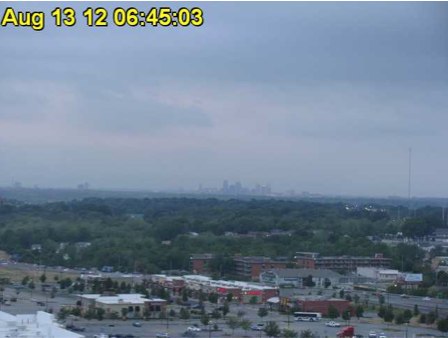
This is a Missouri Dept. of Natural Resources photo from August 13, 2012 from Blue Ridge Mall looking at downtown Kansas City. The KCPT tower, right-middle of the photo, is 3 miles away and the downtown skyline is 8 miles away. On a bad day, you can’t see the tower and on a really bad day even the skyline disappears from view. So what is smog?

The term “smog” was coined at the turn of the century to describe the hazy horizon of industrialized European cities, but around the 1950s, vehicle emissions began to take the place of factories in creating this noxious mixture of “smoke” and “fog”. Smog is a haze we see today during our hot and humid summers. This combination of ground-level ozone, nitrogen dioxide, hydrocarbons and dust particles is monitored regularly and regulated by the US EPA due to increasing health concerns for sensitive populations like children, the elderly and people with allergies or asthma.

In Kansas City, emergency room visits and hospital admissions increase significantly when ground-level ozone concentrations are high. Ground-level ozone irritates the eyes and nose, causes inflammation, difficulty breathing and even chest pain. It is formed by emissions from vehicles, power plants and other sources mixing with heat and sunlight, which is why summer is the most troublesome for air quality. Poor air quality knows no political boundaries, though, and smog will often creep northward with the warm, south winds of summer.

There is something we can all do to help. With daily work commutes averaging around 20 miles, multiple highway corridors, and abundant parking, it’s easy to see why so many folks in the Kansas City area drive to work. It’s also easy to see how our routines are contributing nearly half of the ozone forming emissions that contribute to poor air quality. Leaving your car at home even twice a week can save over 270 pounds of harmful ozone-forming emissions.

The MidAmerica Regional Council’s RideShare Connection is hosting the Green Commute Challenge now through September 28th to help raise awareness of air quality issues, reduce use of single-occupant vehicles in the peak summer season, and encourage transit use across the metro area through an employer-based contest. Thirty teams have joined from across the Kansas City area and over 900 people are taking the challenge to use alternative transportation.

Between bicycling, riding the bus or carpooling to work, and walking or simply staying in for lunch, the challenge has already reduced emissions by over 250,000 pounds. That’s like taking 14,000 cars off the road for a day. During the 12-week challenge, participants track their trips online and earn points. It’s a great way to see how our individual choices can add up to big benefits and many participants are using public transportation to earn serious points for their teams.

We can all do our part for air quality and using transit is a great way to start. And you don’t have to wait for national fuel efficiency standards or alternative energy sector growth to help! Compared to other household actions, using transit can reduce emissions by more than 10 fold.  A robust public transportation system is one of the very best investments any community can make to minimize emissions and reduce greenhouse gases. Transit can’t beat bicycling or other no-emission commutes, but modern buses are often hybrids using natural gas, biodiesel and other low emission fuels. The KCATA Metro MAX has several hybrid and clean diesel vehicles and both KCATA and The JO will be adding natural gas vehicles to their fleet.

Does being a transit rider make you an air quality hero? It depends who you ask but there’s no doubt that reducing even a few solitary commuting trips in your car can help reduce greenhouse gas emissions that contribute to global climate change and poor local air quality. Kansas City had 18 Ozone Alert days already in 2012, up from only 9 last year and 4 in 2010. We’ve exceeded ozone concentration standards 16 times this year and we’re setting a pace to top the last 2 years combined for quantifiable poor air quality. Poor air quality affects everyone’s health and it can make doing business more expensive as tighter regulations are enacted to meet basic national standards.

When local budgets get tight and cuts seem imminent, priorities have to be defined to guide the process, but with growing concerns about air quality and the human health impacts a very clear reality in the Kansas City metro area, you have to ask: why is public transportation not a priority in Johnson County? How can eliminating bus routes by 45% (and reducing service on another 45% of routes) serve our collective goals for air quality when it is the first, best way to reduce harmful ozone-causing emissions? We don’t believe cutting bus services voluntarily is in the best interest of Johnson County or the collective community when it comes to air quality issues or the kind of reliable public transportation system the public increasingly demands.

It’s not too late to improve air quality in Kansas City. From alternative fuel blends and hybrid vehicles to using low emissions paint in our homes and native landscaping in our yards, people across the metro are doing so much to reduce harmful greenhouse gases and ground-level ozone in our community. Using transit is one of the most effective things you can do to help ease air pollution and prevent smog from ever forming. The only question is: if you live or work in Johnson County, will you still have the transit option in 2013?

Contact Johnson County Board of County Commissioners

  1. Phone: 913-715-0430
  2. Email contact form: http://bocc.jocogov.org/webform/contact-us

http://finances.msn.com/saving-money-advice/6804691

http://www.marc.org/Environment/airQ/pdf/FAQfourpage.pdf

http://www.dnr.mo.gov/env/esp/aqm/kccam.htm

http://www.apta.com/gap/letters/2010/Pages/100728_obama.aspx

http://www.marc.org/Environment/airQ/pdf/ozonereports/O3WeeklySummary.pdf

Posted in Action, Local Transit Issues, Regional Transit Issue | Tagged: , , , | Leave a Comment »

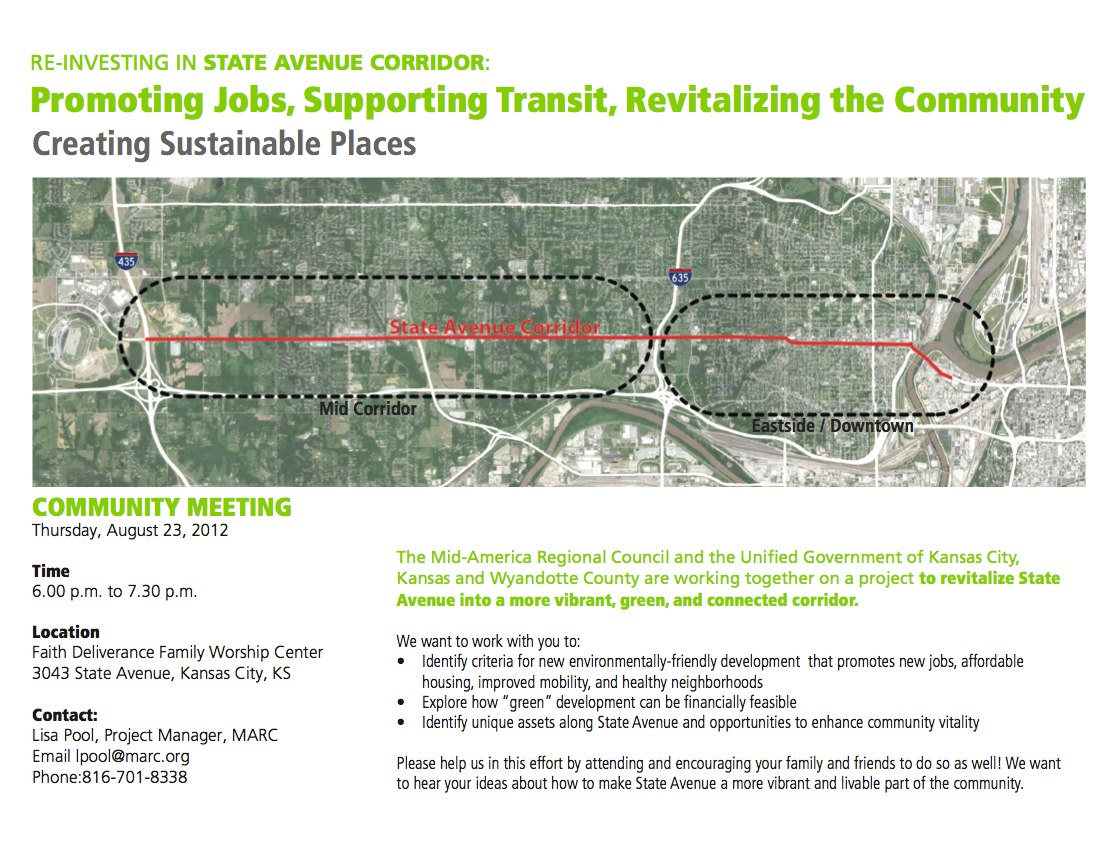
Creating Sustainable Places – Community Meeting in KCK Aug 23

Posted by Transit Action Network on August 13, 2012


This community meeting is related to the $4.25 million grant Mid-America Regional Council (MARC) received from HUD to help create sustainable places in the Kansas City region. A series of community meetings will be held around the region. Print and distribute this flyer for the meeting in KCK. Creating_ Sustainable_ Places_Community Meeting Flyer 

When: Aug 23, 6-7:30 p.m.
Where: Faith Deliverance Family Worship Center
              3043 State Avenue, Kansas City, KS

Investing in the State Avenue corridor will energize the transit corridor to be served by the new CONNEX route and transit infrastructure improvements provided by the $10.5 million federal TIGER grant.

According to MARC’s website for this project “Sustainable places are VIBRANT, with activity centers that offer a rich mix of amenities and housing choices, with easy access to jobs, services and recreation. They are CONNECTED by transportation corridors that accommodate different modes of travel — walking, biking, transit and auto. They are GREEN, respecting and preserving the natural environment while promoting healthy lifestyles and healthy residents.”

CSP_Community_ Meeting Flyer_Option 2

Posted in Events | Leave a Comment »

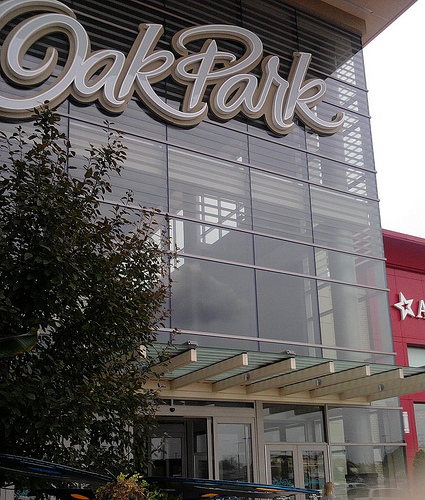
Oak Park Mall Getaway

Posted by Transit Action Network on August 8, 2012


OK, so maybe you’re not a bona fide Mall Rat. In fact, maybe you have some strong biases against malls. No matter. Visiting a mall once in a while won’t kill you — especially if it’s 105 degrees in the shade.

Here’s a plan for a half-day excursion from Kansas City, Missouri, to Oak Park Mall in nearby Johnson County:

Let’s assume you’re a Metro rider. Take the Metro bus of your choice to Crown Center, arriving there by 1:00 pm any weekday. You can get there via any number of routes: Main Street MAX, 27, 54, 123, 142, 173, etc.

Be sure to get a transfer. (If purchase a ticket or if you are using a Metro monthly pass or a Metro day pass, tell your Metro driver, “I need a transfer to The JO.”)

At 1:05 (or thereabouts), board The JO’s Route 672-M (Midday) bus at the Crown Center Square, across from the fountain.

(You can also board at 10th and Main at 12:58 pm.) Swipe your Metro transfer through the farebox, just as you do on a Metro bus, and settle in for a one-hour ride. You’ll find the JO bus to be clean and comfortable, and the driver courteous and helpful.

After a sprint along I-35 you’ll go south on Roe through Roeland Park, west along Johnson Drive through Mission (take note of The JO’s new Mission Transit Center under construction at 4851 Johnson Drive), south on Metcalf past Downtown Overland Park, and pause at Metcalf South Shopping Center (where you could, if you wanted to, see a movie at Glenwood Arts Theater), and west on 95th Street to Oak Park Mall.

You’ll arrive at Oak Park Mall about 2:02.

Once at OPM you can (1) Shop, (2) Window-shop, or (3) Eat at the food court or one of the other eateries in or near the mall.

Transit Schedule at Oak Park Mall

Eventually, even though you might not want to, you’ll need to go back home. Fortunately The JO has several buses that will take you back to Missouri.

Route 670-L (South Johnson County Express) will get you back to Crown Center in practically no time at all: it leaves the OPM park-and-ride lot at 4:18, 4:49, 5:19, and 5:49, and the return trip takes about 30 minutes. (You can also return via Route 575, which takes you to Waldo or 75th and Troost.) Last buses back to Missouri are the 670 at 5:49 and the 575 at 5:50. After that, your coach has turned into a pumpkin, and you’ll have to call a friend or a taxi — or start walking.

Note: You got to OPM on your Metro transfer. The JO accepts a Metro transfer, but not a Metro monthly pass or day pass. You’ll need to pay a regular fare to The JO to return.  Regular fare is $2.00 for adults, $1.50 for seniors (with any ID that shows your date of birth). Kids 5 and under ride free, and kids 12 and under must be accompanied by an adult. If you don’t have a Metro monthly pass or day pass for your onward travel once you return to Missouri, be sure to tell your JO driver “I need a transfer to the Metro.” The Metro accepts The JO transfers.

Easy, right? You’ll have kept cool for an afternoon while experiencing one of the region’s biggest shopping malls, and you’ll have become one of the relatively few transit riders in the region who can say that they’ve ridden The JO.

So what’s keeping you? Give it a try and let us know what great fun you have!

P.S. The 672-M Midday bus is on the Johnson County Transit list of proposed eliminations for 2013.

Posted in Action, Transit Adventures | Tagged: | Leave a Comment »