Transit Action Network (TAN)

Advocates for Improved and Expanded Transit in the Kansas City Region.

July KCATA BOC meeting:Comprehensive Service Analysis, Public Input and Customer Satisfaction Survey

Posted by Transit Action Network on August 8, 2010


KCATA Board of Commissioners meeting July 28, 2010

July 28- KCATA Board of Commissioners Meeting

Comprehensive Service Analysis

The KCATA Comprehensive Service Analysis (CSA) is underway. Link to find out about the 2010-2011 Service Analysis.

Take the Preference Survey for the CSA. It is  important that transit riders speak up and take this survey. It is available in English and Spanish.  The choices are hard.

Link to the CSA July2010 presentation by Nelson Nygaard about the analysis.

KCATA expects to have public meetings in the Fall. We will keep you informed of these meetings.

Public Input:
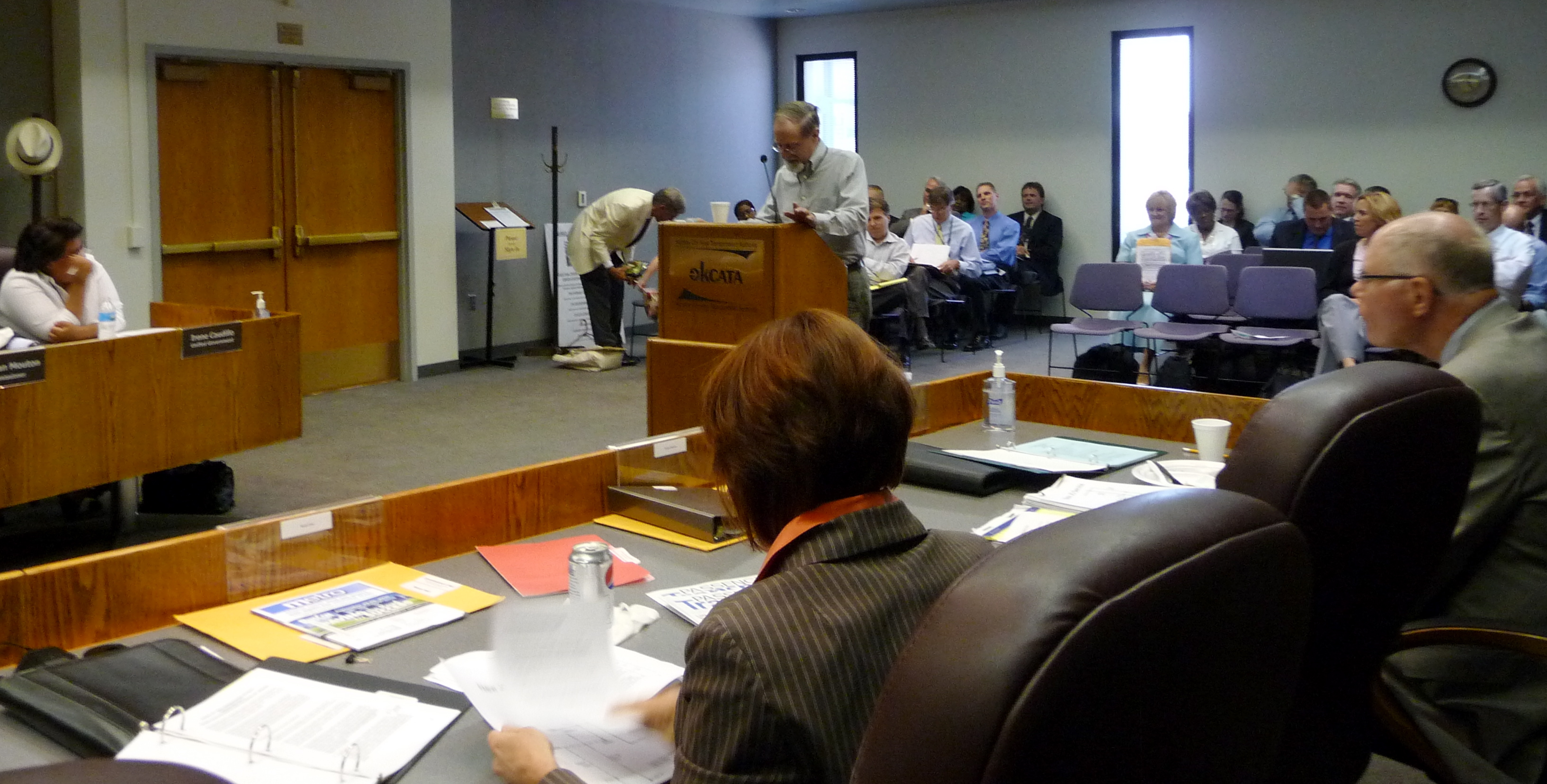
Ron McLinden, advocate with Transit Action Network, presents appeals for seamless transit at the July 28,2010 KCATA BOC meeting

Ron McLinden, an advocate with the Transit Action Network, spoke about the new services started by Johnson County Transit. He expressed TAN’s strong support for this service and the importance of these routes toward the development of Bus Rapid Transit in Johnson County. TAN had met previously with Cindy Baker, KCATA Director of Marketing, about combining signage and schedules between KCATA and the JO for these new routes. Since Cindy had said KCATA was willing to do this, Ron expressed appreciation for this important step toward seamless transit.

Clay Chastain spoke. He offered an “olive branch” to the KCATA and wanted them to work with him on a transit package to take to voters this  November. The board listened politely and thanked him for coming.
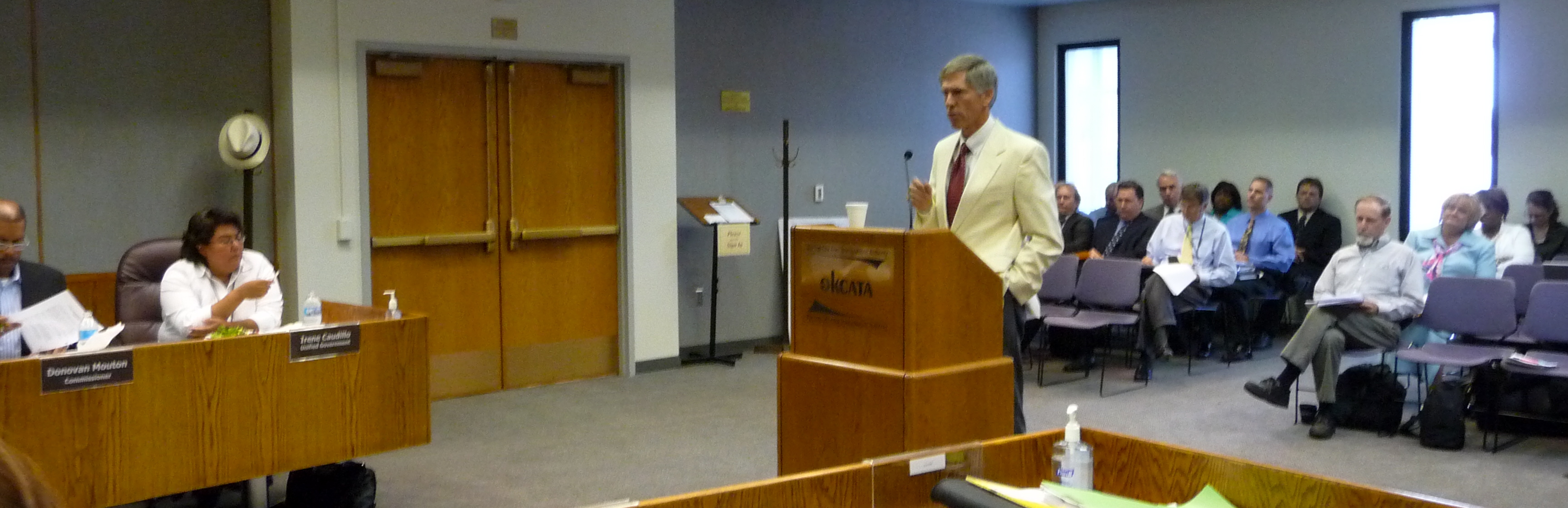
Clay Chastain presentation to KCATA BOC July 28,2010

Customer Satisfaction Survey

ETC Institute recently conducted a Customer Satisfaction Survey about KCATA.  This survey showed overall improvement from the previous survey in 2007.

Sixty-five percent of those surveyed used the service for either going to work or job seeking, supporting the idea of how important the service is to the community. More people are transit dependent than in 2007.

Riders felt there were big improvements in on-time performance and  transit service. Ninety–one percent of riders surveyed would recommend the MAX and the METRO.

Overall results were very positive and better than in 2007 but there is always room for improvement.

Suggested improvements: Improve the courtesy on the Metro information line, integrate technology to distribute information and improve the condition of the buses.

Greatest need: increase weekend service and service between 6am ad 6pm.

Posted in Local Transit Issues, Meeting Reports, Rail, Seamless Transit | Tagged: , | 1 Comment »

Big Week for Regional Rapid Rail

Posted by Transit Action Network on August 5, 2010


This week two very informative articles appeared in the papers about the TranSystems Regional Rapid Rail concept and the hard work Jackson County Executive Mike Sanders has done to promote the idea.  Both articles discuss problems the plan is encountering and give an update of its status.  We strongly encourage you to read them both since they provide different but complementary information.

Report by KC Star’s Brad Cooper and Michael Mansur –Area rail plans advance slowly. Included in the article is a quote by Transit Action Network advocate Janet Rogers.

Report by the Pitch’s David Martin- Jackson County Executive Mike Sanders puts his energy and his reputation into an unlikely commuter-rail plan.

Transit Action Network reported on July 15 that four of the six lines in the Regional Rapid Rail plan are not being pursued at this point. Federal money is being requested by Mid-America Regional Council to study the remaining two lines and a downtown streetcar distribution system.

Additional information about this concept:

The Regional Rapid Rail concept does not use streetcars or light rail. Both of those are electrified and light-weight by train standards. This idea uses Diesel Multiple Units (DMU). Each DMU would be a two-car train probably run on bio-diesel fuel. They can run on freight lines and city streets. This plan uses underused, abandoned freight lines and new tracks in the suburbs. These freight lines are not available in Jackson County once the train enters Kansas City north of the Truman Sports Complex. At that point it would run on new tracks laid on the streets in what is being called a COMMON LINE for the trains from eastern Jackson County. With this concept the trains on the common line would not function like streetcars or light rail, but would travel much like regular trains except they would be on the streets.

The $2 million Alternatives Analysis (AA) is being requested for these two routes:

The two remaining corridors, the I-70 corridor to Blue Springs and beyond using the Kansas City Southern line, and the Rock Island corridor via Raytown and Lee’s Summit, face their own challenges.

These two lines would share the common line from the vicinity of Union Station — the proposed passenger facility would be across the tracks to the north of Union Station and not in the station itself (freight house district in the region of Lidias Restaurant). The common line would travel to the vicinity of 23rd Street and the Blue River where it would link with the Rock Island right-of-way.  This common line would probably be along yet-to-be identified streets. (Truman Road was studied originally but other alignments would be investigated in the AA).

The Rock Island corridor would have to be completely re-built because the existing rails and roadbed have not been maintained since the last trains used them some 30 years ago.

The I-70 corridor faces additional challenges since it is so circuitous. The current alignment has commuter trains from Blue Springs traveling on the existing KCS line to near 33rd and Noland Road, from which there would be a new line parallel to the existing Union Pacific line south to I-70, then westward along the I-70 right-of-way to a point near Blue Ridge Cut-Off where the route would head south to join the Rock Island line south of Truman Sports Complex.

If federal money is received to study the remaining two commuter routes, a downtown streetcar will be reviewed as well.

For the commuter routes, Expanded Express Buses, Light Rail Transit and Regional Rapid Rail would be evaluated and compared in the commuter corridors.

The study of the downtown circulation system would evaluate and compare Local Bus and Bus Rapid Transit, Streetcar and Light Rail Transit.

Various reasons the other four commuter routes will have express bus/bus on shoulder recommended for the near term:

+ The Wyandotte County corridor has little congestion, relatively little ridership potential as a commuter rail line, and would require significant new right of way.

+ The I-29 and I-35 corridors require the high cost of a Missouri River bridge, and have low ridership projections.  The I-29 corridor faces the added challenge of re-assembling an old inter-urban alignment that has been abandoned for many decades.  The I-35 corridor faces the added challenge of a very circuitous route:  commuters to and from Liberty, for example, would travel via Riverside and the north edge of North Kansas City.

+ The US 71 corridor was eliminated largely because of low ridership projections.  In addition, the alignment under consideration would run on or near Van Brunt Extension and Swope Parkway, and would require a new and yet-to-be defined corridor from near the south edge of Swope Park to an intersection with the existing Kansas City Southern line in the vicinity of 83rd and I-435.

Posted in Local Transit Issues, Rail, Regional Rapid Rail | Tagged: | 2 Comments »

Action! – The Green Impact Zone

Posted by Transit Action Network on July 24, 2010


July 21-The Green Impact Zone* (GIZ) is one of our current “targets” for action! Loaded down with KCATA brochures and our own  Summer Fun on Transit-GIZ flyer, we introduced the Transit Action Network (TAN) to several GIZ neighborhood leaders.  We expressed our desire to be one of the partners working to transform the “Zone” toward sustainability and energy-efficient living.

We reminded everyone that earlier this year TAN and GIZ residents contacted our representatives in Jefferson City during their work on the state budget. Together we helped play a role in $3 million being set aside (at least tentatively) for KCATA. The release of the funds is dependant on the state’s economic condition.

We want to continue working with the Green Impact Zone to encourage the KC City Council and the Missouri State legislature to adequately fund our transit service.

Several leaders were interested in our handouts, and we asked them to consider us a transit resource. We even “invited” ourselves to attend meetings in their individual neighborhoods to learn more about the transit needs as seen by those who live in the GIZ.

*The Green Impact Zone is a cooperative effort to focus federal stimulus funds on projects in a 150-square block area of Kansas City, Mo. – bounded by 39th St. on the north, 51st St. on the south, Troost Ave. on the west, and Prospect to 47th to Swope Parkway on the east.

Posted in Meeting Reports | Tagged: , | 1 Comment »

Take The JO to the Jurassic

Posted by Transit Action Network on July 20, 2010


This monster announces the "Dinosaurs Unearthed" exhibit from its post outside Union Station...

...while inside Union Station, this animatronic Dilophosaurus greets visitors with a friendly roar.

There’s a dinosaur exhibit at Union Station, “Dinosaurs Unearthed”     http://www.dino.unionstation.org/

Kids love dinosaurs, right?  And there just happens to be a bus from Johnson County right to Union Station, Route M.

Put it all together and what to you get?  A great “Transit Adventure” from Johnson County to see the dinosaurs.  Or to see the kid-friendly attractions at Crown Center like Kaleidoscope, or the ever-popular fountain at Crown Center Square.

Johnson County Transit, “The JO” is primarily a commuter bus system, with morning and afternoon trips to and from Downtown Kansas City.  If you have transit needs between 9:00 am and 3:00 pm, you’ve been pretty much out of luck – except for Route M (AKA Route 672), a little-known route that makes a single round trip from Olathe to Downtown Kansas City and back in the middle of the day.

Route M, “Midday,” is your key to taking half-day trips to and from points in Kansas City from Johnson County.  It serves several major park-and-ride locations in Johnson County on the way to Downtown Kansas City, Union Station, and Crown Center:

+ Great Mall of the Great Plains

+ Downtown Olathe

+ Johnson County Community College

+ Oak Park Mall Shopping Center

+ Metcalf South Shopping Center

+ 6000 Lamar Transit Center

From one of these locations you can take a morning commuter bus to Union Station to see the dinosaurs and return via Route M (leaving from Union Station shortly after 1:00 pm), or take Route M to Union Station and return via one of the afternoon commuter routes.

We’ve prepared a summary schedule of some of the buses you can take in combination with Route M. (bus schedule to see the dinosaurs ) Other routes are also available, but we’ve chosen the ones that probably work for most people.

Round up the kids, head for one of The JO’s park-and-ride lots, and take The JO to Union Station for an adventure into the Jurassic (Closed Mondays)

Fares:  Regular fare on The JO is $2.00 for adults, $1.50 for kids 6-17, and free for kids 5 and under.

For extra adventure, you can transfer from The JO to MAX or another Metro bus to visit other attractions up and down the MAX corridor stretching from Waldo on the south to Downtown and River Market on the north.  Your JO driver can give you a transfer good for 2 hours on any Metro route.  For your return, pay the regular fare on the Metro ($1.50 for adults, 75 cents for kids 6-17) and get a transfer that’s good on The JO.

So get out there and have a Transit Adventure.  And post a comment on our blog to let us know how it went.

Note: Future adventurers and world travelers need to be familiar with 24-hour clock time, so we have used it on our schedule:  08:00 = 8:00 am, 16:07 = 4:07 pm, 20:10 = 8:10 pm (There is a 12 hour difference between “pm” times and the 24-hour clock; “am” times are the same) The JO buses operate only Monday through Friday.  We’ve made every effort to provide accurate schedule information, but schedules change from time to time.  We suggest you check The JO’s website – www.thejo.com – or call the regional transit information center, 221-0660, for the latest information.


Posted in Transit Adventures | Tagged: , | 2 Comments »

Regional Rapid Rail and MARC’s Alternatives Analysis Request

Posted by Transit Action Network on July 15, 2010


Mid-America Regional Council (MARC) has submitted to the Federal Transit Administration a $2 million request for funding an Alternatives Analysis (AA) based on the results of the Commuter Corridor Study that TranSystems is currently completing. This study includes the Regional Rapid Rail system.

The AA would investigate two commuter corridors: 1) I-70/Blue Springs corridor alignment to Odessa and 2) the Rock Island/Lee’s Summit corridor alignment to Pleasant Hill. In these corridors Expanded Express Buses, Light Rail Transit and Regional Rapid Rail would be evaluated and compared.

In addition a downtown circulation system is included in the request. It would evaluate and compare Local Bus and Bus Rapid Transit, Streetcar and Light Rail Transit.

According to the submission, “Through the proposed alternatives analysis, the region will determine the type of transit that can best facilitate positive changes for the citizens of Greater Kansas City with commuter and urban service”.

Federal funding for this analysis is not guaranteed.

Read the submission: AA request

At the July 7th MARC Transit Committee meeting TranSystems presented an update of the current Commuter Corridor Study. Four of the Regional Rapid Rail lines, US-71 (Grandview), I-70 West (State Ave.), I-29 (KCI Airport), and I-35 North (Liberty), will not be pursued in the Alternatives Analysis.  Express buses/ Bus on Shoulder solutions will be recommended. Multiple reasons were given for 4 of the 6 regional rapid rail lines not being pursued at this time but they mainly related to lack of sufficient ridership numbers to warrant the expense.

Posted in Rail, Regional Rapid Rail | Tagged: , , | 1 Comment »

Transit Action Network – Our First Six Months

Posted by Transit Action Network on July 13, 2010


We formed Transit Action Network in early January, 2010, to fill what we saw as a void in active citizen involvement on behalf of expanded and effective transit service in the Kansas City region.

We have deliberately not created a formal organization, preferring instead to spend our time and other resources on behalf of transit.  Nor have we established a formal membership list or asked for dues.  “Action” is our middle name, and we use words such as “involved,” “nimble,” “informed,” and even “scrappy” to describe ourselves.

Our transit focus is broad. It is regional, multi-modal, and promotes transit for all demographic groups.

Get Involved

If you want to be more involved or just know what we are doing

We have bi-monthly lunch meetings where we discuss current issues and opportunities for action.  These are generally held at the Kansas City, Missouri, Central Library

Here’s a brief overview of what we’ve been up to:

Accomplishments

  • Our information booth at the Green Impact Zone expo, March 27 focused on an “action” to contact Missouri Senators to put emergency money in the budget for KCATA. The action successfully helped to get $3 million in the Missouri budget even though Governor Nixon later suspended the use of those funds.
  • We testified at three of the budget hearings held by the Kansas City City Council and made the Mayor and the Council aware that its budget decisions were diverting scarce resources away from transit.
  • We initiated a series of quarterly “transit lunch” outings for members of the MARC Transit Committee and other interested people in order to experience local transit first hand.
  • We provided a panelist for the Imagine KC telecast on KCPT, February 15.
  • We provided a guest on a KKFI radio program on transportation and air quality, May 10.
  • We had a letter to the editor of the KCStar published about transit in Johnson County
  • We worked with the Green Impact Zone to promote teens using the ATA TRANZ Tags for the summer.
  • Our members have been quoted in newspaper articles frequently about  transit issues.

Regional Transit Initiatives

In response to the proposed “Regional Rapid Rail” system, we have had numerous meetings with decision-makers at Jackson County, MARC, and KCATA regarding the proposal itself, as well as an evaluation of the proposal currently underway by MARC.  We also testified before the Kansas City City Council in favor of deferring support for the concept until further information was provided.  We believe our role has been constructive and pragmatic, stressing the importance of cost-effective transit solutions and not allowing a high-profile proposal to draw attention away from a pending threat to funding of current commuter bus service, particularly in Jackson County.

Meetings with public officials:

Local:

The purpose of these meetings has been to discuss and find out about local transit issues as well as promote the idea of getting dedicated funding to secure and expand current transit services. We discussed funding mechanisms such as a County Transit Authority and Transportation Development Districts for transit. We believe the need for better transit services is now and we shouldn’t wait until gas prices are outrageous, or until a rail system might finally be built, before we improve transit. We have met with:

  • Southern Platte County Mayors
  • Councilmen Whitley, Gray and Mosby of Lee’s Summit
  • Mayor Randy Rhoads of Lee’s Summit
  • Community Development staff of Independence
  • Councilman Bowerman of Blue Springs
  • Mayor David Bower of Raytown, co-chairman of the MARC Transit Committee
  • Mayor Gerry Richardson and Councilwoman Gia McFarlane of Parkville

State:

  • We are actively involved in MoDOT’s Rail Passenger Advisory Committee.
  • We have been active participants in MoDOT’s Traffic Management Committee for construction of the Christopher S. Bond Bridge.

National:

We met Congressional Staff to discuss issues in the next Federal Transportation Bill and issues related to senior mobility.

  • Sarah Woodward, Aide to Congressman Sam Graves

Public Events

We regularly participate in public events related to transit:

  • MARC open house on the Long-Range Transportation Plan
  • February 17 announcement of the award of a federal TIGER (Transportation Investment Generating Economic Recovery) grant, and a subsequent media event to announce details
  • Various forums and “webinars” related to transit and urban development issues
  • MARC Regional Assembly luncheon, June 25
  • Missouri Chamber of Commerce Transportation Conference
  • National Rail Plan Outreach Meeting, May 19

Transportation committees at Mid-America Regional Council

We are a regular, active and informed presence on behalf of transit at the following meetings–and in many cases we are the only transit presence:

  • Transit Committee
  • Total Transportation Policy Committee
  • Bicycle/Pedestrian Advisory Committee (because transit riders use those modes)
  • Missouri STP/Bridge Priorities Committee
  • Air Quality Forum
  • Technical Forecast Committee (because how a region grows determines how well transit can work to provide access to opportunities for all)
  • Long-Range Transportation Plan Subcommittee
  • MARC Board of Directors (observer status only)

We also have regular contact with MARC’s senior staff, and we don’t hesitate to ask for and receive clarification on many issues.

Kansas City Area Transportation Authority

  • We have attended each of the monthly meetings of the KCATA Board of Commissioners this year, and have used these meetings as opportunities to build and improve informal relationships with both Commission members and senior staff.
  • We have regular contact with senior staff regarding a wide range of transit funding and service issues.

Johnson County Transit

  • We have regular contact with staff of The JO to encourage improvement of their on-street presence (e.g., bus stop signs and posted schedules), and to help promote transit ridership in Johnson County with special focus on the new service launched on July 6.
  • We have informal conversations with several members of the Johnson County Transportation Council, and with various Johnson County city and county elected officials.

Outreach / Communication

  • We have been working with MoDOT to build local awareness of the state-supported Missouri River Runner rail passenger service connecting Kansas City and St. Louis.
  • We participate in the kcrag.com discussion forum ( http://forum.kcrag.com ) to disseminate information about transit developments and issues.

Networking

We have informal contacts with:

  • Let’s Go KC
  • MORE2 (Metropolitan Organization for Racial and Economic Equity)
  • Sierra Club
  • Kansas City, Missouri, Environmental Management Commission
  • Kansas City, Missouri, Climate Protection Steering Committee
  • League of Women Voters Kansas City/Jackson, Clay, Platte

(Whew!  Sometimes we surprise ourselves!)

Submitted by Transit Action Network’s very informal steering committee (in alphabetical order):

Ron McLinden

Margie Richcreek

Janet Rogers

Posted in Uncategorized | 1 Comment »

Inaugurating the New Johnson County Transit Service

Posted by Transit Action Network on July 9, 2010


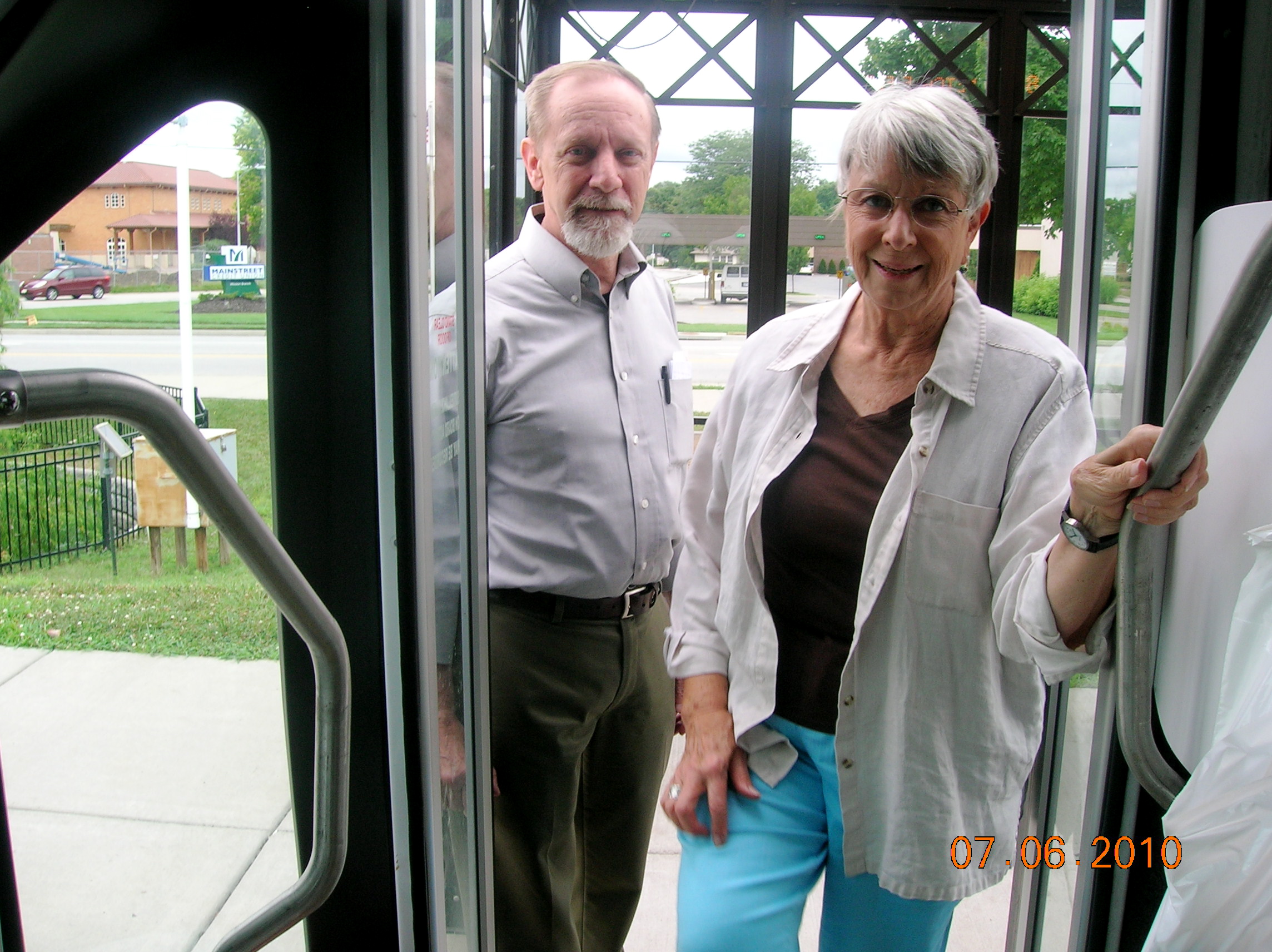
Margie prepares to board Route M bus at 10th and Main

Ron and Margie board Route 856 bus at 6000 Lamar transit center

Hear!  Hear!  There is good news for regional transit…  as of July 6, 2010 the range of transit possibilities to and from Johnson County and Kansas City, MO just got a whole lot bigger!

The JO’s Route M, the midday route that makes a single round trip from Olathe to Downtown and back, plus NEW Routes 856 and 875 opened up opportunities for KC residents to get to Oak Park Mall and Metcalf South Shopping Center, Johnson County Community College (including the Carlsen Center for the Performing Arts and the Nerman Museum) and KU Edwards Campus throughout the day.  And for Johnson County residents, the new routes improve access to the Plaza, the Nelson-Atkins and Kemper Museums of Art, UMKC, Union Station and Crown Center, and Downtown Kansas City via MAX from Waldo or from the Plaza.

On July 6, Margie and Ron celebrated the launch of this new transit service in Johnson County by being among its first riders.  We selected a relatively short loop trip beginning and ending at 10th and Main Transit Center in Downtown Kansas City.  Margie arrived there via ATA Route 129 from Boardwalk Square in Platte County, and Ron arrived via ATA’s MAX route from Midtown.

We used our Metro transfers to board The JO’s Route M at 1:00, and got off at the Transfer Center at 6000 Lamar in Mission. Here we had easy walking access to the Johnson County Administrative Center, Powell Community Center, and several restaurants and retail shops. The NEW Route 856 Metcalf Flex bus arrived early and Don, the driver, snapped a photo of us boarding.  He, too, was celebrating his new assignment!!

Just imagine  –  Route 856 riders have access to everything along Metcalf from 63rd to 135th streets!!  We got off at 75th Street  –  the site of Walgreen’s and CVS among the retail options.  Did you know that more than 65 buses pass by 75th and Metcalf every weekday?

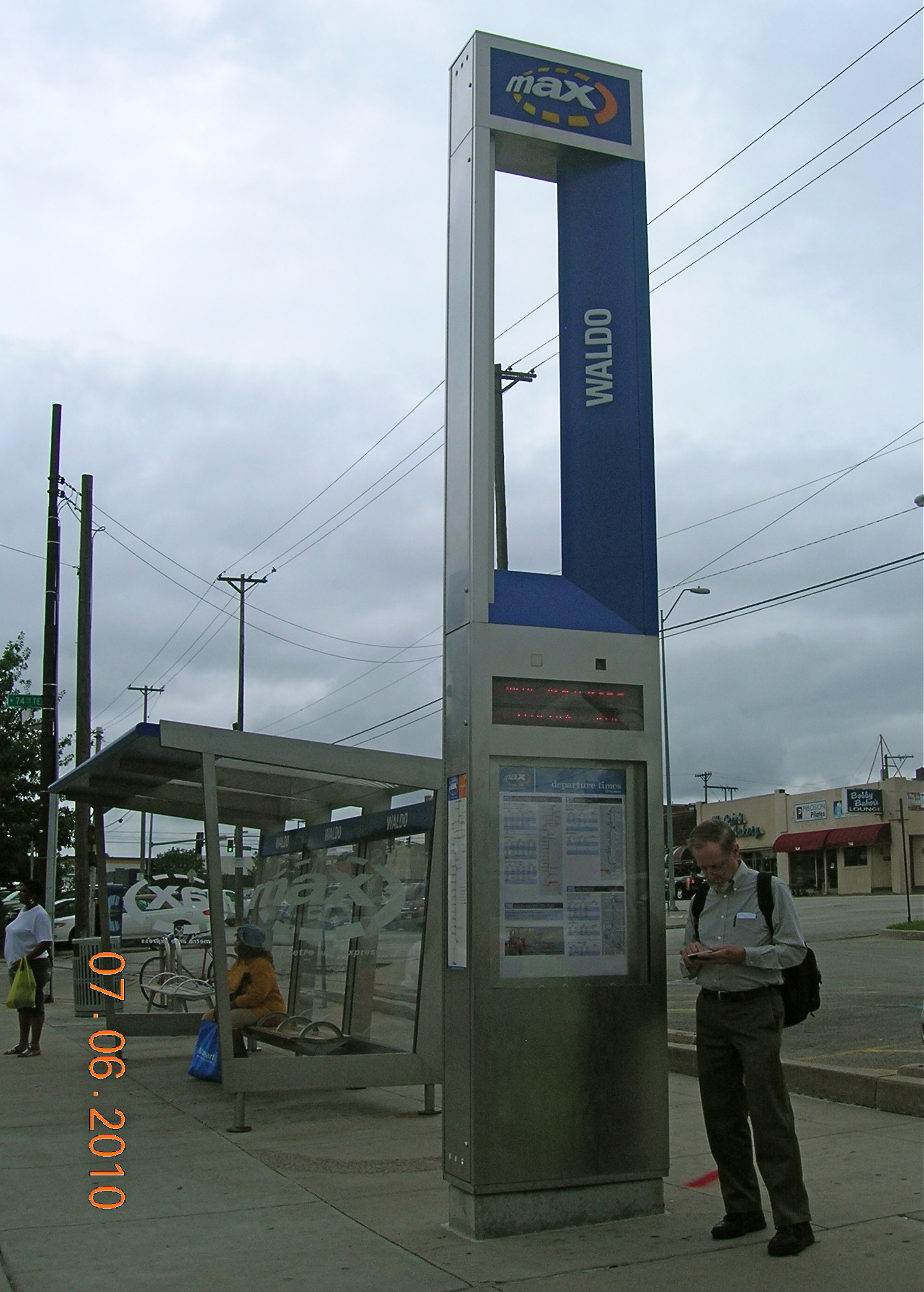
Soon we boarded the NEW eastbound Route 875 Flex bus with Paul at the wheel.  And we were off to Waldo and our next transfer onto the MAX at Wornall and 75th where you’ll find good places to eat  –  unique roof top dining at The Well, “traditionals” such as Waldo Pizza, and Coffee Girls’ new location is just a block west near 75th Street Brewery.  The retail shopping excels, also!

The JO’s Routes 856 and 875 are something new for the Kansas City area: “route deviation” transit.  They follow set routes on a fixed schedule, but the driver can go off-route to pick up or drop off riders who have called a day in advance.

Routes 856 and 875 complement Routes 556 and 575 that operate during the morning and evening commute periods.  These buses travel the same route but don’t go off-route.  Since both connect to MAX, it’s possible for more people to get to and from work and school.  Now, they and many more residents of the region have access to health care, shopping, and a variety of restaurants along these routes throughout the day!

Ron sent a few “tweets” along the way.  Read them at http://twitter.com/transactionkc.

Margie Richcreek reporting

"OH, there is the bus stop"

Ron "tweets' about the experience at the Waldo MAX stop

Posted in Transit Adventures | Tagged: , | 3 Comments »

July 2010 Open Thread

Posted by Transit Action Network on July 6, 2010


Got a thought about transit?  Maybe it’s a new idea or a question or just a beef about some transit situation.  Post it here.  Please limit your comment to about 200 words — but if you write something really good — whether we agree or not — we might tolerate more.  And, of course, we reserve the right to refuse your post if it’s abusive or too far off the (transit) topic. Make it about substantive issues not personalities.

Posted in Open Thread | 1 Comment »

New Silver Route in Independence

Posted by Transit Action Network on July 2, 2010


Before the opening event ceremony at Centerpoint

Mary Hunt, Senior Planner, and Mayor Reimal show the map of the new Silver Route

Mark Huffer, KCATA General Manager, speaking at the opening event

Independence Community Development Director Jennifer Clark and Senior Planner Mary Hunt celebrate the opening of the Silver Route with transit rider Pyllis Mays

July 1 – The opening event at Centerpoint Hospital for Independence’s new Silver Route transit service shows what can happen when people think ahead and creatively. Several years ago Independence structured the Centerpoint Tax Increment Financing (TIF) district to fund a new bus route. The route will run Tuesday and Thursday and connect Centerpoint Medical facilities, the Social Security Administration, 39th & Noland (Walgreens and CVS are both there), Olde Oak Tree Apartments, the Midwest Genealogy Center (a Mid-Continent library and the largest public genealogy library in the country) and the Independence Transit Center.

Independence Mayor Don Reimal pointed out that this is a really good use of TIF money and it shows that when Independence has the money they provide transit.  He emphasized that no money was used from general revenues. KCATA General Manager Mark Huffer pointed out that this is probably the first use of TIF to fund transit in Missouri.

Phyllis Mays, an Independence transit rider and transit advocate who helped develop the route, was the first person to ride the new route.

The buses for this route have been fitted with two wheelchair positions since Independence has identified the need to accommodate additional wheelchair passengers on this route.

We salute Independence for its funding commitment to its regular transit service. Sales taxes are down and the Community Development Department, which administers the transit service, has had budget cuts of 30% over the last two years.  The decision was made to absorb those cuts in other ways and keep the budget for the regular transit services consistent at $1 million.  Anyone who has paid attention to the sales tax funding crisis for transit around the whole country should find this an exceptional commitment to transit in difficult financial times.

JR

Posted in Uncategorized | Tagged: , | Leave a Comment »

June Open Thread

Posted by Transit Action Network on June 24, 2010


Got a thought about transit?  Maybe it’s a new idea or a question or just a beef about some transit situation.  Post it here.  Please limit your comment to about 200 words — but if you write something really good — whether we agree or not — we might tolerate more.  And, of course, we reserve the right to refuse your post if it’s abusive or too far off the (transit) topic. Make it about substantive issues not personalities.

Posted in Open Thread | 4 Comments »

Transit Adventure: A Trip to Harry’s Town via KCATA and Amtrak

Posted by Transit Action Network on June 18, 2010


Jayson lives in Midtown Kansas City.  A few months ago he decided to go carless, and he started a blog, http://www.carfreeinkc.com, to write about his experiences.  He posts occasional reports about his transit adventures, and we especially like the one about a trip he and a friend took from Kansas City to Independence (KCATA Route 24 from Downtown) and return via Amtrak to Union Station.  It’s a pretty easy half-day trip, but you will probably want to make train reservations in advance, http://www.amtrak.com, to avoid an extra charge.  Amtrak fare is generally $8 for adults (second adult and senior tickets are less) and $4 for kids 2-15.  Here’s his account of the trip:

Posted in Amtrak, Transit Adventures | Tagged: , | Leave a Comment »

The JO Will Expand Service in July

Posted by Transit Action Network on June 15, 2010


Johnson County Transit

June 12, 2010

Johnson County Transit has released tentative information about new and expanded routes that will begin in July.  This expanded service represents a significant step toward providing “real” public transit in Johnson County .

Metcalf / Plaza

Route 556 will replace Route H, connecting 135th and Metcalf with MAX at the Plaza, via Metcalf Avenue and Shawnee Mission Parkway .  There will be five morning round trips, and five northbound and four southbound evening trips.  We don’t know if 556 will extend eastward to Troost as Route H currently does.

Route 856 will provide three round trips of midday flexible service in the 556 corridor between 10 am and 3 pm.  Presumably this will be so-called “route deviation” service, with buses operating on a fixed schedule but able to go off-route to make pre-arranged pick-ups or drop-offs along the corridor.

75th Street / JCCC

Route 575 is a new route connecting MAX at 75th and Wornall with Johnson County Community College via 75th Street and Quivira Road .  There will be four morning and four evening round trips.

Route 875 will provide three round trips of midday flexible service in the 575 corridor between 10:30 am and 3 pm.  Buses will operate on a fixed schedule but able to go off-route to make pre-arranged pick-ups or drop-offs along the corridor.

Schedules are not yet available.

The JO is gradually switching from letters to numbers for route identifiers.

Why the different route numbers for midday service in the 556 and 575 corridors?  JCT will define 556 and 575 as “commuter” routes, which are exempt from the requirement to provide “ADA complementary service” during those periods.  Midday, such service is provided by the flexible nature of routes 856 and 875.  Complementary (not complimentary) service is a requirement of the Americans with Disabilities Act.

Source of this information is the agenda packet for the June 9 meeting of the Johnson County Transportation Council (pages 24-25).

http://www.thejo.com/pdf/JCTC/JCTCPacket20100609.pdf

RM

Posted in Uncategorized | Tagged: | 1 Comment »

MARC will Host Webinar on Transportation and Climate Change

Posted by Transit Action Network on June 13, 2010


June 13 – Mid-America Regional Council will host a local viewing of a national webinar from the US Department of Transportation on Wednesday, June 16, from Noon until 1:30 pm at its offices, 600 Broadway.  You may bring your own lunch if you wish; drinks will be provided.  No need to register, but an RSVP to Lisa Pool at MARC lpool@marc.org is recommended.

The webinar is about a newly-released USDOT report to Congress, Transportation’s Role in Reducing U.S. Greenhouse Gas Emissions — see press release:
http://www.dot.gov/affairs/2010/dot7510.htm
It might be a little wonkish for some, but we think it’ll be worth seeing, especially since improved public transit will be a part of our nation’s response to climate change.

RM

Posted in Uncategorized | Tagged: , | Leave a Comment »

KCATA Commissioners approve Comprehensive Service Analysis

Posted by Transit Action Network on June 6, 2010


May 26. Ron McLinden and Janet Rogers attended the KCATA Board of Commissioners meeting.

Items of note:

There are new opportunities for federal funds and KCATA will be applying for this money. Under “Clean Fuels” and “State of Good Repair” programs the requests will be out of items that are already in the ATA’s capital budget, such as hybrid vehicles and electric service trucks, a new revenue collection system and a new bus cleaning system.

The ATA will also be looking for eligible “livable communities” projects using the TIGER and TIGGER grant programs of ARRA.

KCATA is contracting for a Comprehensive Service Analysis of its bus operations. The 15-month $533,881 contract is with Nelson-Nygaard, a transit consulting firm headquartered in San Francisco. See the ATA staff presentation to the BOC-Comprehensive Service Analysis

If you don’t already know, rather than having major service cuts or raising fares again this year, KCATA is using its sales tax reserve account to maintain service. The Finance Department made a report saying if things continue as they are now, KCATA expects to exhaust it reserve fund early in 2014. Of course, improved sales tax revenue, full funding from Kansas City’s ½ cent sales transportation tax and one-time money from the State of Missouri would help to postpone or eliminate the problem.

Posted in Uncategorized | Tagged: | 3 Comments »

National Issues in Senior Mobility-Meeting with Sara Woodward (Field Rep for Congressman Sam Graves)

Posted by Transit Action Network on June 4, 2010


May 12, 2010. I met with Sarah Woodward, local field representative for Representative Sam Graves, for 1 1/2 hours to discuss national transit issues. Representative Graves is a member of the House Transportation and Infrastructure Committee. This committee has jurisdiction over all modes of transportation, including public transit and railroads. Sarah has worked for the Congressman for many years including three years in Washington, D.C. before returning home to the Liberty area.

We spent most of the meeting discussing funding for Senior Mobility. According to the American Public Transportation Association (APTA), the number of Americans over age 65 will grow by 79% in the next 20 years and the number of Americans between ages 65 and 74 will nearly double in this period, from just over 20 million in 2010 to nearly 40 million in 2030. Congress needs to address the transit demands resulting from this demographic change.

Good public transportation is critical for older Americans to maintain independence. To serve the rapidly growing number of Americans over 65, public transportation may incur increased operating and capital costs on the order of another $3.9 billion annually by 2030.

According to the APTA report Funding the Public Transportation Needs of an Aging Population “Public transportation systems will need to expand flexible route and community transportation services, Americans With Disabilities Act (ADA) complementary paratransit, demand-response service, taxi subsidy programs, and volunteer driver programs.”

We discussed the special transit needs of seniors in rural communities, and I also asked that Congressman Graves consider the following:

  • Fully funding the security needs for transit. Only $1.25 billion of the $3.4 billion authorized in the Implementing Recommendations of the 9/11 Commission Act of 2007 have been appropriated since it was enacted and even less has been directed in grants to transit agencies.
  • Increasing the percentage transit receives in the next Surface Transportation Authorization from an 82/18 highway/transit split to a 75/25 highway/transit split, as currently proposed.
  • Funding the Highway Trust Fund in a new manner, such as Vehicle Miles Traveled. (Sarah said Rep. Graves had privacy concerns about this method of funding)
  • Assuring that Congressional earmarks do not compromise the FTA evaluation process for major transit projects.
  • Supporting the Livable Communities Bill, S1619, that is currently in committee in the Senate.

Sarah said she would convey these concerns to Congressman Graves. Sarah works specifically with senior issues so having more information about their transit needs is very helpful.

Sarah and I will keep in touch about these issues.

Janet Rogers, June 4, 2010

Posted in Uncategorized | Leave a Comment »

Meeting with Mayor Rhoads of Lee’s Summit

Posted by Transit Action Network on May 26, 2010


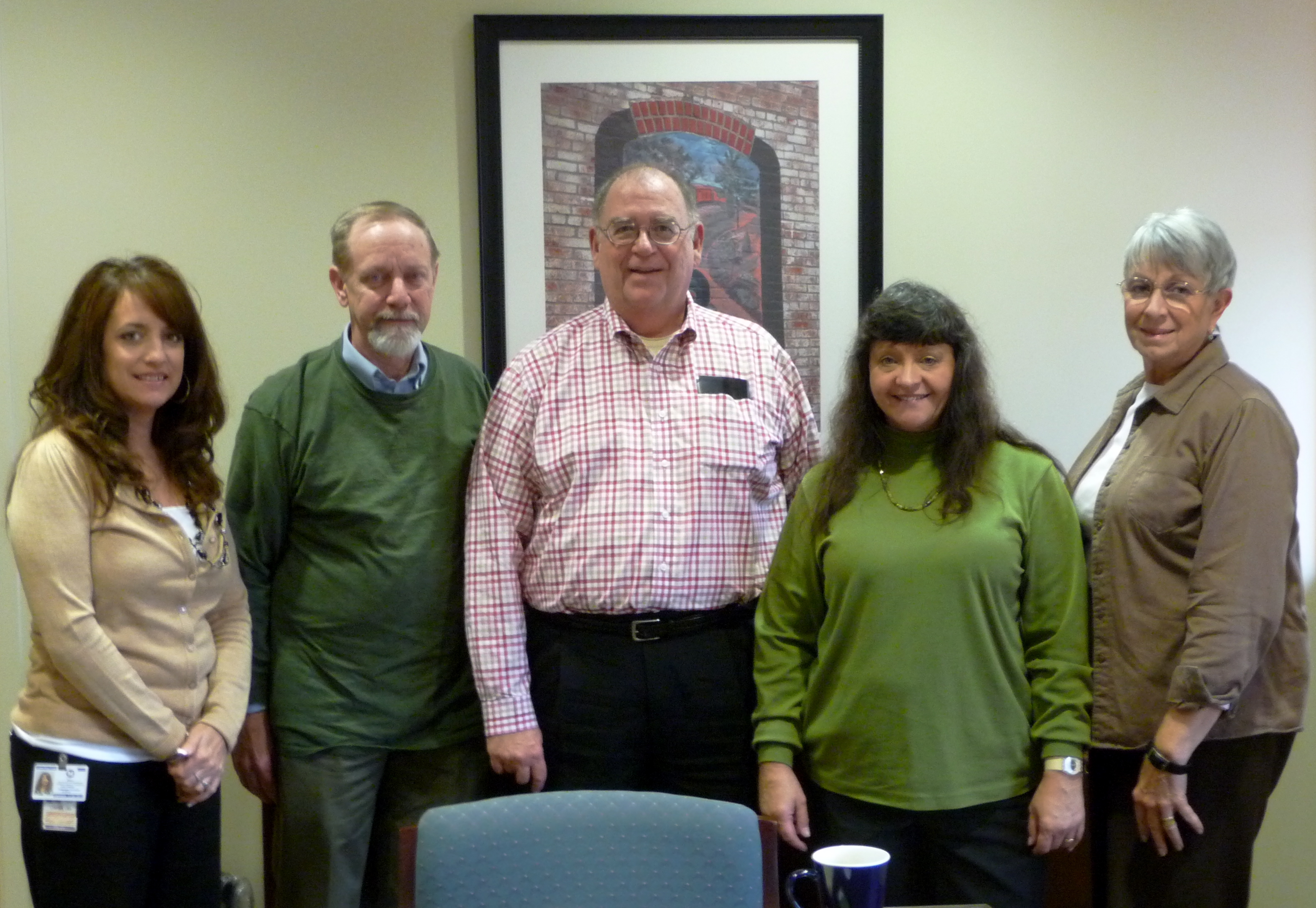
Lisa Lamons, Ron McLinden, Mayor Randy Rhoads, Janet Rogers and Margie Richcreek

May 17, 2010. Transit Action Network members Margie Richcreek, Janet Rogers and Ron McLinden met with the new Lee’s Summit mayor, Randy Rhoads, for an hour.  Lisa Lamons of MoDOT joined us.

Lee’s Summit is trying hard to satisfy the transit needs of its residents and has recently expanded the service area for its Metroflex service.

Janet had previously discussed with Mayor Rhoads the possibility of Lee’s Summit losing its status as a separate “urbanized area” and thus its small-urbanized area grant for transit. The current grant helps to fund the Lee’s Summit Metroflex for seniors, along with some Eastern Jackson County commuter routes. The grant is based on the fact that Lee’s Summit was classified as a “small urbanized area” following the 2000 census. The city has grown so much since then that it will probably lose this classification in the 2010 census, and the associated grant money would no longer be available. We discussed alternate funding for these routes, including Jackson County’s ability to use Missouri legislation to start a county transit authority to fund transit.  We provided information about the benefits of establishing a county transit authority, and offered to serve as a resource.

We discussed using the Missouri Transportation Development District Act for transit improvements, as has been done in the Centerpoint TDD that will fund a new route in Independence. This legislation is particularly good for public/private partnerships in transit.

In addition, we discussed the need for a contingency plan for increasing the commuter express service if gas prices spike in the near term.  We hope that Eastern Jackson County communities, KCATA and Jackson County can have a plan to avoid the type of transit crisis we had in the summer of 2008 when everyone was surprised by the rapid gas price increase.

We invited Lisa Lamons of MoDOT to piggyback on our meeting.  Lisa manages the state-funded Amtrak passenger service between Kansas City and St. Louis, and has been meeting with community leaders along the route to gain their support.  She described recent projects to improve track capacity, and the resulting dramatic improvement in on-time performance of the Amtrak “Missouri River Runner” trains to 93 percent on-time — best of any corridor in the country.  Lisa has marketing resources available and offered to help promote local events and attractions as a way to build ridership.

Mayor Rhoads was very receptive to the information. Since much of the material is new to him, he promised to give it careful consideration.

Janet Rogers

May 26, 2010

Posted in Uncategorized | Leave a Comment »

Mike Sanders will be on Up to Date Tuesday May 25, 2010 at 11:00 am

Posted by Transit Action Network on May 24, 2010


Mike Sanders will be on Up to Date tomorrow, KCUR 89.3FM at 11:00 AM.

They will discuss the County’s Regional Rapid Rail concept, the charter review process and property assessment.

Posted in Rail, Regional Rapid Rail, RRR | Tagged: | 2 Comments »

TAN to City Council–Postpone Support for Commuter Rail

Posted by Transit Action Network on May 20, 2010


Two weeks ago Mike Sanders and Jim Terry (TranSystems) presented the Regional Rapid Rail concept to the Kansas City Council and requested a letter of support for a $4.5 million earmark to do an Alternative Analysis of this concept and supporting transit. The Kansas City Council proposed a resolution to provide this letter. Testimony was held this morning on the resolution.  Mike Sanders and Jim Terry spoke in favor of the resolution. Ron McLinden spoke in favor of putting the resolution on hold until the MARC Commuter Corridor Study is complete in 6-8 weeks. This study is supposed to evaluate the feasibility and viability of the concept. The legislative committee passed the resolution this morning.

Link to Kansas City’s resolution

http://cityclerk.kcmo.org/liveweb/Documents/Document.aspx?q=YqMTgyrZqfbuzQ4IU2LxaHt4aTbzM6yZAILEMUBDk4MoMoIapbXkhY9XeKSqKxrE

Below is a copy of Ron’s statement this morning.

Presentation to the Kansas City Council Legislative Committee on May 20, 2010 by Ron McLinden

The idea of turning underused rail lines into a regional transit system is appealing – almost seductive.  There’s a lot of interest in having rail transit.  Every big city has it, and we don’t want to be left behind.  There’s less agreement, of course, about where it should go, and how we should pay for it.

In January, 2008, when the ATA was doing its most recent light rail study, you heard a presentation from Jeff Boothe, a rail transit expert from Washington, DC.  I recall distinctly one of the things he said:  Before you do light rail you need to know what you want it to do for you.

The same applies today.  What do we want rail transit to do for us, and will this proposed system actually do it?

You may be aware of a commuter corridors study that Mid-America Regional Council has had under way for about six months.  Its principal focus is to determine whether this commuter rail concept makes sense:  Can it deliver the travel time savings needed to attract enough riders to make it a viable project, one that can successfully compete for federal funding?  That study should be completed in six to eight weeks.  We suggest that you hear the results of the MARC study before you endorse the concept.

The concept envisions using city streets for some of the most critical rail segments, and it would cross several boulevards at grade.  We suggest you get input from your Public Works Department, and also from the Parks Board.

If you adopt this resolution now, before you have all the facts, you will further heighten public expectations about a concept that might or might not be viable.  The resolution says that you support asking for federal money to study the proposal further, but the headlines will say that commuter rail is a big step closer to becoming reality.

Candidly, we’re concerned that this proposal is a distraction from more fundamental transit issues:  What kind of total transit system will best serve the citizens of Kansas City, and help our city to grow as the vibrant urban center of the region?  How can we assure adequate and reliable funding for the transit service we already have, and for expansion to meet growing needs?

All of us applaud Jackson County’s interest in transit, and we should seize this opportunity to work with the County to put in place a mechanism for county-wide funding of major transit corridors, including commuter service using buses or rail.  Creating a county transit authority under existing state law is one such funding mechanism.  Jackson County outside Kansas City has unmet transit needs, and funding will be needed regardless of what kind of transit service is ultimately provided, so let’s get going on it now.

In summary, here’s our request to you:

+  Put this resolution on hold pending the results of the MARC study, and input from Public Works.

+  Join with other elected officials and work with Jackson County to establish a broader funding base for transit through creation of a county transit authority.

KC Regional Rapid Rail Concept

Posted in Rail, Regional Rapid Rail, RRR | Tagged: , , , | 2 Comments »

Small Steps Toward Seamless Transit

Posted by Transit Action Network on May 19, 2010


The Transit Action Network wants “seamless transit” for the Kansas City region.

What do we mean by seamless transit?  Basically it comes down to making it easier to connect among the three transit systems (ATA, The JO, and UGT).  Shared bus stops with posted schedules and other information, especially where routes intersect.  A common monthly transit pass, or at least having the three systems accept each other’s monthly passes. Simple things.

At lot is happening in transit right now, and it might seem reasonable to postpone some of these details while dealing with more immediate issues.  We think this is precisely the time to do it.

Looking just at Johnson County, for example, there are opportunities that shouldn’t be lost.  Beginning In July, Johnson County Transit will add trips on Metcalf and Shawnee Mission Parkway, and will launch a new route on 75th Street that will connect with MAX and other ATA routes in Waldo.  In addition, federal stimulus money has been awarded to JCT to prepare for BRT (bus rapid transit) in the Metcalf / Shawnee Mission Parkway corridor, with connections to MAX at the Plaza.

The ATA’s Route 175 currently operates along Metcalf between 95th and 119th, three trips in the morning and three in the afternoon.  That route, along with the new JCT service to begin in July, presents opportunities to improve connectivity for transit users.

Consider:

1 – Add information about the new JCT service at MAX and other stops in Missouri, and to let people know that the two systems honor each other’s transfers.

2 – At Waldo, make sure the new JCT route serves the MAX stop directly, rather than forcing people to cross 75th Street and walk 150 yards to connect to MAX.

3 – At Waldo and the Plaza, add a map of the several routes that radiate outward from those stops.

4 – At the Metcalf South park-and-ride lot, add a schedule poster and information about where to board the ATA Route 175 bus that passes by on 95th and Metcalf, but doesn’t serve the park-and-ride.  (Better yet, reroute the 175 to serve the park-and ride lot.)

5 – When new bus stops are posted along Metcalf, have them show what routes serve them, ATA as well as JCT routes.

6 – Wherever passenger shelters are installed, provide information about transit service.  Every shelter is a 24/7 presence for transit, and should be used as part of the transit marketing plan.

7 – Show all connecting routes when JCT and the ATA publish new or revised pocket schedules, or publish such information on their respective websites.

JCT and the ATA, working with MARC, have been partners in applying for and receiving the federal stimulus money for transit that was announced back in February.  They should use this closer level of cooperation and coordination to make their respective transit services work more like a seamless regional system.

Ron McLinden

May 18, 2010

Posted in Seamless Transit | Tagged: , | Leave a Comment »

Hello world!

Posted by Transit Action Network on May 10, 2010


Transit Action Network welcomes you to our blog.  We’ll  keep you informed about transit in the Kansas City region.

We regularly attend and participate in public meetings where key decisions are made — at Mid-America Regional Council, at city councils and county legislatures or commissions, and at transit agency governing bodies.

We establish contact with key public officials and present the case for improved transit service and more reliable funding.  We also maintain close working relations with staff at all of the relevant agencies.

Because we recognize that we can’t do everything by ourselves, we maintain informal relationships with other organizations and individuals who are also doing great work in support of transit.

Bottom line, we are involved.  Only by being involved can we expect to make progress.

We invite you to be involved, too.  Sign up to be notified about future transit actions, activities and opportunities to support improved and expanded transit in our region.  You’ll also receive notices of new blog postings.  And if you “tweet,” become one of our Twitter followers to receive occasional timely updates.

Informed people make the best advocates.  Get informed, get involved, help improve and expand transit service in the Kansas City region.

Posted in Uncategorized | 1 Comment »