Transit Action Network (TAN)

Advocates for Improved and Expanded Transit in the Kansas City Region.

That Penny Sales Tax — Here’s What We Are Telling the Legislature

Posted by Transit Action Network on February 3, 2014


MOstateflagLast year the Missouri General Assembly considered a referendum (SJR 16) that would ask Missouri voters to approve a ten-year “temporary” one-cent sales tax for the purpose of increasing funding of our transportation systems.

The measure was filibustered and failed in the final days of the session.

It was anticipated that an initiative petition would be circulated early this year, but the Post-Dispatch reports that those plans have been suspended pending another try in the General Assembly.

Representative Dave Hinson has filed HJR 68

http://www.house.mo.gov/billsummary.aspx?bill=HJR68&year=2014&code=R

and Senator Mike Kehoe has filed SJR 48.

http://www.senate.mo.gov/14info/BTS_Web/Bill.aspx?SessionType=R&BillID=28965054

The two bills are virtually identical to those considered last session.

The House Transportation Committee will hold a hearing on HJR 68 on Tuesday, February 4, at Noon in the Capitol Building.  The Senate Appropriations Committee will hold a hearing on SJR 48 that same day at 8:30 am.

We are submitting written testimony to the committees. We encourage others to consider submitting testimony as well.

Following is our statement regarding these bills:

To: Senators Kehoe and Schaefer and members of the Senate Appropriations Committee

Representatives Hinson and Schatz, and members of the House Transportation Committee

From: Transit Action Network (an association of individuals and organizations who work to expand and improve public transit in the Kansas City region)

Subject: SJR 48 and HJR 68 – Testimony for Information Purposes

Please consider this testimony regarding SJR 48 and HJR 68.  We neither support nor oppose the resolution as introduced, but want to offer our perspective.

[1] – Taking Care of the System.  We acknowledge the need for additional funding for MoDOT to keep the existing system of roads and bridges in a state of good repair.  Director Dave Nichols cites a need for $485 million per year to do that, and says he expects to have only $325 million per year beginning in 2017.  We support closing that $160 million gap.

[2] – Need for Transit.  Missouri needs to provide significant additional funding for rural and urban public transit.  We are at or near the bottom among states with significant urban populations in providing state support for transit.  Moreover, if it makes sense for the state to provide farm-to-market roads, it also makes sense to provide “workforce-to-workplace” transit.

[3] – Changing Demographics and Preferences.  Our senior population is growing, along with an increasing inclination for young people to postpone or forego getting a driver’s license.  Nationally, driving peaked about 2006.  Thus, there is an increased need for public transit, and also for intercity passenger rail service such as that provided by our Missouri River Runner trains.

[4] – Concern About the Sales Tax – User Pays Principle.  We are aware of broad concern about using a sales tax to fund an expanded road and bridge program.  That would be a dramatic departure from the long-standing “user-pays” principle for roads and bridges, using the motor fuels tax, vehicle registration fees, and the sales tax on motor vehicles.  To the extent possible, road and bridge costs should be borne by the users and passed through to ultimate consumers as part of the overall cost of goods and services.

[5] – Concern About the Sales Tax – Regressivity.  We are aware that the sales tax is among the most regressive taxes, with the burden falling disproportionately on low-income workers.  These are the very workers who are less likely to drive and more likely to rely on public transit.

[6] – Concern About the Sales Tax – Local Needs.  We are aware of many local needs for which public officials look to a local sales tax.  Thus, there’s reluctance on the part of local public officials to get behind a significant increase in the state sales tax.

[7] – National Discussion on Funding for Roads and Bridges.  There is broad recognition that there are structural problems with total reliance on the motor fuels tax (due in part to changes in energy sources for motor vehicles), and that a shift toward a broader array of user fees makes sense.  We suggest that this might not be the time for Missouri to shift to the sales tax for roads and bridges while other revenue sources are under consideration.  We also suggest that ten years might be too long to commit to a sales tax while other user-based revenue sources are still being considered.

[8] – Here’s What We Think Might Have Greater Appeal.  We believe the following might have greater appeal to voters, as well as to local elected officials:

a – A smaller and shorter-term transportation funding program.

b – An increase in a combination of existing user fees to fund needed improvements to the existing road and bridge system

c – A small increase in the sales tax — as little as two-tenths of one cent — to fund improved and expanded rural and urban public transit, and to stabilize funding for the state-sponsored Missouri River Runner trains operated by Amtrak.

Thank you for considering our testimony.

Posted in Regional Transit Issue | Tagged: | Leave a Comment »

Attend Public Budget Hearing in KCK Feb. 6

Posted by Transit Action Network on February 3, 2014


UG logoTransit supporters needed to help shape the future of transit in Wyandotte County/KCKconnex.

Where: Public Budget Hearing
Commission Chamber
701 N 7th Street
Kansas City, Kansas
 
When: February 6, 2014 at 7 PM
Contact rlindsey@wycokck.org for additional information

Sign up to speak when you first arrive and prepare up to 5 minutes of testimony in support of transit needs in Wyandotte County. Also, be sure to thank the Commission for the great transit improvements over the last year, including the upgrade of Route #101 to the State Ave. CONNEX service with beautiful new facilities and transit centers and an upgrade to large buses on the route. See you at the hearing!!


Posted in Action, Events, Local Transit Issues | Tagged: | Leave a Comment »

Action Alert: KCMO – Please Allow A New Transit Service For The Elderly and Visually Impaired

Posted by Transit Action Network on January 30, 2014


kcmo_big_logoTransit Action Network sent the Kansas City Transportation and Infrastructure (T&I) Committee a letter of support for Ordinance 140028, which would allow a local non-profit charitable organization affiliated with a state or national non-profit charitable organization to operate a vehicle for hire to transport persons who are 65 years of age or older or visually impaired. TAN letter of support for Ordinance 140028

Currently there is an ordinance protecting taxis from competition. This ordinance narrowly opens the door for a limited type of organization to provide “for hire” transit services for a limited group of people, but the ordinance is significant since it changes the “status quo”.ITN_KC-2

The issue came up because a new service provider, Independent Transportation Network® (ITN) — the first and only national non-profit transportation system for America’s aging population, wants to enter the Kansas City market.  They are in 25 markets around the country and they already operate in Lee’s Summit.

ITN provides a unique service that taxis and most paratransit services don’t offer.

From ITN’s Greater Kansas City website:

Characteristics of the Service

  1. Membership based – people 65 years and older (age eligibility varies by affiliate), and visually impaired adults are eligible to join
  2. Community based affiliates are supported by private, rather than public resources
  3. Affordable fares that are typically lower than a comparable taxi ride
  4. Available 24/7 for any purpose
  5. Not “just a taxi” – drivers provide arm-through-arm, door-through-door service and help with packages
  6. No money is exchanged in the vehicle, and tips are not accepted
  7. Riders pre-fund a Personal Transportation Account™, and a monthly statement details all payments and charges
  8. Uses private automobiles, rather than vans or buses
  9. Fees cover rides booked at least 24 hours in advance; same day requests will be accommodated with an additional fee

Most taxi and special transportation services for the elderly are curb-to-curb (you have to get yourself to the curb) or door-to-door (you have to get yourself to the door). There are a growing number of frail elderly people or visually impaired people who require additional help.  ITN provides that additional help with their arm-through-arm, door-through-door service (if needed, drivers come into the home or the office or the shops to assist you getting to the vehicle). This service does not apply to people requiring a wheelchair, since ITN uses private automobiles.

This extra level of service comes at a price. ITN is a monthly subscription service. Since they aren’t asking for a public subsidy, users have to cover the cost, but the drivers are volunteers, which help keep the cost down. A monthly pilot subscription in Lee’s Summit costs $125. Contact ITN for more details. Phone: (816) 500-4377 Email: info@itngreaterkansascity.org

We can’t vouch specifically for ITN, but we do know that it is time to provide more transportation options for the elderly and visually impaired since there is a transit crisis looming caused by the rapid increase in the elderly population. MARC is already having meetings to find a way to deal with the issues related to “Older People Transportation” and we need to allow additional legitimate services to operate.

We’d like to thank Councilmen Johnson and Sharp for sponsoring this ordinance and we request that the mayor and full council adopt Ordinance 140028.

If you haven’t already done so, please contact your council member or the mayor and request adoption of Ordinance 140028.

The T&I committee is expected to address this ordinance on February 6, 2014 at 8:45 am at City Hall, 10th Floor.

ITN America website

Posted in Action, Local Transit Issues | Tagged: | Leave a Comment »

The Penny Sales Tax is Back – And What to Do About It

Posted by Transit Action Network on January 27, 2014


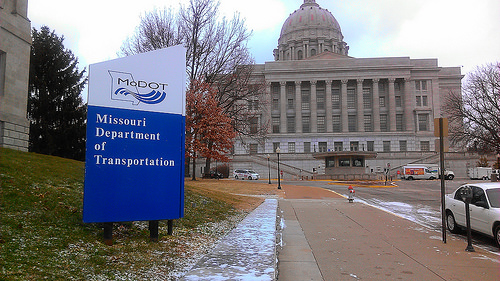
MoDOT Headquarters and Missouri State Capitol. No other major department of state government has closer proximity to the General Assembly.

MoDOT Headquarters and Missouri State Capitol. No other major department of state government has closer proximity to the General Assembly.

Summary: [1] The penny sales tax is back.  [2] A sales tax for highways is a bad idea. [3] If something more reasonable is to even be considered by the General Assembly, it’s up to leaders in Missouri’s urban areas to make it happen.

That penny sales tax for transportation — the one that was defeated in the closing hours of the legislative session last spring — is back.

Rep. Dave Hinson filed House Joint Resolution (HJR) 68 in the House on January 22, and Sen. Mike Kehoe is expected to file a corresponding and presumably identical measure in the Senate during the coming week.

HJR 68
Proposes a constitutional amendment imposing a 1% temporary increase in the state sales and use tax to be used for transportation projects

http://www.house.mo.gov/billsummary.aspx?bill=HJR68&year=2014&code=R

Full text of the bill as introduced:

http://www.house.mo.gov/billtracking/bills141/biltxt/intro/HJR0068I.htm

A summary of the bill has not yet been posted.

Support for it is already being garnered.  After all, if the mostly-highway-lobby sponsors of the tax proposal can it put on the ballot by the legislature, they can avoid the $1-2 million estimated cost of circulating an initiative petition.

On January 23 the Missouri Chamber of Commerce, along with the Farm Bureau, State Highway Patrol, and MoDOT, held their annual transportation conference.  MoDOT’s Chief Engineer Ed Hassinger spoke about the new long-range plan, Vision for Missouri’s Transportation Future.  He was followed by Representatives Hinson and Schatz and Senator Kehoe.  MoDOT’s Director, Dave Nichols, was the luncheon speaker.

By all of the accounts we’ve seen — tweets during the conference and subsequent news reports — the discussion was all roads and bridges.

That shouldn’t surprise anybody, given that it was the Missouri Chamber and Farm Bureau whose support was being sought. We suspect transit and other modes were at least mentioned — in response to a tweet from Tom Shrout of St. Louis, MoDOT Director Nichols gave assurance that he would speak about all modes — but in effect it was all about roads and bridges.

The message was dire: If MoDOT doesn’t get additional funding pretty soon, it will barely be able to maintain Missouri’s 33,000 miles of roads in good condition.  Whats more, within just a few years MoDOT won’t even be able to afford the matching money needed to get the federal funds expected to be available to Missouri.

Pretty stark.

Presentations at the conference were undoubtedly oriented to support what is widely anticipated to be the likely funding solution — a one penny increase in the state sales tax.

We know MoDOT people well enough to believe they’d probably rather get the new money from some other source. After all, they know the sales tax doesn’t do anything to recover from highway users the full cost of building and operating roads and bridges. They know that the sales tax hike gives the trucking industry a free ride, since there’d be virtually no increase in revenue from trucking, even though trucks put an undue burden on roads and bridges, and cause MoDOT to have to build them to carry heavier loads.

MoDOT is in the unenviable position of wanting to maintain our roads in good condition, and to expand capacity where it might be needed, yet having virtually no say in where the money comes from.

But on the other hand, wouldn’t it make sense for MoDOT to at least make a case for some other revenue enhancing scenarios — even if those scenarios don’t have much chance of success in the current political climate in the Legislature? After all, one can’t expect to get support for something unless somebody has at least made a good case for it. Past efforts by MoDOT to get other sources of funding considered have been largely a matter of “testing the political wind,” rather than laying out a “here’s what really makes sense” proposal.

The January 23 conference wasn’t about how best to raise the money.  Instead, it was about building support for the sales tax.  Period. It didn’t matter that the sales tax is regressive, and that it has met resistance from many quarters, including local public officials across the state. We know, for example, that elected officials in the Kansas City area are notably cool to the idea. After all, there are local needs that involve putting sales tax measures on the ballot. Think expansion of the Kansas City Streetcar System. Think Jackson County’s Trails and Transit Plan. And it certainly didn’t matter that trucks would get off scot free.

We recognize, by the way, that a small sales tax might be necessary to provide additional state funding for urban and rural public transit, inter-city passenger rail, and other non-highway modes.  A sales tax of two-tenths of a cent would be more than adequate for those needs.

In his State of the State message on January 21, Governor Jay Nixon called for “robust discussion” of our transportation needs and how to fund them.

A robust discussion can’t be expected to occur at a Missouri Chamber / Farm Bureau conference that was designed to build support for a penny sales tax. If anything, that conference probably served to heighten the division between Missouri’s rural and urban interests.

If we are to see anything resembling the robust discussion that Governor Nixon called for, it’s going to have to be sparked by urban leaders.

We suggest that Mayors James (Kansas City) and Slay (St. Louis), county chiefs Sanders (Jackson) and Dooley (St. Louis), MPO directors Warm (Mid-America Regional Council) and Hillhouse (East-West Gateway Council of Governments), civic leaders — plus the Governor himself — come together and have that robust discussion.  We’d expect the outcome to be a far more reasonable and equitable solution for funding Missouri’s transportation needs than a simplistic penny increase in the sales tax.


Posted in Regional Transit Issue | Leave a Comment »

State Ave. CONNEX Gets Big Buses Jan 5

Posted by Transit Action Network on December 23, 2013


UG logoRiders Rejoice!  The 101 – State Avenue CONNEX route in Wyandotte County/KCK will start using large buses seven days a week on January 5, 2014.connex

TAN advocated for this upgrade and we are extremely happy that the change is being made.

We recently communicated with Mayor Holland and reminded him of the commitment he made last February during our candidate forum to alleviate the overcrowded conditions on this route when it changed to a Connex service . UGT was expecting about 1400-1600 riders daily when the Connex route started, but instead they have seen days with 2200-2300 riders.

Even though the mayor, commissioners and the city administrator knew how overcrowded this route was, they had to find a way to pay the additional $230,000 yearly for the larger buses. UGT and KCATA worked with everyone to find a financial solution. Congestion Mitigation Air Quality (CMAQ) funds will provide 80% the money next year with Unified Government providing the local matching funds.  Read KCATA’s news release

Now riders can enjoy more room on the buses as well as the improved facilities provided by the TIGER grant.

Transit Trends in UG

Recently Unified Government has been improving transit when there is a demonstrated need, such as the planned Rosedale/Argentine line. TAN hopes this favorable attitude toward transit continues.

In 2012 Mayor (then Commissioner) Holland  worked with TAN when we successfully advocated for large buses on Saturdays for this same route.

Last February we questioned the mayoral candidates about this very issue and received a campaign commitment from then candidate Holland.

Mayor Holland answered our forum question regarding the already overcrowded Route #101 with a resounding commitment to improve the service later in the year.

Question: Route 101 will change to the Connex service later this year. Will you make sure that the upgrade in service level is enough to alleviate the current overcrowded conditions, without negatively impacting other services?

 Mark Holland – Absolutely. It looks like this improvement will make a huge difference.

See all of his answers in our the February forum. http://wp.me/pV5fE-1rK

Unified Government does not have any revenue dedicated to transit like Kansas City, MO does, but prefers to allocate funds as needed.  Their local transit funds come out of the General Revenue account, so it is good to see the County providing additional funds for transit when a definite need arises.

TAN particularly appreciates the commitment to better transit from Mayor Holland, Commissioner Murguia and the Assistant County Administrator, Gordon Criswell (who is in charge of transit). Commissioner Murguia is now a member of MARC’s Total Transportation Policy Committee, which means we will see her on a regular basis to discuss transit issues in Wyandotte County.

Riders, enjoy the large buses!

Posted in Local Transit Issues | Tagged: , | Leave a Comment »

Attend the First Transit Stakeholder Forum – Dec 17

Posted by Transit Action Network on December 9, 2013


marclogoMid-America Regional Council (MARC) has announced the first meeting date for the new Transit Stakeholder Forum.Transit_Stakeholder_Fourm-2

When: December 17, 2013,  5 pm to 6:30 pm
Where: Mid-America Regional Council
600 Broadway, Suite 200, Kansas City, Mo

No membership is required for this forum and meetings are open to the public.

This meeting marks the beginning of a new chapter in transit outreach in the region. This forum provides an opportunity for public feedback from users, potential users and advocates to improve the transit experience in KC.

MARC wants to widen participation in transit discussions by including all interested parties and getting positive feedback for improvements to the regional transit system.

From the MARC website:

This forum provides public input for the Transit Coordinating Council, which advises MARC, the Kansas City Area Transportation Authority and local transit partners and jurisdictions on issues, such as regional transit planning, coordination and implementation of priorities.Transit_Coordinating_Council-2 The goals for this forum include:

  • Providing input to the area stakeholders about improvement of accessibility of area transit services.
  •  Providing input on the expansion of regional transit services, in ways that are consistent with the Smart Moves Regional Transit Vision.
  •  Allowing for some interaction with members of the Transit Coordinating Council or members of partner agencies and MARC representatives.

The Transit Stakeholder Forum (TSF) and the Transit Coordinating Council (TCC) work together to replace the MARC Transit Committee. The TCC has already started working on system improvements toward achieving seamless transit and part of the first meeting will be spent presenting those changes and asking for input to make the improvements even better. Some improvements include an online interactive regional transit map for the whole system and getting Google Trip Planner and the Regional Call Center to work for the whole system. Read our previous post New Transit Coordinating Council Off To a Good Start to see what TCC has been working on.

The meeting will provide an opportunity for the public to meet with representatives from each of the transit agencies.

This meeting is not a one-time event, although the Forum doesn’t currently have a meeting schedule. A meeting schedule should be discussed at the first meeting. The TSF is one of MARC’s standing committees and it functions as an adjunct to the TCC. They need to work together to get the best results.

The TSF can help minimize or eliminate the barriers to seamless travel in the KC region and provide a better transit system, but only if the public gets involved. The biggest challenge will be to make improvements within the limited funds available for public transit. TCC is already working to increase those funds.

TAN has advocated for a public transit forum for a long time.  Now that we have it, let’s make it a success!

If you are unable to attend this meeting and wish to submit a comment or questions through TAN, please send us an email at TransActionKC@gmail.com See you on December 17th!!!

See MARC’s webpage for the Transit Stakeholder Forum

Posted in Action, Events, Local Transit Issues, Regional Transit Issue, Seamless Transit | Tagged: , , , , | Leave a Comment »

Missouri’s Transportation Future – Our Latest Analysis

Posted by Transit Action Network on November 21, 2013


On November 18, MoDOT called its regional planning partners to Jeff City to lay out the process for developing a list of projects that would accompany a transportation funding question that could be on the November, 2014, ballot. That question — should it clear the necessary hurdles either through the initiative petition process or by act of the 2014 General Assembly — would ask Missouri voters to approve a one-cent increase in the state sales tax for a period of ten years, producing a total of about $8 billion. The project list would let voters see what they’d be getting. It’s all about accountability, and accountability is good.

Before saying any more we should remind our readers that the penny sales tax is still just a proposal — albeit the most-often discussed proposal — by which Missouri would get additional money for transportation purposes. As we’ve reported previously, there are rumblings of opposition to the proposal. Whether proponents — including highway contractors and chambers of commerce and others having a stake in improving highways — will be able to raise enough money to finance a petition process and then an election campaign to pass the measure, is still unknown. Read our earlier entry:
www.flickr.com/photos/58867268@N03/10808168813/

Based on a briefing by MoDOT and MARC staff at the November 19 meeting of MARC’s Total Transportation Policy Committee, it appears that a lot less is set in stone than we had expected. Moreover, indications are that MoDOT is willing to have the project list include just about anything — anything transportation-related, of course.

A tentative spending plan circulated by MoDOT earlier this year had well over $1 billion coming off the top for reconstruction of the 200 rural miles of I-70 as a six-lane freeway. That is no longer a given. Even the idea of building six lanes all the way is apparently no longer to be taken for granted. That shift in itself is real progress.

Vision for MOUnder MoDOT’s plan, its regional planning partners — Metropolitan Planning Organizations like Mid-America Regional Council in Kansas City and East-West Gateway Coordinating Council in St. Louis, plus Regional Planning Councils throughout the rest of the state — will develop their priority lists between now and next June.

Meanwhile, MoDOT will develop a very general plan for how the projected $8 billion dollar pie would be carved up among categories of needs and jurisdictions. It’s anybody’s guess what that might look like. There might well be a few slices off the top:
– A slice for I-70, as has previously been discussed?
– A slice for public transit, to be divided among the state’s dozen or so transit providers?
– A slice to assure funding for the Missouri River Runner passenger trains between Kansas City and St. Louis.
– Maybe even a slice for some hypothetical “challenge grant” programs to help local communities do long-needed smaller projects?

Whatever off-the-top slices there might be for statewide needs and programs, there would also be an allocation to each of MoDOT’s seven districts for projects to be decided in consultation with MPO’s and RPC’s.

Sound complicated? Well, it probably is, and we have a hunch that even MoDOT’s top staff don’t know yet how it’s going to play out.

What we do know is that we’ve never before seen a proposed spending program that is so open to public involvement and input.

That’s where you come in.MOTM

[1] – MoDOT’s draft long-range plan, “A Vision for Missouri’s Transportation Future,” is now out for a 45-day comment period. Here’s the website:
www.missourionthemove.org/
Throughout the site you’ll find opportunities to click on an orange box and let MoDOT know what you think. Do it!

[2] – Get involved in MARC’s ongoing long-range transportation plan update process:
www.to2040.org/
Begin with MARC’s online survey about priorities:
to2040.questionpro.com/

Transportation_Outlook_2040A final note. We’ve noted before that there are reasons to be concerned about passing a sales tax for transportation and nothing else, while highway user fees are among the lowest in the nation. Perhaps legislators will take that concern seriously in January and devise a revenue package that gives MoDOT enough to keep it going while also meeting other important state investment needs. Meanwhile, it’s important that we play along while we press MoDOT and its planning partners to devise as progressive and inclusive a transportation investment program as possible.

Posted in Action, Regional Transit Issue | Tagged: , | Leave a Comment »

Public Meeting for Streetcar Expansion – North of the River – Nov 21

Posted by Transit Action Network on November 20, 2013


Want to get involved in the expansion of the streetcar north of the river? NorthRail_Kick-Off_Flyer

Attend the first public meeting and share your ideas.

When: Thursday, November 21, 6:00PM to 8:00PM
Where: Community Room, North Kansas City Community Center
1999 Iron St, North Kansas City, MO 64116

Direct questions to Karen Clawson at kclawson@marc.org

Posted in Events, Local Transit Issues, Rail | Tagged: | Leave a Comment »

New Transit Coordinating Council Off To a Good Start

Posted by Transit Action Network on November 15, 2013


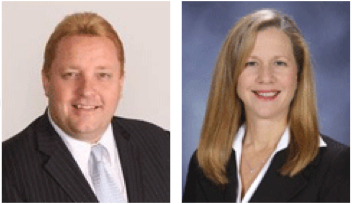
marclogoTransit Action Network is very pleased with the initial efforts of the new regional Transit Coordinating Council (TCC), which is co-chaired by Robbie Makinen of Jackson County and Chairman of the KCATA Board, and the mayor of Mission KS and MARC board member, Laura McConwell.

Robbie Makinen of Jackson County and Chairman of the KCATA Board, and the mayor of Mission KS and MARC board member, Laura McConwell

Robbie Makinen of Jackson County and Chairman of the KCATA Board, and the mayor of Mission KS and MARC board member, Laura McConwell

The new council partially replaces the MARC Transit Committee. The Council consists of local policy officials, and transit and planning professionals.

METRO ogoThe Council has had two meetings, Sept 4th and Nov 6th.

The fractured nature of the region’s transit is well-known so this council is very welcome. It was heartening for transit advocates to hear major regional players actively engaged and enthusiastic about improving transit.

One of the major actions taken by the Council was the establishment of the Transit Stakeholder Forum (TSF). This new forum is an adjunct to the TCC and together the two committees replace the previous MARC Transit Committee. TSF will be an open public meeting and transit riders, potential riders and advocates can comment and provide input on the projects the TCC is working on as well as make additional suggestions. MARC is expected to announce the date of the first meeting soon.

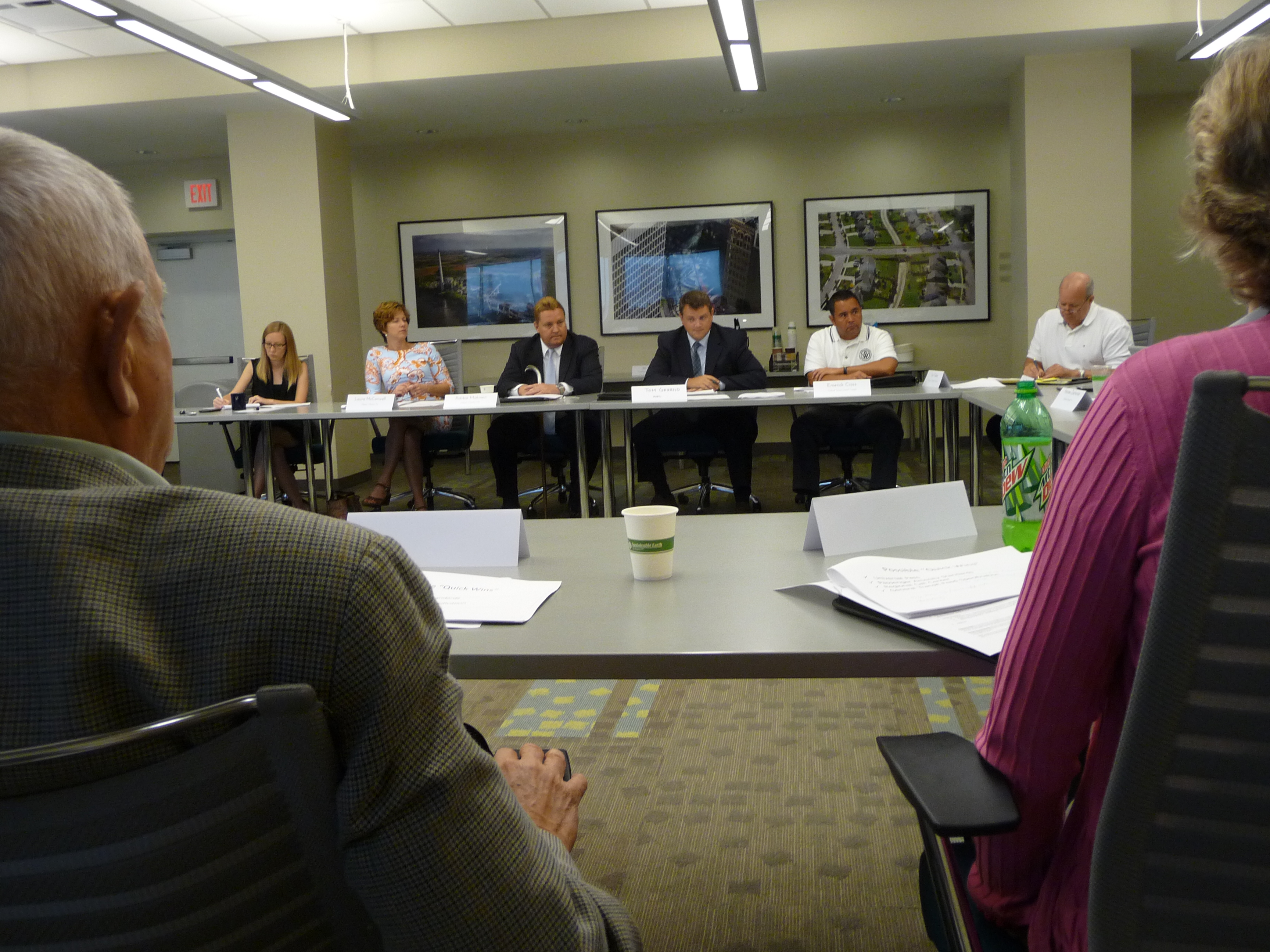
At its first meeting the Transit Coordinating Council developed a set of six priorities, “quick wins”,

At the second meeting they discussed progress on these items.

1. Regional Pass and Fare Reciprocity

First TCC meeting Sept 4, 2103

First TCC meeting Sept 4, 2103

  • Near term implementation of the The JO monthly pass as a defacto regional pass. The JO monthly pass would be accepted on all regional routes, except the premium express buses. This extends The JO monthly pass reciprocity to Unified Government Transit and IndeBus. The JO monthly pass is already accepted on the Metro. This pass costs $75.60. This change is an important step toward regional pass reciprocity but we doubt if it will affect many riders.
  • There was no discussion about The JO accepting the Metro monthly pass with a $1 up-charge as was mentioned in the draft report. We hope this change can be implemented soon but it is still awaiting approval. This change would have the largest impact on riders since people with Metro monthly passes could reduce the current cost of using The JO.
  • An effort to solve the long-term fare reciprocity issue is being addressed with a regional fare study.  The goal is to make fares consistence and improve fare recovery ratios. KCATA fares bring in about 15% of the cost, but the other agencies recovery ratios are lower. They plan to develop a “fare elasticity model” in order to make better decisions about the best time and amount to raise fares. This model helps to project the net impact on revenue since a fare increase usually causes a decrease in ridership.  Expect completion of the study early in 2014.

2. Regional Transit Call Center

  • Work is being done to get IndeBus schedules integrated into the Regional Call Center  (RCC) database so Independence can use the system. Independence still has to decide to fund the additional cost of using the RCC. IndeBus is the only agency not currently using the RCC.
  • The long-term plan is to integrate all the different regional paratrasnit services so they can use the RCC.
  • MoDOT’s 511 call function will be updated to provide a simple way to reach the RCC operator.

3. Regional Trip Planning and General Transit Feed Specification (Google Transit Feed)

TCC meeting Nov 6

TCC meeting Nov 6

  • Independence is in the process of reconfiguring its transit data to work with the industry standard, Google Transit. IndeBus is the only provider not on this system. This change will make the whole system available for regional trip planning using Google’s Trip Planner.

4. Regional Route Map and Regional Transit Service Website

  • MARC has developed a dynamic online service map.  It was made available online on Nov 6th   http://kcsmartmoves.org/ You can drill down to see the routes and link to the appropriate website. All of the regional routes are on the map. This capability is really exciting. It will be available on the transit agencies websites in the near future.
  • A printed regional map is planned in 2014.

5. Regional Transit Branding

  • A request for proposals was released on Nov. 6th to get bids for a designer to develop a coordinated regional transit brand to use as an umbrella image for all regional services. They plan to select a consultant Fall 2013
  • Branding and website development, material, marketing etc. should take place in 2014.

6. Passenger Amenity Standards

  • KCATA is developing standard passenger amenity thresholds for deploying various passenger amenities based on the number of passenger boardings at a stop.
  • Guidelines will be circulated and a technical team will review, finalize and forward for approvals as necessary. Target date 2014

TCC also accepted a workplan for 2014, which includes the items already mentioned as well as:

  • Develop regional transit performance measures and informational reports
  • Support the coordination of local study efforts
  • Initiate coordination of local paratransit services and related customer information
  • Assess and identify the best use of federal transportation funding.

The 2013 workplan requires $45 thousand for regional branding. The 2014 workplan estimates $110 thousand for the regional website/brand deployment and the Fare study. All of these budget items have been covered by local contributions.

TCC will be responsible for programming approximately $1.8 million annually of Congestion Mitigation Air Quality (CMAQ) funds for FY 2015, 2016 and maybe 2017.  Additional projects may be considered from this funding source.

In addition, STP (Surface Transportation Projects) funds of $35 million, which are programmed by another committee, will be asking for projects soon. Traditionally transit projects have had a hard time getting a share of STP funds. The streetcar was successful but that isn’t the norm. TCC decided that a larger coordinated regional project would have a better chance of receiving STP funding than smaller individual transit projects submitted separately by the transit agencies or individual jurisdictions. The committee scheduled a special meeting to Tuesday, December 3 at 9 am at MARC in order to be proactive about creating a regional application.

TCC is still working to define itself and understand its role in the region. Another function we believe the TCC should embrace is being consulted on all transit issues of regional significance. TCC needs to make itself heard and exert its presence and importance as it goes forward. For instance, recently KCMO approved Cerner’s Bannister and I-435 project, including huge incentives, but with NO requirements relating to public transit in Ordinance 130768. Cerner plans to have 15,000 employees at this location. This project is of regional significance and deserves a regional transportation impact analysis, including consultation with TCC regarding the potential for improving transit service both to the project site and throughout the I-435/I-470 corridor.

The Council plans to alternate venues between MARC and KCATA. The Council is set up to meet on a bi-monthly basis. In the off months, transit staff and MARC staff will work on the Council’s priorities.

The TCC meetings are open to the public and there is a public comment period at the end of the meeting.

TAN is very pleased with the progress and direction of the new council. We expect it to exert a positive coordinating influence on transit in our region.

MARC’s TCC presentation presented earlier this year at the  MARC Transit Committee. Presentation_RegionalTransitCoordinatingCouncilConcept011513

MARC’s website link  Transit Coordinating Council

TCC members TCC Members_092013

TAN is very engaged in seamless transit and achieving it is one of our main missions.  When Co-chair Makinen asked for our input last August we submitted a list of twelve items to him and Tom Gerend, Assistant Director of Transportation at MARC, to consider for inclusion in the TCC workplan. We are pleased that we are all on the same page about seamless transit and so many of our initial issues are being addressed.

TAN Recommendations for TCC agenda

Posted in Meeting Reports, Regional Transit Issue, Seamless Transit | Tagged: , | Leave a Comment »

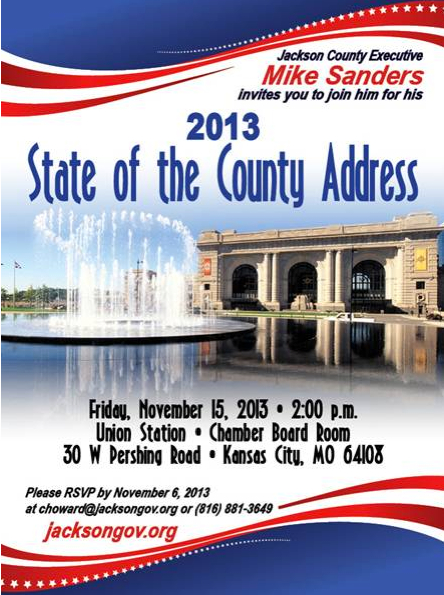
Attend the Jackson County State of the County Address Nov 15

Posted by Transit Action Network on November 12, 2013


Jackson_County_seal-2 Mike Sanders is expected to make an announcement about his transit plan, so be sure to attend.State_of_the_County_Address_2013-2

When: Friday, Nov 15, 2013 at 2 pm
Where : Chamber Board Room, Union Station, 30 W. Pershing Road, Kansas City, MO
 RSVP: choward@jacksongov.org or call 816-881-3649

Posted in Events | Tagged: | Leave a Comment »

Provide Feedback To Update The Transportation 2040 Plan – NOV 7

Posted by Transit Action Network on November 5, 2013


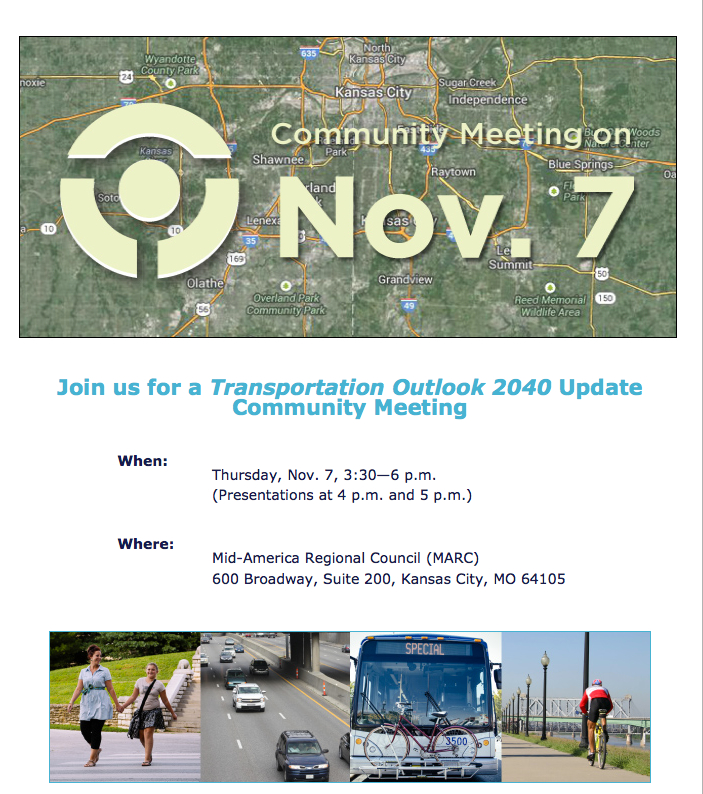
Transportation_Outlook_2040MARC is updating Transportation Outlook 2040, the Metropolitan Transportation Plan (MTP) for the Kansas City region, as required every five years by federal regulations.Public_meeting_on_Nov_7

As part of this update process, they need your feedback to ensure that the plan’s vision and goals point the Kansas City region in the right direction.

Share your thoughts on these important goals. These decisions about transportation will guide the spending of billions of dollars in transportation funds over the next few decades.

marclogoLet’s make sure Transit gets a fair share of these dollars.

When: Thursday, Nov. 7, 3:30—6 p.m.
(Presentations at 4 p.m. and 5 p.m.)
Where: Mid-America Regional Council (MARC)
600 Broadway, Suite 200, Kansas City, MO 64105

Posted in Events | Tagged: | Leave a Comment »

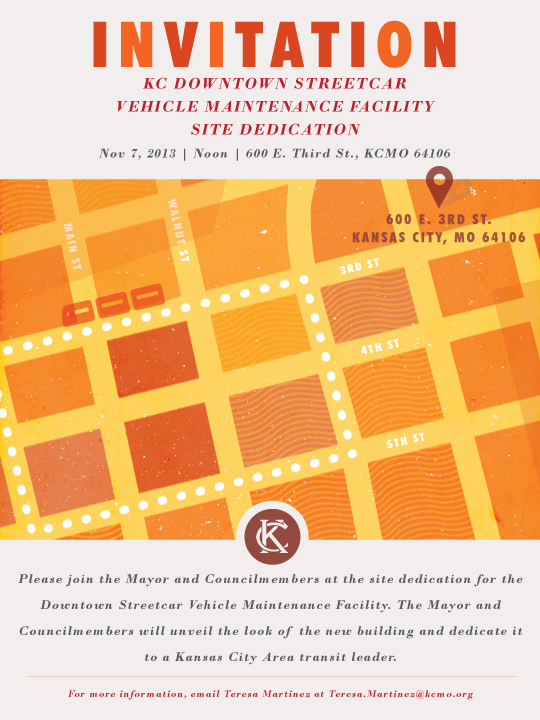
Attend The Site Dedication for the Streetcar Vehicle Maintenance Facility – NOV 7

Posted by Transit Action Network on November 4, 2013


Site Dedication for the Downtown Streetcar Vehicle Maintenance FacilityStreetcar-Blast-Invitation

When: November 7, 2013 at Noon

Where: 600 East Third Street, KCMO 64106

See the Invitation for a map and more details.

Posted in Events, Rail | Tagged: | Leave a Comment »

Public Meeting About A Possible Prospect MAX – Oct 22

Posted by Transit Action Network on October 21, 2013


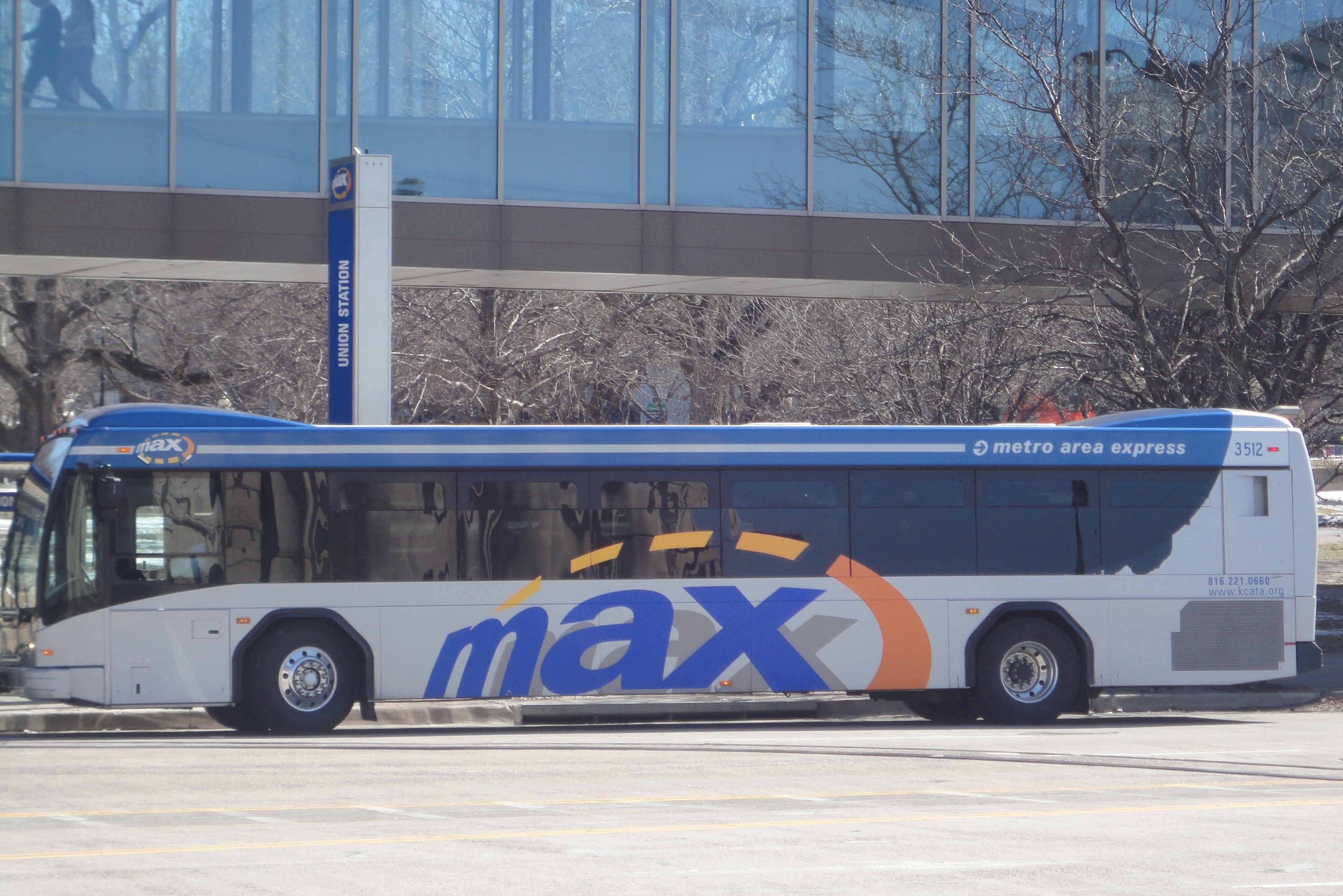
METRO logoKCATA, City of Kansas City, MO, and Mid-America Regional Council are having a public meeting to discuss the possibility of a MAX line on Prospect from Downtown to South Kansas City.

When: Oct 22, 5 pm to 7 pm
Where: Emmanuel’s Community Center, 3510 Prospect Ave., Kansas City, MO 64128MAX brt

The planning process in underway so it is important to get input from customers and area residents.

At the meeting:

  • See and tour a MAX bus
  • Ask questions about possible MAX service and submit comments
  • Enjoy complimentary appetizers

Bus connections: Take 71-Prospect or 35-35th Street to the community center. Plan a trip online or call 816-221-0660 for assistance with schedules.

KCATA link   Let’s Talk Prospect MAX

Posted in Events, Local Transit Issues | Tagged: , , | Leave a Comment »

Denver Commercial Development Booms Around Transit Stops

Posted by Transit Action Network on October 9, 2013


The new commuter rail "Canopy" at Denver's historic Union Station. The old station building is at the top of the photograph connected to the rail terminal by the portico shown; and to buses and light rail by facilities below the rail level.

The new commuter rail “Canopy” at Denver’s historic Union Station. The old station building is at the top of the photograph connected to the rail terminal by the portico shown; and to buses and light rail by facilities below the rail level.

The Regional Transit Alliance series on Transit and Economic Development recently had a luncheon talk by Phillip A. Washington, General Manager of Denver’s Regional Transit District (RTD).  Mr. Washington testified to the ability of transit to concentrate development around transit stations. The RTD is an active partner in development, with a Manager of Development and a staff of five people.

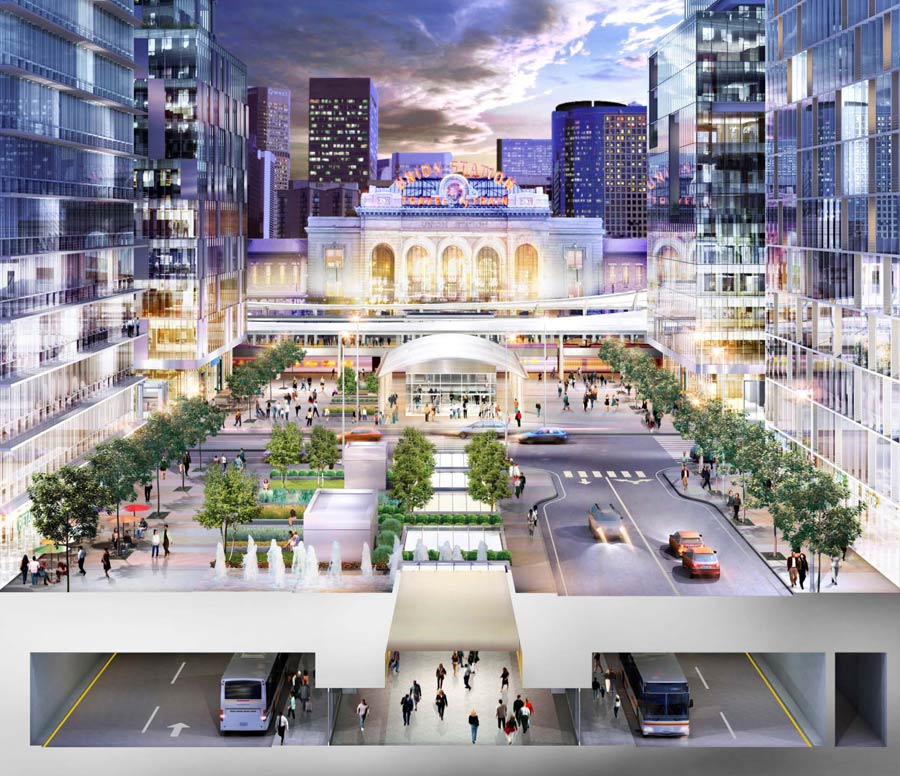
Rendering of Denver Union Station showing new streets, pedestrian mall and underground bus-way. Note development on either side of street/pedestrian mall. Subterranean walkway, surface streets and pedestrian mall connect to light rail stop.

Rendering of Denver Union Station showing new streets, pedestrian mall and underground bus-way. Note development on either side of street/pedestrian mall. Subterranean walkway, surface streets and pedestrian mall connect to light rail stop.

As readers of this blog are probably aware, Denver already had a large transit network, both rail and bus, and is now in the midst of a $4.7 billion transit improvement project called “Fastracks“. The program includes light rail, commuter rail, BRT, and a radical re-purposing of the old Denver Union Station as a multimodal hub.

The Union Station part of the project alone will cost about $500 million and utilizes some nine different funding sources including six different Federal sources. The light rail facility is located a few blocks from the commuter rail and bus facility. The distance between the two is spanned by a wide pedestrian mall which was part of approximately 50 acres of vacant land (former rail yards) surrounding the station. See an artist’s rendering of the completed mall.

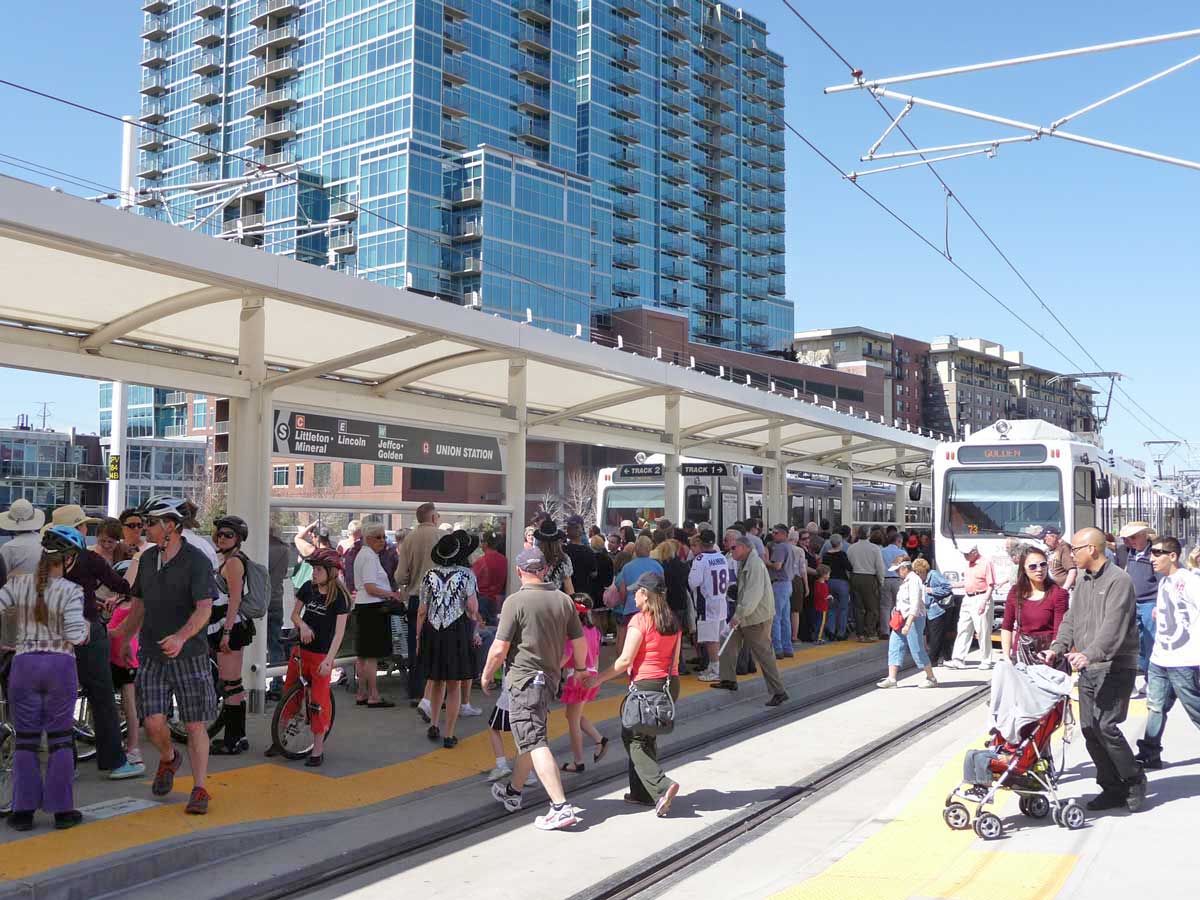
Land not used for transit facilities is being developed by a partnership of Union Station Neighborhood Corporation, two private development companies in the Denver area, the RTD, and the City of Denver. The next photograph shows the new Union Station Light Rail facility and some recent development around Union Station.

With 50 acres of downtown real estate, two of the most experienced developers in Denver as partners, and RTD’s own staff focused on development, one is not surprised that Mr. Washington is bullish on development around transit stations. One might add, “And how!”.

New Union Station light rail facility on first day of operations of the "West Line" light rail. Note new mixed use development in background.

New Union Station light rail facility on first day of operations of the “West Line” light rail. Note new mixed use development in background.

The photograph also shows the opening day of the West Line or “W Line”, light rail line. Opened in April, 2013, it was the first part of the FasTracks project completed. Running 12.1 miles between Denver Union Station and Golden, Colorado, at a cost of $709 million; the line is estimated to carry 18,000 riders per day. In fact, ridership was about 14,000 in the initial months, without the benefit of college students commuting to colleges along the route.

Eighteen thousand riders per day sounds staggering to anyone familiar with ridership estimates for Kansas City area transit projects over the years. For example, the Ridership Comparison chart shows Denver’s West Line compared with two current Kansas City area projects. (Ridership for the I-70 commuter rail is the average ridership projected from the two models used for the 3rd and Grand terminus in the Jackson County Commuter Corridors Alternatives Analysis (JCCC AA))

Click To Enlarge

Click To Enlarge

These projects are not strictly comparable as they include different modes, serve different sorts of neighborhoods, and Denver’s ‘W Line’ is integrated into an existing rail transit network. Be that as it may, Kansas City projects generally continue to show low estimated ridership numbers compared with projects elsewhere – a consequence of our history of well designed boulevards and extensive interstate system.

Low estimated ridership for rail proposals also causes cost-per-rider to be high. This measure of cost effectiveness, used by the Federal Transit Administration, often inhibits the Kansas City area’s ability to attract Federal Funds.

Note however, as the  Annual Capital Cost per Rider chart indicates, that the downtown streetcar, which recently received a Federal TIGER grant, has a lower cost per rider than Denver’s West Line. This is due to both lower construction cost per mile and relatively strong ridership for the short 2 mile distance.

By contrast, the proposed Jackson County commuter rail project has a very high cost per rider due to very low estimated ridership, even though the capital cost, at $385 million (average of estimated range from the JCCC AA), is much lower than Denver’s West Line.

Click to Enlarge

Click to Enlarge

While it is a good measure of system efficiency, ridership is not the only factor relevant to evaluating a transit project’s success. Commercial development and indirect job creation are other important parameters, as Mr. Washington pointed out.

One of the lessons to be drawn from his talk, albeit indirectly, is that development around transit stations doesn’t just happen, It requires the transit agency and units of local government to be proactive, and partner with experienced developers from the private sector to make projects happen. Surely it also helps if you have fifty acres of undeveloped property adjacent to the city center that happens to also be next to one of your stations.

Posted in Meeting Reports, Rail | Tagged: , , | Leave a Comment »

Attend the Midtown MetroCenter Grand Opening, KCK, Sept 27

Posted by Transit Action Network on September 25, 2013


Celebrate the opening of the largest transit center in the region. TIGER

What: Midtown KCK MetroCenter Grand Opening
Where: 47th and State Avenue, Kansas City, Kan. (Indian Springs)
When: Friday, Sept. 27, 2013, 10 a.m.

UG logoThis is the second transit center to open related to the new State Avenue Connex service, a major east-west route in the region. The new transit center is part of the $10.5 TIGER (Transportation Improvements Generating Economic Recovery) grant from the U.S. Department of Transportation that the State Avenue corridor received.

Other TIGER-funded enhancements along the State Avenue corridor include bus stop platforms; passenger shelters and benches; and landscaping and environment improvements.

After the opening ceremonies, stay for the party.

Posted in Events, Local Transit Issues, Regional Transit Issue | Tagged: , | Leave a Comment »

Transit Action Network Has Questions About MARC’s Next LRTP

Posted by Transit Action Network on September 23, 2013


Transportation_Outlook_2040MARC’s current Long Range Transportation Plan was adopted in 2010 when the “Great Recession” was still relatively new.  That plan was based, at least in part, on the optimistic assumption that the economy would recover quickly and return to the “status quo ante” — that the “New Normal” would look a lot like the Old Normal.  In fact, the New Normal might well be closer to “Perpetual Uncertainty” than to the Old Normal.  marclogo
 
In spite of this uncertainty, MARC’s current expectation is that the upcoming LRTP will be a relatively minor update. 
 
The update will begin with a review of the Policy Framework for the 2010 plan:
 
We consider that policy framework to be generally excellent.  However, we wonder if it is being fully reflected in the spending decisions that MARC makes for the region.
 
Here are some questions we hope MARC will ponder:
 
[1] – Have there been fundamental changes in the national (and global) economy that warrant a careful reconsideration of the region’s transportation policy — something more than a “minor update?” 
 
[2] – Were the assumptions underlying the 2010 LRTP even consistent with what we knew, or should have known, at that time? 
 
[3] – Since 2010 there has been a significant change in expectations regarding the availability of federal funds for transportation projects.  Considering this new situation, does it make sense to adopt some specific policy guidance regarding construction of new transportation infrastructure, particularly new roads at the region’s edges?
 
[4] – The 2010 LRTP was based on MARC’s population and employment forecasts derived from a model that reflects pre-2008 development and commuting patterns. The updated forecasts are being characterized as imperfect, but the best that MARC can do. Should the methodology for deriving these forecasts, particularly forecasts for 2030 and 2040, be subjected to an independent evaluation? 
 
[5] – A major issue in 2010 was whether to adopt a significantly different forecast, a so-called “Adaptive Scenario” that could be expected to significantly reduce the cost of new infrastructure.  Does revisiting such a forecast make even more sense at this time?
 
[6] – Current national transportation policy emphasizes “performance measures.”  Might an inventory of “underperforming infrastructure” (e.g., streets and other infrastructure that are underused because development is going elsewhere) be a useful endeavor as input to this LRTP update?
 
[7] – Access to jobs is a growing concern, both for job-seekers and employers.  Can continued location of new jobs at the edges of the region be justified, either from an economic or equity perspective?  
 
[8] – As the region expands outward, it becomes increasingly costly to provide public transit service, while at the same time many people are choosing to drive less and rely more on transit.  Are we willing to see a declining percentage of the region’s population have access to jobs and other opportunities via transit?  If not, can we afford to expand the transit system to prevent that from happening?  
 
No doubt many other relevant questions can be posed.  During the coming months we look forward to spirited dialog between and among public officials and the region’s citizenry as a new Long Range Transportation Plan is prepared.

Posted in Local Transit Issues, Regional Transit Issue | Tagged: | Leave a Comment »

TIGER Grant Reduces Need To Take Money From The Buses

Posted by Transit Action Network on September 15, 2013


TIGERTransit Action Network is very excited about the city receiving the Federal $20 million TIGER grant. These grants are very competitive and there are a lot more applications than there is money to distribute.

We congratulate Kansas City on its successful application. As the US Secretary of Transportation, Anthony Foxx, told  the Kansas City Star when he was in Kansas City on September 6 to announce the grant,  “The community has its act together in a big way,” he said. “Coming together to put an 80 percent match on the table — we know what the overall vision for Kansas City is.”

DTSC

You may wonder why the city only had 80% of the money. The 20% streetcar-funding shortfall that Foxx referred to happened when Kansas City decided to reduce the top rates for the TDD (Transportation Development District) property tax prior to the streetcar election. In the original plan, the top property tax rates, combined with the sales tax, would have fully funded the streetcar from revenue collected within the TDD. In order to close the funding gap the city created, the city plans to take $2 million a year from the revenue generated by the city-wide 1/2 cent Transportation Sales Tax. This sales tax is used to pay for bus service. Since the federal government is now filling that funding gap through the TIGER grant, the city shouldn’t need to tap the half-cent sales tax. Applying that yearly $2 million toward bus service would come close to paying for a new MAX line on Prospect, or on another urban corridor such as Independence Avenue or North Oak Trafficway. METRO logo

We hope the city will do the right thing and use this TIGER grant money to fill the streetcar funding gap, thereby reducing or eliminating entirely the amount taken from the ½ cent Transportation Sales Tax. The federal TIGER grant for the streetcar is a huge win for everyone, provided the city uses it to restore money that would otherwise be diverted from the bus system.

Posted in Local Transit Issues, Rail | Tagged: , , | Leave a Comment »

Rosedale and Argentine Neighborhoods Get New Transit Service May 2014

Posted by Transit Action Network on August 13, 2013


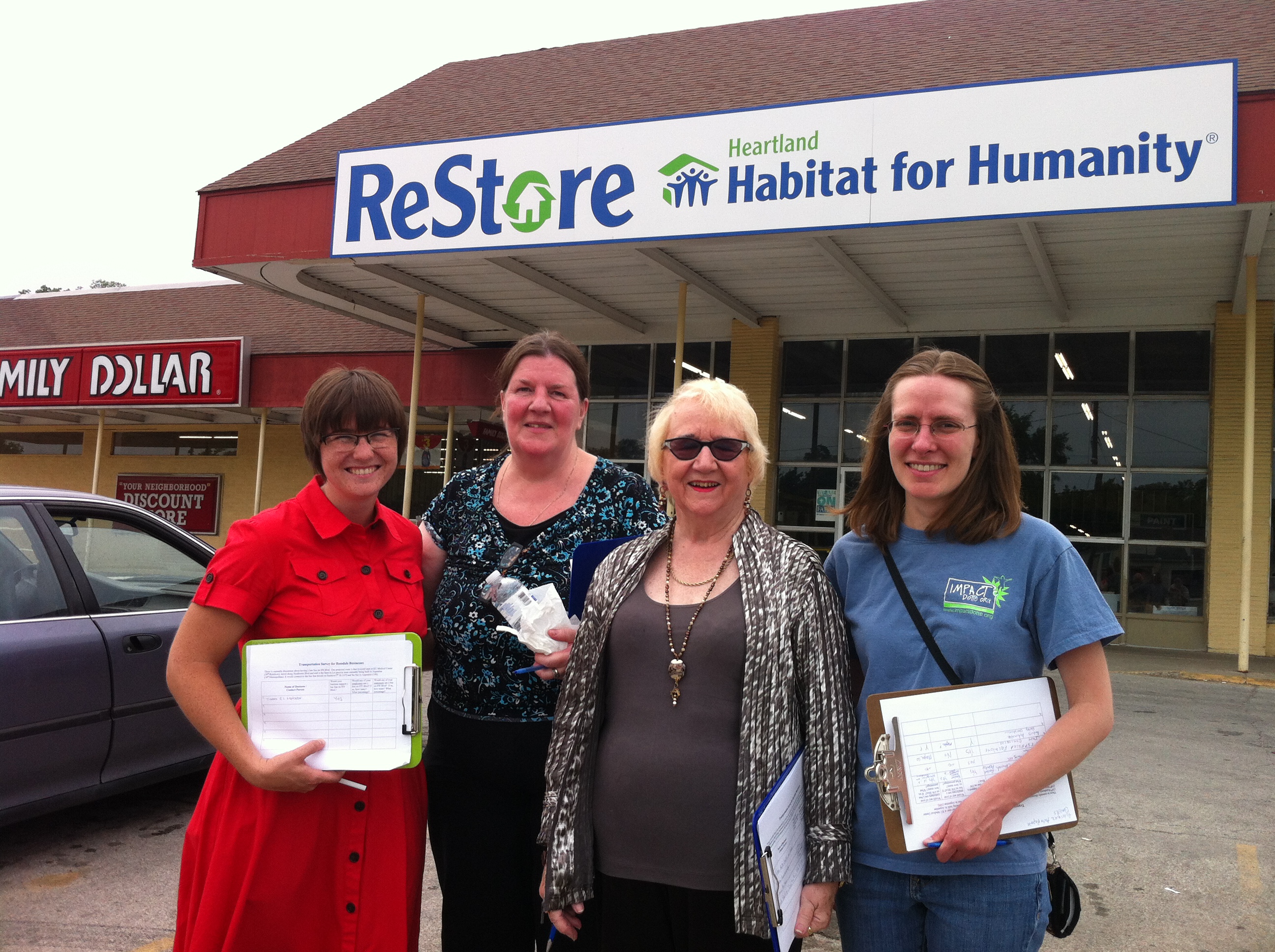
Erin, Carol, Carroll and Rachel conducting the Rosedale Transit Survey

Erin, Carol, Carroll and Rachel conducting the Rosedale Transit Survey

The Unified Government of Wyandotte County Board of Commissioners approved a 2014 budget that includes a new bus route serving the Rosedale and Argentine neighborhoods.  Bus the Boulevard, an informal coalition composed of representatives from Rainbow Mennonite Church, Rosedale Development Association, Rosedale Ridge Apartments, Westwood Christian Church and Transit Action Network, started working in October 2012 to get a new bus route on Southwest Boulevard.UG logo

Bus the Boulevard came together when Rosedale residents began voicing their concerns about Rosedale Ridge, an apartment complex housing 160 families that is isolated from public transit at the top of a very steep hill.  Residents reported having little access to grocery stores, places of employment, and medical care and having to walk over 1.5 miles to the nearest bus stop.  The group began gathering data about the transportation needs of Rosedale Ridge residents and sharing their results with UG Transit.

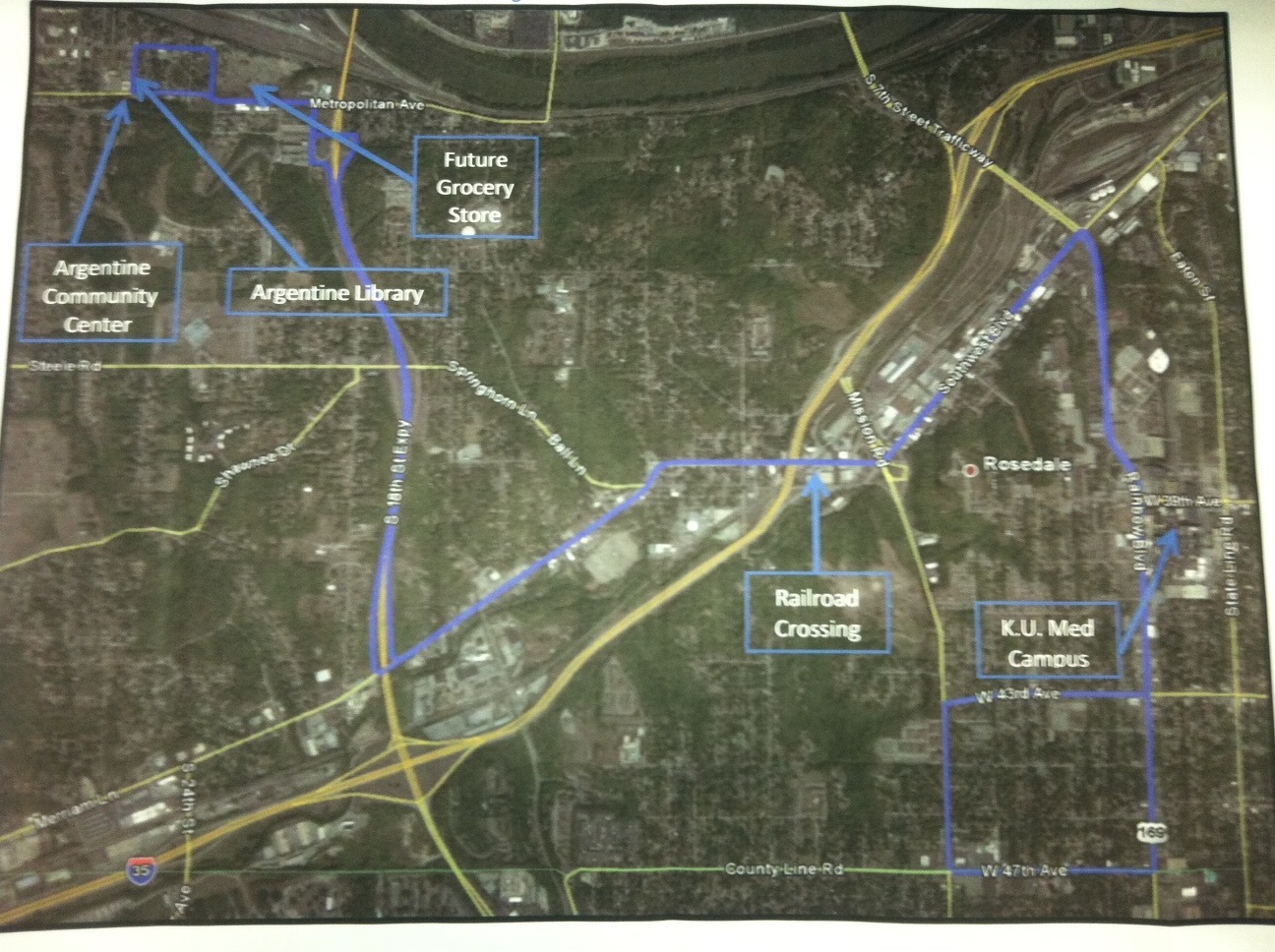
In response to the data, UG Transit designed a totally new route (pictured as a blue line in the map below). According to Emerick Cross, Director of UG Transit,   “Currently, the newly proposed Rosedale bus route will run from 47th Street (Oklahoma Joe’s area) by KU Med. down to SW Blvd. onto Merriam Lane, north on 18th Street Expressway to Argentine and back.”

Waiting to testify at the UG Finance Committee budget meeting. Erin, Connie, Carroll, and Carol

Waiting to testify at the UG Finance Committee budget meeting.
Erin, Connie, Carroll, and Carol

The route connects Rosedale residents with medical care at the University of Kansas Hospital, the University of Kansas Medical Center, and Southwest Boulevard Family Health Care on the east end, and the new Save-A-Lot Grocery store on Metropolitan Avenue, as well as the Argentine Community Center and the South Branch Library, on the west end.

The new route is scheduled to start running on May 1st, 2014, following a service study by KCATA.

According to Erin Stryka from Rosedale Development Association, “We are thrilled to see people who live, work and play in Rosedale connected to essential community resources through the new bus line!”

All of the coalition members appreciate the help and support provided by UG Transit and District 3 Commissioner Ann Murguia.  We are very excited by this successful result and we thank the UG Commissioners for funding this new service.

Click to Enlarge

Click to Enlarge

Posted in Local Transit Issues, Meeting Reports | Tagged: , | 2 Comments »

Ribbon Cuttings KCK Metro Centers – Aug 9 and Sept 27, New Connex Service – Aug 11

Posted by Transit Action Network on August 5, 2013


INVITATION_7th_Street_METROCENTER.jpg_and_Document1 Kansas City, Kansas has a lot to celebrate with the start of the new Route #101 State Avenue Connex service and the opening of two new Metro Centers.

Join them for the first ribbon cutting:TIGER

What: Downtown KCK MetroCenter Grand Opening

Where: 7th and Minnesota

When: Friday, August 9, 2013, 10–11 a.m.

For more information about the grand opening, visit the Unified Government Transit website.

In addition, the Route #101 State Avenue CONNEX service will start Sunday, August 11th.

There are changes to the route from the current alignment, especially in downtown KCK where the route will be straightened out along Minnesota Ave.

New Alignment effective Aug. 11, 2013

New CONNEX Alignment effective Aug. 11, 2013

The new service and transit center will affect these routes:

101-Minnesota-State Ave.
102-Central Ave.
103-3rd Street-Fairfax
104-Argentine
106-Quindaro
107-7th Street
115-Kansas Avenue

The changes to these seven routes serving downtown KCK should create more convenient connections between Metro and Unified Government Transit routes.

For details of route and schedule changes see the related KCATA  bulletin.

The next ribbon cutting is scheduled for September 27th at the 47th Street Midtown KCK MetroCenter (47th and State Avenue/Indian Springs).

These transit centers are part of Kansas City’s $50 million TIGER (Transportation Improvements Generating Economic Recovery) grant from the U.S. Department of Transportation.

Other TIGER-funded enhancements along the State Avenue corridor include bus stop platforms; passenger shelters and benches; landscaping and environment improvements.

Watch the  TIGER Progress Report  episode 9 to learn more about local transportation and transit improvements, including construction of the 7th and Minnesota Transit Center.

To learn more about the impact of TIGER on the Kansas City region, visit www.marc.org/TIGER.

Posted in Events, Local Transit Issues, Uncategorized | Tagged: , , | Leave a Comment »

NEXT RAIL – Streetcar Expansion Kickoff Event – August 8

Posted by Transit Action Network on July 31, 2013


Next_RailKC needs your ideas on how to move forward with Phase 2, an expansion of the streetcar system.

August 8

Union Station

30 West Pershing Road, Kansas City, Missouri 64108

6pm – 8pm

According to the NEXT Rail Facebook page, “Through a community-based and data-driven process, the City of Kansas City, Missouri will develop a plan for the expansion of the Downtown Streetcar line into a citywide network that creates new connections between people and places and catalyzes the revitalization of our neighborhoods. “DTSC

Join them at the NEXT Rail kickoff event:

Agenda

6:00 PM Opening remarks by Mayor Sly James and other elected officials
6:30 PM Public presentation on the project
7:00 PM Interactive model exercise

Posted in Events, Local Transit Issues, Rail | Tagged: | Leave a Comment »